60 Years Ago Today

Thursday, 3 July 1952:

In the morning my breakfast in the hotel included a really soft six minute boiled egg. Then we started the day by visiting a church that was built over St. Francis’ grave. In the middle of the church the frescos began with a beautiful mural by Giotto and another artist. Giotto’s mural had a bright blue background with his characteristic holes.

Then we went down into the lower church and into the crypt where I saw an ornamental iron grave. At the crypt there was a German speaking monk. Another monk came up to us as we were leaving and asked for change. He had lots of small change in American money and wanted to change it for American dollars, so we obliged. Next on the tour was the upper church. It was Gothic even more so than the middle church.

Soon after it was back to the bus and off to Florence. The bus climbed up to Perugia, which was one of the most beautiful hill cities, and then down to the shores of Lake Trasimeno. With Florence coming up I napped.

I couldn’t tell for sure about this place yet. It was pretty hot! We were all anxious to get out, relax, and cool off somehow. We reached Atlantico Hotel. My first thought was for a drink of water. The lobby looked fairly nice, but the room was not as nice as last night. However we had a bath nearby.

Mrs. Hansen, Mrs. McDonald, and I decided to go shopping, but I lost them quite soon. I found Mrs. McDonald talking to a couple of American servicemen from Maryland that were stationed in the woods near Leghorn. They shared with us that they don’t like Italy, because it’s too dirty. Also they warned us not to drink or eat any of the dairy products, because several of the boys from their unit had gotten spinal meningitis. Furthermore they felt the Italian Communists were out for anything they could get. One soldier liked Austria and Germany much better than Italy. All the soldiers were anxious to get home to the United States.

I wandered around a book shop reading the books before buying them. I ended up with a book about Florence and Rome. Then I ran into Irene, Hermine, and Betty. Eventually we located a little restaurant that wasn’t open until 7 p.m. We were standing there wondering what to do when a cute little gray haired man came and opened the door. We followed the man inside to take a look and see what kind of place it was.

It was so cool, restful, and clean with flowers and fruit sitting all around. We thought we would have to wait until 7 p.m. to eat, but the man motioned us to sit down and brought us a menu. We had quite a hilarious time ordering. With the help of my Spanish, we finally made it clear that we wanted to eat dinner.

Our dinner started out with ravioli. And during that time the manager, who spoke a little English, came over to help us. Also a GI from San Antonio, who was stationed in Germany, came and offered his assistance as well. He loved Italy, in contrast to the other GI’s, but didn’t like Germany so well. The manager’s daughter had been helpful to him, so he had more or less made this his headquarters. We talked to him until she came over. He said she would be able to show Irene where to find a transformer for her iron.

The whole family was accommodating and willing to do anything they could for us. The wife of the manager and another daughter of the man, who opened up the restaurant for us, came by with her little baby. We had old home week playing with the baby.

2 July 1856 – Railroad Travel – Mary Taylor

From the Diary of Samuel Openshaw

July 2 – We started on the Western Railway at twenty minutes to twelve and passed through a large extensive woodland country a distance at 200 miles, when the train stopped at one o’clock a.m. at a place called Greenbush, near the Albany River.

From the Journal of Joseph Beecroft

July 2nd Wed. We awoke and got up about 3 and attended to packing, and before six we got breakfast and packing finished. I then got our things out and then guarded for a brother while he got his things out. About 8 o’clock I was on my way to station, on a van loaded with our luggage and set on tins to keep them on. When arrived we got our things weighed and kept an eye on them till my wife and John came that we could go into our carriage, which was a cattle van. Our luggage had to be box for seats, and at night our beds. I felt highly delighted as we passed along in seeing the various streets and houses. A little past eleven we were steaming away from Boston towards Iowa City. I had some delightful reflections as we beheld the splendid buildings and beautiful landscapes that spread out before our eyes as we rapidly passed along. We passed Malbro [LOCATION UNKNOWN] and a many interesting villages with their chapels and spires. At six we were at Springfield, a large city and stopped a while and while there we were asked many questions about our passage, the numbers on board, deaths & the places from whence we started and where we were going. One apostate tried to dissuade us from going further, some laughed and turned up their noses with scorn. We had got 100 miles from Boston, and had got to Albany, which place we reached about 12 at midnight. Our carriages were luggage vans vans [SIC], and our seats were our luggage which was in our way. We were uncomfortable in some some [SIC] things, but comfortable in mind. We were cramped with being confined, some slept in the [p.34] carriages and some laid down on the ground and some walked about till we had orders to pack up and go a quarter of a mile to a camping ground near the ferry called Offman on a broad part of Hudson. We crossed the ferry and had near a mile to carry our provisions to station, which we found in the middle of a street unfenced off. We were soon on our journey which was rendered very pleasant with being in good carriages and having good Saints about us. We passed Utica a large city and arrived at Rochester early in the morning.

60 Years Ago Today

Wednesday, 2 July 1952:

I took my bag down to breakfast. Herr Rogers called me down for not bringing it sooner. I was too late! The bus was all packed. After breakfast, I carried my own bag to the bus and with Mrs. Hansen’s help I put it on the top myself. I had Andre check the strap for me though.

Soon we were off for Assisi! Evidently we have to go back through Naples. While there we stopped at the hotel to pick up some stuff the kids had left. Then we raided a fruit shop and got back on the road to Rome via Cassino. It seems all roads to Rome must be tree lined.

Cassino was at one time the most bombed out place of World War II. Germans used Cassino as a stronghold and Americans finally had to bomb them out. Herr Watkins fought here. The most bitter fighting in Italy took place here and it became a no man’s land for a while.Since then it has been reconstructed. A documentary movie, San Pietro, was filmed in the area in 1945.

Then as we left Cassino we passed a former town on a hillside that was completely in ruins. A new town had been built below. We had lunch on the road. In Rome we stopped back to pick up Betty’s coat and get a drink of water in the public horse trough. We passed several monuments and huge buildings that I didn’t see when we were here before. We saw the Etruscan Capitaline Wolf statue from the 5th century, who had rescued Remus and Romulus, Rome’s mythological twin founders, from death.

I observed the big stadium and the Tiber River which was a beautiful green. Some of the scenery looked a lot like Utah. One section of land had sugar cane or something that looked like it. Today was kind of a lost day. It was really hot and Bev had heat exhaustion or something of the sort. I missed the scenery for some well needed napping and writing.

Our next rest stop was at Turin. I snapped a picture of oxen and a man with a donkey cart who posed for us. By the time we left there was a huge crowd around the bus. Dusk was coming on as we met the hilly and windy roads. We caught sight of the Assisi Arched Gateway like in the picture shots we saw in Italy.

We stopped to stay at a beautiful hotel where the section we were in was probably once an old monastery. I talked to a girl from Nebraska and found a little book about Assisi for 250 lire. Then we ate dinner at a restaurant down a little street from the hotel.

Soon after it was time for bed. My only mistake was laying down on the bed before getting undressed. At 3:30 a.m., I finally got undressed and climbed under the covers.

60 Years Ago Today

Tuesday, 1 July 1952:

At the continental breakfast we had marmalade and chocolate. I lost count of how many slices of bread we ate. Later I tried to brush my teeth without water. Today we’re off to the island of Capri. All of us walked down to the same pier we had gone to the night before and climbed through three boats to get to ours—a cutie speed boat. I climbed on top of the boat to sun bathe or burn.

As we rounded the bend, Capri’s blue shadow gradually grew larger. After approximately an hour there was a crowd of boats ahead. We sat rockin’ like a rocking chair waiting to go into Blue Grotto cave, one of the biggest draws on the island. Several kids got quite seasick and “tossed their breakfast.” It included Nelda, Carol S., Carmela, Betty Lou, and Joyce.

We had to get down low in the bottom of the boat to get through the hole into Blue Grotto cave. It was a huge cave with clear crystal blue water. It was absolutely indescribable as we swam in the water close to the boat—so refreshing!

Eventually we got back in the boat and everyone was trying to change back into their clothes. The men were first as they held a towel in front of the cabin door. Then it was the girls’ turn. What a circus! I wore my swimsuit underneath my clothes so it was a cinch for me. I just left my wet suit underneath.

Then we went back around the island to dock. We had three more boats to go through again to reach the shore. There were convertible open buses waiting for us. We enjoyed a wonderful dinner on the terrace of a beautiful hotel overlooking the Mediterranean Sea. Dinner consisted of spaghetti, breaded veal, potato chips, salad, and fruit. After I took pictures from the terrace.
We piled aboard a bus for a 300 lire per person ride around Capri. We wound round and round past the little shrine and beautiful white villas. I saw a pensione once owned by Caesar Augustus. At the top we stopped at a village of little shops for our benefit. We walked past the shops to a beautiful view of the Mediterranean Sea, a part of the island of Capri, and the mainland. I took a couple more pictures of the sea.

Then we proceeded back through the Nastri Gelati marketplace. And I couldn’t resist a couple of scarves. I talked the Italian man down from 2800 lire to 2300 lire for both scarves. Next we followed Herr Watkins up to view the rocks of Capri and its gardens. I spotted a chateau in the distance. On the way back I got lost in the shops and succumbed to some bathing shoes for 1600 lire. I hope I’m not sorry. Then back to the square again to catch the bus and then the boat.

We got on a big boat this time–but heavens, it rocked more than the little boat. Water came over the sides and got the kids wet near the rail. Nelda, Betty and Carmela got sick again. An accordion player played for us and went around asking for alms. Again we passed over three boats to the shore. Then we climbed up the road and finally the stairs to the hotel.

Some Italian ladies and girls knocked themselves out laughing at us in a rather rude way. I don’t know for sure what brought it on, but we sensed ridicule in it. Perhaps it was the Levi’s, shorts, and peddle pushers they found so hilarious. One of the ladies stopped Alicia to tell her about her son who is in America in a very high and harried voice.

At the hotel I dashed up and stripped down to my bathing suit. I took 100 lire with my soap down to the beach for a swim and shower while Alicia had a bath in the wash basin. Then we dressed for dinner.

I scraped my soup bowl until the waiter asked me if I wanted more. He hardly had gotten through asking me when I was ready for more soup. It was mighty delicious tomato soup. White fish, pastry roll, and fruit followed the soup. Afterwards I walked down to look around the shops and the people. Back at the lobby I fell asleep trying to write. Once again we slept on the terrace.

50 for 50 #26 – Learn Somthing New

The year is half gone and I’ve now crossed over the half way point in my 50 for 50. This week I decided it was time to learn something new. Bill has played around with making bracelets out of paracord. He is coming up to the first day of Girls Camp in a couple of weeks to teach the girls how to make them. He showed me a new sample bracelet that I really liked, so today he taught me how to do it. It is the KBK Bar and there is a very good video on how to do it by TIAT. Tying It All Together makes the best videos on how to tie knots that I’ve ever seen.

Here are the photos from my effort. The rope I’m using isn’t paracord but it works ok for practicing. We have a bunch of paracord on order but it hasn’t arrived yet.

my finished KBK Bar bracelet

wearing my new KBK Bar bracelet

30 June 1856 – Arrival in Boston Harbor – Mary Taylor


From the Life History of John Jaques;

Mon. 30: About 7 o’clock the steam tug “Huron” came alongside and towed us to Constitution Wharf. Brother Haven returned having learned that Brother Felt was in New York. The presidents of wards had the privilege of going onshore with two or three men from each ward to bring provisions for those who wanted them. I and Brother Steel, Paul and Taylor went and bought cheese, bread, butter, and sugar for our ward. I bought for myself about eighty cents worth of bread, about three pounds of cheese, two pounds of butter, a little fresh meat, and a few other things. Very hot day. Took a walk with Elders Haven and Steel along Washington Street. Elder Haven leaving us went on the Common. Very tired on our return. City very clean, also the people. Bought one quart of milk, 5 cents, several 10 cent loaves, 4 or 5 pounds of ham, and several other articles. Our letter did not appear in the Journal. The editor rejecting it, ostensibly on account of its length. I and Brother Haven shortened it and he gave us to understand that he would print it.

From the Diary of Samuel Openshaw;

June 30 – Very hot. Remained in the vessel while arrangements were made for us to go by rail.

From the Journal of Joseph Beecroft;

Monday 30th I arose a little to four and with my wife arranged our loose things into bags, during which time the Saints was emptying their bed into the river through the portholes. We had to throw out our good flocks and have some 3 months to lay on hard boards or ground. We got our things arranged, washed our floor, and being invited I went on shore and was in through this business [UNCLEAR] I felt comfortable. We breakfasted on cold water given to us by Sister Peel and about 7 the steam tug came and about 8 o’clock we were on tugged to Boston. I went on deck and enjoyed the scenery and the view of buildings next the sea as we passed along. The town is a great length along the side of the bay and presents a dazzling prospect from the water, but our joy was short for we were ordered below with orders that a man was not to stir, except by leave.

While below I got up some boiled rice, and about this time the anchor was cast and double guards were placed at each of the hatchways to prevent parties from coming to plunder us. While a number of awkward looking men came and wanted to come in our midst. About eleven I was asked to go onshore with our president and went with him and quite a number of the brethren in search for provisions and I had cheese, butter, and bread bought by Elder Brodrick [Broderick], who exerted himself as he always has done for our well-being.

The Saints had the privilege given to go on deck so I went up before Elder Brodrick [Broderick] was ready and looked abroad and Elder Brodrick [Broderick] having come to us I went out of the ship on the quay, followed by my son John, who so soon as he felt the floor, he stamped with one foot and then the other exclaiming, “I have put my feet on ground again.” I now felt joy to spring up because I had got to land and thought of those who had kissed the very ground when they first touched the shore. I felt on free soil for the gospel has made me free and I will live under its banner while I live and in death I will sail under it into another world, and in the resurrection I will be a more than conqueror under its ample folds and life giving principles through the spirit of God. [p.32]

When Elder Brodrick [Broderick] was ready in company with a many brethren we went into Boston and traveled a great part of a street that runs alongside the quay or harbor till we came to the marketplace, and there we purchased a large cheese and some butter and while [-] there the sweat flowed freely from us in consequence of our weak state, the sharp walk and the exceeding weather. The parties of whom we bought our provisions inquired where we had come from and where we were going and one gave the address of his brother-in-law who resides in Provo, Salt Lake Valley and presented me with a last Saturday’s newspaper which afforded me the news that the American government had dismissed Mr. Crampton, the English minister and that England was likely to dismiss the American minister. Strange news, what I oft feared., I felt glad I had escaped.

We got a good drinking of new bread, principally with butter and cheese, what luxury. I wrote a letter for my Brother William and finished a letter for Brother Peel, in which I enclosed my letter for brother William. I wrote much in journal and felt happy.

I got the privilege to go out again a little before 8 o’clock and in company with Brother John Pears went through a many streets, and while out we were passes by few water engines which was drawn at a good run by the men who was going to put out a fire. We should have gone further but I began to rain very hard. The rain passed off and we hastened on to ship which we reached a little after 9. The streets and houses was brilliantly lighted up by lightening ever now and then. Got some American coin for half a sovereign, I gave to Elder Brodrick [Broderick] to get changed. Attended prayer meeting and about 10 went to bed on the boards. A many put their beds on the floor in the gangway. Some slept on boxes, others on bags. Brother Litter [James Lister] and others cracked jokes and kept us our merry as pipers. [UNCLEAR]


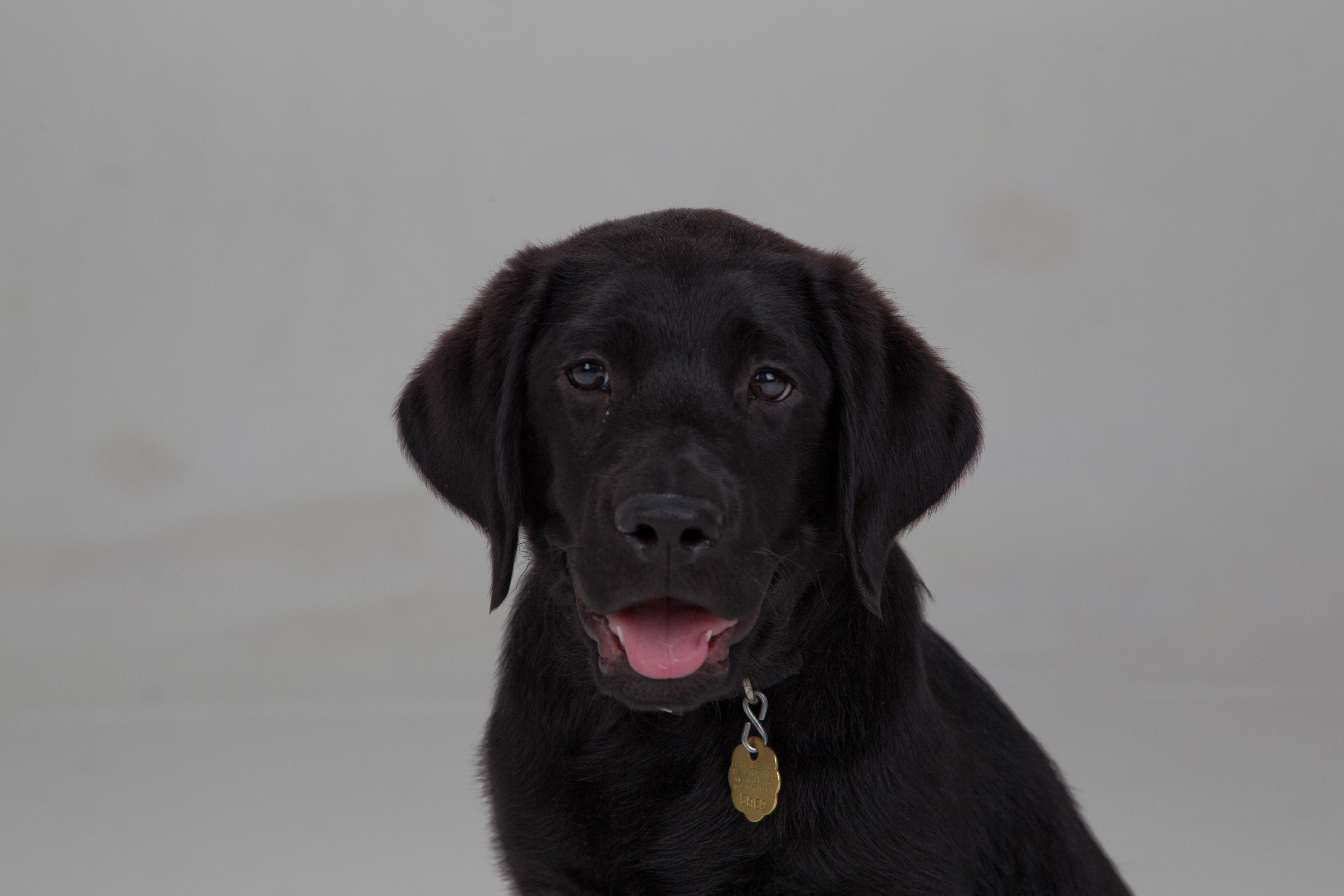
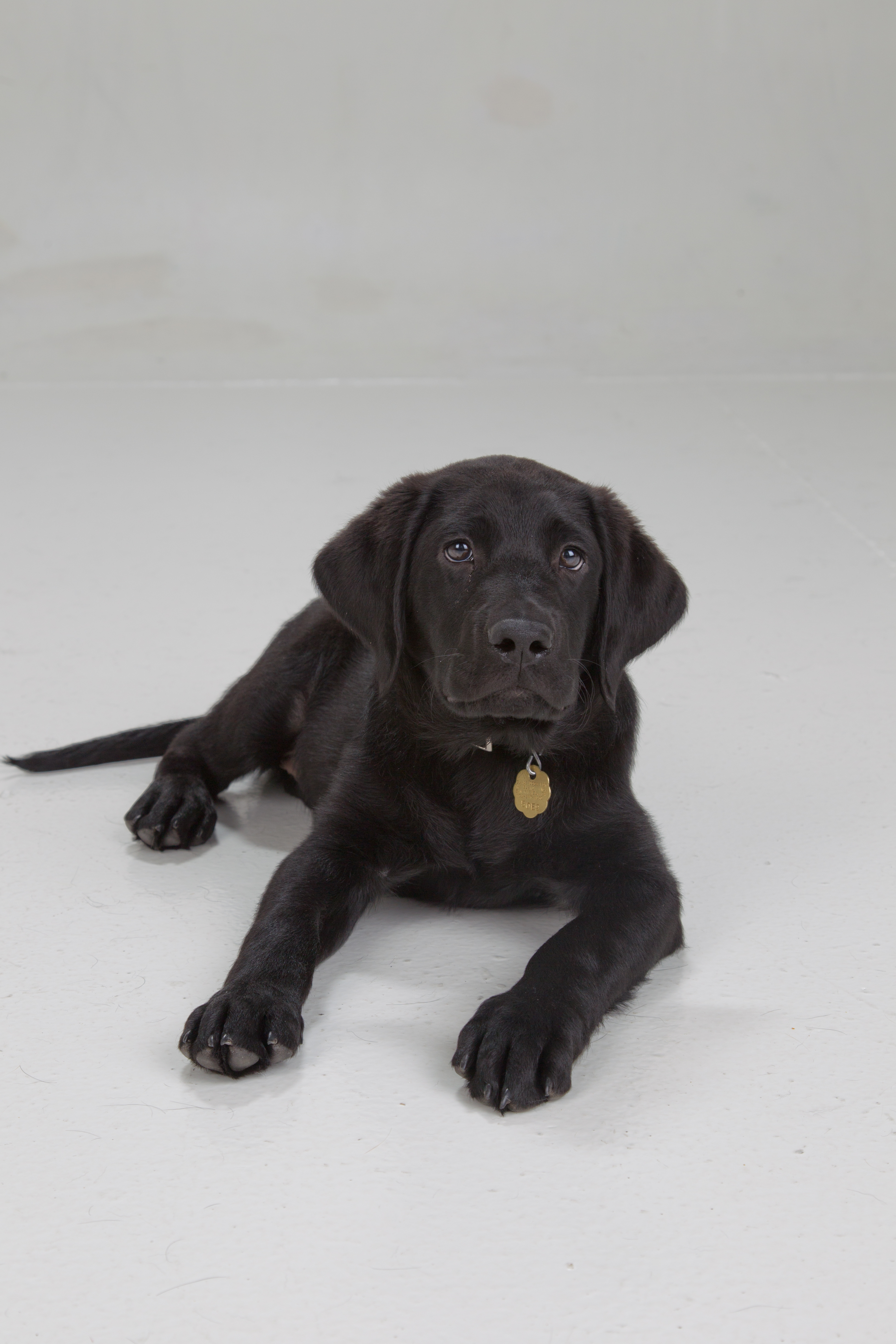
Puppy Photo Shoot

Yakira and Zodiac by Lisa Thompson

A few weeks ago Lisa Thompson, did a photo shoot for the puppies in our club and this week I got a cd with the photos. She was our club leader until a couple of years ago and she has access to a photo studio through her job. So once or sometimes twice a year she invites the club to come and she and a friend of hers take wonderful pictures of our pups. I have a wall about our stairs where I hang the “official” portrait of each of our GDB puppies. All but Apex’s are from Lisa’s photo shoots. I have them printed on 10″ x 10″ canvas at Pixels, where she works with their name and the year they were born. I’m so excited to get Yakira’s and Zodiac’s images up on our wall.

Now I just need to pick which pictures to use. I’ve narrowed it down to these. I thought it would be fun to see if any of you have opinions of which image you like for their official portrait. Just comment and let me know what you think.

Yakira #1

Yakira #2

Yakira #3

Yakira #4

Zodiac #1

Zodiac #2

Zodiac #3

60 Years Ago Today

Monday, 30 June 1952:

I had a good continental breakfast with the seething masses of people already up early. There were all kinds of vehicles. We proceeded to an ancient church built in 1600 a.d. that was restored. It had 54 silver statues with each one representing a saint. Our guide told us about the parade and feast day with different floats sent from each church. We found a sculpture in silver created in 1695 a.d. that weighed 45,000 pounds. It was St. Michael with a dragon. A large and ancient baptismal font was used to baptize by immersion. We passed through a section of the city that had been attacked during World War II and people were living among the ruins.

We got off on the wrong track to Mount Vesuvius and ended down at the Mediterranean Sea. We stopped traffic getting the bus turned around. And I observed a church with two beautiful yellow and green domes. There were purple frustration flowers creeping over the walls of the ruins and cactus plants in the courtyard. Then we squeezed by an overflowing wagon load of baskets. I noticed the dark rich volcanic soil. No matter how often it erupted, the Italian people refused to abandon the city.

Orchards and vineyards lined the road in Vesuvius. Italians had plenty of fruits and orchards, but lacked minerals. Then Andre had another tight squeeze past a small vehicle on a one way street. Some little kids ran to watch us and raised their hula hoops as we passed. The curves were too sharp for our long bus, but once again Andre did a super job. I viewed a man in the street without shoes.

At last a panoramic view of Naples, the valley, and the Mediterranean as we climbed higher and higher. Naples had a population of 1,600,000. By the side of the road there were little pepper fields. We passed a man and his family taking fruit to the market by wagon.

Again we had trouble with the curves. Andre really earned his money today. Lava flows had taken over some of the orchards here. Various kinds of vegetation were popping up everywhere since Mount Vesuvius had last erupted. This included wild grass and flowers. There were still some strips of fruit trees higher up in some spots between the lava flow.

The bus engine heated up with its 4000 ton load. We made it around the curves without having to back up. We stopped at the Eremo Restaurant and Hotel to pick up our guide and to gain the privilege of going on a private road for 300 lire apiece.

With our finances collected, the road turned out to be rather narrow and treacherous. We parked the bus and took to our feet, and me in Voodoo sandals, through loose lava, slate and dust. The road went inside the original crater that had destroyed Pompeii. A small crater had fallen into the larger crater in 1944.

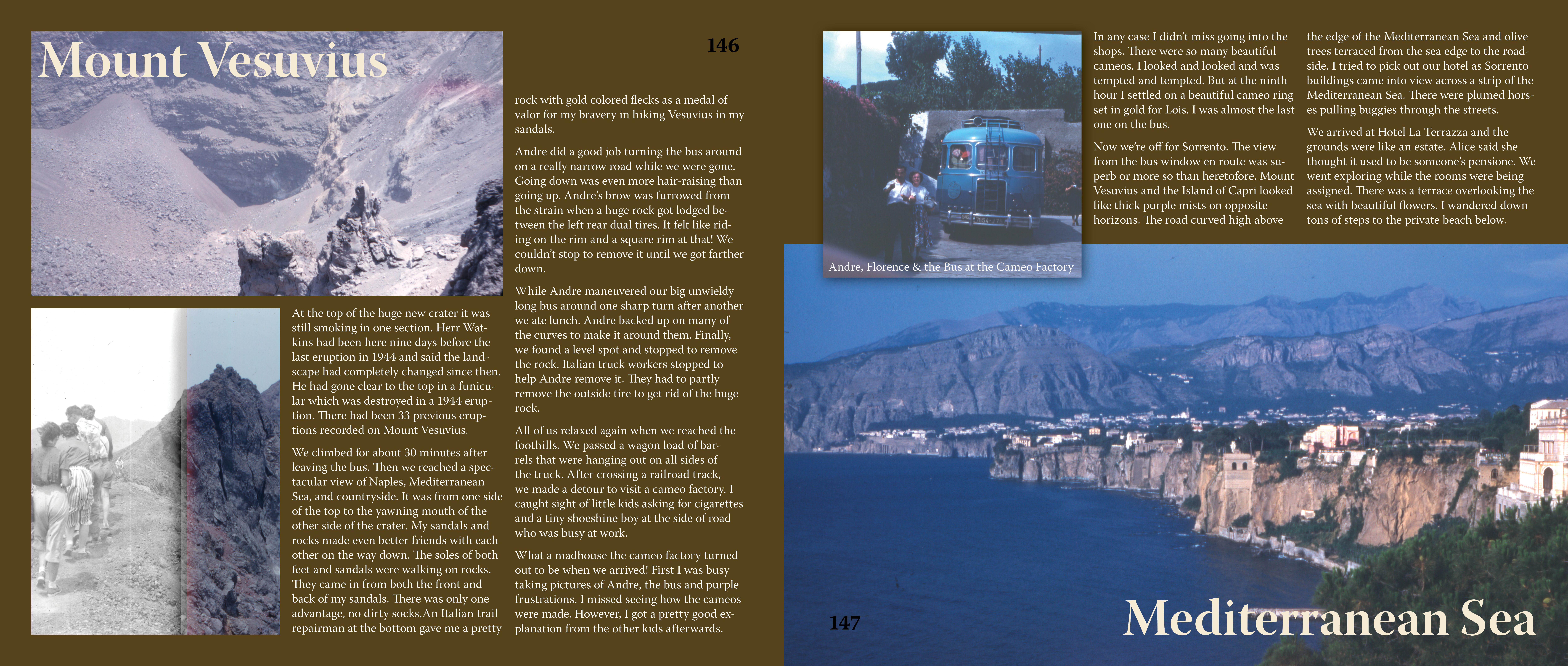
At the top of the huge new crater it was still smoking in one section. Herr Watkins had been here nine days before the last eruption in 1944 and said the landscape had completely changed since then. He had gone clear to the top in a funicular which was destroyed in a 1944 eruption. There had been 33 previous eruptions recorded on Mount Vesuvius.

We climbed for about 30 minutes after leaving the bus. Then we reached a spectacular view of Naples, Mediterranean Sea, and countryside. It was from one side of the top to the yawning mouth of the other side of the crater. My sandals and rocks made even better friends with each other on the way down. The soles of both feet and sandals were walking on rocks. They came in from both the front and back of my sandals. There was only one advantage, no dirty socks.An Italian trail repairman at the bottom gave me a pretty rock with gold colored flecks as a medal of valor for my bravery in hiking Vesuvius in my sandals.

Andre did a good job turning the bus around on a really narrow road while we were gone. Going down was even more hair-raising than going up. Andre’s brow was furrowed from the strain when a huge rock got lodged between the left rear dual tires. It felt like riding on the rim and a square rim at that! We couldn’t stop to remove it until we got farther down.

While Andre maneuvered our big unwieldy long bus around one sharp turn after another we ate lunch. Andre backed up on many of the curves to make it around them. Finally, we found a level spot and stopped to remove the rock. Italian truck workers stopped to help Andre remove it. They had to partly remove the outside tire to get rid of the huge rock.

All of us relaxed again when we reached the foothills. We passed a wagon load of barrels that were hanging out on all sides of the truck. After crossing a railroad track, we made a detour to visit a cameo factory. I caught sight of little kids asking for cigarettes and a tiny shoeshine boy at the side of road who was busy at work.

What a madhouse the cameo factory turned out to be when we arrived! First I was busy taking pictures of Andre, the bus and purple frustrations. I missed seeing how the cameos were made. However, I got a pretty good explanation from the other kids afterwards.

In any case I didn’t miss going into the shops. There were so many beautiful cameos. I looked and looked and was tempted and tempted. But at the ninth hour I settled on a beautiful cameo ring set in gold for Lois. I was almost the last one on the bus.

Now we’re off for Sorrento. The view from the bus window en route was superb or more so than heretofore. Mount Vesuvius and the Island of Capri looked like thick purple mists on opposite horizons. The road curved high above the edge of the Mediterranean Sea and olive trees terraced from the sea edge to the roadside. I tried to pick out our hotel as Sorrento buildings came into view across a strip of the Mediterranean Sea. There were plumed horses pulling buggies through the streets.

We arrived at Hotel La Terrazza and the grounds were like an estate. Alice said she thought it used to be someone’s pensione. We went exploring while the rooms were being assigned. There was a terrace overlooking the sea with beautiful flowers. I wandered down tons of steps to the private beach below.

First thing on the docket for me was a dip in the Mediterranean Sea. It cost 100 lire and I was the first one in. What fun I had riding the waves! I played water ball and talked to Puerto Rican girls who knew the kids on the Sibijak. I found a warm shower on the beach, my bath for today.

Afterwards there was a long trek up just like climbing the steps of Notre Dame.
We dressed for dinner on the terrace. We had sliced bread, water, soup with a little macaroni, hamburger with a cheese topping, and cheese rolled in pepper skins. The meal was 300 lire and dessert was a potato-like ice cream or pastry cake fruit.

Then we went downstairs to the square called the Bagalella. A boy from the hotel showed us the way to the native Tarantella dances. This traditional Italian folk dance had a fast upbeat tempo and used tambourines like castanets. There were beautiful costumes, a blues singer, and musicians wearing black and white striped shirts.

Another group of American girls were there from Roanoke, Virginia. They were really dressed up. I sat by a man and his wife and daughter from Buenos Aires, Argentina. He pronounced thousand as Susan. Alicia talked to the daughter and a small Italian man asked me to dance. He was a good dancer and smooth, but so short.

We sat down to talk and he asked me what “ice block” meant. He had a letter from a girl signed “ice block.” I tried to explain. Then another character came over. I decided it was time to bid them adieu before things got involved. They both had spoken pretty good English though.
On the way to the hotel one of them followed us on a motorbike and offered to give us a ride. I said okay if the two of us could come. Eloise hung tightly to him and I to her for a hair-raising ride to the pier. We rounded the curves laying on one side of the motorbike. We climbed up on the pier and talked for a few minutes.

Then another bike roared up the hill. It sure looked liked a “put up job.” He asked permission to introduce us. I said “You can introduce us but that’s all.” The second bike left and I decided that we best get out of there. No! He said he’d take us home in a few minutes.

But before a few minutes were up the other bike came back. Then the other guy came up and talked to us. We convinced both of the bikers that we don’t smoke or drink and must get back to the hotel. We insisted on going back together, but they swore so sincerely to take us back to the hotel that we relented. We arrived at the door safe and sound, but the manager complained about the noise of the motorcycles.

It was a gorgeous view from our room. However, there was no water stopper in the tub which made taking a bath challenging. Margaret, Helen, Alicia and I took our mattresses out on the terrace to sleep under the stars.

60 Years Ago Today

Sunday, 29 June 1952:
I was up early at 6:30 a.m. Alice didn’t really think I would get up early, so she wasn’t ready. Around 8 a.m. we finally went straight up our street to Saint Magiore Cathedral and past Peter in Chains to the Coliseum. At the Coliseum I had to get up higher to get a better picture. I kept wandering inside the forum and the guard continued to kick me out again. However I begged him to let me take a picture and then I quickly took off, climbed the rocks, and got the picture while Alice tried to calm him down. I practically ran all the way back so he wouldn’t be upset.

As we drove out of town we passed the Coliseum again and then went through modern Rome. We kinda got lost and turned down a beautiful tree-lined boulevard. I really hated to leave Rome. It was so beautiful.

Next we journeyed past gorgeous greens at a golf course that had rough grass in between the greens. We continued near a railroad that was right next to the highway. The highway and railroad were as close as the two could get. Then there were many beautiful well kept vineyards and soon after an intersection with a road to Tegis.

The bus proceeded to Anzio and its beachhead. We went over a bridge to a city on a hill. A public watering place and a beautiful valley greeted us. What captivating sights: checkerboard fields, fairly new trees lining the streets, trees that curbed each side of the road and railroad, another small town, busy market place, and trees growing out of the pavement along the main street.

This part of the country seemed much more fertile here than coming into Rome from the north. There were ladies with big loads on their heads and modern irrigation of a big canal. It helped explain the greater fertility here in Italy. Then there were huge fields of wild poppies, mountains rising on the left, orchards, and villages and towns built part way up. The name of the highway was Via Appia.

The city of Terracina was next. As we entered the city the Mediterranean Sea was at the side of the street coming into town. Purple frustration flowers were everywhere with a high wall between us and the mountain. The beach tapered out to leave just enough room for the road between the mountain and the sea. Then the beach widened again for a beautiful vineyard and palm trees between the road and Mediterranean Sea. We sang church hymns. What a beautiful way to spend Sunday, soaking in this magnificent scenery and singing!

What’s up? Cars were lined up for over a quarter mile. Around the curve of the road, the men took off to get the scoop of what was happening. We proceeded to eat lunch with dry tuna on dry biscuits, pastries and oranges.

A boy with the scoop biked around the line of cars. He said a boy riding a bike was hit by a truck in a semi-phore or a four way intersection. Unfortunately he was killed. We drove past the little boy’s body. It was covered up, lying on the road with blood and gore spread around him. His family was huddled by the rail. I didn’t feel much like singing anymore.

There were mules and donkeys, reminiscent of Christ’s time. A whole family was in a cart behind one mule and a tiny girl was carrying a basket on her head. Oleanders, an evergreen shrub, were alternating with trees along side the road. Whatta picture!

There was a spectacular double row of trees. I wish I could have captured it all with my camera. I spied a little canvas covered truck with a mother, child, and household belongings in the back. Next were fields of strange looking hay? We stopped at a railroad crossing and Herr Watkins asked a man what kind of hay it was. It was cannibas hay, which was used to make clothing.

At 2:30 p.m. we reached Naples, that was supposed to be the dirtiest city in Italy. The green, white and red, Italian flags were hanging in the corners of the city square with the obelisk in the center. I strained to get my first view of Mount Vesuvius. There were herds of goats on the side of the road with signs pasted on walls down the street.

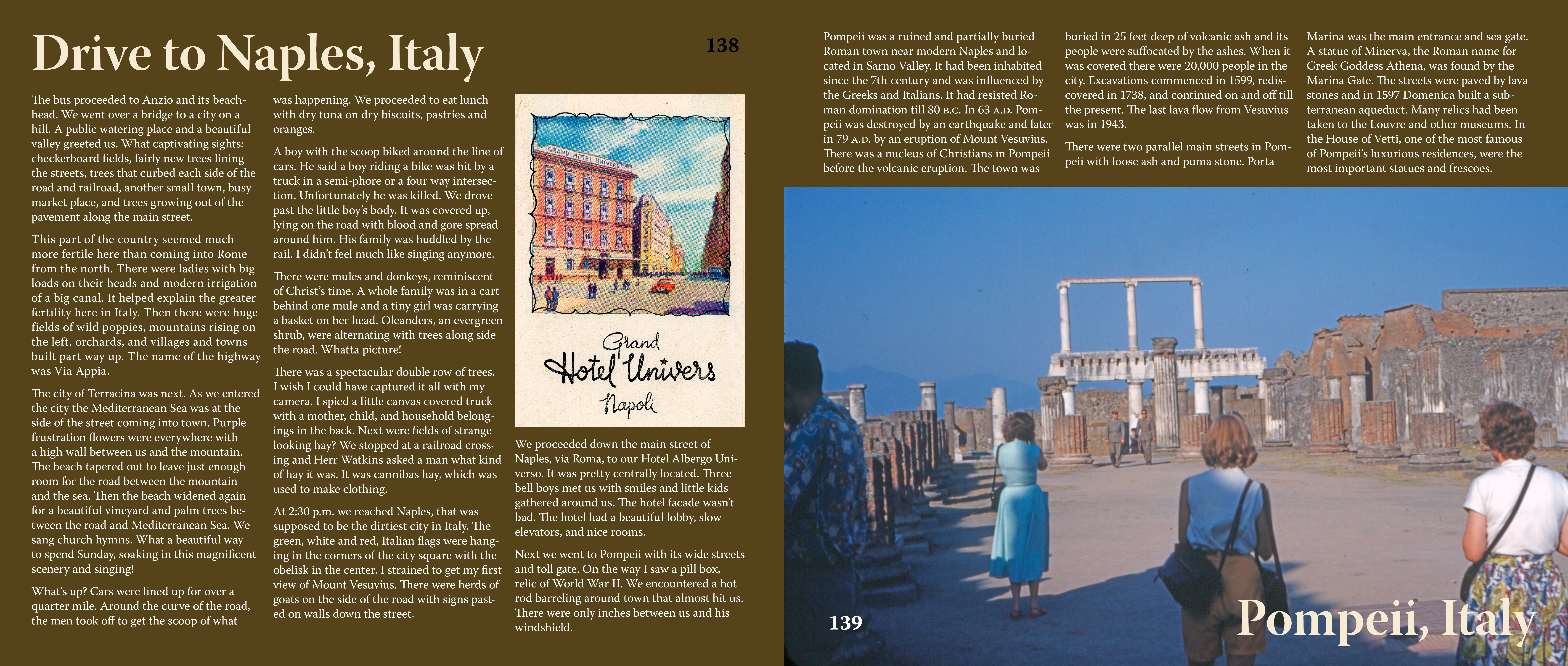
We proceeded down the main street of Naples, via Roma, to our Hotel Albergo Universo. It was pretty centrally located. Three bell boys met us with smiles and little kids gathered around us. The hotel facade wasn’t bad. The hotel had a beautiful lobby, slow elevators, and nice rooms.
Next we went to Pompeii with its wide streets and toll gate. On the way I saw a pill box, relic of World War II. We encountered a hot rod barreling around town that almost hit us. There were only inches between us and his windshield.

Pompeii was a ruined and partially buried Roman town near modern Naples and located in Sarno Valley. It had been inhabited since the 7th century and was influenced by the Greeks and Italians. It had resisted Roman domination till 80 b.c. In 63 a.d. Pompeii was destroyed by an earthquake and later in 79 a.d. by an eruption of Mount Vesuvius. There was a nucleus of Christians in Pompeii before the volcanic eruption. The town was buried in 25 feet deep of volcanic ash and its people were suffocated by the ashes. When it was covered there were 20,000 people in the city. Excavations commenced in 1599, rediscovered in 1738, and continued on and off till the present. The last lava flow from Vesuvius was in 1943.

There were two parallel main streets in Pompeii with loose ash and puma stone. Porta Marina was the main entrance and sea gate. A statue of Minerva, the Roman name for Greek Goddess Athena, was found by the Marina Gate. The streets were paved by lava stones and in 1597 Domenica built a subterranean aqueduct. Many relics had been taken to the Louvre and other museums. In the House of Vetti, one of the most famous of Pompeii’s luxurious residences, were the most important statues and frescoes.

There were plaster casts of the city as it was at the time of the erupting volcano. There also were plaster casts of just about everything: Dead people, dead animals, wheels, money box, huge steel deal, fish hooks, cameos, ring stone, pearls, scissors, fish scales, vases, bread, wine, press, dentist instruments, gold and silver coins, cake molds, strainer, locks, keys, little stoves, and taps. One third of the city had not yet been excavated.

Excavated items included earrings, springs, bones from San Marzano, statue from 500 b.c., pottery with art work, tufa stones, sculpture with little figures on a dish, baby jewelry, silver cups, bronze hooks, little statuettes, needles, jewelry, dice, and mill out of lava stones for making olive oil.

There were statues in the museum in Naples, including the statue of Livia. The original sidewalks and walls the Romans had constructed were still there as well. The walls were made of webbed tufa stones. Next we discovered pillar of bricks, wine shops, sliding doors, families living behind the shops, and imitation marble decorations. As we continued we saw the Apollo Temple, statue of Drana, Magistrate of Pompeii, and Palace of Justice Tribunal.

The forum, main square, included the religious and political center of the city. The Temple of Jupiter had marble carving on its gateway. The people washed their clothing with their feet. In the Temple of Augustus the walls were covered with marble and had its original altar. There were money changers, food markets, and big wine jars. Blocks were put up to stop traffic.

Then we went to the Temple of Fortune which had a chapel shrine inside and the triumphant arch of Nero. The public baths were like a club with Terne el torre Mosaic floors. The cold baths were open to the sky with frieze around the top of the walls. The Temple of Fortune still had its original marble floors, beautiful decorations, and locker area for the tepid bath. The hot bath had marble mosaic floors with a round dome of steam falling down on the side. A big wash bowl was there for washing hands and face.

I spied a wine shop across from the bath houses on the main street. Pompeii was symmetrical just like some modern cities. Also, we went to Casa del Poetatregica, the House of the Tragic Poet, with the infamous cave canem inscription which means beware of the dog. I discovered some lizards there.

Next the House of Dancing Fauns, built during the 2nd century b.c. was one of the largest, and most impressive private residences in Pompeii. The house had a fruit and flower garden and filled one whole city block.

Then to the House of Vetti, another important home, had large blocks with coats of plaster and original gargoyles. It was well preserved. The bedroom was so small there was only space for the bed. And there were high doors and a Roman bowl that dated back to 15-20 years before Christ. Some of the paintings were well preserved as we caught sight of paintings by Mercury, Juno, and Isis. In the dining room there were Pompeii red figures on a black background.

Other art included two money boxes, cupid breaking medicine, and paintings of Gods. There was a slab of lead to keep out the dampness around the floor. We walked through one sitting room for mom and pop and another one for the kids. In the kitchen were copper looking apparatus’, lead pipes, and fountains out of mosaic.

During our tour we found out that our guide had been in the movie September Affair and spoke four languages. He took us through the butcher shop, soap factory with a mill stone, and by the beautiful statue of Nero. I noticed that the pharmacy symbol was represented by snakes. Also, I caught sight of a rock that had a hole in it in order to tie the horses during that time period. The Doric columns in Pompeii were dated to 600 B.C.

Next on the tour was the ancient Roman city of Stabiae which was destroyed in the eruption. Then the Greek style theater, which seated 5,000 people, which opened upwards to the sky. On rainy days they put up an awning and on hot days they put water on the awning to cool themselves.
Picturesque Towns of Italy Swarmed With Tourists From All Parts of World

Editor’s note: This is the seventh of a series of letters written by Mrs. Afton A. Hansen giving her impressions of a trip through Europe she is making with a group of 35 Utah college students. This one was written on July 7 in Italy.

Dear Friends;
From one end of Italy to the other—from north to south and back again, we have traversed this strange land—along its blue Mediterranean coast, over the dry summer hills, to the rim of Mt. Vesuvius, which was so dry and windy that workmen went ahead of us to clear the trail of wind blown dirt and rolling rocks.

Throughout the country we find construction work going on in roadway and building. It is said that Italy is using her lend lease money [post WWII economic aid from the US] for reconstruction of their country to attract the tourist who provides a major part of the national income. These lovely towns are swarmed with tourists from all parts of the world.

Our first stop in Italy was somewhat disappointing. Expecting some romantic Romeo to serenade us with song, or hear a street cleaner singing an aria, we were almost alarmed when looking through the hotel window to see four dismal looking characters playing cards. Unkempt, dirty and mostly toothless, they were pounding the table in vigorous competition of the game.

Felt Like Emigrants
Having been repeatedly warned to watch our baggage, I was much concerned when an Italian gentleman attempted to help with my heavy suitcase. Although I said “No, No!” he insistently carried my bag to my door and went down stairs laughing. Indeed we looked like we might need help as we trudged from bus to hotel with bags and bundles.

A few of us with scarfs on our heads looked and felt like emigrants sitting on all our worldly possessions.

The next hotel in which we stayed—Grand Verde, in Rapolic—held the romance of situation on the hilbarde, overlooking the beautiful Mediterranean from a balcony window. No Romeo’s yet though.

Not until we came to our noisy Atlantico Hotel in Florence did we hear street singing. Two boys on a bicycle, in working clothes at 5 a.m. were lustily singing an Italian “ditty.” The little girl, strolling along with her parents in the warm summer evening singing to her heart’s content, was unnoticed, except by us Americans.

Enjoy Laughter
Italian like the French seem uninhibited, stopping anyplace on the street to discuss and gesticulate. They seem to enjoy laughter and a good joke.

The country of Tuscany affords picturesque traveling. Our 30-mile-per-hour bus permits good seeing. The hill tops are crowned with old medieval castles, walls and fortifications, while below them are ripening grain fields, trees and gardens. Highways are lined with Oleander trees, fig, olive and pomegranate trees.

For centuries, women here have trudged to the water well with jugs on heads. I am anxious to try out, with brush and paint some of the sketches I have of a young lady balanced on a donkey with heavily laden baskets on either side, and the family coming home from market in a large two-wheeled cart drawn by two white oxen.

There is a variety of interest in every city we visit. Even the ancient dead city of Pompeii had an amazing silent story to tell. Two thousand years ago it was a thriving commercial and agricultural city on the side of the hill near the Mediterranean. For nearly 10 centuries before Christ the nearly 25,000 inhabitants traded with Greece. One day they heard a deep earth rumbling and their beautiful city was shaken with an earthquake. Then on a warm August day at about 1 p.m. in the year 79 A.D., the nearby Mt. Vesuvius erupted, spreading ashes and pumice over the entire area, covering Pompeii in a depth of 30 feet. It remained covered until about 60 years ago when the excavation began. One third of the city’s 161 acres still remains to be uncovered.

Ancient Wheel Ruts
As we were guided along the stone sidewalks, two and three feet wide, we noticed the ruts in the narrow stone streets made by the many chariot wheels rumbling along thousands of years ago. We saw the shops along the main streets, stores, snack bar, stock exchange, wool market, dye shops, palace of justice and fountains on the corner where we quenched our thirst.

In one house, once lived two rich merchants, perhaps father and son with their family. A sign on the entrance read — “Care Canni” — which means “Beware of the dog.” In the vestibule were marble columns, benches and low chests. The house had many so-called modern conveniences such as a central heating system for warm and cold air. Bath tubs were of Carrara marble. A huge wash basin of Egyptian Chipolena marble, was put there at a cost of $60,000,000.

This size basin would be convenient for a large family for it could easily accommodate eight people at once. The stone stove in the kitchen could bake 89 loaves of bread at one time.

Glorious Past
This dead city tells of a glorious past, with only one inner yard being kept alive with flowers, shrubs, grass and vases.

Don’t you wonder what these people did, when the volcanic ash began to spread over their city? Of course many of them left the city when the earthquake occurred, but about 3000 victims have been uncovered from the ruins. From the position of their bodies we can be almost sure that they did what we have been told to do in case of an atomic bomb attack. They threw themselves to the ground covering their faces with their arms. One man sat in a corner protecting his face with his hands. A dog was found in an agonizing position.

Bodies Restored
We wondered how they could recover these bodies with such detail even to eye lids, folds of the skin and expression of the face. The guide told us that the ashes and pumice hardened as it poured over the bodies. In time the flesh decayed, leaving a cavity containing bones, skull and teeth. Into this cavity was poured a thin plaster which was left to harden for several months.

With small picks and a brush, the ash was cleared away, leaving the perfect shape of a victim of suffocation. The same process was employed in recovering furniture.
In the houses have been found furniture—kitchen utensils, cereal, cloth, water faucets, ring, money, surgical instruments, oil press, wine press and other things which would indicate their activity. So much could be told of Pompeii as well as many other places which are so interesting by we who see them but could become tiresome on paper.

Let me tell you a little about the schools. For more than an hour we visited with an elementary grade school teacher and her sister who teaches piano lessons. They were delightful ladies who discussed education in Italy through our interpreter Dr. Watkins.

From the readers and work books which we saw, we were pretty sure that an Italian child of seven or eight in the second or third grade was two to three years ahead of our youngsters the same age and grade in the reading, writing, arithmetic and ability and quality of work.

Even in these young grades they learn to sing songs from the opera. The program of Verdi’s work put on by these youngsters was very good, according to the teachers and principal. These youngsters of course have an opportunity to visit these museums, so full of history. Their penmanship is excellent.

We wondered, if, in our mania for freedom we have lost some thing in basic values. This would be worthy of further investigation. One choice idea from this visit was old but always worth repeating: “Keep the avenues of expression and conversation open between you and the child.” These people love to converse.

Afton A. Hansen

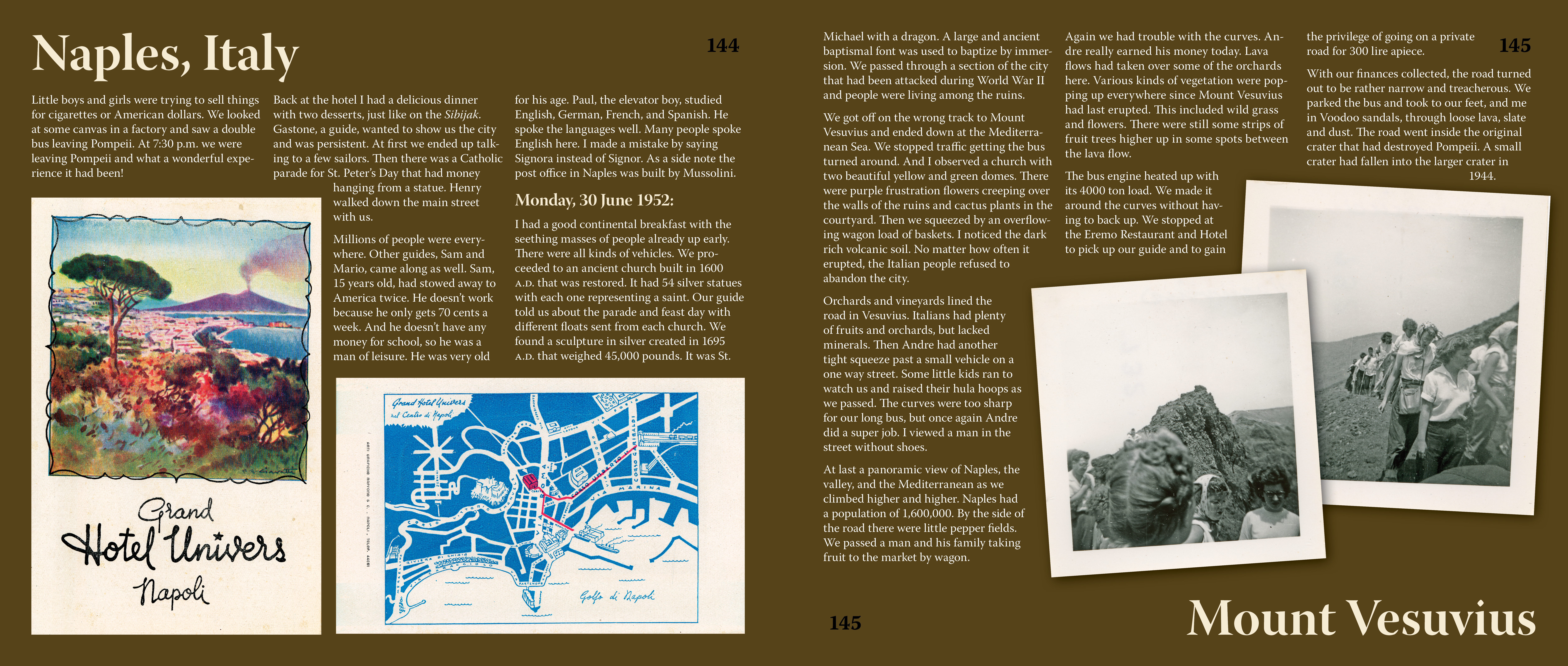
Little boys and girls were trying to sell things for cigarettes or American dollars. We looked at some canvas in a factory and saw a double bus leaving Pompeii. At 7:30 p.m. we were leaving Pompeii and what a wonderful experience it had been!

Back at the hotel I had a delicious dinner with two desserts, just like on the Sibijak. Gastone, a guide, wanted to show us the city and was persistent. At first we ended up talking to a few sailors. Then there was a Catholic parade for St. Peter’s Day that had money hanging from a statue. Henry walked down the main street with us.

Millions of people were everywhere. Other guides, Sam and Mario, came along as well. Sam, 15 years old, had stowed away to America twice. He doesn’t work because he only gets 70 cents a week. And he doesn’t have any money for school, so he was a man of leisure. He was very old for his age. Paul, the elevator boy, studied English, German, French, and Spanish. He spoke the languages well. Many people spoke English here. I made a mistake by saying Signora instead of Signor. As a side note the post office in Naples was built by Mussolini.

28 June 1856 – First Sight of Land – Mary Taylor

From the Diary of Samuel Openshaw:

June 28 – Beautiful day and a propitious wind brought us in sight of “Yankee Land” which is the first land that we have seen since we left sight of Ireland and truly it was beautiful. As we entered into the Bay of Boston to behold the rise and decline of hills beyond hills intersecting covered with green grass, cattle grazing, bedecked beautiful houses, rocks rising out of the water as if to resist the force of the waves. It was truly sublime to us to gaze upon it. Our hearts were cheered to behold our destined fort. We cast anchor about nine miles from the city of Boston. A pilot came on board.

From the Life History of John Jaques:

Sat. 28: Beautiful calm morning. Many small vessels seen. A thin sandy broken black streak was pronounced land which proves true, being Cape Cod. Great rejoicing at this. Towards the middle of the day a fresh breeze sprung up which sent us right into the harbor at the rate of 10 to 12 knots per hour. It was truly refreshing to see the houses, trees and the green landscape after being deprived of the privilege for some time. We cast anchor at 6 p.m. within a mile or two of Boston. As we came up the river the passengers were kept down below while the sailors were taking in sails. This was quite a deprivation, but was submitted to with patience. The captain went ashore soon after casting anchor and took with him a letter to the Daily Journal and one to President John Taylor. I saw a steamship about the harbor. There were plenty of little sailing vessels such as yachts and barges. Also a steam packet or two. The view of Boston and the vicinity is very interesting. A small hillock is an island, with trees upon it, is quite a relief to the eye.

From the Journal of Joseph Beecroft:

Saturday 28th I arose about four and looked out of the porthole but could see no land. I went to bed again, and laid till half past 5, washed, shaved, carried up water, and about 7 o’clock I hear a person say he saw land from the first landing on the mast. I ventured up and the 3 of our company to see land for the first time for near 5 weeks. About 9 o’clock we could see land very plain from the ship side of the forecastle. The same Saints seem [p.28] highly pleased with the sight. I feel grateful to my Father in Heaven for his goodness in sparing our lives to see the land of Zion, the land of the free and home of the brave. The land of Joseph’s, choice above all lands. Glory to God in the highest and goodwill to men. I got breakfast after prayer meeting, and then went on deck, and beheld from the ship side the distant hills which indeed appeared lovely to those who have been a long time deprived of the sight of [-]. I stood on the forecastle and with joyous feelings beheld our noble vessel glide rapidly through the yielding waters and bringing us nearer to the sand hills in the distance. About noon we had got opposite the hills which lay on the left side of the ship and in a short time we were opposite Cape Cod Fishery and opposite the Cape Cod Lighthouse. In the neighborhood which was a wind hill and at a short distance from this was a number of houses, the first I had beheld since the channel. We continued our course about a mile or so from the shore and could see one sandbank after another until, I discovered with my small glass, large fields clothed with waving corn and yellowing for the harvest. This sight was truly gladdening to behold. I could see the fences separating field from field. We were all ordered to our berths and having obeyed orders we saw but little of what passed, but though I took off a lock from a box and put on another yet being near our porthole I had a grand chance of seeing village after village as we passed along. We came to a point of land that retired and a great basin was formed, and we could see but the dark mountains in the distance. In a short time we came up with the land again and at this juncture I asked to go out to [-] and got on deck finding a number of Saints up, I thought I had as much right up as anyone so I stayed. For a long way as we went a short distance from one side of the shore while on the other side lay the wide ocean. As we passed along we came opposite village after village with fields interspersed between dotted here and there with trees. Now was a gentle slope inclining to the sea covered with fields, houses here and there, and then an opening beyond which we could see the water as far as we could see. By and by we came to a large [p.29] embankment which we were told was Naval Fortifications. About this time we began to be enclosed on both sides with land at a short distance and passed no less than 3 lighthouses. Here we came to little islands and then we had on our right hand an opening to the wide ocean and ships or vessels gliding in all directions. Every now and then a large boat passed us which skimmed lightly along. The individuals who manned them were dressed elegantly. The sights that presented themselves all on all sides baffles all description. Such was their grandeur, splendor, and sublimity. Among other buildings as we passed was custom house and quarantine hospital, on our right, which when we had neared, the first mate at the orders of the pilot, cast an anchor, at 25 minutes to 6 p.m., for we had got the pilot on board a little before he being brought in a light barge. He is the picture of a Yankee. Having cast anchor I came below deck and found the porthole by our berth crowded with Saints all anxious to catch a glance of things as a view was afforded through the hole. I got tea and attended to writing till we had privilege to go on deck. It was a little before sunset that we got on deck and lovely indeed was the evening as the orb of day went out of sight, right behind the city of Boston. A many boats came past us and two large ships passed for Boston. The shades of night soon followed. The setting of the sun and shut from our sight the lovely landscape that surrounded us and left the eye not to rest upon but the dim outlines of some near objects and the lights of the lamps in Boston and those of a revolving and stationary lighthouse. After chatting a little with Brother Jesse Haven upon the resources of the Americans in case of war &c. I came down and got to bed. Thus ended one of the most important days that ever dawned in my history.