This Week in 1856 – News of Rescue – Mary Taylor

From Samuel Openshaw:

In the midst of all this uncertainty and doubt, our hopes were realized for lo and behold, Joseph A. Young and two others with him, came riding into camp. Voices from all parts of the camp rang out, “help for the camp.” We all rushed together to hear the news. He told us that there were about 10 Wagons loaded with flour, sent out from the valley for our relief, and was about 50 miles ahead of us at a place called Devil’s Gate.

From John Jacques:

The 28th of October was the red letter day to this handcart expedition. On that memorable day, Joseph A. Young, Daniel W. Jones and Abel Garr, galloped unexpectedly into the camp amid the cheers and tears and smiles of the emigrants. These three men, being an express from the most advanced relief company from Salt Lake, brought the glad word that assistance, provisions and clothing were near, that ten wagons were waiting at Devil’s Gate for the emigrants which intelligence had been previously communicated to Captain Hodgett’s wagon company, in camp hard by, and first reached by the express, who after a very brief stay in the handcart camp, pushed on to Captain Hunt’s wagon company, encamped on the Platte, about ten miles below and beyond the handcart company. The express stayed with Hunt’s company for the night.

All was now animation and bustle in the handcart camp, and everybody was busy at once, in making preparations for a renewed start in the morning. The revived spirits of the company were still further exhilarated by an increased ration of flour that day, three quarters of a pound, I believe. With cheered hearts and renewed hopes, the emigrants retired to their beds that night, and no doubt many of the sleepers made pleasant excursions into the mystic regions of dreamland.

From Samuel Openshaw:

In the morning, we summoned all our efforts and strength, impulsed with the prospect of deliverance, and we again started on our journey.

From John Jacques:

Early on the morning of the 29th, the handcart company left the Platte and struck across the country for the Sweetwater. Joseph A. Young and his companions, returned from Hunt’s company, over took Martin’s company before night and camped with it at Rocky Avenue, about 36 miles east of Devil’s Gate.

In the afternoon of the last day of October, the company met Cyrus H. Wheelock, Daniel W. Jones, and David Garr, who were going to meet the various companies. About dark, the company arrived at Greasewood Creek, between thirty and forty miles from from the last crossing of the Platte. At Greasewood Creek, were found George D. Grant, Robert T. Burton, Charles Decker, D. G. Webb and others, with six wagons, laden with flour and other things from Salt Lake, who had come to the assistance of the belated emigrants. This was another time of rejoicing. Some of this relief party had met the emigrants a mile or two away from camp and had helped to pull some of the carts along. Here, some stockings boots and other clothing were distributed among the emigrants, also a few onions, which were highly prized, and pound of flour rations was served out, which was the daily ration, with the exception of about two days, if I recollect rightly, thenceforth to the end of the journey.

From Samuel Openshaw:

We now had one pound of flour per day, which in a measure began to recruit our strength so that we were enabled to perform the journey before us. The brethren which came out to meet us, did administer every comfort and help that was within their power, to the sick and the infirm. We continued our journey until we arrived at Devil’s Gate.

From John Jacques:

This was the beginning of better days, as to food and assistance, but the cold grew more severe, and was intense much of the way. On the evening of November 1st, the handcart company camped at the Sweetwater bridge, on this side of the river, about five miles on the other side of Devil’s Gate, arriving three about dark. There was a foot or eighteen inches of snow on the ground, which, as there were but one or two spades in the camp, the emigrants had to shovel away with their frying pans, or tin plates, or anything they could use for that purpose before they could pitch their tens, and then the ground was frozen so hard, that it was almost impossible to drive the tent pegs into it. Some of the men were so weak, that it took them an hour or two to clear the places for their tents and set them up. They would shovel and scrape away at the hard snow for a few minutes, and then rest, then shovel and scrape and rest again and so on.

The next day, the company moved to Devil’s Gate, where there were more of the relief party with wagons and provisions. The wagon companies arrived within two or three days after.

Devil’s Gate, at that time, was a sort of fort or trading post, consisting of several log houses or huts, but vacated when the emigrants were there, as it was not a pleasant place for wintering. But those log huts, with generous wood fires on the hearths, seems very comfortable to the emigrants, thought not large enough to accommodate more than a few of them.

An earnest counsel was held to determine whether to endeavor to winter the emigrants at that point, or push them on to the Great Salt Lake, as fast as possible, It was decided to continue the march to Salt Lake the same season. Two or three days after arriving at Devil’s Gate, the handcart company was part reorganized, and most of the carts were left there. Two, I believe, of the best remaining, were retained for each Hundred, and those were loaded chiefly with cooking utensils, such as frying pans bake kettles, sauce pans ,and camp kettles, so that the loads in these few carts were of a weighty nature. The remainder of the baggage of the company, was put on the wagons.

When the wagon companies came up to Devil’s Gate, it was decided to store most of their freight in the log houses or huts, for the winter, which was done, and twenty men were left, under the direction of Daniel Jones, to take care of the goods. Those twenty men had a hard time of it before they were relieved the following summer, and the goods brought along to the valley. The freight was left behind because the teams were unable to haul it further.

On the 3rd of November, Joseph Young and Abel Garr were sent as an express to Salt Lake to convey information as to the situation of the emigrants. In preparing for this express journey home, Joseph Young put on three or four pairs of woolen socks, a pair of mocassin’s, and a pair of buffalo hide overshoes, with the wool on, and then remarked, “There, if my feet freeze with those on, they must stay frozen till I get to Salt Lake.” This express arrived at it’s destination at 4 o’clock on the morning of the 13th of November.

50 for 50 #42 – Washington Monument

I didn’t have the time or the budget to travel to Washington D.C. this week to see the Washington Monument so I did it virtually. When I was three years old my family moved to Maryland. The closest congregation of our church was in Washington D.C. so each Sunday we made the drive in the morning for Sunday School and then stayed in the city until Sacrament Meeting in the afternoon. We would usually spend that time at one of the many attractions of Washington D.C.

Not long after we moved to the east coast we sent to the Washington Monument for our Sunday outing. We were enjoying the huge reflecting pond between the monument and the Lincoln Memorial. As children do, me and my sisters starting dragging sticks in the water. Seeing the potential for disaster in our Sunday clothes my parents told us to stop. My sisters listened but I didn’t and soon fell into the water. Because I didn’t know how to swim my dad had to jump in to get me out. We ended up having to drive back home so my dad could change our of his wet suit. I’m not sure if I actually remember this day but there are vague images that seem to be from that day.

I also remember climbing the stair to the top, but I’m pretty sure that we did that on another day. I wonder now if I really made it to the top at such a young age. Maybe I got a little help from my mom and dad. It was fun to take a trip down memory lane this week to celebrate my 50th year.

My virtual tour on the internet turned up some interesting things about the monument and the reflecting pool.

Lincoln Memorial Reflecting Pool Nearly Complete

Washington Monument Earthquake Update


Enhanced ebooks – Cookbooks

by Aruna Khanzada

Here is some more info on Blurb‘s new enhanced ebooks. I think it sound intriguing  add sound and video to a book. I can’t wait to try this out. I wish I could drop all my other projects and play around with this. The video below is about Aruna Khanzada who has made more than 200 Blurb books. She describes what inspired her to write her books. I am inspired by her story.

Curry Base Video

Curry Base Book Preview


This Week in 1856 – Her Husband Dies – Mary Taylor

From John Jacques:

The next day after crossing the Platte, the company moved on slowly, about ten miles, through the snow, and camped again near the Platte, and at the point where the road left it for the Sweetwater. It snowed three days, and the teams and many of the people were so far given out, that it was deemed advisable not to proceed further for a few days, but rather to stay in camp. It was hoped that the snow and cold would prove only a foretaste of winter and would soon pass away and the weather would moderate, but that hope proved delusive.

From Hodgett Wagon Company, Jesse Haven, clerk:

Wednesday, October 22, 1856:

Went back today to Brother Hunt’s camp. It is about 10 miles back. Took Brother Upton to see doctor. He had a bad arm. He is some out of his head.

Thursday, October 23, 1856:

Cold last night. Brother Upton died this morning about 10 o’clock. Came back to my own camp in afternoon. Snow melting some. The Handcart Company came up to us tonight and camped [100 yards from] us. Many dying in that company.

From Hunt Wagon Company Journal:

Thursday, October 23, 1856:

The weather was very cold and frosty. William Upton who arrived from Capt. Hodgett’s company the previous evening by Jesse Have to consult Dr. Wiseman, died of mortification of the hear age 34 years. The camp was still detained because of snow. By this time several of the cattle had died.

There is some confusion about this entry and some believe that this is a different William Upton than Mary’s husband. But no other William Upton can be found in searching the records. So the conclusion is despite the different age recorded by the Hunt Wagon Company, this is our William Upton. We also don’t understand how he came to be part of the Hodgett Company. Some have thought that he was enlisted to drive for the Hodgett Company when several of their drives left the company earlier in the journey. William’s symptoms may have indicated a heart attack or maybe hypothermia from assisting in carrying people across the river. Mary, her mother and her aunt are left to carry on alone.

From Samuel Openshaw:

We are now seeing the storms increasing upon us in the midst of an inclement and howling desert, far away from human succor and having only a few days rations in the camp, we summoned all our strength  and efforts to make another move, but our oxen, having died off, and our strength being over much reduced, the snow, cold and the blasting winds, it seemed impossible for us to travel. In fact, we were traveling all day cold, hungry, and fatigued, and only traveled 5 miles. We put up our tents, and then shoveled out the now and put it around the bottom of the ten, in order to keep out the winds and to make ourselves somewhat comfortable.

From John Jacques:

It was expected that help from Salt Lake would soon reach the company, which cheering expectation was shortly realized. In this camp, the company stayed, resting and recuperating as well as could be under the circumstances, the snow remaining on the ground the the frost being very keen at night. Her, the flour ration fell to four ounces per day.

This was the extremity of their privations as to food, but not the end of their sufferings, for the injurious effects of their privations told upon them during the remainder of their journey, and for some time after. Indeed, with some of the company, relics of these effects remain, of one sort or another, to this day. In addition to the four ration, considerable beef was killed and served to the company as had been the case most of the journey. But the cattle had now grown so poor, that there was little flesh left on them, and that little was as lean as lean could be.

The outlook was certainly not encouraging, but it need not be supposed that the company was in despair, not withstanding that the situation was rather desperate. Oh, No! A hopeful and cheerful spirit pervaded the camp and the “songs of Zion” were frequently heard at this time, though the company was int the very depths of its privations. Thought the bodies of the people were worn down, their spirits were buoyant, while at the same time, they had become so accustomed to looking death in the face, that they seemed to have no fear of it, nor of the corpses either, the bodies of the dead having become such familiar sights as to lose their ordinary influence on beholders.

This Week in 1856 – Crossing the Platte – Mary Taylor

From John Jacques:

At Deer Creek, on the 17th of October, owing to the growing weakness of emigrants and teams, the baggage, including bedding and cooking utensils, was reduced to ten pounds per head, children under 8 years, five pounds. Good blankets and other bedding and clothing were burned, as they could not be carried further, though needed more than ever, for there was 400 miles of winter to go through. A detachment of soldiers were stationed at the bridge over the North Platte, to remain there until the emigration had passed, and then to withdraw to Fort Laramie to winter.

19 October 1856:

That was a bitter cold day. Winter came on all at once, and that was the first day of it. The river was wide, the cold, exceedingly cold water, was up to the wagon beds in the deepest parts, the current was strong, and the bed of the river was covered with cobble stones. Some of the men carried some of the women over on their backs, or in their arms but other women tied up their skirts and waded through, like the heroines they were, and as they had done through many other rivers and creeks. The campy was barely over, when snow, hail and sleet began to fall, accompanied by a piercing north wind, and camp was made on this side of the river.

Captain Hunt’s wagon company camped on the other side of the river, and Captain Hodgetts was on this side. That was a nipping night, and it told its tale on the oxen as well as on the people. The snowstorm appears to have been a very extensive, as well as severe one, reaching westward at least to the Wasatch Range.

Patience Loader

October 19, 1956:

We halted for a short time and took shelter under our carts. After the storm had passed we traveled on until we came to the last crossing of the Platte River. . . . The water was deep and very cold and we . . . drifted out of the regular crossing and we came near being drowned, the water coming up to our arm pits. . . .

“. . . After we got out of the water we had to travel in our wet clothes until we got to camp and our clothing was frozen on us. . . . When we got to camp, we had but very little dry clothing to put on.

“We had to make the best of our poor circumstances and put our trust in God our Father that we may take no harm from our wet clothes. It was too late to go for wood and water, and wood was too far away that night. The ground was frozen [so] hard we was unable to drive any tent pins in. As the tent was wet when we took it down in the morning it was somewhat frozen, so we stretched it open the best we could and got in under it. . . .

Every day we realized that the hand of God was over us. . . . We knew that we had not strength of our own to perform such hardships if our heavenly Father had not help us. . . .

(Wallace Stegner, The Gathering of Zion: The Story of the Mormon Trail [University of Nebraska Press, 1992], 3, 247.)

Josiah Rogerson

October 1856

The crossing of the North Platte was fraught with more fatalities than any other incident of the entire journey. . . . More than a score or two of the young female members waded the stream that in places was waist deep. Blocks of mushy snow and ice had to be dodged. The result of wading of this stream by the female members was immediately followed by partial and temporary dementia from which several did not recover until the next spring.

(Josiah Rogerson, Salt Lake Tribune, 14 Jan. 1914, as quoted in LeRoy R. Hafen and Ann W. Hafen, Handcarts to Zion [Glendale, Ca.: The Arthur H. Clark Company, 1960], 109.)

Elizabeth Horrocks Jackson Kingsford

October 19, 1856

My husband (Aaron Jackson) attempted to ford the stream. He had only gone a short distance when he reached a sandbar in the river, on which he sank down through weakness and exhaustion. My sister, Mary Horrocks Leavitt, waded through the water to his assistance. She raised him up to his feet. Shortly afterward, a man came along on horseback and conveyed him to the other side. My sister then helped me to pull my cart with my three children and other matters on it. We had scarcely crossed the river when we were visited with a tremendous storm of snow, hail, sand, and fierce winds. . . .

About nine o’clock I retired. Bedding had become very scarce so I did not disrobe. I slept until, as it appeared to me, about midnight. I was extremely cold. The weather was bitter. I listened to hear if my husband breathed, he lay so still. I could not hear him. I became alarmed. I put my hand on his body, when to my horror I discovered that my worst fears were confirmed. My husband was dead. I called for help to the other inmates of the tent. They could render me no aid; and there was no alternative but to remain alone by the side of the corpse till morning. Oh, how the dreary hours drew their tedious length along. When daylight came, some of the male part of the company prepared the body for burial. And oh, such a burial and funeral service. They did not remove his clothing—he had but little. They wrapped him in a blanket and placed him in a pile with thirteen others who had died, and then covered him up with snow. The ground was frozen so hard that they could not dig a grave. He was left there to sleep in peace until the trump of God shall sound, and the dead in Christ shall awake and come forth in the morning of the first resurrection. We shall then again unite our hearts and lives, and eternity will furnish us with life forever more.

I will not attempt to describe my feelings at finding myself thus left a widow with three children, under such excruciating circumstances. I cannot do it. But I believe the Recording Angel has inscribed in the archives above, and that my suffering for the Gospel’s sake will be sanctified unto me for my good.

(Elizabeth Jackson, as quoted in LeRoy and Ann Hafen, Handcarts to Zion [Glendale, Ca.: The Arthur H. Clark Company, 1960], 110-13.)

Mary – two more illustrations

Indians along the trail

It has been a while since I posted an update on the project to put together and illustrated book about my great-great-grandmother, Mary Taylor’s early life and experience crossing the planes. My niece has done two more illustrations. The image above is illustration #10 and the text will cover  Mary walked all day pushing and pulling a handcart with her mother, father, husband and cousin in the Martin Handcart Company. One day, Indians rode by the handcarts. The Indians did not hurt the pioneers.

Six illustrations down and about 18 to go. We are past the 25% mark on the illustrations. Realistically I can’t see getting to the text until December at the earliest. I have too many other things on my plate until then.

Burt Simons with his loaded carriage

This is illustration #16 showing Mary’s rescuer, Burt Simmons, who had a stout carriage full of food. He was ready and left to save the pioneers before the other wagons. It is exciting to see more illustration getting finished for this project.


Europe 1952 – Passport Stamps


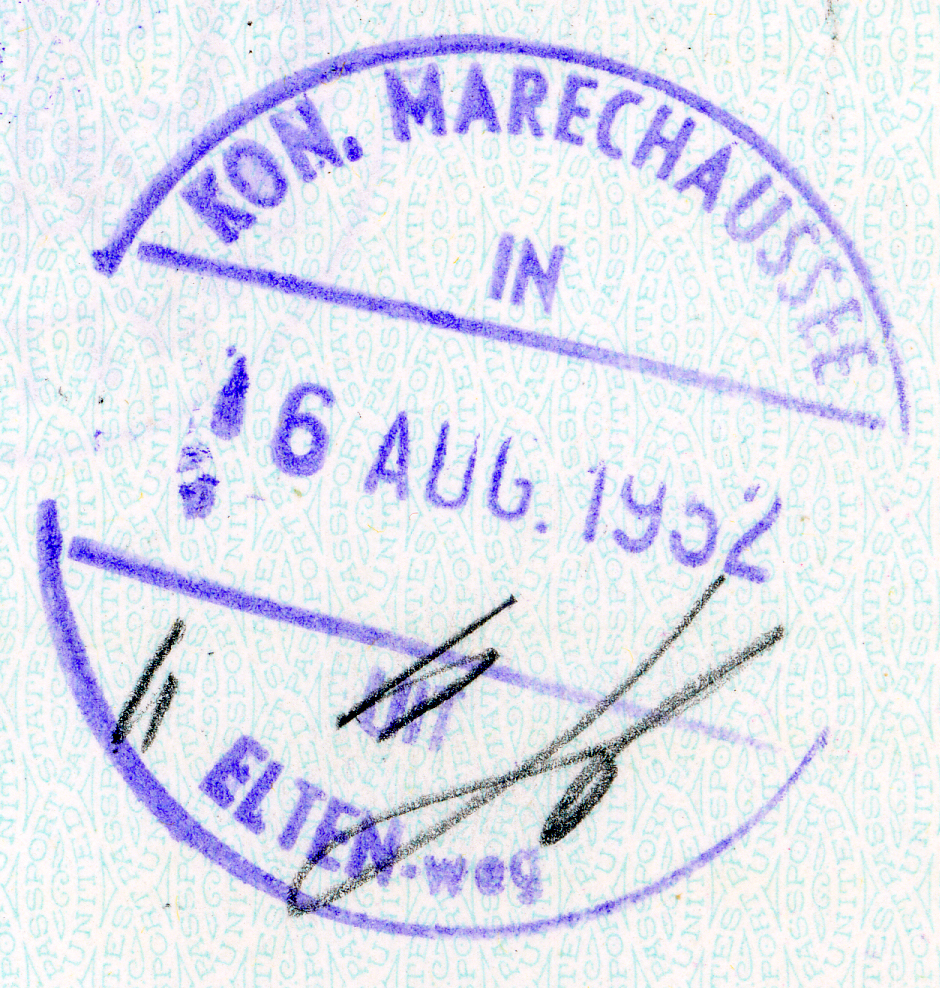
I’ve always loved passport stamps and dreamed of having a passport full of interesting stamps. So I wanted to find a way to include all the stamps from my mother’s passport into the book about her trip. But just scanning the pages and including them that way seemed like an ugly solution. After some thought I decided to figure out a way to include just the image of the stamp on each chapter heading page.

scan of passport page

After scanning the pages of her passport I  cropped each stamp into a separate image from the rest on the page. Some of the stamps overlap which just gave me more stuff that I erased from the image. All of these work was done in Adobe Photoshop.

cropped to single passport stamp

Now I started playing around with a way to separate the inked image from the background. With a simple white background it is easy to use the magic wand tool to select and then remove the background. But as you can see passport paper isn’t plain. The tool that helped the most was the background eraser tool. I hadn’t used this before so it was good to learn about it. But I still ended up doing some clean-up by hand.

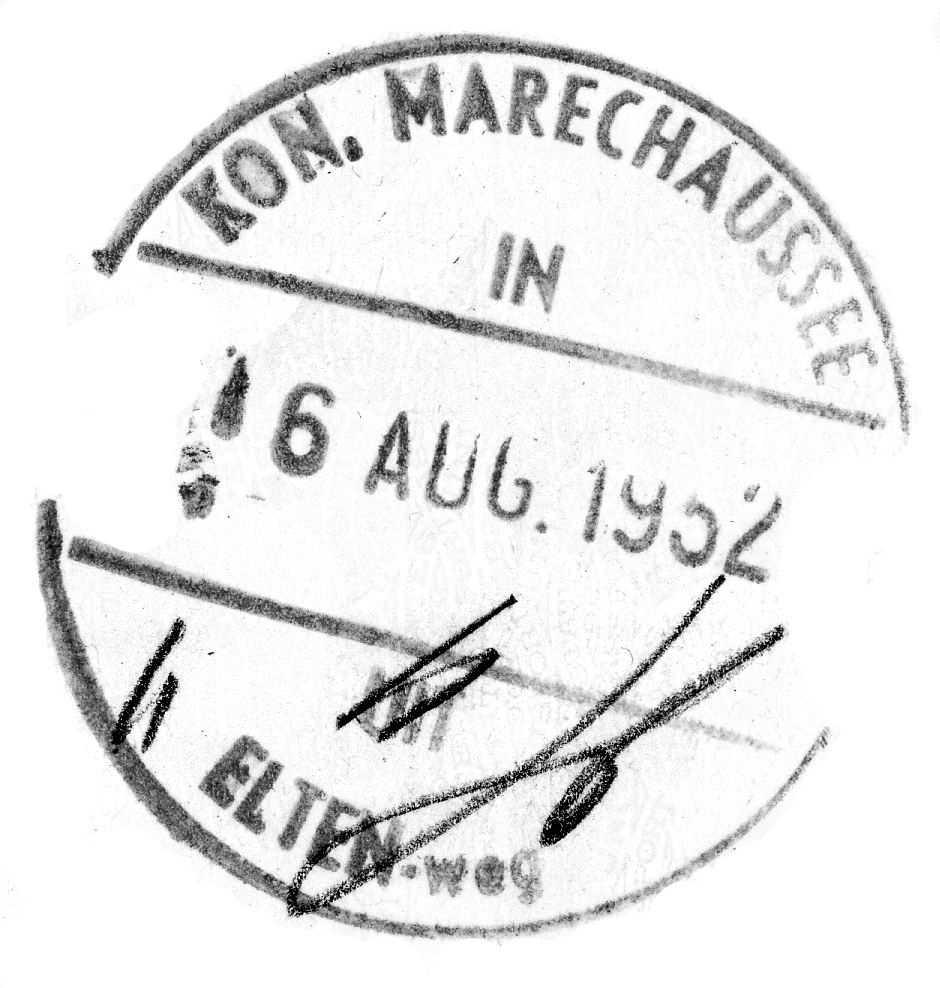
cleaned up passport stamp

The last step I did was to make the image black and white before I placed it on the chapter heading page. To give it more of the effect of being stamped on the page I changed the transparency to multiply. There is probably a better way to clean-up these images but I got it done and I was happy with the effect. I like having the passport stamps for each country on that country’s chapter heading page.

What ways have you found to include things like passport stamps in your projects?


This Week in 1856 – Fort Laramie – Mary Taylor

8 October 1856: (near Salt Lake City)

Rescuers moved out from their meeting spot at Big Mountain.

8 October 1856:

Mary Taylor’s father, Joseph Taylor (age 44) died, probably from the combination of not enough food and dehydration or heat prostration. He was buried in an unmarked grave in the campground.

From John Jacques:

The company arrived at Fort Laramie October 8th, and camped east of Laramie For, about a mile from the fort. Before reaching Laramie, the company met a fine looking and finely dressed friendly Indian chief on a fine American horse, and soon after, two dragoons on horseback, gave some sweetmeats to the children of the company and appeared immensely pleased to see the people.

On the 9th many of the company went to the fort to sell watches or other things they could spare and buy provisions. The commandant kindly allowed them to buy from the military stores at reasonable prices, biscuits at 15 1/2 cents; bacon at 15 cents, rice at 17 cents per pound, and so on. Some bought a few things at the sutler’s, but much higher prices rule at his store.

I believe the company left Fort Laramie the next day. Thenceforth, until the close of the journey, although noteworthy events were on the increase and some of them were indelibly impressed on the minds of the emigrants, yet they were so fully occupied in taking care of themselves that they had little time to spare to note details with exactness, and many notes that we made at the time, were lost and cannot now be found.

Up to this time, the daily pound of flour ration had been regularly served, but it was never enough to stay the stomachs of the emigrants and the longer they were on the plains, and in the mountains, the hungrier they grew. Most persons who traveled the plains with ox teams or handcarts, know well enough the enormous appetite which that kind of life gives. It is an appetite that cannot be satisfied. At least, such was the experience of the handcart people. You feel as if you could almost eat a rusty nail or gnaw a file. You are ten times as hungry as a hunter, yea, as ten hunters, all the day long and every time you wake in the night. And so you continue to your journey’s end, and for some time after. Eating is the grand passion of a pedestrian on the plains, an insatiable passion, for her never get enough to eat. . .

Well, at the time when this great appetite was fully roused up and had put on its strength, it was further sharpened by the increasing coldness of the weather.

Soon after Fort Laramie was passed, it was deemed advisable to curtail the rations in order to make the hold out as long as possible. The pound of flour fell to 3/4 a pound, then to half a pound, and subsequently yet lower. Still the company toiled on through the Black Hills, where the feed grew scarcer for the cattle. As the necessities of man and beast increased, their daily flour diminished. In the Black Hills, the roads were harder, more rocky and more hilly, and this told upon the handcars, causing them to become rickety and need more frequent repairing.

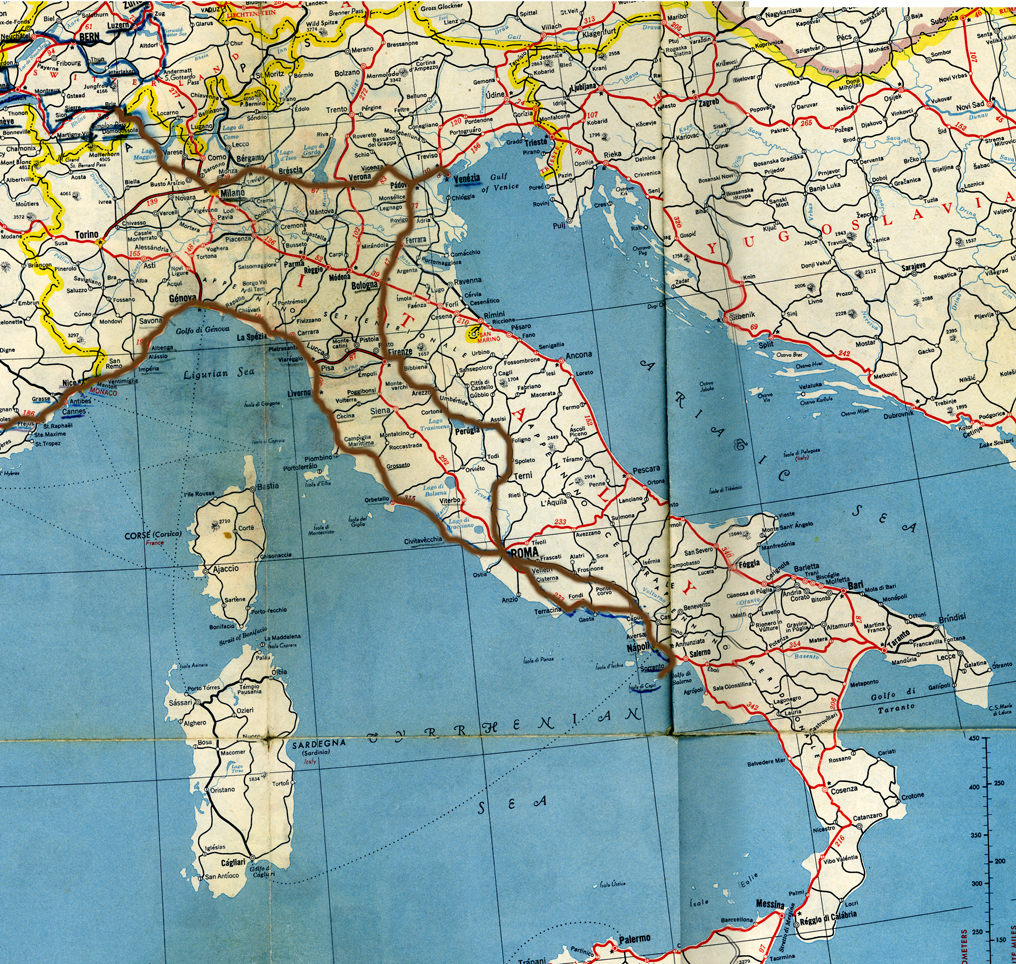
Europe 1952: Maps

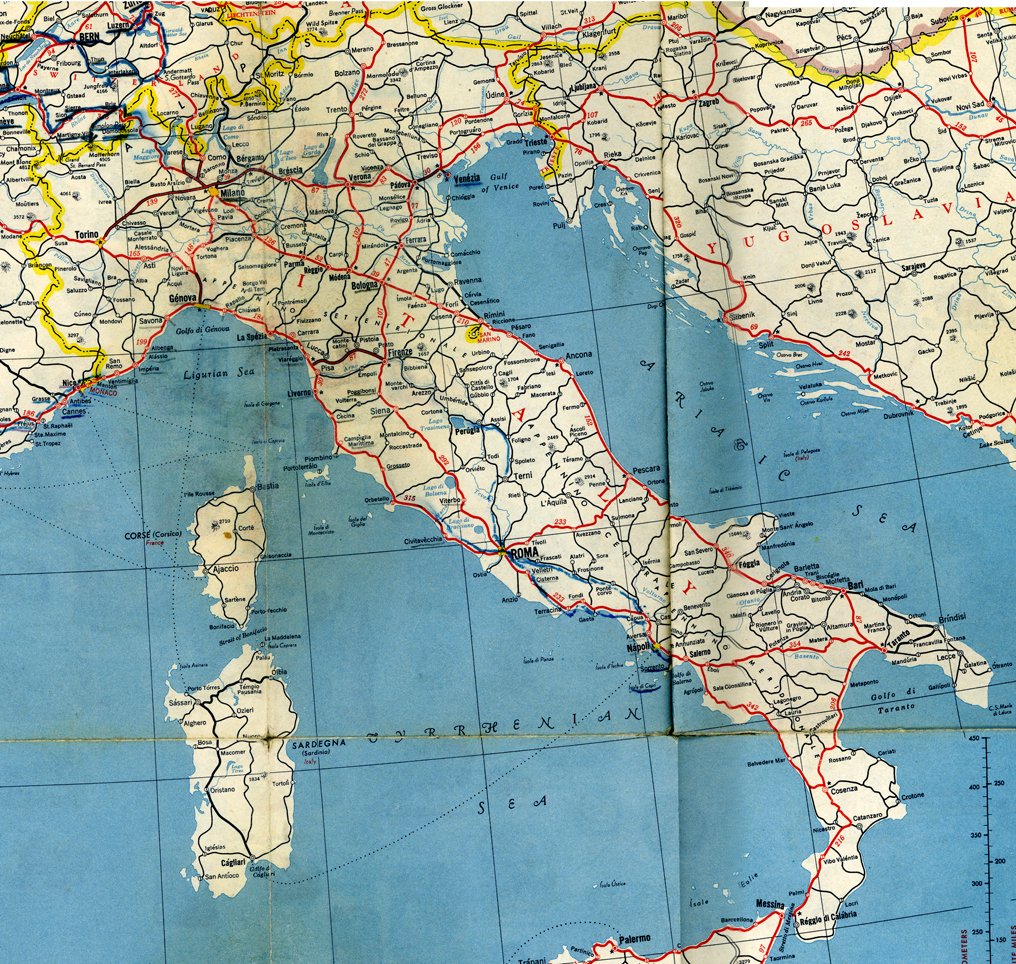
Among the many items that my mom saved from her trip to Europe in 1952 was a large map. I decided I wanted to use it at the beginning of each chapter. The map was challenging to scan because it was so big. So I scanned sections of it and then used Adobe Photoshop‘s photomerge to stitch together the section of the map for each country. If you’ve never used photomerge it is a very handy tool for doing things like panorama shots.

photomerged map

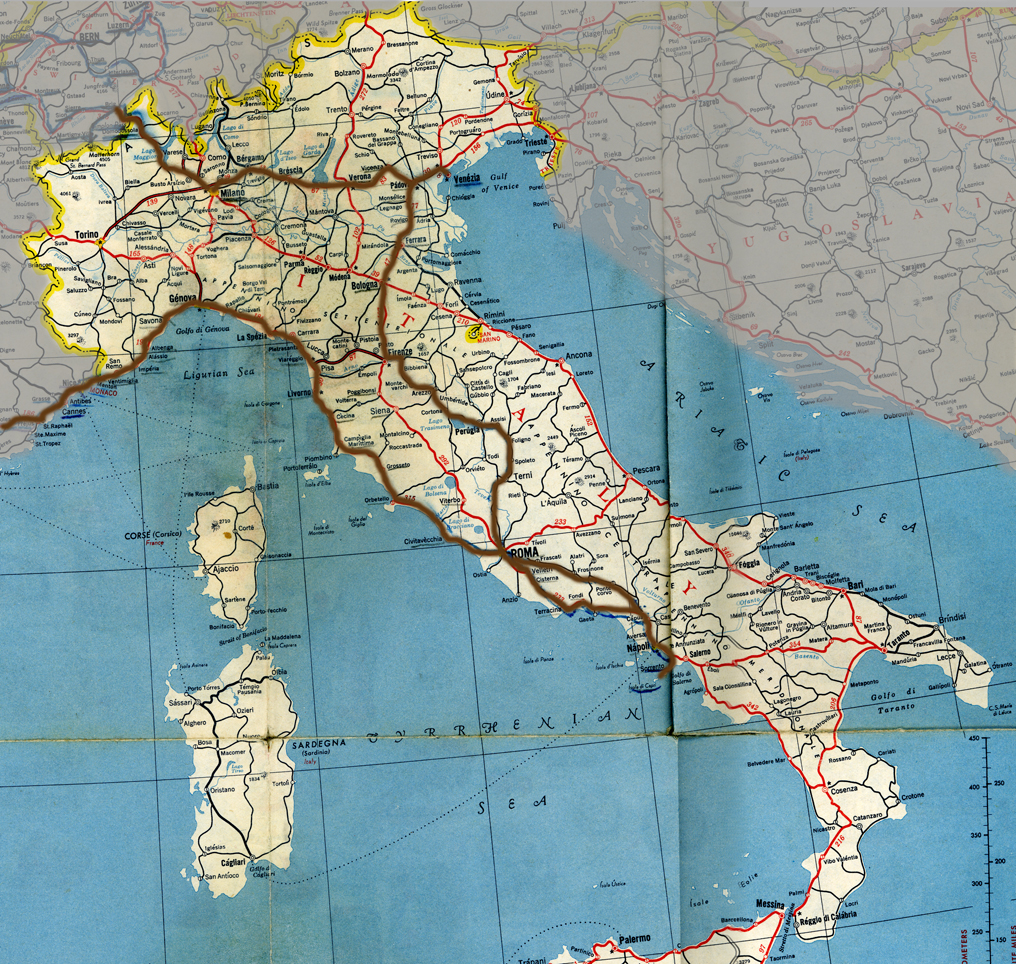
After I had a map section for each country I added a brown route line to mark the roads they traveled in that country. I did this also in Photoshop using the brush tool. To bring more focus to the country I added a grey mask that partially block out the neighboring countries, by adjusting the transparency of this layer.

map with route

map with surrounding countries grayed out

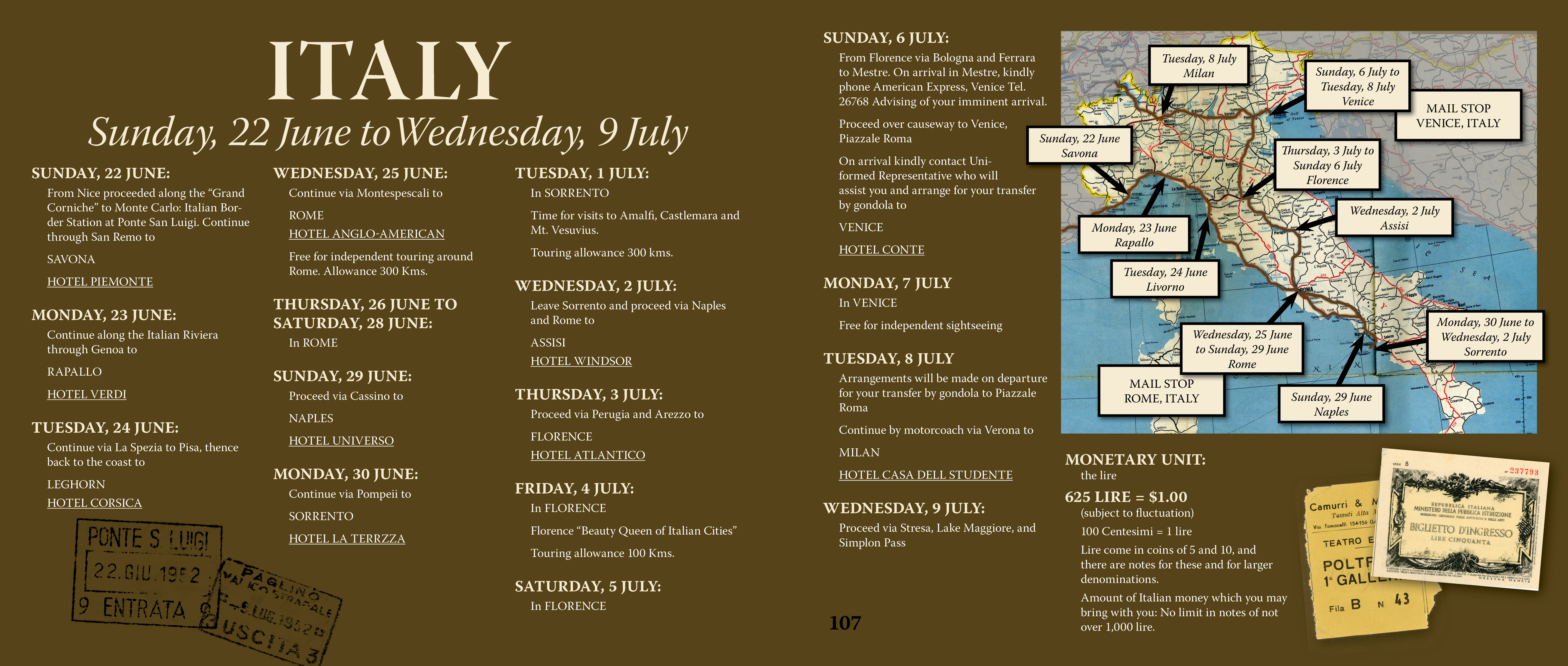
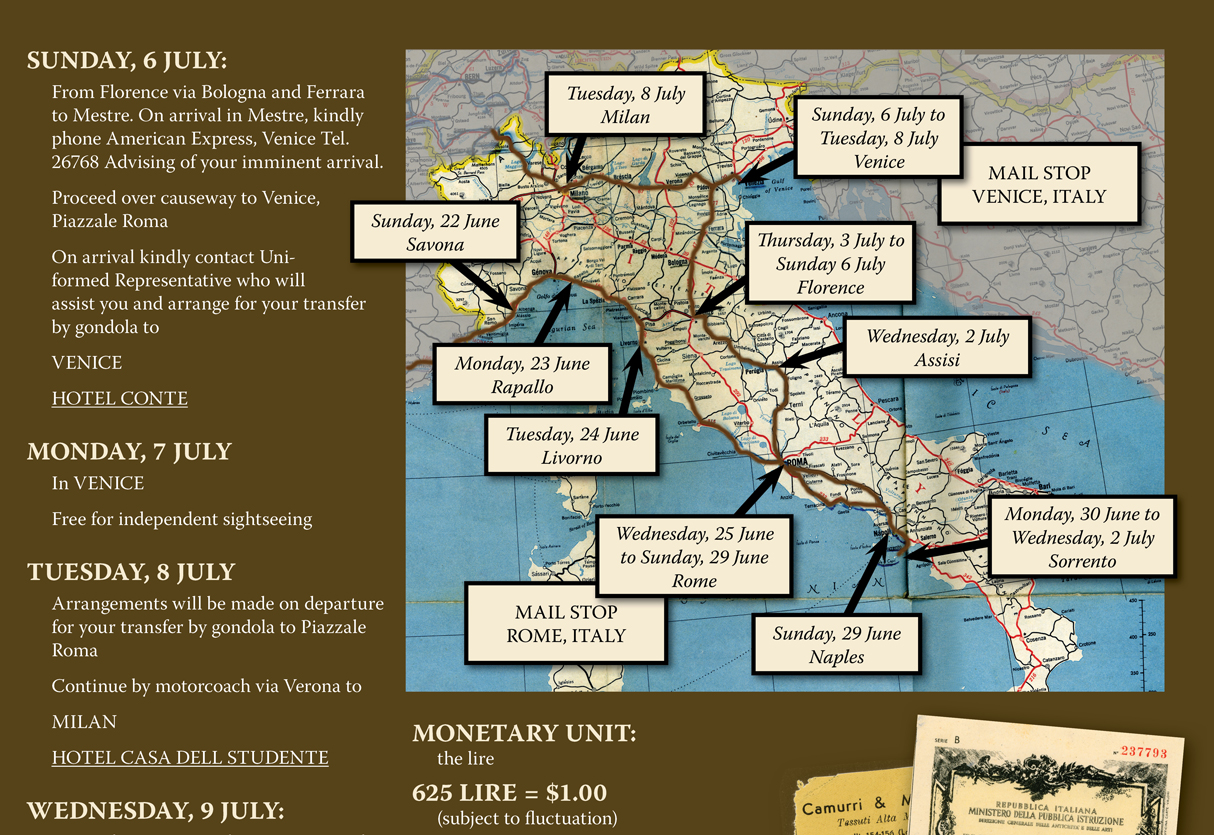
Once I brought the map image into Adobe InDesign, I added text boxes to label the cities they stayed in along with other relevant information and arrows to make it easier to tell the location of the city on the map. Arrows are easy to make in InDesign, just go to the stroke palette and select the style of arrow point you would like for the beginning or end of the line you made with the pen tool.

map with labels

I think the maps were effective in communicating a lot of the information at the beginning of each chapter in a visual way. How have you used maps in your projects?

This Week in 1856 – Chimney Rock – Mary Taylor

From Jessie Haven (with the Hodgetts Wagon Company):

2 October 1856:

Weather warm. Very warm for the season, and dry.

3 October 1856:

Hot today. Thermometer stood at noon in the sun at 119 degrees. United States troops passed us on their way to Laramie, Passed Chimney Rock today.

From John Jacques:

On the 3rd of October, near Chimney Rock, a company of United States Dragoons, under Major Hunter, with ten or twelve mule teams from Fort Kearny for Fort Laramie, passed the company and a boy named Aaron Giles, left the handcart company and went with the soldiers.

[There are some indications that Mary’s husband William Upton began to drive a wagon for the Hodgetts company at this time because some of their drivers left the company and went with the U.S. troops.]

On the 4th of October, the company passed Scott’s Bluffs. Parley P. Pratt‘s company of missionaries, going east from Salt Lake, passed the Bluffs about the same time, but the two companies did not see each other.

From Samuel Openshaw:

4 October 1845:

Passed Chimney Rock, which rises in the form of a monument or chimney, and can be seen at a distance.

———————————————————————————————

4 October 1856: (Salt Lake City, Utah)

Franklin D. Richards arrived and notified Brigham Young of the plight of the handcart companies on the plains.

5 October 1856: (Salt Lake City, Utah)

Brigham Young announced at General Conference the need for wagons, supplies and men to go rescue the handcart companies.