60 Years Ago Today

Thursday, 19 June 1952:

At 7 a.m. I opened an eye to look at my watch. A few minutes later and a knock came at my door. French—which we presumed meant it was time to get up. A few minutes later that funny buzz again.

“Madam would you like tea in your room?” About 15 minutes later we crawled out of bed and went down to breakfast. We had a continental breakfast of chocolate rolls and jam for 210 francs.
I noticed I had about six bites on my arms. Where did they come from? Then I found a small grocery shop and pastry shop around the corner. I bought a big loaf of bread for 50 francs. Then I chose cheese pastries and fruit but I had left my money belt in my room. However I recovered with the help of Connie and Bette L. I was really trying to lighten my load—maybe too much.
We were back on the road again with fields of flowers, roses, and the Rhone and Saone basin. I learned this was the lowest valley in France and that the Rhone river originates in Switzerland. Soon after the countryside included roses climbing on a cement fence, haystacks, rich agriculture districts, rich meadow lands, and coal districts nearby. I spied wheat, corn, cattle, and poultry. These lowlands funneled the Southern European influence. Then there were Roman ruins from 600 b.c.

Next was the Cathedral of St. Maurice de Vienne in Angers. It had painted archways and recessed portals which were built in the 12th to 16th centuries in Gothic architecture. The cathedral was in a state of decay with the lilies of the valley inside.

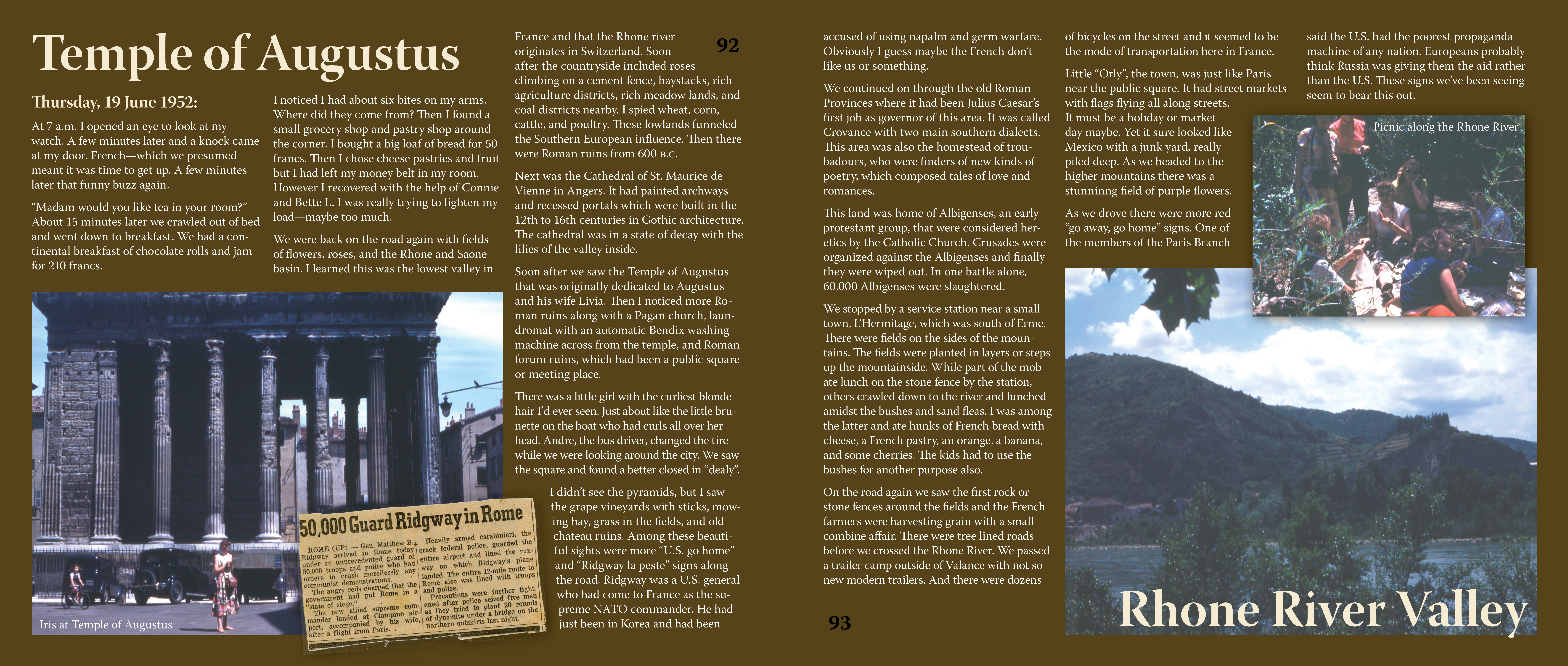
Soon after we saw the Temple of Augustus that was originally dedicated to Augustus and his wife Livia. Then I noticed more Roman ruins along with a Pagan church, laundromat with an automatic Bendix washing machine across from the temple, and Roman forum ruins, which had been a public square or meeting place.

There was a little girl with the curliest blonde hair I’d ever seen. Just about like the little brunette on the boat who had curls all over her head. Andre, the bus driver, changed the tire while we were looking around the city. We saw the square and found a better closed in “dealy”.
I didn’t see the pyramids, but I saw the grape vineyards with sticks, mowing hay, grass in the fields, and old château ruins. Among these beautiful sights were more “U.S. go home” and “Ridgway la peste” signs along the road. Ridgway was a U.S. general who had come to France as the supreme NATO commander. He had just been in Korea and had been accused of using napalm and germ warfare. Obviously I guess maybe the French don’t like us or something.

We continued on through the old Roman Provinces where it had been Julius Caesar’s first job as governor of this area. It was called Crovance with two main southern dialects. This area was also the homestead of troubadours, who were finders of new kinds of poetry, which composed tales of love and romances.

This land was home of Albigenses, an early protestant group, that were considered heretics by the Catholic Church. Crusades were organized against the Albigenses and finally they were wiped out. In one battle alone, 60,000 Albigenses were slaughtered.

We stopped by a service station near a small town, L’Hermitage, which was south of Erme. There were fields on the sides of the mountains. The fields were planted in layers or steps up the mountainside. While part of the mob ate lunch on the stone fence by the station, others crawled down to the river and lunched amidst the bushes and sand fleas. I was among the latter and ate hunks of French bread with cheese, a French pastry, an orange, a banana, and some cherries. The kids had to use the bushes for another purpose also.

On the road again we saw the first rock or stone fences around the fields and the French farmers were harvesting grain with a small combine affair. There were tree lined roads before we crossed the Rhone River. We passed a trailer camp outside of Valance with not so new modern trailers. And there were dozens of bicycles on the street and it seemed to be the mode of transportation here in France.

Little “Orly”, the town, was just like Paris near the public square. It had street markets with flags flying all along streets. It must be a holiday or market day maybe. Yet it sure looked like Mexico with a junk yard, really piled deep. As we headed to the higher mountains there was a stunning field of purple flowers.

As we drove there were more red “go away, go home” signs. One of the members of the Paris Branch said the U.S. had the poorest propaganda machine of any nation. Europeans probably think Russia was giving them the aid rather than the U.S. These signs we’ve been seeing seem to bear this out.
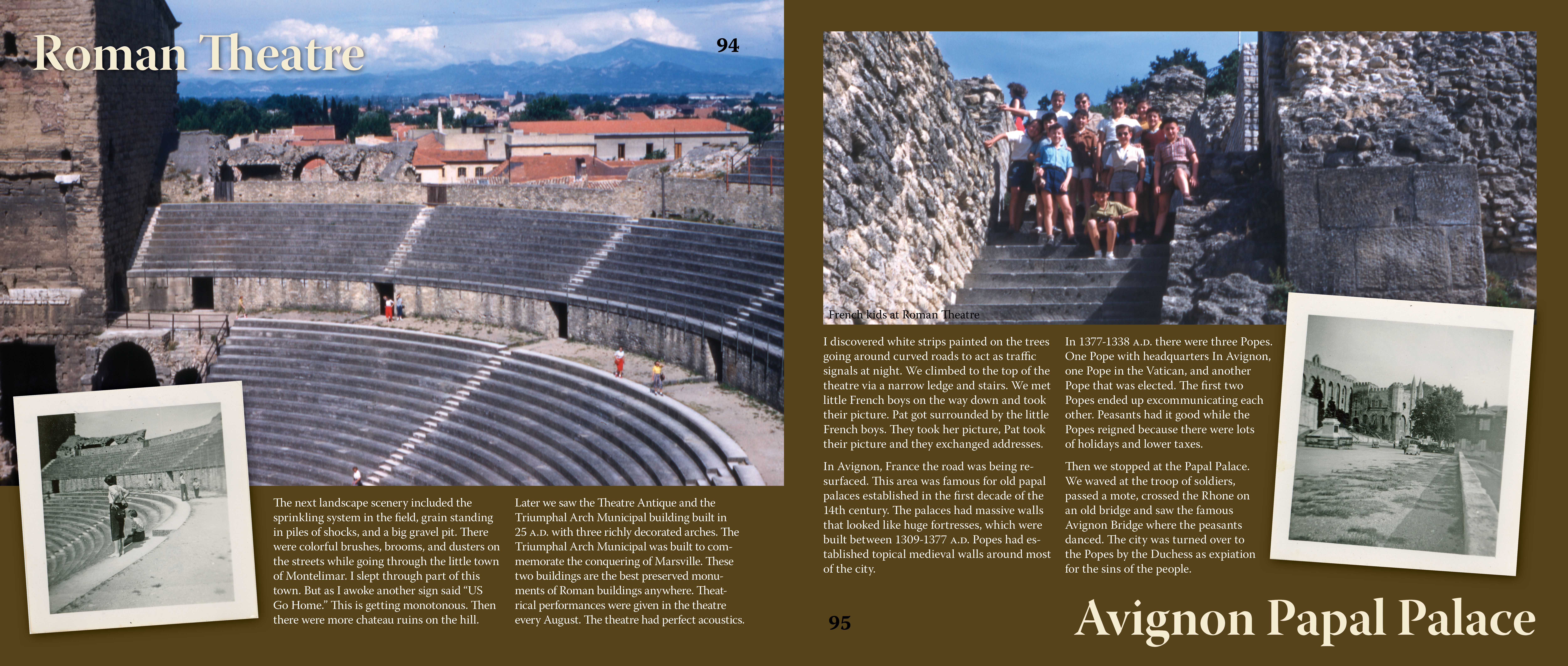
The next landscape scenery included the sprinkling system in the field, grain standing in piles of shocks, and a big gravel pit. There were colorful brushes, brooms, and dusters on the streets while going through the little town of Montelimar. I slept through part of this town. But as I awoke another sign said “US Go Home.” This is getting monotonous. Then there were more château ruins on the hill.

Later we saw the Theatre Antique and the Triumphal Arch Municipal building built in 25 a.d. with three richly decorated arches. The Triumphal Arch Municipal was built to commemorate the conquering of Marsville. These two buildings are the best preserved monuments of Roman buildings anywhere. Theatrical performances were given in the theatre every August. The theatre had perfect acoustics.

I discovered white strips painted on the trees going around curved roads to act as traffic signals at night. We climbed to the top of the theatre via a narrow ledge and stairs. We met little French boys on the way down and took their picture. Pat got surrounded by the little French boys. They took her picture, Pat took their picture and they exchanged addresses.

In Avignon, France the road was being resurfaced. This area was famous for old papal palaces established in the first decade of the 14th century. The palaces had massive walls that looked like huge fortresses, which were built between 1309-1377 a.d. Popes had established topical medieval walls around most of the city.

In 1377-1338 a.d. there were three Popes. One Pope with headquarters In Avignon, one Pope in the Vatican, and another Pope that was elected. The first two Popes ended up excommunicating each other. Peasants had it good while the Popes reigned because there were lots of holidays and lower taxes.

Then we stopped at the Papal Palace. We waved at the troop of soldiers, passed a moat, crossed the Rhone on an old bridge and saw the famous Avignon Bridge where the peasants danced. The city was turned over to the Popes by the Duchess as expiation for the sins of the people.

Soon after we observed one boat of girls and another boat of boys rowing on the river. Pont du Gard, which was one of the grandest Roman works in existence, had a bridge and aqueduct over the Gard River. It was 880 feet long by 160 feet high. Its system consisted of a system of three arches carrying water for 25 miles to Nimes. Other aqueducts copied Pont du Gard.

There was rocky country as we left Avignon and arrived at the Aqueduct. And the scenery included vineyards, tree lined roads, men harvesting grain with scythe, and another “US Go Home” sign. Maybe it was the communists who keep telling us to go home. I discovered spots to show the middle of the road.

We arrived at the aqueduct and climbed up the winding bush-lined trails. It was a massive structure. I took picture of the kids on the top with the aqueduct from the trail. It took 30 minutes to get to the top instead of 10 minutes. Next was a grove of olive trees, dry dock over some railroads, and houses with green, blue and yellow shutters.

At 7 p.m. we got into the city of Nimes. There was a Roman amphitheater that was built in 140 a.d. which held 20,000 spectators. It was one of the best preserved ancient arenas and it could be emptied in five minutes. This area contains more important well preserved ruins than any other city besides Rome.

Later on the bus ride was the Palais de Justice which was an old Gothic cathedral with flying buttresses. A physician lived here by the name of Nicot. He introduced tobacco in France and gave it his name. Next was the Temple of Maison Carree, considered one of the most beautiful temples of modern times. The French had bullfights in this arena.

Finally, we arrived at the Hotel Le Cheval Blanc. Its facade was nice looking. My room was 59 on the 4th floor. The suitcases were taken down early for tomorrow. I wasn’t able to sleep in my pajamas tonight. Carol and Eloise had difficulty with the door. Twila couldn’t get it to open either, but we finally got it open. The WC was at the other end of the hall. I cleaned up with a foot and spit bath combination. Then we dined at the hotel sidewalk café—omelet cambron and pomes frites for 15 francs. We had one omelet between the three of us.

We strolled down the boulevard in search of a French movie. We turned down one movie with Lucille Ball and then passed a street side cabaret deal with a small orchestra, but no one was dancing. People were sitting around watching each other. They really concentrated on us as long as we were in view. We found a movie Deux Sous de Violettes with Dany Robin. The heroine of the movie had so many heroes it was a little confusing, but quite amusing nonetheless. At the end of the day there was only one pillow on the bed.
My Current Projects: Goals and Progress

Evaluate Goals for last week:

++ print goals for the week – complete
++ post at least once per day, Monday to Saturday – I want to get more posts done on other people’s work, but I didn’t get that done.
++ send reference images to Kim for the Horizon – I sent some images and links to Kim, plus I talked to her about the illustration and I think that was helpful.
++ finish adding links to blog – I got this done, I’m not all that happy with the way I have some of this set up but it will do for now.
++ finish Casey’s book – I got it uploaded, ordered and even got it back! Good job Blurb.
+    Send info on MS Sibijak – I almost gave up on this goal, then I decided I could upload all the images I have of the Sibijak to my SmugMug site and send off a link. I got them uploaded but haven’t composed the email yet with some historical information.
–    2 hours on Key West Audio transcribing – zilch on this.
+10 rate my progress

Progress on projects not on my goal list:

I got several of the Europe 1952 posts – 60 Years Ago Today – done ahead.

Goals for this week:

  1. print goals for the week
  2. post at least once per day, Monday to Saturday
  3. Send info on MS Sibijak
  4. talk to my dad about the Key West Audios – I need a different tactic
  5. Get Volume 6 – Our Family moving forward again
  6. rate my progress

Still struggling to get more done in a day. Do I just need more focus? Am I wasting too much time? Not sure the answer but hoping for inspiration. So much to do and I don’t think I’m making enough progress. Any suggestions?

60 Years Ago Today

Wednesday, 18 June 1952:

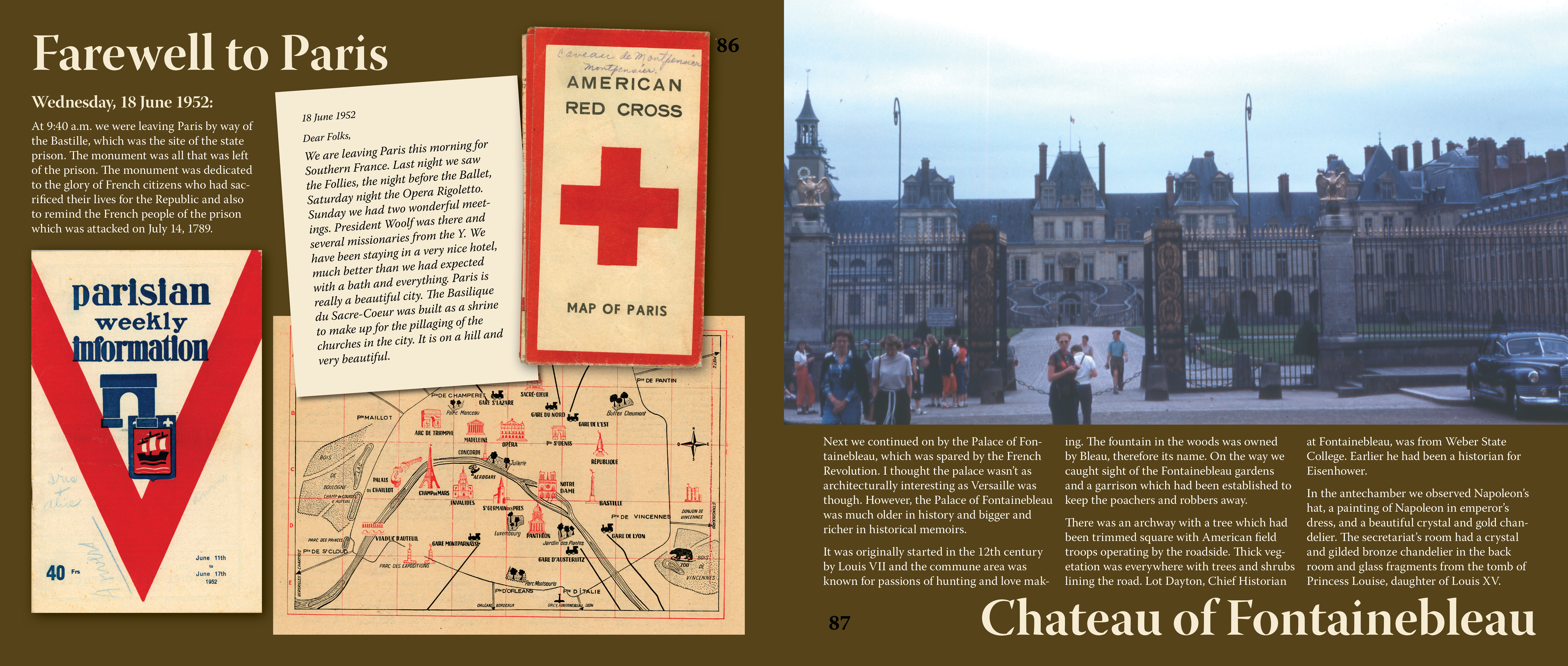
At 9:40 a.m. we were leaving Paris by way of the Bastille, which was the site of the state prison. The monument was all that was left of the prison. The monument was dedicated to the glory of French citizens who had sacrificed their lives for the Republic and also to remind the French people of the prison which was attacked on July 14, 1789.

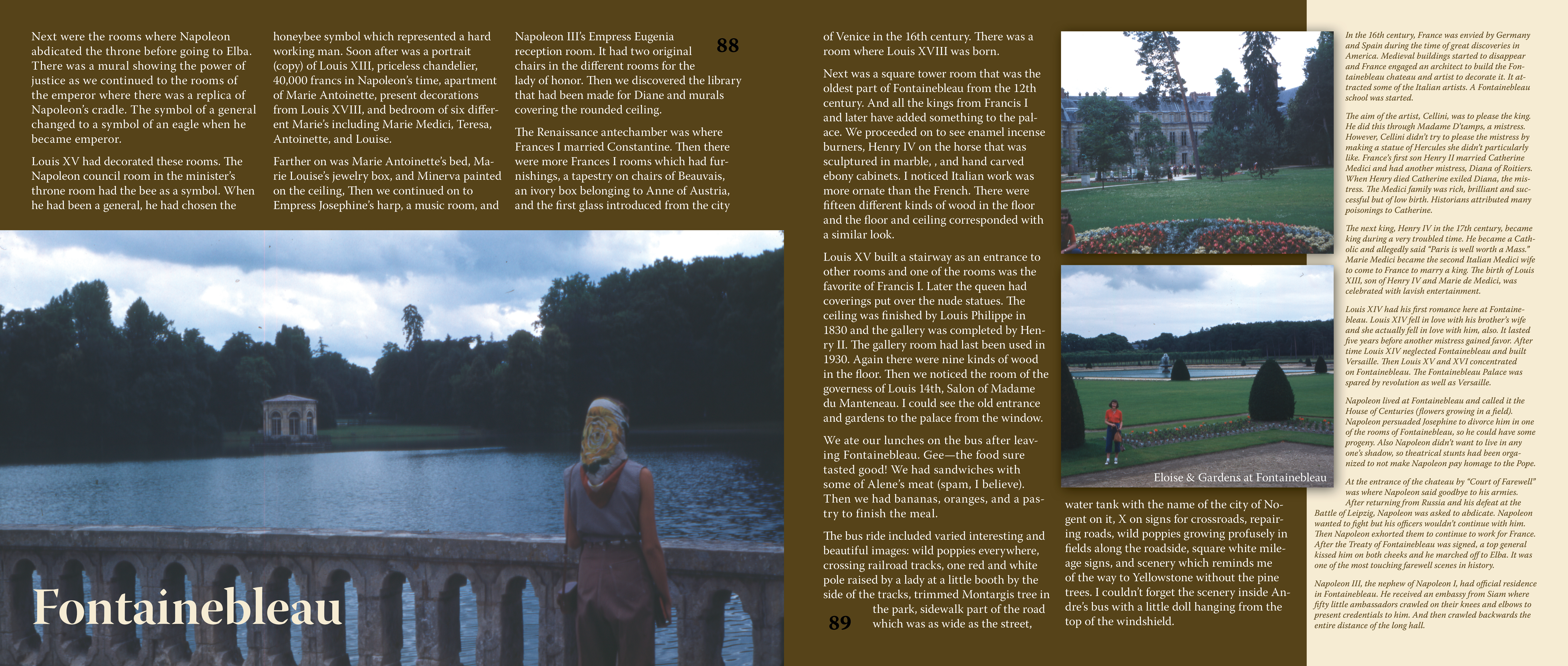
Next we continued on by the Palace of Fontainebleau, which was spared by the French Revolution. I thought the palace wasn’t as architecturally interesting as Versaille was though. However, the Palace of Fontainebleau was much older in history and bigger and richer in historical memoirs.

It was originally started in the 12th century by Louis VII and the commune area was known for passions of hunting and love making. The fountain in the woods was owned by Bleau, therefore its name. On the way we caught sight of the Fontainebleau gardens and a garrison which had been established to keep the poachers and robbers away.

There was an archway with a tree which had been trimmed square with American field troops operating by the roadside. Thick vegetation was everywhere with trees and shrubs lining the road. Lot Dayton, Chief Historian at Fontainebleau, was from Weber State College. Earlier he had been a historian for Eisenhower.

In the antechamber we observed Napoleon’s hat, a painting of Napoleon in emperor’s dress, and a beautiful crystal and gold chandelier. The secretariat’s room had a crystal and gilded bronze chandelier in the back room and glass fragments from the tomb of Princess Louise, daughter of Louis XV.

Next were the rooms where Napoleon abdicated the throne before going to Elba. There was a mural showing the power of justice as we continued to the rooms of the emperor where there was a replica of Napoleon’s cradle. The symbol of a general changed to a symbol of an eagle when he became emperor.

Louis XV had decorated these rooms. The Napoleon council room in the minister’s throne room had the bee as a symbol. When he had been a general, he had chosen the honeybee symbol which represented a hard working man. Soon after was a portrait (copy) of Louis XIII, priceless chandelier, 40,000 francs in Napoleon’s time, apartment of Marie Antoinette, present decorations from Louis XVIII, and bedroom of six different Marie’s including Marie Medici, Teresa, Antoinette, and Louise.

Farther on was Marie Antoinette’s bed, Marie Louise’s jewelry box, and Minerva painted on the ceiling, Then we continued on to Empress Josephine’s harp, a music room, and Napoleon III’s Empress Eugenia reception room. It had two original chairs in the different rooms for the lady of honor. Then we discovered the library that had been made for Diane and murals covering the rounded ceiling.

The Renaissance antechamber was where Frances I married Constantine. Then there were more Frances I rooms which had furnishings, a tapestry on chairs of Beauvais, an ivory box belonging to Anne of Austria, and the first glass introduced from the city of Venice in the 16th century. There was a room where Louis XVIII was born.

Next was a square tower room that was the oldest part of Fontainebleau from the 12th century. And all the kings from Francis I and later have added something to the palace. We proceeded on to see enamel incense burners, Henry IV on the horse that was sculptured in marble, , and hand carved ebony cabinets. I noticed Italian work was more ornate than the French. There were fifteen different kinds of wood in the floor and the floor and ceiling corresponded with a similar look.

Louis XV built a stairway as an entrance to other rooms and one of the rooms was the favorite of Francis I. Later the queen had coverings put over the nude statues. The ceiling was finished by Louis Philippe in 1830 and the gallery was completed by Henry II. The gallery room had last been used in 1930. Again there were nine kinds of wood in the floor. Then we noticed the room of the governess of Louis 14th, Salon of Madame du Manteneau. I could see the old entrance and gardens to the palace from the window.

We ate our lunches on the bus after leaving Fontainebleau. Gee—the food sure tasted good! We had sandwiches with some of Alene’s meat (spam, I believe). Then we had bananas, oranges, and a pastry to finish the meal.

The bus ride included varied interesting and beautiful images: wild poppies everywhere, crossing railroad tracks, one red and white pole raised by a lady at a little booth by the side of the tracks, trimmed Montargis tree in the park, sidewalk part of the road which was as wide as the street, water tank with the name of the city of Nogent on it, X on signs for crossroads, repairing roads, wild poppies growing profusely in fields along the roadside, square white mileage signs, and scenery which reminds me of the way to Yellowstone without the pine trees. I couldn’t forget the scenery inside Andre’s bus with a little doll hanging from the top of the windshield.

As we continued traveling we passed the Briare Canal, a tributary of the Seine, and women working in the fields alone. I caught sight of a man on a bicycle with a cart behind him and another lady pulling her cart along the road as well. There was little traffic on the French roads. There was a gorgeous field of tall white flowers was used to make oil for salads. Then we went through a little town that had narrow winding streets like Mexican cities. We moved along a curbed road lined with trees with a valentine sign, a mowed swatch of grass along side the road, and some men working on the railroad Nuervy underpass. After awhile I started dozing. Then Andre hit his funny loud horn and I woke right up.

Along the roadside there was a beautiful grove of trees, load of hay, lumberyard, cut patch of grass raked and ready to bunch. I kept dozing. After my napping I came to realize there was a little horn and big horn that could jerk me quickly out of my sleep.

Now back to sightseeing. La Charite in Loire Valley dispersed on both sides of the River Allier. In the next village I spotted a house covered with climbing vines. Then we passed groves of trees still maturing, Nevers train station, Hotel Moderne, and some grass bunched along the road.
Soon we stopped at the railroad station. Was it really a “dealy” for the bathroom? However, I didn’t go in and walked down the street to the pastry shop. I enjoyed a fresh roll with raisins, an orange, and a drink. Yea, a clean toilette in the shop! Back on the road there was construction on both sides of road. Soon there were cattle in the fields, and then pigs, sheep, and cows.

In the city of Moiry there were cement telephone poles with rectangular squares. And we learned that each average French farm had 25 acres. The tobacco, utilities, armament, and matches industry were run by the government. If there was a fire, owners of the buildings had to pay for the expenses and damages. The franc was worth 25 cents to an American dollar before World War I and about 36 francs to a dollar before World War II.

The French in this area were Celtics. Their language related to Latin, Greek, Slavic. They were a tall fair-haired people that lived in tribes and had the Druid religion. The Romans wiped them out and ruled with no written law. Clovis was the first king to unite all the tribes in France and he became an important leader in France. He was Christian, so all warriors converted to Christianity. Clovis succeeded in driving out the Visigods from Southern France. In 350 a.d. the Franks in the north had headquarters in Paris and the Burgundians were in Southeastern France.
We saw the old Castle Orateau which was built during the Renaissance in the 9th century. As the Frankish kings became weaker, Charlemagne took over from 768-814 a.d. as a Frankish king and helped define Western and Central Europe. Also, Charlemagne protected the Pope while he knelt in prayer and as a result the Pope crowned him the King of the Renaissance.

The Carolingian Renaissance, in 843 a.d. , stands out as a period of intellectual and cultural revival in Europe. This was the beginning of the Romance languages. Later the Burgundians, a Eastern Germanic tribe, with their seat of government in Dijon, France and Geneva, Switzerland were subdued by the Franks. Afterwards, the fierce and warlike Normans came in the 9th and 10th centuries while Rouen was the capital of Normandy. Charles the Simple, the French king, gave his daughter to a Viking leader Rollo. Then the Normans accepted Christianity and became a vassal to the king.

Later the Normans in 1066 a.d. conquered England and the Normans took home with them the French language and culture, because they had forgotten their own. As a result the French language became the official language of Europe.

The Englishmen like action and wild behavior where the Frenchmen were more mind oriented, intellectual and not so sports minded. Also the French loved order and Frenchmen were more subtle in tastes and in expressing their opinions. However the Spanish were passionate. And the Germans loved romantic literature and had feelings of love. Romanticism came to prevail with Victor Hugo, a French playwright and author, for a short period of time.

Back to sightseeing we saw French peasants that were passing through the rich fertile farm area. In the Middle Ages, the French peasants were a little better off than the European peasants in general. They were quite satisfied with their lives as fifty percent had become land owners during the revolution. This status and high percentage was the best in Europe. In 1952 nearly all the land in France was owned by peasants. The peasants represented the one big obstacle to communism. However there were some sharecroppers in Southwest France that were breeding places of communism. Today France and England have the same form of government.

In the 19th century, peasants constituted 75% of the population. Whereas in 1952, 23% of the population were peasants. Tredita Agular lent money to the peasants. But there were no big supermarkets or tractors to be seen anywhere, because peasants disliked machines. When the peasants died out, the farms were given back to the government.

On the road I spied some road construction where the workmen wore wooden shoes. Then we stopped at a small town on the way for drinks and gas at 80 cents a gallon. Before we left we gave gum to two little girls in the restaurant.

Now back in the bus we gazed at the scenery which had beautiful rolling hills, checkerboard farms, and tombs in a cemetery. There were little tombs where people had been buried on top of each other.

Next on the drive was a basketball court, windmill, vineyard, red tile roofs, circus in Roanne, and Loire River. The night brought a beautiful rainbow and sunset. Coming up was Lyon, France which was the largest silk center and one of the leading car producing centers in Europe. It was the second largest city in France.

Finally we arrived at Hotel de Angleterre about 10:30 p.m. We were hungry and the dining room had just closed as we arrived. Can you believe I got a room 51 all by myself! It has a big double bed, plush red cover, and marble fireplace. Sadly Connie came down to sleep with me though.
In the bathroom I discovered a lavatory, foot bath, hot water, and a short bed with a canvas sheet on the bottom. It was a modern look with a roll pillow and big pillow on the bed. Mrs. Hansen and Dick were put in the same room. The hotel changed it when they realized what had been done.

60 Years Ago Today

Tuesday, 17 June 1952:

I t was a slow start as we discovered the Louvre was not open. Wouldn’t that frost you? And that was where I had planned to spend most of the day. Instead we stopped by an oculist (ophthalmologist) shop to get the ear piece on my sunglasses fixed. Thanks to Alicia, we were successful in getting the lady to understand us.

Then we left a forwarding address at the American Express for the next mail stop. Next was the Lafeyette Department Store that was just like an opera house. It had a dome of stained glass and ornate gold railings around each floor.

We had lunch on the terrace of the Lafayette Department Store after searching four floors to find it. We had a view of the apartment roofs. There were two table cloths, cloth napkins, ice water, and bread. I ordered an omelette and ham while I ate four pieces of bread. Alice got a rare steak, but by using her French she got it recooked some more.

Then we paid the cashier and left for Printemps, another department store, and cheaper restaurant. We found the toy department and bought Kleenex for 325 francs.

Outside again, a lady surprisingly stopped and asked me “ou est la metro?” We tried to help her and then we took the metro to the Seine River. We got off near Sarah Barnhardt’s Theatre and identified the Saint Jacques Tower. We traveled to see St. Chapelle but it was closed. Tuesday’s sure seemed to be the day for everything to be closed.

Instead we strolled down by the Seine River. Here we saw another side of Paris. People lived in river boats with their wash blowing in the breeze. Others seemed to live along the banks, although we didn’t see any shelter for them. One man was washing his clothes in the river while an old beggar was eating trash out of a dirty can. Others were laying by the side of the river sleeping or unconscious. Then we took pictures of some little children and gave them some gum.

We found the Pont Marie metro station to go to the Eiffel Tower. We changed lines five times in order to get to the Eiffel Tower by the shortest route. We switched once at Franklin D. Roosevelt Station, made a mistake, and had to come back to it from Etaile.

The newest and most modern show windows on the trains were of an aluminum looking material. The walls were covered with the same thing as well. It was really smoky and stuffy in the train. I missed a few scenes resting my eyes.

Afterwards, there was one interesting scene with a Negro nanny, daddy and little baby crying. Another scene showed a spinning pool on a stage. It was quite a trick with girls coming down from the ceiling. I took several good shots from the second Etage (story). I was going to walk up to see it but I didn’t have time. The metro was jammed with people going home from work. We literally rubbed shoulders with the people of France.

I met a cute little English man coming back from the Eiffel Tower to the hotel, and he helped us cross the street. He told us he worked at the auto races.

Then Dick guided us down several streets from the Montmartre metro to get to the Folles Theater at 8:30 p.m. The curtain went up just as we sat down with Dick, Henry, and about thirty women. Talk about luxurious costumes and shapely figures in the play. There were about four risque scenes, but nothing in particular happened when they were all dressed up. It was interesting.

50 for 50 #25 – Knocking Out Teeth

Me with my missing teeth

When I was three years old I knocked out two of my front teeth while playing on the swings. Here is what my mom wrote in her diary:

Our three-year old Raelyn recently tried to copy the big kids by jumping out of the swing before it stopped. Result: She is eligible to sing all I want for Christmas is my two front teeth.

It is funny how memory works. I thought I was swinging on my stomach and fell out face first. But that note of my mom makes it sound like I was trying to jump out of the swing and didn’t navigate the landing. Now I wonder what really happened. Usually the closer to the time something happened the more likely correct. I also thought that it was my two front teeth but the one photo I found it show one front tooth and then the tooth next to it. I guess this is also a lesson in how facts can get shifted around in time.

I also remember getting really sick and tire of the song, “All I want for Christmas is my Two Front Teeth.” It was several years before my permanent teeth came in so every Christmas it was the same old thing.

I did have celebrating this incident in my early childhood on my 50 for 50 list but I thought that I would celebrate it by finding a swing set and having a swing. But instead I knocked off part of my tooth eating a sandwich with crusty sourdough bread. At first I thought that somehow a rock got into my bread. But the truth came out a few bites later when I realized a chunk of my tooth was missing. I think the dentist called it number 12. So my 50 for 50 this week was getting a crown on tooth #12. I’m guessing it was a lot less painful this time around.

60 Years Ago Today

Monday, 16 June 1952:

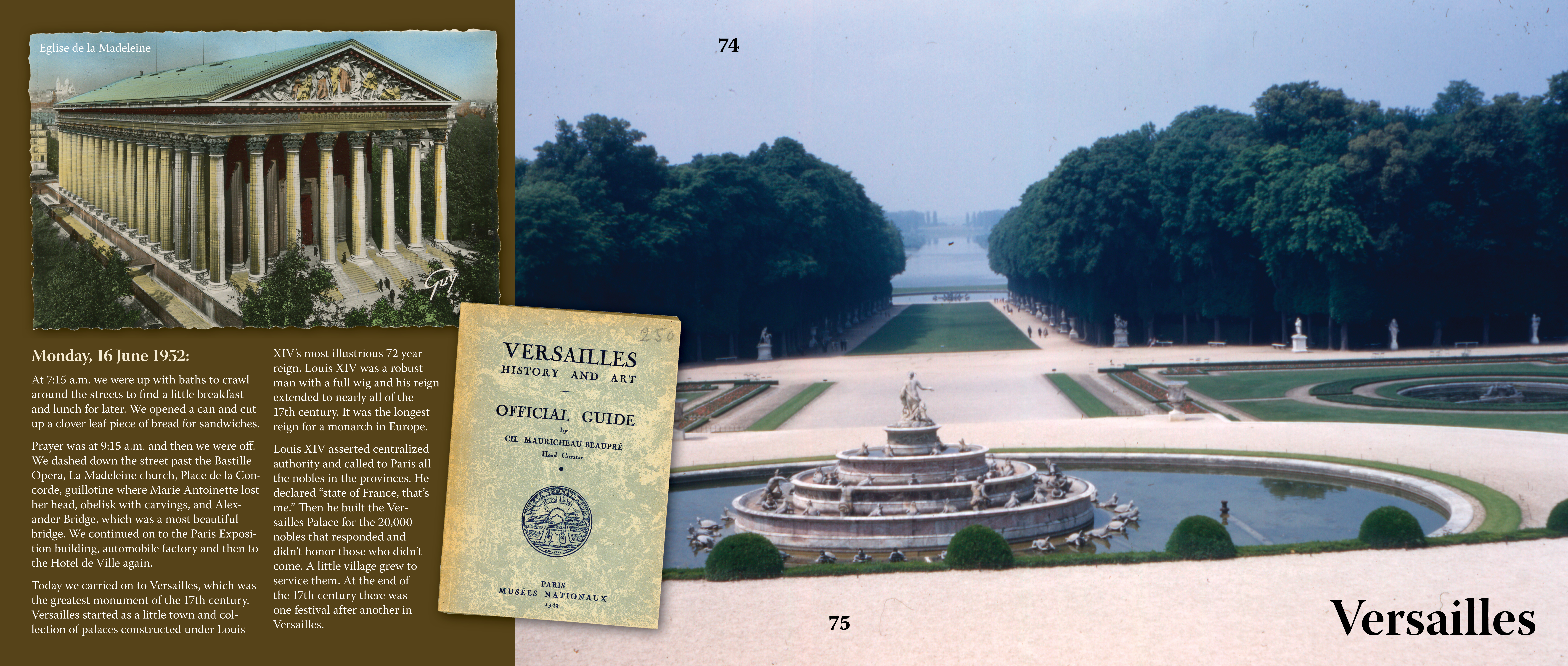
At 7:15 a.m. we were up with baths to crawl around the streets to find a little breakfast and lunch for later. We opened a can and cut up a clover leaf piece of bread for sandwiches.

Prayer was at 9:15 a.m. and then we were off. We dashed down the street past the Bastille Opera, La Madeleine church, Place de la Concorde, guillotine where Marie Antoinette lost her head, obelisk with carvings, and Alexander Bridge, which was a most beautiful bridge. We continued on to the Paris Exposition building, automobile factory and then to the Hotel de Ville again.

Today we carried on to Versailles, which was the greatest monument of the 17th century. Versailles started as a little town and collection of palaces constructed under Louis XIV’s most illustrious 72 year reign. Louis XIV was a robust man with a full wig and his reign extended to nearly all of the 17th century. It was the longest reign for a monarch in Europe.

Louis XIV asserted centralized authority and called to Paris all the nobles in the provinces. He declared “state of France, that’s me.” Then he built the Versailles Palace for the 20,000 nobles that responded and didn’t honor those who didn’t come. A little village grew to service them. At the end of the 17th century there was one festival after another in Versailles.

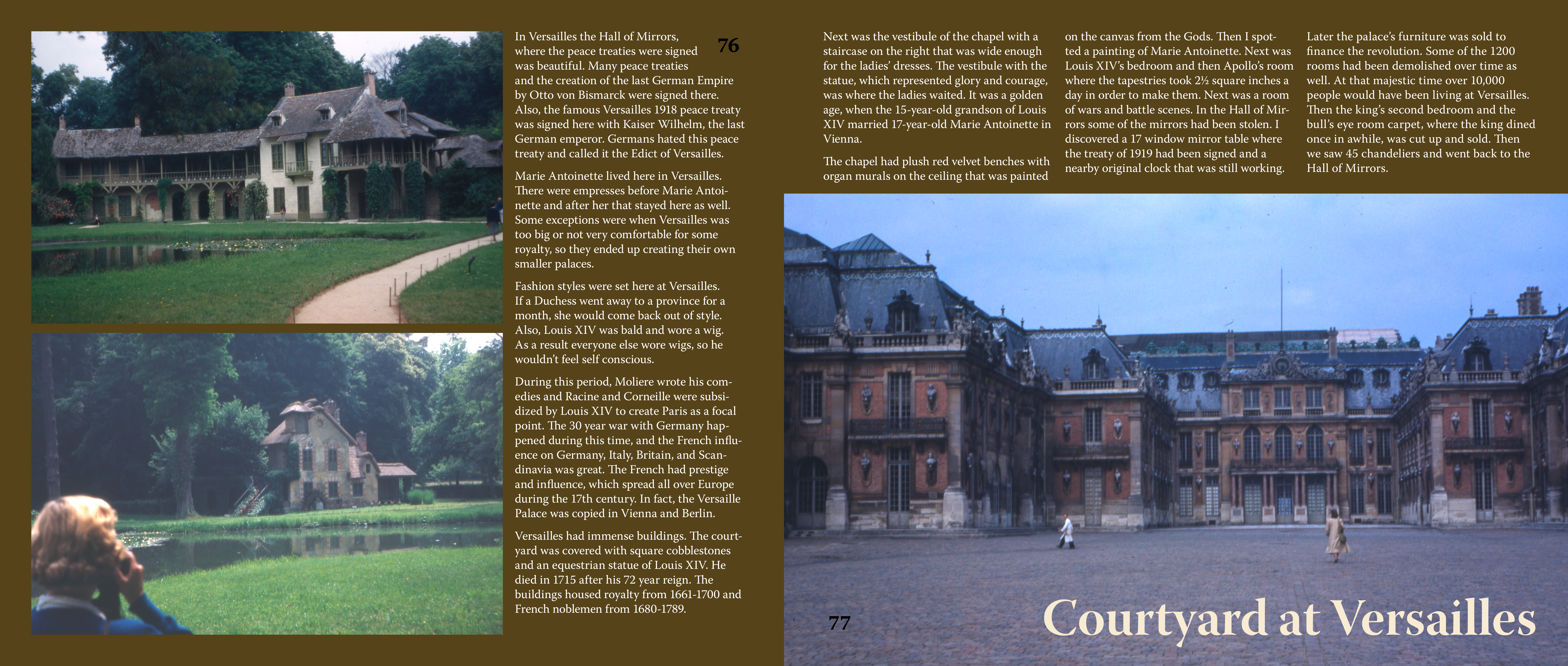
In Versailles the Hall of Mirrors, where the peace treaties were signed was beautiful. Many peace treaties and the creation of the last German Empire by Otto von Bismarck were signed there. Also, the famous Versailles 1918 peace treaty was signed here with Kaiser Wilhelm, the last German emperor. Germans hated this peace treaty and called it the Edict of Versailles.

Marie Antoinette lived here in Versailles. There were empresses before Marie Antoinette and after her that stayed here as well. Some exceptions were when Versailles was too big or not very comfortable for some royalty, so they ended up creating their own smaller palaces.

Fashion styles were set here at Versailles. If a Duchess went away to a province for a month, she would come back out of style. Also, Louis XIV was bald and wore a wig. As a result everyone else wore wigs, so he wouldn’t feel self conscious.

During this period, Moliere wrote his comedies and Racine and Corneille were subsidized by Louis XIV to create Paris as a focal point. The 30 year war with Germany happened during this time, and the French influence on Germany, Italy, Britain, and Scandinavia was great. The French had prestige and influence, which spread all over Europe during the 17th century. In fact, the Versaille Palace was copied in Vienna and Berlin.

Versailles had immense buildings. The courtyard was covered with square cobblestones and an equestrian statue of Louis XIV. He died in 1715 after his 72 year reign. The buildings housed royalty from 1661-1700 and French noblemen from 1680-1789.

Next was the vestibule of the chapel with a staircase on the right that was wide enough for the ladies’ dresses. The vestibule with the statue, which represented glory and courage, was where the ladies waited. It was a golden age, when the 15-year-old grandson of Louis XIV married 17-year-old Marie Antoinette in Vienna.

The chapel had plush red velvet benches with organ murals on the ceiling that was painted on the canvas from the Gods. Then I spotted a painting of Marie Antoinette. Next was Louis XIV’s bedroom and then Apollo’s room where the tapestries took 2½ square inches a day in order to make them. Next was a room of wars and battle scenes. In the Hall of Mirrors some of the mirrors had been stolen. I discovered a 17 window mirror table where the treaty of 1919 had been signed and a nearby original clock that was still working.

Later the palace’s furniture was sold to finance the revolution. Some of the 1200 rooms had been demolished over time as well. At that majestic time over 10,000 people would have been living at Versailles. Then the king’s second bedroom and the bull’s eye room carpet, where the king dined once in awhile, was cut up and sold. Then we saw 45 chandeliers and went back to the Hall of Mirrors.

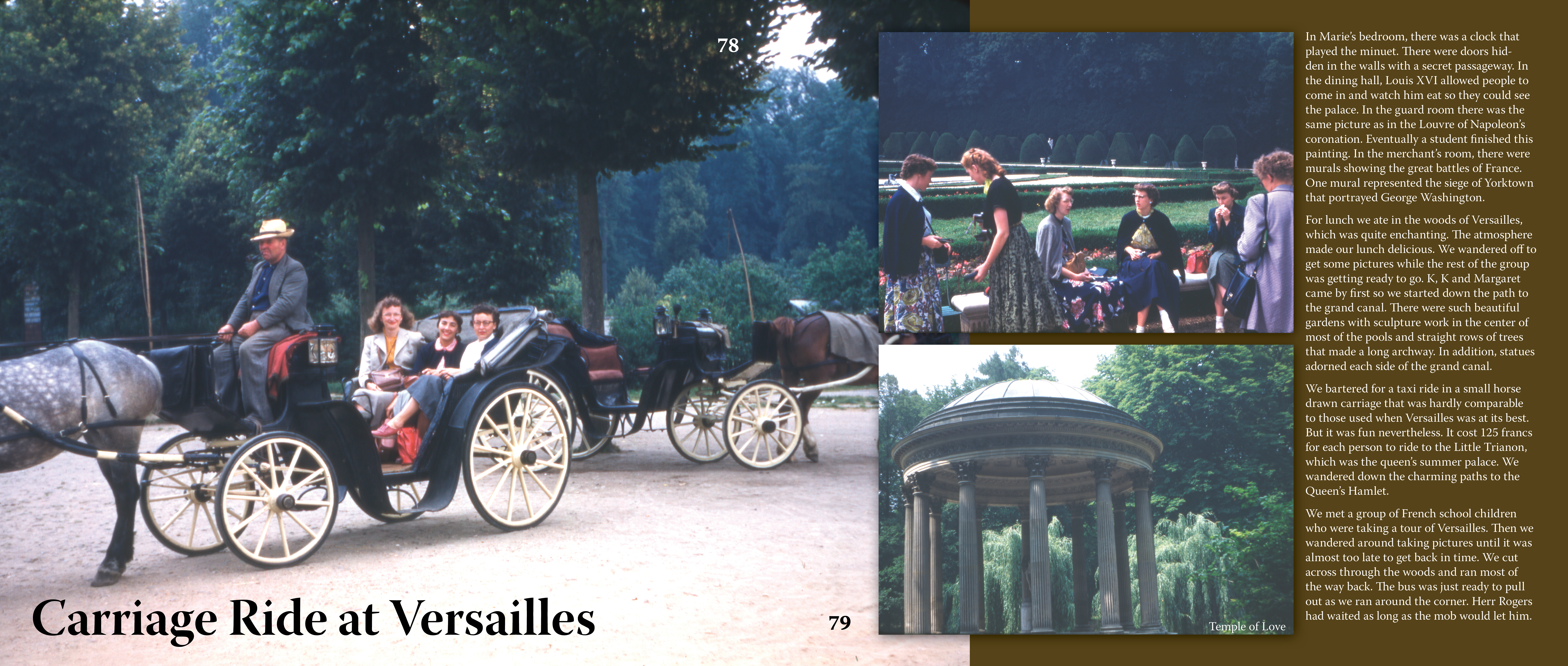
In Marie’s bedroom, there was a clock that played the minuet. There were doors hidden in the walls with a secret passageway. In the dining hall, Louis XVI allowed people to come in and watch him eat so they could see the palace. In the guard room there was the same picture as in the Louvre of Napoleon’s coronation. Eventually a student finished this painting. In the merchant’s room, there were murals showing the great battles of France. One mural represented the siege of Yorktown that portrayed George Washington.

For lunch we ate in the woods of Versailles, which was quite enchanting. The atmosphere made our lunch delicious. We wandered off to get some pictures while the rest of the group was getting ready to go. K, K and Margaret came by first so we started down the path to the grand canal. There were such beautiful gardens with sculpture work in the center of most of the pools and straight rows of trees that made a long archway. In addition, statues adorned each side of the grand canal.

We bartered for a taxi ride in a small horse drawn carriage that was hardly comparable to those used when Versailles was at its best. But it was fun nevertheless. It cost 125 francs for each person to ride to the Little Trianon, which was the queen’s summer palace. We wandered down the charming paths to the Queen’s Hamlet.

We met a group of French school children who were taking a tour of Versailles. Then we wandered around taking pictures until it was almost too late to get back in time. We cut across through the woods and ran most of the way back. The bus was just ready to pull out as we ran around the corner. Herr Rogers had waited as long as the mob would let him.

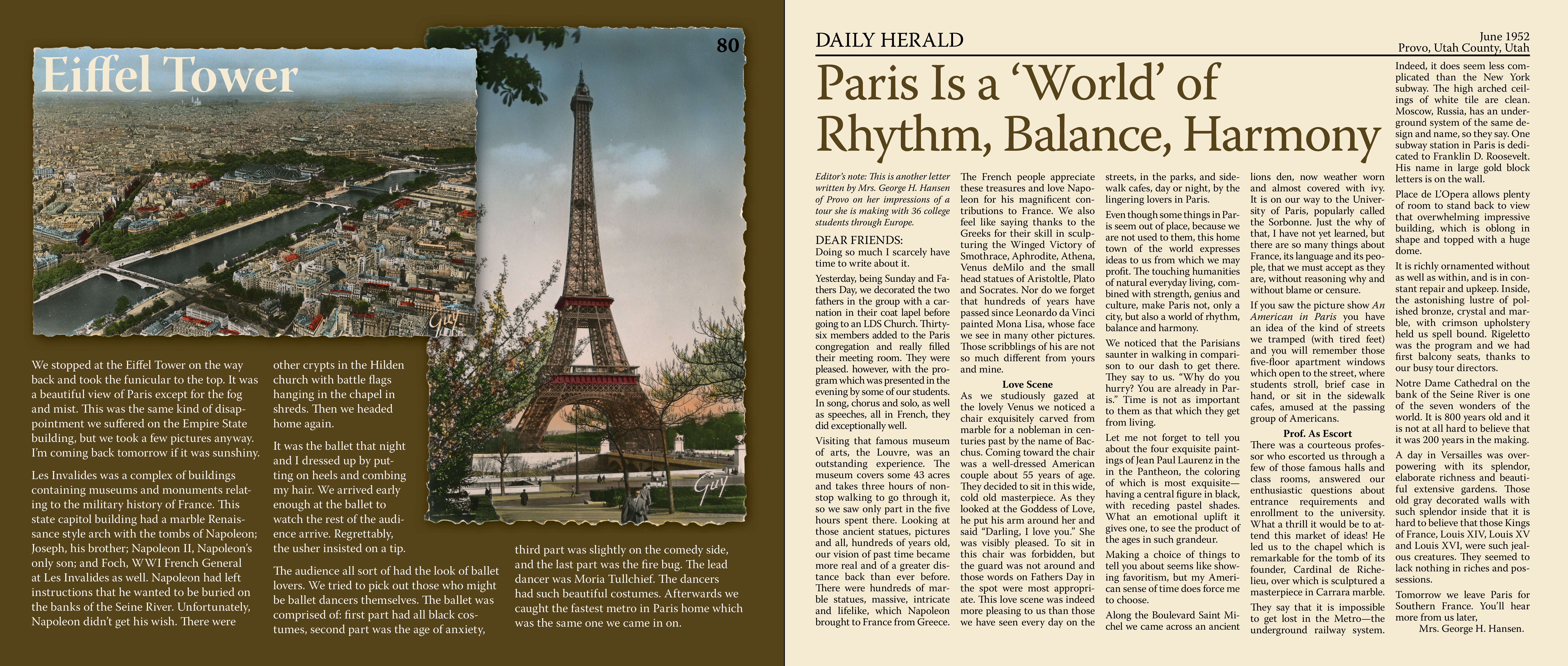
We stopped at the Eiffel Tower on the way back and took the funicular to the top. It was a beautiful view of Paris except for the fog and mist. This was the same kind of disappointment we suffered on the Empire State building, but we took a few pictures anyway. I’m coming back tomorrow if it was sunshiny.

Les Invalides was a complex of buildings containing museums and monuments relating to the military history of France. This state capitol building had a marble Renaissance style arch with the tombs of Napoleon; Joseph, his brother; Napoleon II, Napoleon’s only son; and Foch, WWI French General at Les Invalides as well. Napoleon had left instructions that he wanted to be buried on the banks of the Seine River. Unfortunately, Napoleon didn’t get his wish. There were other crypts in the Hilden church with battle flags hanging in the chapel in shreds. Then we headed home again.

It was the ballet that night and I dressed up by putting on heels and combing my hair. We arrived early enough at the ballet to watch the rest of the audience arrive. Regrettably, the usher insisted on a tip.

The audience all sort of had the look of ballet lovers. We tried to pick out those who might be ballet dancers themselves. The ballet was comprised of: first part had all black costumes, second part was the age of anxiety, third part was slightly on the comedy side, and the last part was the fire bug. The lead dancer was Moria Tullchief. The dancers had such beautiful costumes. Afterwards we caught the fastest metro in Paris home which was the same one we came in on.

Paris Is a ‘World’ of Rhythm, Balance, Harmony

Editor’s note: This is another letter written by Mrs. George H. Hansen of Provo on her impressions of a tour she is making with 36 college students through Europe.

Dear Friends:
Doing so much I scarcely have time to write about it.

Yesterday, being Sunday and Fathers Day, we decorated the two fathers in the group with a carnation in their coat lapel before going to an LDS Church. Thirty-six members added to the Paris congregation and really filled their meeting room. They were pleased. however, with the program which was presented in the evening by some of our students. In song, chorus and solo, as well as speeches, all in French, they did exceptionally well.

Visiting that famous museum of arts, the Louvre, was an outstanding experience. The museum covers some 43 acres and takes three hours of non-stop walking to go through it, so we saw only part in the five hours spent there. Looking at those ancient statues, pictures and all, hundreds of years old, our vision of past time became more real and of a greater distance back than ever before. There were hundreds of marble statues, massive, intricate and lifelike, which Napoleon brought to France from Greece. The French people appreciate these treasures and love Napoleon for his magnificent contributions to France. We also feel like saying thanks to the Greeks for their skill in sculpturing the Winged Victory of Smothrace, Aphrodite, Athena, Venus deMilo and the small head statues of Aristoltle, Plato and Socrates. Nor do we forget that hundreds of years have passed since Leonardo da Vinci painted Mona Lisa, whose face we see in many other pictures. Those scribblings of his are not so much different from yours and mine.

Love Scene
As we studiously gazed at the lovely Venus we noticed a chair exquisitely carved from marble for a nobleman in centuries past by the name of Bacchus. Coming toward the chair was a well-dressed American couple about 55 years of age. They decided to sit in this wide, cold old masterpiece. As they looked at the Goddess of Love, he put his arm around her and said “Darling, I love you.” She was visibly pleased. To sit in this chair was forbidden, but the guard was not around and those words on Fathers Day in the spot were most appropriate. This love scene was indeed more pleasing to us than those we have seen every day on the streets, in the parks, and sidewalk cafes, day or night, by the lingering lovers in Paris.

Even though some things in Paris seem out of place, because we are not used to them, this home town of the world expresses ideas to us from which we may profit. The touching humanities of natural everyday living, combined with strength, genius and culture, make Paris not, only a city, but also a world of rhythm, balance and harmony.

We noticed that the Parisians saunter in walking in comparison to our dash to get there. They say to us. “Why do you hurry? You are already in Paris.” Time is not as important to them as that which they get from living.

Let me not forget to tell you about the four exquisite paintings of Jean Paul Laurenz in the in the Pantheon, the coloring of which is most exquisite—having a central figure in black, with receding pastel shades. What an emotional uplift it gives one, to see the product of the ages in such grandeur.

Making a choice of things to tell you about seems like showing favoritism, but my American sense of time does force me to choose.

Along the Boulevard Saint Michel we came across an ancient lions den, now weather worn and almost covered with ivy. It is on our way to the University of Paris, popularly called the Sorbonne. Just the why of that, I have not yet learned, but there are so many things about France, its language and its people, that we must accept as they are, without reasoning why and without blame or censure.

If you saw the picture show An American in Paris you have an idea of the kind of streets we tramped (with tired feet) and you will remember those five-floor apartment windows which open to the street, where students stroll, brief case in hand, or sit in the sidewalk cafes, amused at the passing group of Americans.

Prof. As Escort
There was a courteous professor who escorted us through a few of those famous halls and class rooms, answered our enthusiastic questions about entrance requirements and enrollment to the university. What a thrill it would be to attend this market of ideas! He led us to the chapel which is remarkable for the tomb of its founder, Cardinal de Richelieu, over which is sculptured a masterpiece in Carrara marble.

They say that it is impossible to get lost in the Metro—the underground railway system. Indeed, it does seem less complicated than the New York subway. The high arched ceilings of white tile are clean. Moscow, Russia, has an underground system of the same design and name, so they say. One subway station in Paris is dedicated to Franklin D. Roosevelt. His name in large gold block letters is on the wall.

Place de L’Opera allows plenty of room to stand back to view that overwhelming impressive building, which is oblong in shape and topped with a huge dome.

It is richly ornamented without as well as within, and is in constant repair and upkeep. Inside, the astonishing lustre of polished bronze, crystal and marble, with crimson upholstery held us spell bound. Rigeletto was the program and we had first balcony seats, thanks to our busy tour directors.

Notre Dame Cathedral on the bank of the Seine River is one of the seven wonders of the world. It is 800 years old and it is not at all hard to believe that it was 200 years in the making.

A day in Versailles was overpowering with its splendor, elaborate richness and beautiful extensive gardens. Those old gray decorated walls with such splendor inside that it is hard to believe that those Kings of France, Louis XIV, Louis XV and Louis XVI, were such jealous creatures. They seemed to lack nothing in riches and possessions.

Tomorrow we leave Paris for Southern France. You’ll hear more from us later,
Mrs. George H. Hansen.

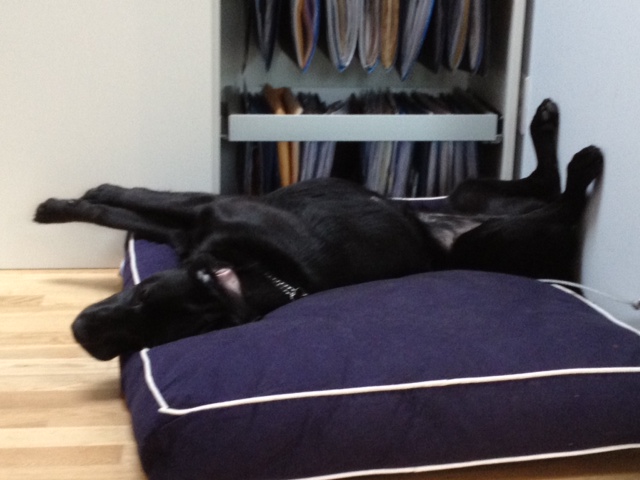
Update on Casey

Casey asleep on her new pillow

Casey is getting all settled into her new home as you can see from the photo above. I got an e-mail from Carrie earlier this week and here is some of what she said.

We have settled in nicely. Our plane trip home went smoothly. I even had to wake her up after the landing both times because she was sawing it off! I had a job interview first thing Monday morning, and she helped me win over the employer as I got the job (just a small part-time contract). She did great on our first day at the office last Thursday.

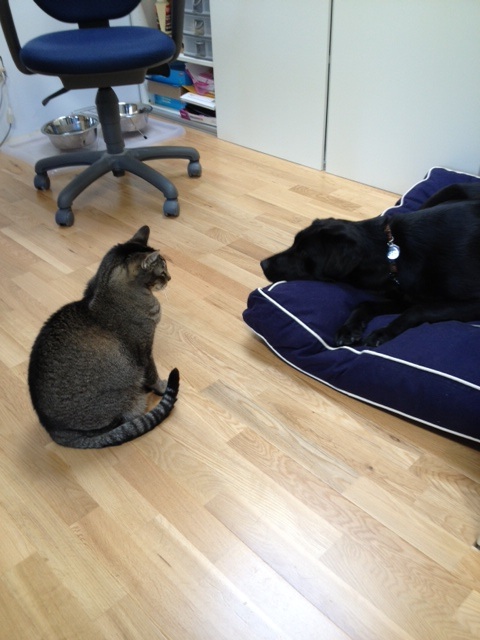
We are working on the cat-dog relations slowly but Sammy is coming around. Casey keeps showing Sammy how cute and playful she is but he is not quite convinced yet. We have done several long walks around my neighborhood towards the ocean and back. We’ve also gone to the pool where I swim 3 x per week and she was great on the pool deck. There are LOTS of dog distractions in my area – it is a very popular dog walking region, so we are working on that, plus trying to educate dog owners to keep moving past us as we don’t want to do the meet and greet while she’s working….

I gave her a day off today as it’s been a long week. We’re back at it this week with several appointments, bus rides, a trip to the vet to weigh her, etc. While I’m still tired and figuring out the routine, I am so thrilled to have her in my life – it is a huge difference, and I get so many smiles from the public!

Casey making friends with Sammy

It makes my day when ever I get e-mail from one of our pups and with photos it is even better. I’m so happy with the wonderful handlers for each of our first three pups.

60 Years Ago Today

Sunday, 15 June 1952:

Since we stopped to get carnations for Dr. Rogers and Dr. Watkins for Father’s Day, we were late for Sunday School at the French Branch. At the meeting a convert was confirmed and we sang Prenez Courage. Later an English class was held where President Woolf welcomed us and told us a little about the history of the middle area of France, Joan of Arc, and Napoleon. President and Mrs. Taylor were introduced and released from another mission.

After church we gabbed with President Woolf, members, and some missionaries, Davis Bitton, Louis Cardon, and Harriet Robinson. President Woolf recommended a little restaurant Caveau and it turned out to be our best meal since arriving in Paree. The meal consisted of hors d’oeuvres, ham, spinach, and strawberries for 475 francs which included the tip.

An English lady gave us a little assistance in ordering because the waiters did not speak English, and we had some difficulty reading the menu. She and her companions, another English lady and a Frenchman, were interesting to talk to. We told them our story and they informed us of theirs.
At 2:30 p.m. we arrived at the Louvre and bumped into part of the mob with Herr Watkins and Rogers. We paid 50 francs to take our cameras inside. Then I snapped two pictures of the original Venus de Milo. And I examined busts of Roman Emperors, fragments from the Temple of Zeus, paintings, and frescoes. There was an original winged victory statue La Victoire de Samothrace, statue of Botticelli—a painter of the Florntine school, Fra Angelico, famous early Florentine painter, and painting of Jesus of Nazareth in The Crucifixion. Titien, 1488-1576, who was one of the most successful painters who ever lived, displayed a painting. The Veronese Wedding of Cana had 120 figures with barely two figures that were not larger than life. Other paintings included Mary Magdalene washing Christ’s feet in the house of Simon, statue Jupiter of Versailles and painting Mona Lisa by Leonardo da Vinci. We needed to spend more time in the Louvre. There was so much to see, and it was all so magnificent.

We started back to the hotel, but about faced into the Regent Hotel. Instead of going back to our hotel, we wrote letters in the beautiful Regent Hotel lounge until church. After writing we ate lunch and stopped for delicious French pastries at the shop near the church. And we bought bread for sandwiches for tomorrow.

At church we joined in on choir practice and gave most of the church program which included: a talk by Dr. Rogers, a quartet in French by Kay, Marilyn, Pat and Alicia, a talk by Dr. Watkins, a song by Mrs. Rogers in French, some chorus songs You’ll Never Walk Alone and America, and a farewell speech by Bob Mercer. Afterwards we chatted with the members of the church.

Then Carol, Alene, Irene, Hermine, Joyce and I ventured off to the Eiffel Tower. We viewed the outside of the Palais de Chaillot while the fountains were lit up. Alene and I went to the first story of the tower and met Puerto Ricans, Zachary Scott and his friends, just coming down. The Arc de Triomphe and Sacre Coeur were all lit up as well. The Seine River and lights of the city were just beautiful. We walked on the lawn and took the metro back to the hotel through the Franklin D. Roosevelt station again.

60 Years Ago Today

Saturday, 14 June 1952:

At 7:45 a.m. Alicia and I ate breakfast which consisted of oranges and apples. Next was a meeting about opera tickets. As we left the Republique Hotel, we saw women riding bikes with their dresses billowing in the wind.

At 10 a.m. we departed to the Hotel de Ville, a Renaissance municipal building, where the affairs of the city were carried on. This building and the opera were the most sumptuous buildings. Under the clock on the Hotel de Ville were the words liberty, equality and fraternity where there were hundreds of pigeons residing. There were flags flying there for a military organization ceremony centennial celebration (Official Leguard Republique de Ville military reception).

Next we headed to Notre Dame on Island Ile de la Cite. We saw the statue of Voltaire and crossed the Seine River to the Hotel Dieu, which was the oldest hospital dating back to 500 a.d. Then I observed a small shop with china which was stacked up really high as we arrived at Notre Dame. It was one of the oldest Gothic cathedrals in France and was built between 1163 and 1240 on Ile de la Cite. No other building in Paris was more worthy of a visitor’s attention.

At Notre Dame the street level came up 13 steps where St. Denis was holding his head that was chopped off. There was exquisite iron work on the doors and under the balustrade was the king’s row that had 28 statues representing the 28 kings of France. It started as a Romanesque church which transitioned into the mother of all Gothic architecture in France and Europe. All distances in France were measured from the front of Notre Dame. It was in construction so long, they lost the plans.

In addition, it was supposed to have had two big spires on the top. The left portal pointed above and the right portal did not. And there was a big rose window in the center with recessed portals in front. Hugo’s Hunchback of Notre Dame was supposed to have gone along the top to ring the bell.
Notre Dame was over 800 years old and inside Notre Dame, I couldn’t see any gold. I learned there was no gold with Gothic—that was Byzantine. But there were huge massive pillars, bundled columns, and Corinthian capitol decorations that adorned the building. The stained glass windows had rather subdued colors except for the big windows at the front sides and high up.
Some church workers wore Napoleon looking costumes as I viewed the vaulted ceilings and Joan of Arc statue. We paid 50 francs to go up and see the gargoyles. I noticed the spiral staircase, peep holes and big Notre Dame bell which weighed 13,000 tons. The bell could be heard for ten kilometers on holidays and national events. At the end of the tour everyone gave tips to the guide. I had to go back to tip the guide because I hadn’t tipped him yet.

In April 1682 Louis 14th and Queen Mary had been christened father and godmother of the Notre Dame bell. It had such a beautiful sound with the bell tower measuring two meters by six hundred meters high. In order to ring the bell it took 500 kilograms of power or a total of eight men to swing the bell with four men on each paddle. There were oak timber works to support the bell and its name was Emanuel. This was the second largest bell of Paree after the largest bell at Sacre Coeur Basilica at 17 tons. Then I had someone snap a picture of a gargoyle and me.

There was a spiral staircase, funeral hearse, and flowers on the outside of the oldest royal palace. I caught sight of a streetside john and the police department. Next we visited the Coeur de la Ste Chapelle. It was one of the smallest cathedrals in France and one of the best examples of Gothic architecture, 1200-1450 a.d. The cathedral was high reaching in order to get closer to God. It was on the grounds of the Palais de Justice where Marie Antoinette was tried and imprisoned.

Outside there was iron work on the apartment buildings and accessible Latin Quarter with its attic apartments. Then I experienced the famous Boulevard St. Germain with all of its stores, ancient forum, lions den, and Cluny Museum. We passed a French lady that was on the street knitting and selling papers.

After taking a picture of the chapel where the musicians were performing in the streets, we visited the Sorbonne University where Hugh Law went to school. Next we toured Lycee Saint Louis, an ancient college, with its library, Bibliotheque de Universitie, and round amphitheater lecture rooms. In these amphitheater rooms doctors’ five hour examinations were held where the public was invited to attend. And these rooms were used to teach French to foreigners of all ages and where students worked on their master’s degrees.

There was a beautiful painting above the lecturer’s desk with accompanying plaques presenting the faculty of the school. Other paintings included Corneille, Moliere, Pascal, Bossiret, Descartes, Racine, and Cardinal Richlieu. There were paintings on the ceiling, beautiful gold work around the pictures, and gold velvet on the doors. As I looked around at the paintings, I was distracted by a one armed man who came in. Focusing back at the art, I looked at statues of Victor Hugo and Pasteur.

With repairs being made to the front of the church of Sorbonne, the inside of the church had the original organ at the back of the chapel. The tomb of Richlieu, cardinal of France, was buried there along with his whole family and had marvelous carved details on his statue—folds, lace, wrinkles in hands—by sculpture Girardon. In 1694 it was made out of one block of marble and his hat hung above his statue. Also, a mural of Richlieu in a gold robe was three centuries old. At the end there was a statue, sculpture of bronze, of Cardinal Richlieu on his death chair by LeFavre in 1642. He died while writing with his eyes open at age 57.

The courtyard had lines drawn representing the original Sorbonne. There were exams going on so we couldn’t go into the library. Then I discovered the murals of middle ages characters and talked to a student about Latin and Greek languages. Herr Watkins had attended this school for about two years.

A student showed us around and helped us find a restaurant and pastry shop. At the restaurant the waiter accidentally spilled water on my skirt. The man was in a tizzy, because all of us didn’t want full dinners. I could hardly wait to see what the soup looked like. My second thought was I wish I hadn’t ordered the soup. In fact, I certainly was not hungry when I saw the soup—it looked disgusting. I ate all my pastries instead and I could see I was going to starve to death in France.

We visited the Pantheon, a Romanesque architecture, which included the tombs of famous Frenchmen. The inscription above the entrance read Aux Grands Hommes La Patrie Reconnaissante. It means to great men the grateful homeland. We walked around the Pantheon that was built over the tomb of St. Genevieve. We saw the tombs of Voltaire, Hugo, Rousseau, and a monument to unknown heroes. There was a list of battles with murals of Vow of Clovis at the Battle of Tolbiac and St. Genevieve. There were more murals: Joan de Arc, St. Genevieve giving Parisians confidence as the Attilons or Huns approached Paris, barbarians coming into Paris, and Le Martyre de Saint Denis.

We continued sightseeing with the Palace of Luxembourg, gardens, and Senate building. We met up with Eloise and Ginny as we walked past the Saint Sulpice Church and Abbey of St.-Germain-des-Pres. We asked a man “ou est la metro?” as we struggled with our French until he asked us if we spoke German or English. Speaking in English he gave us directions.

A couple of blocks farther on we stopped a young lady and asked “ou est la metro?” She bettered him by personally showing us to a bus stop and telling us how to take the auto bus directly to the Louvre. She informed us that the bus costs 5 francs cheaper than the metro.

Then a nice lady sat by me on the bus and showed us where to get off. I had a little trouble finding the entrance across from the Lafayette statue which was erected by U.S. school children in memory of Lafayette, a French general. We only had a half hour at the Louvre before it closed at 5 p.m. Then we transferred to another metro in order to return to the hotel to get ready for the opera. Montie Woolley showed us the way.

We were late for the reception at the LDS branch before the opera, because we couldn’t locate the address. It ended up being upstairs and we only had thirty minutes left for the reception. We sang a French song and introduced ourselves. They gave us lollipops afterwards and we sucked the lollipops as we charged down the street in our heels. The French people stared at us anyway, so one can imagine what a show that was!

The L’ Opera Building, which was built in 1669, had chandeliers of glass and gold. As we climbed up several flights of stairs at the opera the lady would not allow us into our box without a tip. She wanted 100 francs from each of us, but she settled for 100 from the five of us: Hermine, Bonnie, Alene, Lucy and me.

We sat behind a pillar, kinda sorta, and the first act had already started. Eloise finally arrived several minutes later with the news that Alice didn’t have her ticket and that the usher had kept her 1000 franc note. We tried to locate Dr. Rogers, but we had no luck.

Then we left in order to attempt to recover her change. Yea! We retrieved her money back successfully. However, we had not found Dr. Rogers. But at the end of the first act we found Dr. Rogers and there were no more tickets available. And to top it off Alice was gone and heavens knows where!

We hurried back for the second act. The box next door was empty so Eloise and I climbed over to the next box just as the lights went out. At the end of the act, I borrowed some money from Alene to go and phone the hotel to check on Alice.

Before I got to the door, the usher came bursting in talking sixty miles an hour in an excited voice. We had a stinking suspicion that the characters next door had been tattling on us. We acted dumb and walked out running headlong into Alice.

Miracle of all miracles! When hearing her story, they let her in for nothing. She had been sitting with some English people in a box right next to the stage. So Eloise, Alice and I hurry back over to her box for the next act.

It was interesting to watch the orchestra and actors at close range. We found the bar between the next act and quenched our thirst with an orange drink. We scrambled back to box 24, our original box, for the last act.

The staging of Rigoletto was superb. The set was three dimensional and in the last act there were moving clouds and storms. Rigoletto was a romantic opera with love, vengeance, and tragedy. At the end there were only two curtain calls.

The opera house was elaborate with ornate gold work, glass and gold chandeliers, murals on the ceiling, and marble stairs. There was a predominance of Americans in attendance. Afterwards, we met a tennis player from the ship and went to an American restaurant, Pam Pam, across the street. We sat at sidewalk tables which were near a colored boy and several interesting California couples, who both were staying at the Grand Hotel.

As we compared notes, the conversation was fascinating about our trip and theirs. They came on Ille de France which was leaving Le Havre harbor as we were coming in on the Sibijak. Then I ordered a bacon tomato sandwich with cheese to go, for lunch tomorrow, you know.

60 Years Ago Today

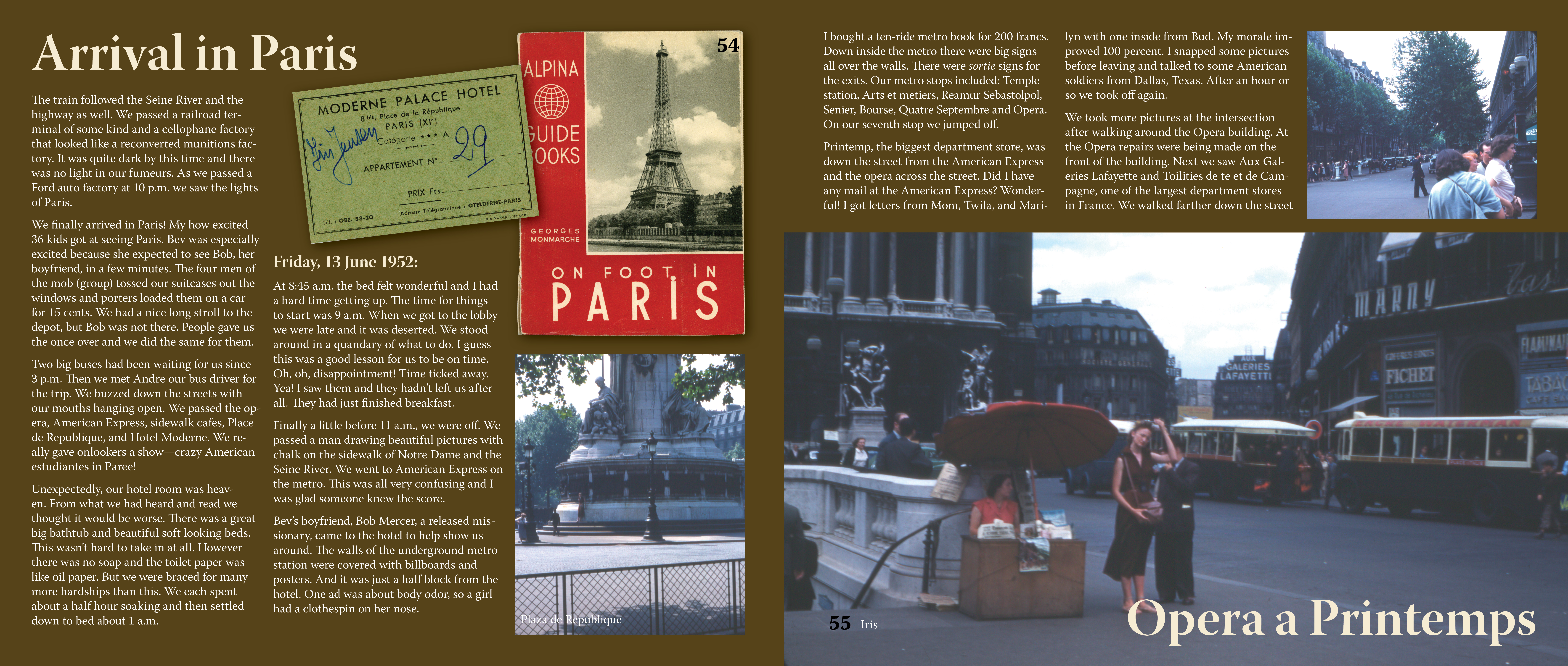
Friday, 13 June 1952:

At 8:45 a.m. the bed felt wonderful and I had a hard time getting up. The time for things to start was 9 a.m. When we got to the lobby we were late and it was deserted. We stood around in a quandary of what to do. I guess this was a good lesson for us to be on time. Oh, oh, disappointment! Time ticked away. Yea! I saw them and they hadn’t left us after all. They had j­­­­­­­­­­ust finished breakfast.

Finally a little before 11 a.m., we were off. We passed a man drawing beautiful pictures with chalk on the sidewalk of Notre Dame and the Seine River. We went to American Express on the metro. This was all very confusing and I was glad someone knew the score.

Bev’s boyfriend, Bob Mercer, a released missionary, came to the hotel to help show us around. The walls of the underground metro station were covered with billboards and posters. And it was just a half block from the hotel. One ad was about body odor, so a girl had a clothespin on her nose.

I bought a ten-ride metro book for 200 francs. Down inside the metro there were big signs all over the walls. There were sortie signs for the exits. Our metro stops included: Temple station, Arts et metiers, Reamur Sebastolpol, Senier, Bourse, Quatre Septembre and Opera. On our seventh stop we jumped off.

Printemp, the biggest department store, was down the street from the American Express and the opera across the street. Did I have any mail at the American Express? Wonderful! I got letters from Mom, Twila, and Marilyn with one inside from Bud. My morale improved 100 percent. I snapped some pictures before leaving and talked to some American soldiers from Dallas, Texas. After an hour or so we took off again.

We took more pictures at the intersection after walking around the Opera building. At the Opera repairs were being made on the front of the building. Next we saw Aux Galeries Lafayette and Toilities de te et de Campagne, one of the largest department stores in France. We walked farther down the street to the Place Vendome. Napoleon’s statue had such beautiful carvings and the leaves represented his victories. The French took the statue down when Napoleon fell at Waterloo. Napoleon’s nephew, Napoleon III, put it back by melting down a canon to rebuild the monument. The clouds made the statue seem like it was moving.

Then we went to Jardin des Tuileries, one of Paris’s most visited gardens. Eloise said they were going to use my yellow ribbon, which I lost there, for a landmark. While there Dr. Rogers was accosted by a man with pictures of nudes.

The next stops were the Place de la Concorde, Arch de Triomphe du Ca, and du Louvre that had beautiful iron work and elaborate carvings.

Afterwards we went to the restaurant, E. Robert and H. Bogey. It was cheap, just 148 francs, but ugh! We wandered in du Louvre while waiting for the mob. It seemed we needed to start moving faster. Paree might wait for us, but our time wasn’t going to wait for us ever. And we only had five days in Paris. Distracted I looked around and spotted a beautiful plaid silk organza dress for 24,000 francs.

Finally, we were off again. There were not many new cars in Paris and trinkets and tourist items were everywhere in the store windows. Hotel Maurice was probably like a hotel in Mexico no doubt. The mob was strung out the length of a block and we ended up at some kind of shop Bob Mercer had guided us to. The lady supposedly gave us a bargain.

Then we proceeded to go across Tuileries to Place de la Concorde and the American Embassy. This area was considered the wealthiest area of Paris. We found a statue placed where Marie Antoinette was killed by guillotine and her blood flowed in the streets in 1793.

Next on our tour was the Avenue des Champs Elysses which was built for Napoleon’s march of victory. Strangely no one sits on the grass in the beautiful parks here. Then I spotted small kids who were riding donkeys in the park along Champs Elysses.

There were sidewalk cafes and pigeons on the gravel along the sidewalk. I couldn’t really tell which was the street or sidewalk. The cars came right up on what I thought was the sidewalk. Later we passed a store for tall femmes and fat femmes. At a sidewalk cafe we stopped and had orange mineral water (looked like lemon). I took a picture of the Arc de Triomphe with traffic buzzing by on both sides. Then we saw the flame burning on the tomb of the unknown soldier.

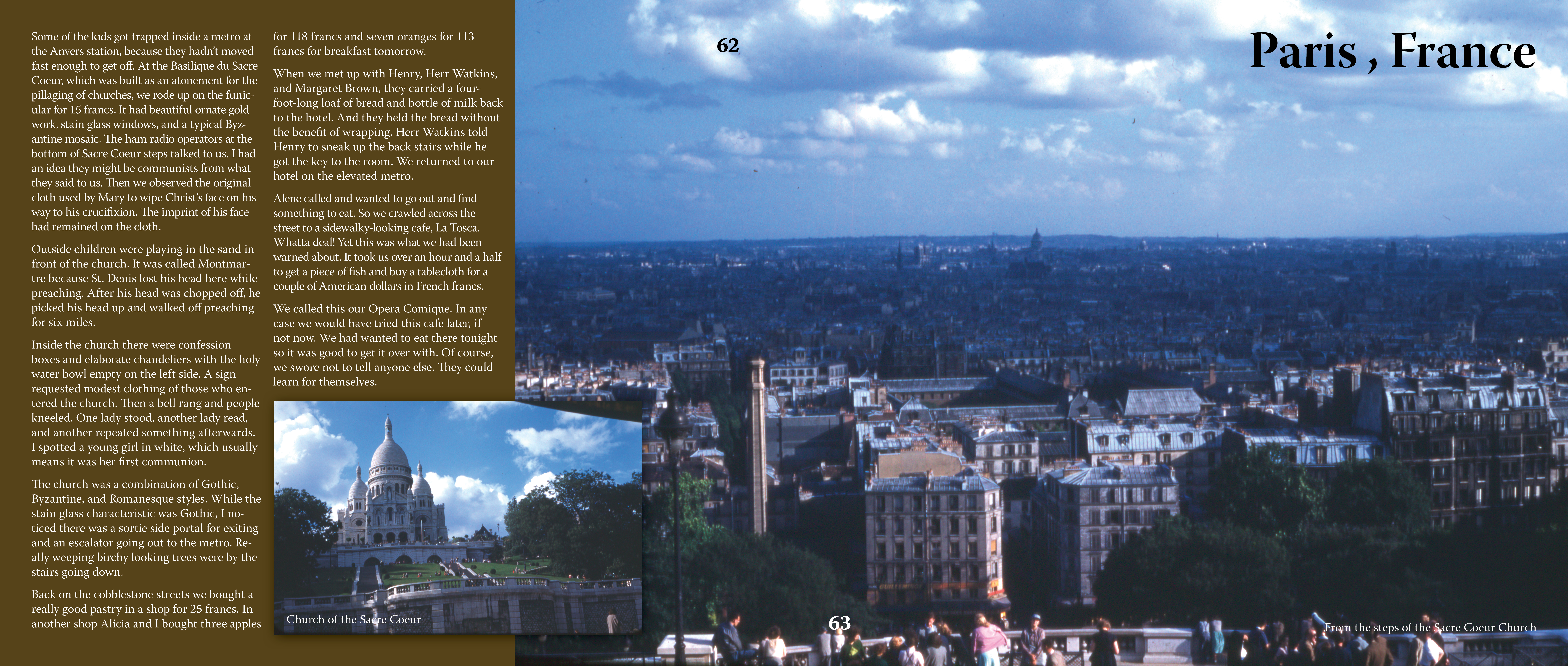
Some of the kids got trapped inside a metro at the Anvers station, because they hadn’t moved fast enough to get off. At the Basilique du Sacre Coeur, which was built as an atonement for the pillaging of churches, we rode up on the funicular for 15 francs. It had beautiful ornate gold work, stain glass windows, and a typical Byzantine mosaic. The ham radio operators at the bottom of Sacre Coeur steps talked to us. I had an idea they might be communists from what they said to us. Then we observed the original cloth used by Mary to wipe Christ’s face on his way to his crucifixion. The imprint of his face had remained on the cloth.

Outside children were playing in the sand in front of the church. It was called Montmartre because St. Denis lost his head here while preaching. After his head was chopped off, he picked his head up and walked off preaching for six miles.

Inside the church­­­­ there were confession boxes and elaborate chandeliers with the holy water bowl empty on the left side. A sign requested modest clothing of those who entered the church. Then a bell rang and people kneeled. One lady stood, another lady read, and another repeated something afterwards. I spotted a young girl in white, which usually means it was her first communion.

The church was a combination of Gothic, Byzantine, and Romanesque styles. While the stain glass characteristic was Gothic, I noticed there was a sortie side portal for exiting and an escalator going out to the metro. Really weeping birchy looking trees were by the stairs going down.
Back on the cobblestone streets we bought a really good pastry in a shop for 25 francs. In another shop Alicia and I bought three apples for 118 francs and seven oranges for 113 francs for breakfast tomorrow.

When we met up with Henry, Herr Watkins, and Margaret Brown, they carried a four-foot-long loaf of bread and bottle of milk back to the hotel. And they held the bread without the benefit of wrapping. Herr Watkins told Henry to sneak up the back stairs while he got the key to the room. We returned to our hotel on the elevated metro.

Alene called and wanted to go out and find something to eat. So we crawled across the street to a sidewalky-looking cafe, La Tosca. Whatta deal! Yet this was what we had been warned about. It took us over an hour and a half to get a piece of fish and buy a tablecloth for a couple of American dollars in French francs.

We called this our Opera Comique. In any case we would have tried this cafe later, if not now. We had wanted to eat there tonight so it was good to get it over with. Of course, we swore not to tell anyone else. They could learn for themselves.

The $64 question was who was St. Raphael Quinquina? St. Raphael was one of the seven archangels who performed all manners of healing. Also St. Raphael Quinquina had an alcoholic drink named in his honor.