60 Years Ago Today

Tuesday. 19 August 1952:

It was gray and drippy as we left for Belgium the next morning. We traveled through the Holland Tunnel again, along a large dyke, and by a 21 Windmill section. All of us ate Dr. Rogers’ apples as we crossed the Rhine again and the North Sea Dykes.

We reached the Belgium border around 2 p.m. There was a beautiful tree-lined road with big houses and thatched roofs. Later on there were lovely fields of begonias. We drove into a Flemish speaking section of Antwerpen where there were narrow buildings and a big opera house with a Rococo decorated arch. Then we got to see the Royal Palace grounds with guards all around it.

Next we continued driving to Brussels, which was two hours from Antwerp, where we were to present a program for LDS members at 8 p.m. However, I had a sore throat and wasn’t feeling too hot, so I decided to goof off. So instead of doing the program, I enjoyed a nice rest in the hotel room.

50 for 50 #33 – Swiss Chocolate

Lindt milk chocolate

This week, to celebrate turning 50 years old this year, I decided to eat some Swiss chocolate. I picked up a bar of Lindt classic milk chocolate from the grocery store. The package stated that it was actually made in New Hampshire but that the quality was guaranteed by Lindt & Sprungli of Switzerland. So it wasn’t actually Swiss chocolate but it was still yummy.

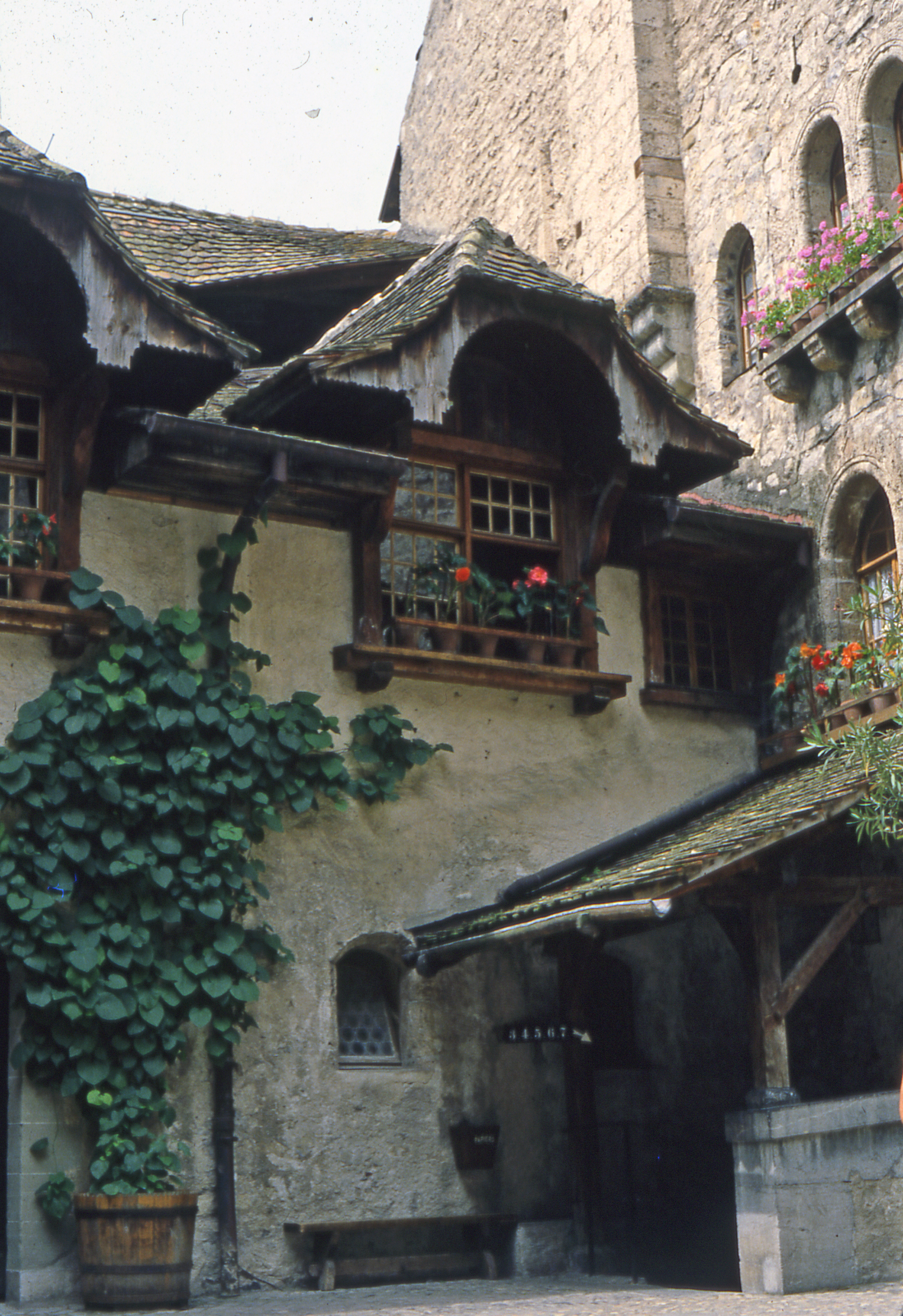
Almost 30 years ago, while I was playing volleyball at BYU, we took a month-long trip to Europe. One of the stops on our tour was Switzerland. I remember seeing the Chateau de Chillon with its stone walls by the lake, Bern and the LDS temple there, and finally the beauty and quiet of Interlaken. I’d love to visit Switzerland again some day.

Chateau de Chillon – 1983

60 Years Ago Today

Monday, 18 August 1952:

At 6 a.m. the hotel desk called us too early. Horrors! We scurried back to bed till 7 a.m. or so for more sleep. Breakfast was at 7:30 a.m. and we didn’t have time to shower, but the kids on the top floor did however.

Then it was time to decide whether we wanted to go on a boat trip at 9:15 a.m. or an art museum at 10 a.m. I decided on the latter along with Elo. With our extra time we trotted around trying the doors of shops until we finally found one open. I purchased a pencil, which I’m using right now, and a little tablet dealy.

Elo and I got a clue about Rembrandt’s house so we proceeded to try and find it. We picked up a guide at the Clock Tower and as a result got there in a round about fashion. I identified a likely spot where Brother Avery might have gone barreling in the mossy brine of the canal. Along the way we passed canal barges loaded with junk scrap metal. At the market place they sold all kind of junk instead of food like most others we had seen.

As Rembrandt’s house was closed when we got there we gazed at the outside, which was quite unpretentious. Then we got rid of our guide and looked for a spot to catch the trolley and ended up at Neve Market. After we caught trolley 11 and thence transferred to trolley 7 we got off practically at the door of the museum with 10 minutes to spare.

We caught sight of Virginia down the street gazing in a window, so we ducked in a doorway and stood there grinning from ear to ear when she came by. We had to wait a few minutes to get in the museum, so we walked through the big archway to see the back of the building.

It was a pretty big museum. As a crowd was waiting to get in the museum we saw that several other members of our mob found their way here too. The famous paintings we saw inside are listed in the back of my Amsterdam guide book.

During the tour we unfortunately discovered that the Van Gogh paintings were in another museum, Stedibjk Municipal Museum to be exact. Our time was almost gone as we hurriedly tried to find the other museum according to the guides information. However, there were many buildings behind the museum and we didn’t know which building it was. I asked a couple of ladies, but they turned out to be tourists too.

Then we found a lady that wasn’t a tourist. She didn’t understand at first, but soon we came to a mutual understanding and she directed us to the right building. It was a miracle. We found it! So we had a running jump through the museum, but not clear through it. Though we did see most of the Van Gogh paintings and some other important artists.

A girl at information directed us to a trolley. We were already ten minutes late so we ran to catch the trolley when we discovered it was going the wrong way. The next trolley going the right way came soon after. Here we were right across from the Kursael or Concert Hall. It seemed like an awfully slow trolley. When we finally came running and puffing into the dining room most of the kids were on their second course. At any rate, due to the good timing by the waiter, with a delay in serving desserts for the rest of the mob, we ended up finishing at the same time together.

At about 1 p.m. or shortly thereafter we were off to Rotterdam. We stopped at American Express across from the Royal Palace. Bev had a letter from Elder Elton about tapestries, but he had been transferred. We picked up Ione at the Hague. The Hague which means hunting grounds, was the capital of Netherlands and the seat of the World Court.

Ione was waiting with Claire right by the Peace Palace. I ran over and stuck my nose inside the Peace Palace which was built in 1913. A man wanted us to pay even for that small privilege. A donation was given by Carnegie for the overall cost of the Peace Palace. He gave 1½ million to help build the beautiful gardens, marble staircases and an elaborate lobby. It is older than the League of Nations. Over three million people live around the Hague.

As we came into Rotterdam we passed through a large housing district and sighted our hotel before we had wandered half as far as we usually do. We were staying at the Atlanta Hotel, but first we had to deal with our baggage problem.

Afterwards, we found out there was an American Express just down the street. I thought I was following Herr Rogers and Watkins to the said American Express, but I found myself down the street in the wrong direction. An accommodating young man helped to get me started in the right direction. In fact, he practically walked me to the door. Just for kicks, I asked for mail in the mail depot. Well, whatta ya know! A big fat surprise with a letter from the Hoyts.

Then I found my way back to the bus. Not everyone was there, but we went anyway. We traveled through the Maas Tunnel which was a fine example of Dutch engineering skill. There were six tunnels with two tunnels each for cars, bikes, and pedstrians with each tunnel going one way.
En route we ran into a little unexpected difficulty as Andre came close enough to almost hit a little girl either on foot or on a bike. When our baggage problem was finally taken care of we went back to our “neaty” hotel. There was a bathtub in each room. Yea!

From our short travels through Rotterdam I could see that the heart of the city had been completely destroyed by Hitler and vast reconstruction was in process. This was the birthplace of Erasmus, a classical theologian scholar and celebrated philosopher. We ended up at an open cute little restaurant, Erasmus, which was not far from the hotel. There was an Erasmus statue in front of the restaurant and I had a fish dish called Erasmus. Funny heh? Near the hotel I noticed An American in Paris was playing at a movie theater. Then I lost one of my one ounce copper earrings and went back to the cafe looking for it.

One Year Old – Yakira

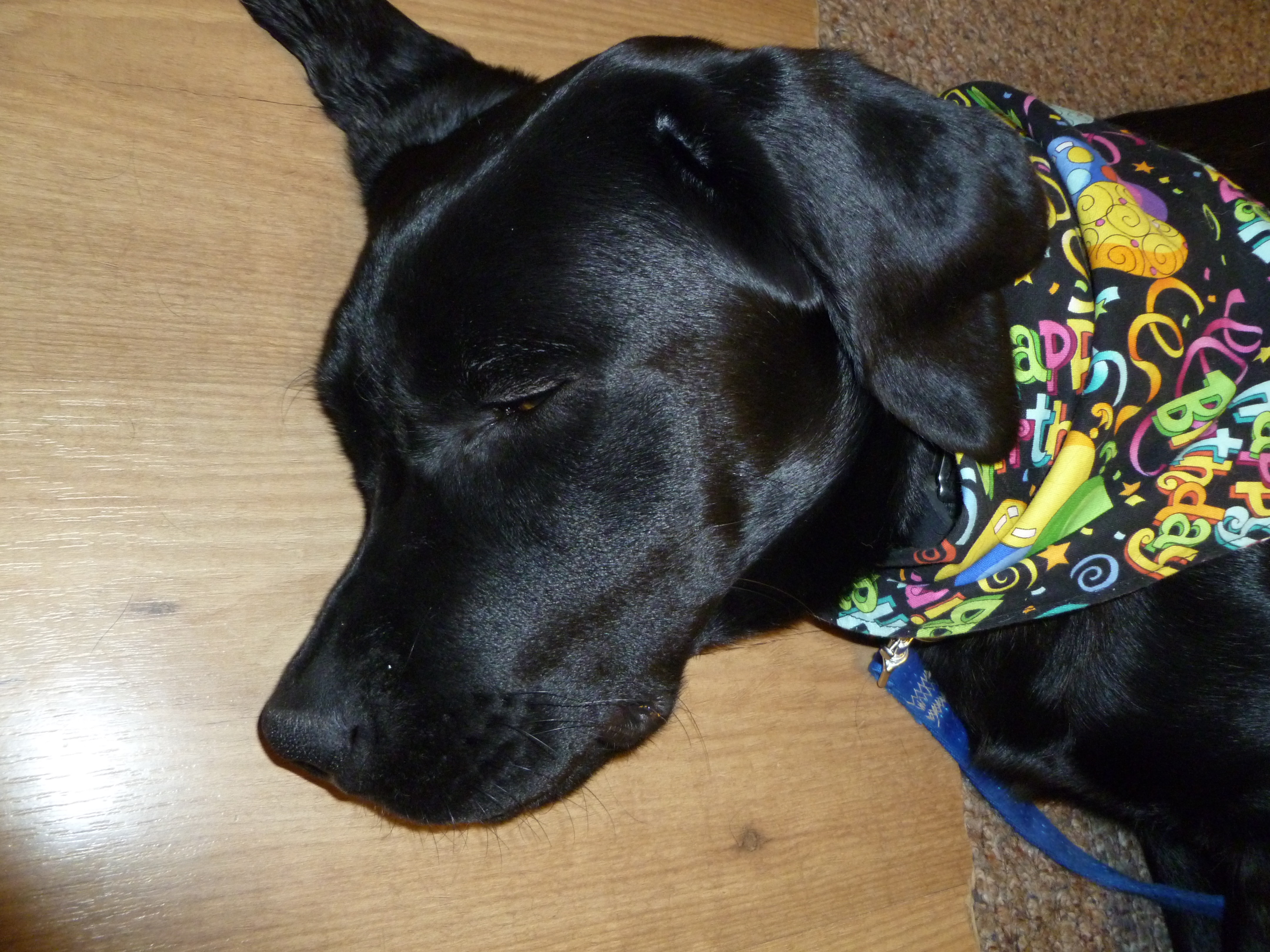
Yakira in the birthday bandana

This week marked Yakira’s first birthday. This is a big milestone in a puppies life. Now we switch her over to adult food. So I got out a bunch of small storage containers and measured out all the food for the next week so that she can make a smooth transition without any digestive upset. I like to do it this way instead of trying to keep track of how much of each food she is supposed to eat each day. Plus it makes it easier for Bill, who usually feeds the pups their breakfast. Usually we are also finishing off the last of the puppy food so then once it is all measured out I can tell when to actually start the transition and not end up with a bunch of puppy food to store until we get the next puppy. With Zodiac here I didn’t have to worry about that.

The other side of Yakira’s birthday is that her time with us is coming to a close. She will probably head back to guide dogs in two months. It could be longer depending on the timing of puppy trucks and what the needs of the breeding department is. Last year Casey’s return was delayed a couple of months because the breeding department had too many dogs to evaluate already that they didn’t want her yet. Yakira is a sweet and wonderful dog and she is “very well put together” as the CFR (Community Field Representative) put it when she evaluated her in July. Because of this she sent a note to breeding to keep an eye out for Yakira. That put together with her diverse lineage from outside of GDB, I’m guessing they would really like for her to be a breeder if she passes all the other tests.

So we have entered the final leg of raising Yakira. I’m sure the time for her to get on the truck will be here too soon. At the same time I always look forward to finding out what the future brings for our dear sweet Yakira. Plus in many ways I am looking forward to being a one dog household again.

60 Years Ago Today

Sunday, 17 August 1952:

In the morning I bathed standing in a little round wash basin as I cleaned the bottom half of me. And then I cleaned the top half of me sitting on a marble table around a bowl. Afterwards, I felt quite clean. Then it was off to breakfast for a delicious meal which was similar to the breakfasts we had on the Sibijak. I noticed LO came to breakfast in peddle pushers.

Then we were off to church at 10 a.m. Our 10-15 minute walk turned out to be a 25 minute stroll past canals and leaning buildings. We met Clara Borgeson and Grace Lam. We gave our program in a good sized hall with a piano and organ which was used for church services. Members were friendly, but not quite so prone to shake hands with everyone.

The Dutch seemed quite easy to understand, so it wasn’t too difficult to sing the hymns in Dutch. In class one of the missionaries answered our questions about Holland and socialized medicine. We learned that a collector came around each month to collect money for health services. Also that Dutch school was compulsory till age 14 and four languages were taught in school: English, Dutch, French and German.

Unfortunately, there were many inactive LDS members in Holland. And the converts to the LDS Church came from people who had fallen away from other denominations. Most Dutch were narrow in their ideas and felt comfortable in ruts that they didn’t want to be disturbed. And while the missionaries served in Holland, they tended to gain weight, because of the good food here. Holland had special lanes for bikers which the missionaries used to get around.

Afterwards, we caught trolley 16 back to the hotel for dinner and another big delicious meal. I finished with a big bowl of fruit for dessert.

Next we were off to Marken Island with uncertain weather. On the ride out I glimpsed windmills, houses, and other sights. Some canvas came loose and started flapping in the breeze so we had to stop in order to fix it. While we were stopped, I snapped a picture of a windmill in the distance. I wanted to take advantage of an opportunity when it presented itself. I spotted ships on a dry dock on the way to the island.

Our bus drove onto a ferry to cross a big canal. I noticed curtains in the little boats along the canal. When we got to the island we parked the bus and the mob spent money for Dutch chocolate ice cream with windmill spoons.

A small motorboat chugged across Zuiderzee Bay. In ten years or so this will all be land and canals.

Then it started raining cats and dogs. The streets were deserted except for a couple of boys standing near the buildings. That was quite frustrating since our main purpose for coming here was to see people and take pictures of them. Instead we strolled around in the rain.

As the sun tried to shine a little we got a few pictures of typical Dutch costumes and houses. Inside a quaint little shop was an old withered lady in native dress where I bought a souvenir. There were lamps with lace shades and cracks in the wall. Then I had great difficulty in getting shots of the Dutch men, because they would turn away. It was hard to tell little boys from little girls. I heard a guy expanding on the differences in their costumes.

So many tourists were running around it was almost impossible to get pictures without one of them in it. I discovered that a few of the children were dressed like those in America. Some people wore wooden shoes and others had regular shoes on. A man, who was dressed just like anyone else, strolled along with two little girls in native costumes in each hand.

When it was time to go back we had more rain. But where was the bus? I stopped in a souvenir shop and saw blue and white jewelry, wooden shoes, and little costumes. There were painted black caps and aprons which weren’t quite so colorful. We strolled over to the cafe next door to the WC. It was jammed with people, mostly tourists, I believe. There was a Dutch sailor who had had several drinks and was in high spirits.

Henry started waving across the street in order to gather the mob. I had gotten off on the wrong street and heard the big wingding in a café. There were costumes, music and dancing. Finally I followed the brick streets along the canal to the bus. I don’t know for sure how Andre got here or how we found him, but we were all together again. Yea!

Missionaries called back from a souvenir shop to tell “them” (Dutch members) that we would be late for church. We were scheduled to give a program–good thing to let “them” know. We did go to the church first, but it was already too late by the time we arrived. We didn’t even go in and headed back to the hotel.

At the hotel L.O. and I jumped out of the bus and dashed down to see if we could get tickets to Heidelberg Romance. Yep! After buying tickets, we hurried off to dinner. Gee! I could really gain weight on these types of menu. We had delicious cream soup again and all the rest of the works with luscious ice cream for dessert.

I got a good start on packing before the movie. My, my, I didn’t realize I had collected so much literature on the trip. We had to pack so we can leave our big suitcases at Rotterdam. Afterwards, as we walked down to the movie we were met by throngs of people coming from the earlier show. They took over the street like we do on the hill road at Ricks College off of the upper campus between classes. Only there was so much more people. About the only thing I spotted getting through this crowd was the big trolley.

At the theater there was a small man from the night before that was ushering the second door and he recognized me. As we entered the theater we were greeted with clouds of smoke from people smoking. This was much different from our experiences in America. Our seats, which were the cheapest we could buy, turned out to be almost on the stage and up the side wall it seemed.
At first I had to fight to stay awake because it was so warm. Still we were able to enjoy the movie immensely despite the heat, smoke, and seats. In the movie we got to see the famous sights which included the Heidelberg castle, former old bridge, and Red Ox Inn. We even got to see the famous Heidelberg fireworks.

Back at the hotel I ended up packing until almost 2 a.m.

60 Years Ago Today

Saturday, 16 August 1952:

I woke to find soot from the ventilator on one of my pillows. Since my bottom sheet didn’t reach all around my straw tick bed, there was straw tick all over and half of Alene’s mattress hanging over my bed. I purchased breakfast for two marks. It consisted of three rolls with meat and watered chocolate. Then we stashed the suitcases in the bus. Whatta chore this baggage was!
On to one of the grandest Gothic cathedrals in the world. Cologne Cathedral which was started in 1248 a.d. Unlike those of Notre Dame the towers were completed. I observed a big hole in one of its walls though. It was damage from World War II.

One of the members showed us around. She was dressed in something like a nurse’s aide costume. She had been coming to this cathedral for 52 years and each time she came she saw new meaning in the surrounding symbols. I noticed the organ was damaged as well. As we were leaving Cologne I noticed block after block of buildings in ruins. Cologne was apparently one of the hardest hit cities in Germany.

Meanwhile, Betty told us about her trip up the Rhine River and meeting Duane and his companion in Dusseldorf. The missionaries go to Berlin for conferences and they told her many stories they had seen there. It was similar to our impressions in Vienna, Austria of empty cities with unfriendly people. About 1000 people came across from East Berlin every week after the war and they had to leave everything. Allies were trying to feed and cloth them even while utilizing Russian flags to make clothes for the children. She confirmed that there was practically no reconstruction in Russia controlled areas to speak of.

During a big youth conference, the people were tightly rationed with food for weeks so they could put on a good show. Scaffolding was put in front of buildings and flags hung all over to prepare for the conferences. Then we drove through an industrial section of Germany with many factories.
As we passed through the Ruhr district of Germany we saw many fields of flowers. I noticed “Rats” written on a building. We sighted our first windmill while we were still in Germany. Here we were racing toward Holland and already I could feel the Dutch influence.

At the border I spent my last pfennigs on two oranges and a roll of candy. Then Dr. Rogers came in and gave me a big scare. My German visa had never been signed by the official who had made it out. After all the times I’ve been in and out of Germany, the Germans caught it on my last time out. Thankfully the situation worked out and I was good to go.

Medieval, Royal Castles Are Big Attraction for Travelers

(Editor’s Note: This is another in a series of articles by Mrs. Afton A. Hansen of Provo on her impressions of a European tour she is making with a group of Utah Students)

Letter to the Editor

Dear Friends,
Castles and palaces in Europe are so numerous that they should come in for their share of mention.

Although the medieval kings and the emperors tried to outdo each other in buildings of splendor, it was Louis XIV of France who was the most imitated. His display of magnificence, splendor, wealth and beauty, at Versailles is oft repeated throughout Europe. Not many of those palaces are now occupied as living quarters, but are museums of treasure and art, owned by the government, and open to the public for a small admission fee.

The Royal Castle of Herrenchiemsee is a gigantic structure created by King Ludwig II of Bavaria. He was called the “mad king.” It was unfinished, but the finished royal splendor surpasses the original at Versailles. Entering the richly decorated, gold and marble staircase, we see hanging from the ceiling a Viennese crystal chandelier with 125 candles, partly burned. On the walk are original masterpieces representing mythical characters — statues of Apollo, god of poetry and song, Flora, goddess of flowers, and Minerva, goddess of wisdom.

Fabled Richness
We proceed through a vast extension of rooms and apartments, gradually increasing in richness and brilliance. There are curtains (drapes) of lilac damask, silk, embroidered with gold thread. One pair of purple velvet drapes weighs 300 pounds. French Gobelin tapestry in exquisite design and color are on walls and bed canopy. Fireplaces are of marble with one of Meissen porcelain, which is unbelievable elaborate and beautiful. Hardwood floors are artistic in design with a variety of woods. The balustrade in the state bedroom is skillfully carved wood and gold leaf. A 300 year old clock within a gold case in the conference room is still keeping good time. Enormous mirrors on the walls in the reception room, 100 feet long, make the room seem infinitely larger as they reflect lights from 33 crystal chandeliers, and 44 candelabrums, hold 2300 candles which are lighted by 60 people every Saturday evening when a public concert is held. I hope that it is almost as breathtaking to read about as it was to see. The short boat ride to and from the castle added to the romance of the day.

Another castle built by Ludwig II is small but none the less a treasure of wealth and artistry. Poor fellow, he only lived here a few days, but it took nearly five years of strenuous work to build it. The formal gardens and terraces might have been more extensive and luxuriant had he lived longer than his 41 years.

History Made
Heidelberg Castle on the banks of the Neckar River in Germany has a somewhat different story—not so elaborate, but where intense history was made. The courtyard here is as highly commercialized as an American carnival, but we were glad for the milk bar and a cold glass of milk.

People of Heidelberg can also boast of their renowned university, as well as the famous representative of the human race—the Heidelberg jaw, a fossilized bone, belonging to the earliest known type of Paleolithic man. Many evidences of prehistoric man, dating back 1000 B.C. have been found in this area.

Castles Numerous
Medieval Fortresses, castles and cathedrals are also numerous on the banks of the Rhine River. A seven hour trip up the Rhine by river steamer from Mainz to Kein revealed a grand panorama of legend and reality, industry and commerce. No wonder the Rhine as well as the rich Ruhr valley is so desirable and strategic.
Though Germany’s wounds are deep, her efforts for the good and noble are persistent, as is shown in the Oberammergau Passion Play, the Wagner Music Festival in Bayreuth, and Kinderzeche in Dinkelsbuhl and the other community activities. This display of talent, with democratic cooperation will go a long way in proving that love and humaneness are superior to brutal force.

Afton A. Hansen

Then we went to exchange our money. It was 3.70 guilder to a dollar. Hofs Dutch Officials came in with our passports after the Germans had gotten through with them. The Dutch looked us over as the passports were passed back.

Now we’re off to see Holland. There was a flood on the road with isolated houses in ruins. We spotted our first big windmill in Holland. Everyone was clamoring for a picture. So, of course, Andre buzzes on. I recognized new kinds of architecture which kind of reminded me of Baltimore. We drove through a town with a cheese mill. Then back to woods, fields, hay in bunches, and our first man wearing wooden shoes! Next we hit a territory that looked just like those around sawmills at home. Darling houses were everywhere. Oh my kingdom for great pictures! Heather was growing in the open places.

A fruit stand stood by the roadside along with beautiful homes and flowers, cows in the meadows, and bridges. Everything was clean and neat. It was raining like it usually did when we entered a new country. We discovered canals, bicycle lanes, power lines, railroad cars and more houses. The autobahn was much smaller here than it was in Germany. LO was having a tizzy about the stunning sights she saw out the bus window.

We drove by a beautiful park with people on the grass and a basket of fruit all wrapped up with ribbons. The quite wide streets were filled with bikes but few autos. I identified a kind of square architecture which was repeated over and over again. As kids were fishing in a canal, I realized I hadn’t seen any ruins from World War II yet.

Dr. Watkins was asking for directions in German I guess. There were canals at every turn and a market place selling all kinds of odds and ends instead of food for a change. A boy on a bike showed us the way to Schiller Hotel which wasn’t bad looking from the outside. It was on a one way street with trees growing out of the sidewalk all along the canals. We had to go around the block to get on the right side of the street.

At the Schiller Hotel cab men were out front watching and smiling. A Rembrandt statue and park were across from the hotel and a sidewalk café was nearby. We checked in and I got room 33 on the 3rd floor. I walked the narrow carpeted stairs that went up half a floor at a time. It was a nice room that overlooked the square.

In the room there were two round basins, hot water, rugs, drapes, satin comforter, two tables, and lounging chairs. It was really cute.

As soon as we were settled we hit the streets. One shopping street was entirely turned over to pedestrians with no cars on the street at all. The shopping area had people walking down on the right side and back on the left side. There were tall people as well as short people, which was kinda nice for a change.

I looked around in a department store for various things to buy and then wandered into a small shop which directed me to an even bigger shop. By this time the gang had become separated. Shopping in groups always seemed to present a challenge.

A store called Gerzon had several shops on the same street. The first shop just had yard goods. Finally, I found the store with some linen and there was Alicia buying hankies. After much debate, I bought a large size pure linen cloth and a couple of hankies. I cashed my two five Swisse franc notes. The poor cashier showed me all the different kinds of money she had changed in one day. I received 4.31 francs for the 5 franc note.

My dinner was especially delicious as I enjoyed it with my two letters which miraculously appeared with the key to my room. I received news from Caroline and my old faithful letter writer, Twila.

Back to eating, I indulged in the most delectable soup since Italy or Swisse. The rest of the meal had peas, carrots, beans, french fries, bread, and roast beef. The bread and roast beef were particularly good. The meal was topped off with dessert and whipped cream. The restaurant gave such wonderful service.

Later I spent a little time after dinner in our darling room looking out at the city lights in Rembrandt Square and writing. At 9:30 p.m. I left for a movie. There were mobs of happy people thronging the streets of all nationalities. Amsterdam at night was really fascinating. It seemed everybody goes to the theater.

I caught sight of clean, delicious looking food in a stand-up café on the corner across from the square. The streets were wide and clean. Once again there were not too many cars, but a big trolley and lots of bikes. We were really excited about seeing I Lost My Heart In Heidelberg. However, we made a new discovery. If you want to see the movie in Amsterdam one must buy tickets in advance. Big sigh! “Geschlossen” on the box office! We coaxed and tried to persuade the doorman to let us stand or sit on the steps but no soap!

The only alternative was window shopping. So we caught the trolley 16 past Kursal where there was a concert that we didn’t go to. With the help of a kind man we got off and transferred to trolley 1 past the Latin Quarter, tenements, and residential area. Then on to the central station. From there we took trolley 5 back to the Rembrandt Plaza. This kind of made a triangle of the west portion of the city. It showed us what at least one section of Amsterdam looked like.
Now at the hotel again, we stopped to talk to LO and two missionaries. Bert and the other missionary told us about the plan to reclaim most of the Zuiderzee Bay from the sea in the next ten years, and also about Avery’s plunge into the canal.

This week in 1856 – Approaching Florence Nebraska – Mary Taylor

From Samuel Openshaw’s Journal:

12 August 1856:

We should have started at seven o’clock this morning, but for two of the mules who ran away. We found them and started at 9 o’clock, and arrived at the camp ground 20 minutes to six, and camped upon the prairie grass, not far from wood, but water was not so fluent.

13 August 1856:

We were delayed again at 9 o’clock, on account of the mule teams having to turn back a little for flour. We traveled about 20 miles and arrived at the camp ground about 6 o’clock. We passed through Fort Des Moines, which is quite a new settled place. Lots of brick building, which is stylish for a new town.

14 August 1856:

We started about 8 o’clock this morning, and crossed over the North Coon, with our handcarts in the water, in the county of Edby. We found Robert Kirkman. He had stopped behind from Haven’s company last Saturday night, and was cut off from the Church. We took him along with us and crossed over another river, which is also about knee deep. The women and children crossed over the river on a small bridge. We camped close by the river about 5 o’clock.

15 August 1856:

A child was buried this morning. The coffin had to be made, which delayed us until about 8 o’clock. We traveled about 13 miles and pitched our tents about half past twelve o’clock, which gave us a chance to wash a little. James Ferguson, John McAllister and Dan Jones camp us with their carriage and stayed all night with us.

16 August 1856:

We started about 7 o’clock and traveled about four hours before we saw a house or any water to drink. We took but little water with us, and most of it was finished up long before we got to any house. The day being hot, we felt the want of water. We traveled about 17 miles and pitched our tents about two o’clock.

17 August 1856:

Sunday. We started about 7 o’clock this morning and traveled all day without seeing a house or even a tree, except fro a few at a distance. Nothing but prairie grass to be seen. We traveled about 10 miles and pitched our tents about 2 o’clock. As soon as we had put our tents up, a thunderstorm came. In our travels today, we found a well, by having a pole set up with a flag upon it, having wrote, “the devil in the well below the spring.” Eliza is a little better. We camped near Morrison Grove.

18 August 1856:

We started for Morrison Grove at 8 o’clock, and traveled until 11 o’clock, when we stopped two hours for dinner. Started again, traveled 21 miles and pitched our tents at 6 o’clock, close by the River.

60 Years Ago Today

Friday, 15 August 1952:

I woke to the ringing of the church bells. The day looked dreary, but maybe it was too early to tell. I dressed and hurried downstairs for a breakfast of ham and eggs with Mrs. Hansen. The cheaper rates for breakfast were good till 8:30 a.m.

There had been a big dance last night and Mrs. Hansen had stayed in Weisbaden till midnight. Many LDS servicemen were disappointed cause we couldn’t go. And so were we.

Everyone lugged their bags down at 9:30 a.m. to wait for the river boat down the Rhine. In the still dreary morning I bought a pastry and looked for some fruit. I sat in a street side hotel café writing till boat time. I noticed a bicycle brigade with boys and girls touring by bicycle. I talked to one of them down by the pier, who was from Baltimore. They were from all over the states and most of them were quite young looking. They were traveling with the SITA, a group that arranges international travel experiences for students.

As I got on the big river boat I discovered there were two decks. Lots of people were piling on the boat when we got on and lots more after us. It was smooth sailing with interesting people and sights. There were three languages being spoken at our table: German, English and French.

The waiter brought in delicious looking fruit sundaes. I asked one waiter where we could wash the fruit we had brought with us. He brought us a bowl of water and a napkin. There was a full menu for dinner downstairs. Meanwhile we ate our fruit, pastries, and a candy bar from Mrs. Hansen. I spied a Wiesbaden PX box on the boat.

The boat stopped at little towns along the way to let passengers off and take on more. It seemed there were castles at regular intervals and we heard about the Rhine River legends. We got a souvenir map that showed the details of what we saw.

It was almost 3:30 p.m. and my stomach couldn’t stand it any longer. So some of us went down to the foredeck dining room to eat. Since it was between meals, we were afraid we had lost our chance to eat. However, the waiter, who was friendly and sympathetic, found us some wieners, bread, and potatoes. We also had apple soft which was an alcohol free apple drink. LO and Alice succumbed and bought the tall dishes of fruit sundaes we saw earlier.

After eating I tried again to watch the scenery and write at the same time. The kids on the SITA tour were taking the opportunity to sleep on the deck.

In Cologne, the missionaries, Andre, Helen and Margaret met us. The latter came with Andre so they could visit the P.E. school. We dashed straight to church to give a program. We were changing clothes on the bus and in the church. It was quite an experience with both guys and girls changing at the same time.

Our program was quite similar to the Frankfurt program. Yet we had a smaller and more appreciative crowd. We used their organ but our chorus was rather stale. Poor Bev was still saying “Ick” during the program.

After the meeting, we talked to several of the members. One of the members we talked to was a little blonde girl of 16. She looked much older and gave us her address since she was coming to America in about a year. The branch president told us that they had tried to get a big hall for our program, but no soap. Boxing clubs can rent the hall, but not the Mormons, even after all they have done to help the people after World War II. As usual we had a rough time getting away.

Just like in Nuremberg the first sight of our hotel was quite a shock, but it wasn’t so bad inside. We ate while waiting for the confusion to subside over who went where. Seven of us were in a dormitory upstairs and down the hall. I just took a quick look in the room before I hurried downstairs to write. I ended up talking to the missionaries until 2 a.m. At 2:30 a.m. the manager at Hotel Deutzen Hof sent me off to bed.

Dear Folks,                                                                   15 August 1952:

Today we are sailing down the Rhine. It’s cloudy today, but beautiful nonetheless. This Rhine steamer is crowded with people of all nationalities, a group of American students touring on bicycles, and a group of little boys from England. We saw the room in the Frankfurt mission home where President McKay slept.

We gave a program to a big crowd of missionaries, members and investigators in Frankfurt. It was fun doing it and I hope they enjoyed it. It is pretty hard to prepare programs en route. That one was advertised as a concert, but I’m afraid it couldn’t be classed as such. We gave one the night before in Heidelberg, and then afterwards the missionaries and servicemen took us to the snack bar and treated us to hamburgers and ice cream. I gave my speech again in Nuremberg instead of Vienna and did a better job than the first time.

Most of the cities we have visited in Germany are still very much ruined, although they have been built up a great deal since the war, but when you consider the fact that they were practically leveled, it’s really sad. They have managed to save some of the art treasures by taking them out in the country. The relics from Goethe’s house in Frankfurt were taken to twelve different places and kept till after the war. The house has been restored and the relics brought back to celebrate the 200th anniversary of his birth.

In Bayreuth we were really lucky to see Parsifal. In fact, we were so lucky and it was so wonderful I could hardly believe it. In fact, I’ve been pretty lucky all along. I think I’ve seen more operas and concerts than anyone else. Rigoletto in Paris, La Traviata in Rome, Elektra in Munich, Marriage of Figaro in Salzburg, The Gypsy Baron in Innsbruck, Parsifal in Bayreuth, just to mention the operas.

Vienna was quite an experience. You’ve never seen our bus so quiet as when we entered the Russian zone. We weren’t sure what to expect and we didn’t want anything to happen to keep us from getting in the area. The Russian who checked our passports and cards was very young and kind of a smart aleck. The streets seemed deserted in the little towns we passed through. It may have just been the time of day, but the people we saw seemed very quiet and they didn’t smile or wave.

The American zone of Vienna is built up quite a bit, but practically nothing has been done in the Russian part. They really scared us about taking pictures, but we managed to get a few. There weren’t any operas or anything going on there, but we went to an American movie and had popcorn. Silly thing to do in Europe, but different. We had seen movies in all other languages.

Our meeting with the saints in Vienna was wonderful The people really appreciated having us come, and we really enjoyed meeting them. Many of them are trying to come to America, especially from the Russian part. Some, in fact, may leave all they have just to get out. Our plans are all final for the Scandinavian tour. We are supposed to give a program in Malmo, Sweden, while we are there. We will not get to Stockholm, because we will only have two days actually in Sweden.

60 Years Ago Today

Thursday, 14 August 1952:

After I indulged in a continental breakfast at the hotel, all of us brought our bags down before we left to see Frankfurt. Then I waited at a street side café next to the hotel for Alice and Dot. Karen and Leland came along with them and they took us on a conducted tour of the zoo, the second oldest zoo in Germany.

The zoo was started in 1858. On March 18, 1944 the zoo was bombed and many animals had to be shot. Since the war, the zoo had been rebuilt with animals like flamingos, tigers, leopards and laughing hyena. Metro & Goldwyn Studios had donated some lions to the zoo. Approximately one million people visit the zoo every year.

They had American Prairie dogs and Steinmarder weasels. Boy! How the rodents room smelled. Some remains of the zoo ruins had not yet been restored from the war. Also there was a ruined castle and an old aquarium which had once been one of the finest in the world. There was a children’s playground near the Shetland ponies, monkeys, and little baby goats. I snapped a quick picture.

A Nestle Kinder zoo was still in the process of being built. Next animals were the donkeys, dogs, cats, roosters, hippopotami, mom and baby elephants, rhinoceros, and seals. Then there was a bear castle and thatched roofed houses for the bison and zebras. Only one building had not been damaged during the war.

After the zoo we caught a trolley. Soon after we met the bus as we walked towards Aachen, which included the Kaiser Karl’s Gymnasium, town hall and cathedral. There was a famous statuary before the cathedral which was 13th or 14th Century Gothic architecture. Holy Roman Emperors had been crowned here. At that time seven electors would meet at the cathedral to elect the new emperor. The badly ruined cathedral was being repaired. I observed the coat of arms and the Carolingian building that was replaced in 1200-1250 a.d. It was the sole relic of what was known as the short knave inside the cathedral. The golden bull and art treasures survived the bombings of World War II in 1944.

Next on the tour was the tower, which took 100 years to build. It was started shortly after the cities of Ulm and Strasbourg were built. The interior was still under repair. There were ugly 9th century murals in the process of being replaced. An altar piece carving reminds me of the work of Donatello, an early Renaissance Italian artist and sculptor from Florence. I observed red Gothic pillars and that everything was in bad condition.

Then we went around to the tower entrance where kids were playing in the court yard. For 30 pfennigs we hiked a long dizzy climb. At the top there was a beautiful view of the devastation from the war. We observed a famous old bombed out bridge, an American hospital on the horizon, and the Main river.

We met a couple from Argentina on the top. He was born in Frankfurt and had come back for a visit. He asked us about Mormons, so I gave him a tract. Afterwards, we walked along the river over to Romerberg square. Some men and boys were sitting on the door steps of the former town hall or rathaus which was being repaired. There were three Gothic steps and the gables which were emblems of Frankfurt and statues of the four Holy Roman Emperors that were crowned here in Aachen: Friedrich I, Ludwig I, Karl II, Maximilian II. It was reconverted to a town hall in 1405 a.d. Next was Paulskirche which was a church with important political symbolism.

We circled around it till we found the Goethe haus where Johann Wolfgang von Goethe lived until 1765. There were paintings with children that represented different months of the year. I found a place where rain water ran down and was saved for washing clothes. On March 22, 1944 the house was damaged during a bombing raid. The original furniture was taken out to the country to 12 different places with samples of wallpapers so it could be reconstructed. It was restored for the 200th anniversary of Goethe.

I noticed a 1700’s hand carved wood framed mirrors, clay and cast-iron stoves, walnut cabinet, inlaid furniture, 1800’s paintings of hunting scenes and original dishes from the famous pottery plant nearby. In the kitchen there was an open hearth stove, running water in the house, and cookie forms which were wooden carved. Coffee grinder, copper bread box, shopping basket, waffle iron, tea warmer, cake and pudding forms were in the kitchen as well. Other interesting finds included a little pack with a box to take food on a trip and a chair and ladder combination.

As we progressed through the Johann Wolfgang von Goethe’s house I discovered a linen cupboard in the hall. We were told the stairs and railings were original. Sketches of the Vatican, St. Angelo, and Coliseum were in the house. A Venetian glass chandelier hung in the dining room upstairs. The porcelain stove was made in one of finest factories and there was a portrait of Goethe’s grandfather on his mother’s side, who was mayor of Frankfurt at one time.

In the music room the guide played a few notes on the spinet, a keyboard instrument. There was a game table and clavichord where Goethe had had his first piano lessons. A family portrait hung with five little angels in background to represent the children in the family who had died.
In the house, there was an astronomical clock which was made in 1749. It told the time, day, month, year, and zodiac sign. It ran for eight days and five hours then when it was time to rewind the bear would lay down. Soon after in the library of the father, who had been a lawyer, there were books, sheepskin bound and handwritten. There was a calendar showing Goethe’s birthday. In the father’s waiting room there were paintings collected by him, mirrors brought from Venice, and porcelain pipe lighters. In his mother’s writing room there were paintings of Goethe at 27. He lived here until he was 26 years old.

In other rooms in the house I saw a sewing chest, card table, stove fired from outside, lantern to light the way in the streets, (wealthy people had two candles), and portraits of Goethe’s father and mother. We walked in the room where Goethe was born and there was a bust of Goethe at age 30. And a symbol of his poetry and star which had come from his death room in Wiemar, Germany, where he died in 1832. There was a newspaper with a notice of his birth on Friday August 29, 1749 and some relics of Cornelia, his sister.

Goethe’s work room was next with the desk where he wrote Faust and other works. Then we got to see the library and a puppet theater that was given by Goethe’s grandmother when he was five years of age. He wrote little plays for it. I glimpsed at originals of many books and a picture of the square with the crowning of Leopold II. Also, included were scenes from Goethe’s original production of Faust, a plan of Frankfurt in 1760, and other drawings. Some were done by Goethe himself, as well. In the hallway there was a standing writing desk, spinet, and a linen press with 12 dozen sheets. Washed linens were done twice a year. Two servicemen listened to Dot translate what the guide said in German.

After Goethe’s house we caught another trolley and traveled past the shell of the opera house. Written on the front of the opera house was Dem Wahran Schoenen Guten. We also saw the US Court of Appeals and the Rothschild Estate.

We jumped off the trolley at Palmen Garten, a botanical garden near the Service Club and snack bar. And on the lake were swans and boats. At the botanical gardens there were hot houses with all types of cactus, coxcomb, begonias, and all kinds of beautiful tropical flowers and plants. Among the park landscape I caught sight of a pond with gold fish.

Karen and Leland were telling us jokes as we walked through the gardens. Then there was a palm house with Bavarian and tropical palms, and a room with all sizes, shapes, and hues of orchids. In the water lily room I tried to take a picture. One really hot and damp room had parasitic plants that were tropical. Finally, we ended with a stunning rose garden.

Afterwards, our trolley was waiting at the gate. As we got on a serviceman gave me his seat. We got off at the Central-Bahnhof Frankfurt Station at 4 p.m. Ben and Cherie were talking with the missionaries and servicemen. The crowd gathered and we crossed the street to get on our trusty bus and head off to Wiesbaden. Ben and Cherie stayed behind to get a camera. Then we discovered Pat and Betty were missing too! Betty had gone to meet her boyfriend.

We traveled through the Rhine Valley and stopped at Wiesbaden for 45 minutes or so. Boys were playing near our bus by a huge red Protestant Church. I talked to one and he showed me the main street of Wiesbaden. There was a passageway through a building just like in Salzburg. Also there was a beautiful park, concert building and statue of Kaiser Friedrich, a German Emperor and King of Prussia nearby. I snapped a picture of my friend in front of the big concert hall and exposition building. He called it the Kurhaus.

At 6 p.m. I heard the church bells ringing. So we headed for our bus. When I got there the gang argued about whether I was late or not. Everybody had a different time though, so I think I dodged the fine for now. However, all of us had to wait longer for Bonnie and Kay.
After we found everyone, we followed the Rhine River to the Rudesheim Hotel Germania, which was right on the banks of the river. I was in room 25 which was on the top floor. It wasn’t luxurious but comfortable with a straw tick. There were no towels and the WC was on the first floor.

At the hotel the weiner schnitzel was 3.50 marks. Too much! I looked around for something cheaper, but ended up coming back to eat in the little cellar below the hotel. It was the same kitchen for both places. The atmosphere was interesting with accordion players and singers plus the food was delicious. Upstairs we found the waiter we had talked to and he had decided that he would give us the rate of 2.50 marks for dinner. But I guess it was then too late for us to get that rate.

Betty Lou and I walked down a little narrow street on the other side of the hotel. It was really buzzing and full of people. I observed cabarets, bars, and cafes. There was even dancing in one place. It started to rain so we stopped in the doorway to watch the dancing. We came “home” when the rain subsided and fell into bed exhausted.

60 Years Ago Today

Wednesday, 13 August 1952:

All of us had breakfast on the house this morning. The hotel had made this offer for all of us. Our breakfast consisted of cold milk, rolls, and jam. Then we were off at 8 a.m. but we didn’t get too far. The bus was sick with a gasket or something of the sort. American Express came to our aid and we’re back in Heidelberg. We had to report back at 9 a.m. to get the good word on how long the repairs will take.

L.O. and I dashed through the quaint streets of Heidelberg looking for Haus zum Ritter which was the oldest mansion. After help from several of the natives we found it right across the street from the Holy Ghost Church. We curiously ventured to the church to see how it had been divided. We walked down to the river and then wandered back through several other churches. There was a big red sandstone building past the library known as St. Peter’s Church or Peterskirche, which had cloisters. Then we went off window shopping until 9:00 a.m.

American Express gave us news that the bus would hopefully be ready at 2 p.m. I decided to make an excursion to the top of Konigstuhl, the highest point on the mountain. We stopped at a shoe shop on the way. Alice’s purse and my sandals received a nice polish. We wandered all over searching for the funicular.

Then we climbed the dark stairs to the top of a tower. Too bad it was a hazy day. On the way down we stopped at the castle to look for Helen’s lost glasses. And we talked to a cute German guide and learned the German word for cloister which was oterskirke. We also met some Spanish women.
We stopped in the university bibliotek reading room where there were a collection of manuscripts, original charter and registration, Luther’s manuscript, Goethe writings, and papyrus. There were manuscripts from Persia, India, Greek and Arabic as well. The founder of the university was Heinrich. We caught sight of a chimney sweep on our way back. Then we had dinner at a snack bar with the rest of the mob. There was a bearded man from the day before that was here again. He doesn’t look like an American to me.

Finally, we where back at the bus at 2 p.m. and it was ready and waiting. Yea! We were finally off to Frankfurt. Kids, who were late, were charged for being late today. They were burned up cause they didn’t charge yesterday for being late.

Still we made good time to Frankfurt and arrived about 3:30 p.m. We stopped at American Express and I received a letter from Mom and a letter from Twila. Mom sent me a clipping of President McKay’s European tour report.

Next we reached Hotel Eden Am Zoo which was a new hotel built by the Marshall Plan near the zoo. My room 204 sat behind the main hotel in a separate building. It was comfortable and we each had a little card with a map of the city inside.

Alice called her cousin who then invited Alice, Betty Lou, and me out for dinner and a bath. We caught a special cab which cost 90 cents or $1 in script. Mr. and Mrs. Frank Jonas and family had a beautiful apartment and a German maid. What a delicious dinner and wonderful bath! We just got finished in time to walk over to a church through a big park and Forben buildings that had been taken over by the U.S. Forces. They hadn’t been bombed in World War II. The maid accompanied us on our walk. When I looked ahead there was a nice chapel and a big crowd waiting for us to give our program.

During our program our septet got started on the wrong foot. We didn’t get our pitch, but we pulled through okay. Several numbers seemed to have a little difficulty, but all in all it turned out okay, I guess. We had to change it from the night before because there was no room on the stage for the dances. So we left them out. An extra talk by Henry was added and the Italy deal was changed to a poem instead of a song. There was a big visiting fest afterwards.

Later we visited the mission home and it was the biggest and nicest we had seen. Mrs. Cannon took us on a tour and everything was spotless. I took a quick look at the guest room where President McKay had stayed. Then we ate some homemade candy and President Cannon took us down to see the mailing room plus some other rooms. We arrived at home about midnight or thereabouts. And I couldn’t decide which bed to sleep in.