Europe 1952 – Master Page and Using a Grid

When figuring out the way you want to layout the pages of a book I like to use a grid as the structure for the design. Before & After‘s has a two-part video that talks about using a grid in your design. If you want to learn more about grids in your designs it is well worth the 10 minutes or so it will take to watch them. I especially like part 2.

Because of the large size of the pages of this book (about 13″x11″) I wanted to have the text in columns. If a line of text gets too long in relation to the size of the letters it gets harder to read because it is so easy to lose your place on the line. Having columns of text solves this problem. I decided on three columns so I put guides on my master page for three columns. I also put guides horizontally to divide the page in three sections with in the margins. Instead of a small header or footer I chose to put a large title on each page. Part of the reason for this was that my mom, who the book is for, has macular degeneration plus cataracts so she couldn’t see well. Before I finished the project she had cataract surgery which helped her vision a lot. I thought that she would at least be able to read the title on each page and see something of the largest photos even if she couldn’t read all the text. It is important to keep in mind who you expect to read your stories and make decisions that will help them to be drawn into your book.
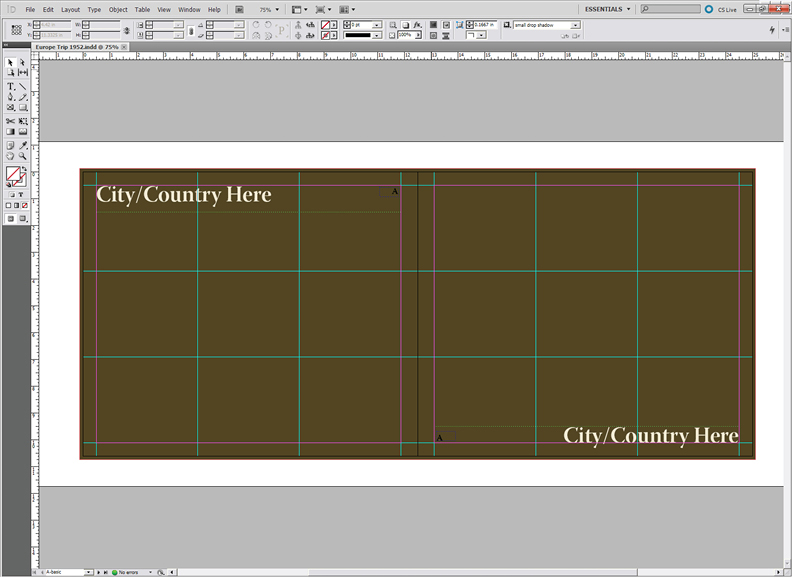
Basic Master page

If you haven’t used master pages you are missing a great time saver. In InDesign it is a simple as clicking on the master page in the pages pallet. By default there is a blank master page there called A-Master. Also by default this master page is applied to you whole document. When you add anything or edit anything on this page it is added to your entire document. Don’t worry, you can override this by dragging the [None] page in the pages pallet to any pages you don’t want to have the A-Master applied. I created two other master pages, one for the beginning of chapters and another for newspaper articles. I’ll talk about those in more detail in another post.

The advantage that having the three by three grid gave me was that it helped to make it simpler to figure out the layout for each page of the book. I had lots of photos and most of those photos are either one, two or three columns wide. Some are full bleed and a few go across to the facing page. But I still used those grid lines to help me to decide how large those photos were. Here are some examples pages.

The left hand page shows a “three column” photo and the right page is a full bleed.

This page has a bleed on three sides with a small “one column” photo overlapping on the left, while the right had page has two “two column” photos.

Here I have a “four column” full bleed and a couple of “one column” plus. When I was overlapping photos like here I was willing to allow photos to be wider than their column.

So how did I decide what size to make each photo? The first criteria was appeal of the image including the quality of the exposure. Because I wanted the photos to be the focus, if the image justified it I would make it as big as I could. Next I had to take into account how many photos or other memorabilia and the amount of text. Sometimes it is very tricky to get it to all coordinate together. But having the grid makes this easier and unifies the look of the book.

If you have any questions about how to do any of this please let me know. Next week I’ll cover how I handled the many newspaper articles I had for the book.

This Week in 1856 – Nebraska – Mary Taylor

From Samuel Openshaw’s Diary:

9 September 1856:

We started this morning about 8 o’clock, and traveled through a very hard, sandy uphill and down, road. Halted for dinner about 2 o’clock, but there was no water, just an old mud pit. Started again at 6 o’clock. It thundered and lightninged awfully, and rained at a distance, but, as if to give everyone their share, it rolled over and gave us a good soaking in the rain. It rolled on until it died away at a distance. We were almost worried with mosquitoes. Traveled until 11 o’clock, when we camped at Prairie Creek, which is very good water. We have traveled two days without water, except mud water, and only twice.

From John Jacques:

On the 9th of September, in the afternoon, the company came to a round pit or pond of water. Parched with thirst the cattle rushed pell mell into the pond and stirred up the mud until the water was thick and black, before the people had supplied themselves for their own use. But it was all the water available, and so it was used for cooking purposes, making coffee, tea, bread and porridge or hasty pudding, which when made was quite black, but was eaten and drunk nevertheless.

At 7 p.m. the camp started for Prairie Creek, nine miles, reaching it between 11 and 12 o’clock, but very glad to get to clear running water, after having been without two days.

From Samuel Openshaw’s Diary:

10 September 1856:

Started about 9 o’clock from Prairie Creek. We went about three miles and then crossed it. Traveled until 1 o’clock, when we stopped for dinner one hour. Traveled until 6 o’clock, and camped again at the Prairie, where we found a little wood, which is the first wood that we have seen since Monday morning. We had to cook with buffalo chips.

11 September 1856:

We started about 9 o’clock again this morning, traveled until 1 o’clock and stopped for dinner. Started again, traveled until 6 o’clock and camped again at Prairie Creek.

From John Jacques:

On September 11th, 8 or 9 miles from Lone Tree and Wood River, the company passed the graves of two men and a child belonging to Almon W. Babbitt‘s wagon train, who had been killed on the 25th of August by some Cheyenne Indians, who were on the war path that summer. Two of the teamsters escaped death, and Mrs. Wilson was taken prisoner. Most of the property plundered from the wagons was subsequently recovered by Captain Wharton and the Untied States troops at Fort Kearny. A mile or two east of the graves of the teamsters, a paper was tacked on a board, on which the chief of the Omaha Indians disclaimed participation in the murders. Early in the journey from Florence, the company met two or three hundred Omahas, who passed by quite peaceable.

From Samuel Openshaw’s Diary:

12 September 1856:

Started about 8 o’clock; traveled about 4 miles when we came to Wood River, which we crossed on a small bridge, continued down the side of it and stopped for dinner at 12 o’clock. For ought we knew, but a cripple, a young man who walked with crutches, had been left behind. We sent four men back to search for him which caused us to move none today. About sunset, they brought him into the camp.

13 September 1856:

Started about half past 8 o’clock this morning; traveled until one o’clock when we stopped for dinner, nearly opposite Fort Kearney, where the soldiers are stationed. Started again, and traveled until five o’clock when we camped at the Platte River. A man fell down dead, (William Edwards). The Indians are very hostile about here. They have attacked some of the emigrants who have passed through this season, and rumor says that some have been murdered, but they have kept out of our way, for se have seen none since the sixth, no even so much as one.

From an account of Josiah Rogerson:

September 13 1856:

About 10:30 this morning, we passed Fort Kearny, and as one of the singular deaths occurred on our journey at this time, I will give a brief and truthful narration of the incident. Two bachelors, named Luke Carter, from the Clitheroe Branch, Yorkshire, England, and William Edwards, from Manchester, England, each about 50 to 60 years of age, had pulled a covered cart together from Iowa City to this point. They slept in the same tent, cooked and bunked together; but for several days previous, unpleasant and cross words had passed between them.

Edwards was a tall, loosely built and tender man, physically and carter more stocky and sturdy. He had favored Edwards by letting the latter pull only what he could in the shafts for some time. This morning, he grumbled and complained, still traveling, about being tired, and that he couldn’t go any further. Carter retorted; “Come on, Come on. You’ll be all right again when we get a bit of dinner at noon.” But Edwards kept on begging for him to stop the cart and let him lie down and die. Carter replying, “Well, get out and die then, the cart was instantly stopped. Carter raised the shafts of the cart. Edwards waled from under and to the south of the road a couple of rods, laid his body down on the level prairie, and in ten minutes, he was a corpse.

We waited, (a few carts of us) a few minutes longer till the Captain came up and closed Edwards’s eyes. A light loaded open cart was unloaded. The body was put thereon, covered with a quilt, and the writer pulled him to the noon camp, some five or six miles, where we dug his grave and buried him a short distance west of Fort Kearney.

Just before Edwards closed his eyes and was dying, Albert Jones brought to him a drink of water in a tin panikin and moistened his dying lips.

From Samuel Openshaw’s Diary:

14 September 1856:

We started about 9 o’clock and traveled until 12 o’clock when we camped for the night. Eliza is a little better, but is so weak, that we still have to pull her on the handcart.

15 September 1856:

Started at 8 o’clock and traveled until 2 o’clock, when we stopped for dinner at Buffalo Creek, started again and traveled until 7 o’clock. Saw several droves of buffalo, but could not get no higher to them than three or four miles. Camped at Buffalo Creek.

50 for 50 #35 – Make a Slide Show

Photo & Video Sharing by SmugMug “I Know” slide show

So this week I finally got around to making a slide show. Back in college I took a class on putting together slide shows, but that was the old-fashioned way with multiple slide projectors and fancy dissolve units and a special cassette tape player to record the syncing of the music and the timing of the slide changes. I totally loved that class. The power of images and music together was awesome.

I intended to use Photostory recommended by Stephanie. Remember her “Raising Skyler” video? When I looked at the details of Photostory it didn’t look like to would work for my needs. The slide show I need to put together was going to be show to a group of girls and their parents at our girls camp awards night. And the reviews of Photostory said you couldn’t save it in a high res or burn it to a DVD. The plan was to show it using a DVD player and a television. So I had to pick another program. My research didn’t give me an obvious favorite. But I settled on ProShow Gold. They had a free two-week trial, so I thought I could make the slide shows and then decided if I wanted to buy the software.

I tried it out and it seemed pretty easy. The one problem that I didn’t realize with the trial was that it put a big banner across the bottom of the screen. There was no way I could have that “trial” banner in my finished slide show. I figured this all out the middle of the week and the deadline was Sunday. I didn’t have time to start over with new software. So I went ahead and paid the $69 for the software.

The hardest part of putting the slide shows together was sorting through the photos to find the best ones. I actually did three slide shows. I had selected three songs that focused on three different things to do with camp. One was focused on the beauty of nature with the song “I Know” by Jenny Phillips. The second was another song by Jenny Phillips called “A Light on a Hill”. This song was the inspiration for our camp theme and I wanted it to focus on the girls and how they were an example to others. Both these songs are on her “Arise and Shine Forth” album. The last song “This Little Light of Mine” by The Lower Lights, was our actual theme song at camp. We sang it every day with verses that the girls made up. This show was all about the fun of being at girls camp.

Photo & Video Sharing by SmugMug “A Light on a Hill” slide show

I didn’t have time or the knowledge to really customize each slide show. I just picked out the photos, got them into a rough order and let ProShow do the rest. I let it pick the timing and the transitions. After it synced everything together I went back and adjusted the order of the photos to work with the words better. The software crashed on me multiple times, which was frustration. It did a pretty good job of recovering where I was at but it took a long time to get things back up and running after each crash. By the time I got the last slide show together it was after 5 a.m. Sunday morning. I was exhausted of course.

I got a couple of hours of sleep and then between choir practice and church I worked on figuring out how to get the slide shows onto a DVD. Well that didn’t work. I don’t know why but I could get it to even begin to cut a DVD. So I had to go to plan two. I exported each show as an mov file. This worked fine but it was a very slow process. (My computer isn’t very fast). So by the time I got all three slide shows saved as mov files I needed to go set up for the awards night. There was no more time to experiment in trying to get the slides shows on to a TV. So I just took my laptop and played them on that. Since the screen isn’t big enough to show to a whole room of people we played the slide shows before the meeting started and during the refreshments afterward.

Photo & Video Sharing by SmugMug “This Little Light of Mine” slide show

Now I’m uploading them to the internet so that the girls can download them and have their own copies to enjoy. It was a good learning experience and I can’t wait to do another one. This time with the time to really learn how to control things and not just slap the thing together. ProShow really did a pretty good job but I’d like to see how much more it can do. Hopefully the crashing won’t be too much of a problem because I’d love to put together many more slide shows and I really don’t want to buy another piece of software.

What software have you used for putting together slide shows? I’d love to learn from your experience.


Lady Liberty


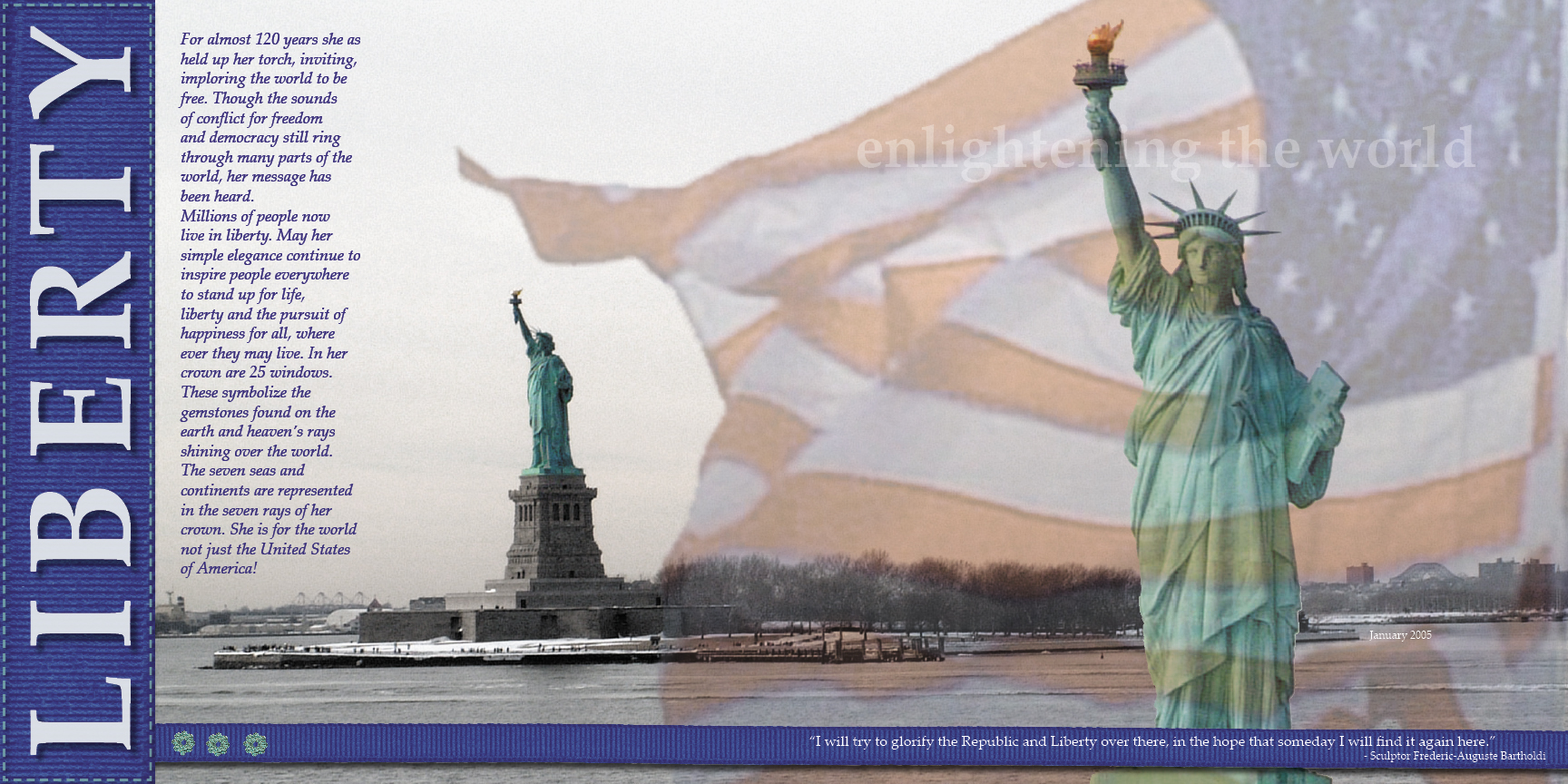
As I thought about what I wanted to write about today, my thoughts turned to a layout I did back in 2005. We had lived in Brooklyn, New York for a few months and took the opportunity to go by the Statue of Liberty via the ferry to Staten Island. Some of the photos I took on that trip inspired me and this is the result. It seems proper today being Patriot Day and the 11 anniversary of 9/11.

For almost 120 years she as held up her torch, inviting, imploring the world to be free. Though the sounds of conflict for freedom and democracy still ring through many parts of the world, her message has been heard. Millions of people now live in liberty. May her simple elegance continue to inspire people everywhere to stand up for life, liberty and the pursuit of happiness for all, where ever they may live. In her crown are 25 windows. These symbolize the gemstones found on the earth and heaven’s rays shining over the world. The seven seas and continents are represented in the seven rays of her crown. She is for the world not just the United States of America!

“I will try to glorify the Republic and Liberty over there, in the hope that someday I will find it again here.”                                                                      – Sculptor Frederic-Auguste Bartholdi


Publishing Your Story – Traditional vs. eBook

I came across and interesting post a few weeks ago on the FamilySearch Blog about traditional publishing vs. eBook publishing and was very interested in James Tanner’s view on this subject with the continued improvements and use of eBooks. You can read the post here.

Publishing Your Genealogy – Traditional vs. eBook

He shared an outline of how books were published in the past that was interesting.

  • Writing
  • Editing
  • Table of Contents and Indexing
  • Inserting Illustrations
  • Formatting for Printing (book layout, fonts)
  • Proof Reading
  • Typesetting
  • Application for ISBN/Copyright
  • Proof Print
  • Printing Pages
  • Binding
  • Distribution and/or Sales

Having only done self-publishing through print on demand I hadn’t ever thought of all these steps in publishing a book. It is wonderful that through modern technology we have other options to print just a few copies of a book or even just one at a very reasonable price. Traditional printing methods were not cost-effective unless you printed a large number of books. And face it, most of the stories we want to share just don’t have that wide of an appeal but that doesn’t make them any less important to us or our family and friends.

James Tanner points out that today all the above steps can now be done by the writer but we can still contract out any of these steps to someone else, including writing the book. I have one issue with his information about print on demand. He wrote:

Today, there are book publishing machines that will publish one book or a hundred. The cost of the first book is very reasonable. The major drawback for those wanting legacy materials is that the binding is limited to softcover perfect (glued) binding.

It might be true that some on-line printers only offer softcover perfect bound books, but I know that Blurb’s softcover books are perfect bound or glued. They also have hardcover books and their website says “our Hardcover books feature library binding.” This got me curious so I dug deeper and found some information to suggest that blurb hardcover books less than 120 pages our stitched from the side but their large hardcover books are glued or perfect bound. This seems to be mostly true. I checked the blurb books that I have here. The 440 page Europe! is not stitched it is glued. While the 9 7×7 books between 40 and 80 pages are all stitched except 1. So that was some interesting research. I’ll have to see if I can find out more.

Here is what James Tanner had to say about eBooks:

With the popularity of eBook readers such as the Kindle and the Apple iPad, publishing a book electronically is more than a fad. If you look at the New York Times Best Sellers List, you may be surprised to find that many of the best selling books are now available only in eBook format. One advantage of publishing a book in eBook format is that it can be updated at any time and distributed in a variety of formats. EBook publishing is exactly like traditional publishing except for the final printing and binding. There is still a need for good writing skills and the book files have to be adapted for a variety of electronic book readers.

Just as with more traditional publishing you can do these steps yourself even to the “printing” on your own computer. One simple option is to publish in a PDF format and distribute that to family and friends. May eReaders can read PDF documents but in my experience their are challenges with the small size of the screen and PDF documents that letter size. The text can be difficult or impossible to read with the entire page on the screen or you have to do lots of scrolling around to read the text.

If the book is just text there are simple enough ways to export it for eBooks using a word processor. But for me the images are at least as important as the words. And I’m not sure how you design for the fluidity of an eReader with images. There is new software that helps with formatting for eBooks so maybe it isn’t as hard as it seems to me. I love the idea of eBooks with embedded media but have yet to see how it works for projects like sharing family stories.

I agree with James Tanners basic assessment:

Whether you publish your book on paper or electronically, you will find that it takes considerable time and effort. Electronic publishing may cut out some of the steps necessary for a paper publication, but the quality and readability of the book has to be adapted for online or eBook reading.

It will be interesting to see how eBooks effect self publishing in the future. I believe that the best way may be to use both mediums so that we reach a broader audience and greater likelihood that our stories will be safe for the future to enjoy. Hopefully there are ways to make this as painless as possible.

National Service Dog Month

September in National Service Dog Month in the United States. So this month I thought I’d highlight guide dogs in my weekly puppy posts. This week I decided to start with how a little about training guide dogs. Guide Dogs for the Blind did a series of videos  a few years ago by following a trainer through San Fransisco. It shows one dog, Solana and some of what a training session is like.

This first video show the dogs loading up in the morning. It is the longest video and the least interesting in most ways. So if your pressed for time skip this one or if you really like the others come back to this one.

In this video show unloading the dogs from the training van, harnessing up and starting off down the street in San Fransisco.

This video features training on escalators and subway platforms.

In the last video you get to meet Solana’s partner on her graduation day.

Mary – three more illustrations

I’m past due for an update on how the illustrated children’s book of my great-great-grandmother, Mary Taylor, is coming. Kim has completed 4 illustrations now and I’m happy with how they all look. I decided that I might as well start the actually book document now that I have 4 of the images.

Crossing the Platte River

We are planning to use blurb.com to publish this book. I love the 7×7 format that I’ve used for several other projects and we are using that again for this one. The blurb plug-in for InDesign is great. I put in the book size and the number of pages and it creates my blank document and then a second document for the cover. It is a much nicer system then the old templates. I took my outline for the book, (you can read it here in the original post about this project) and placed it on the pasteboard. The pasteboard is a handy area outside the page in InDesign. It is a great place to gather the items for a page until you know where you want them to go. It really helps me to get things organized without cluttering up the page. Then it was easy to make sure I was putting the illustrations in the right place. Plus I have a reminder there of what the text for that page should cover. It feels good to have the actually document started. I hope it will inspire me to get started on the text soon.

Fog and Icebergs Crossing the Atlantic

I recently finished a book about the Willie and Martin handcart companies called “The Price We Paid” by Andrew Olsen. Several of the missionaries when we were at Martin’s Cove recommended it. I skipped the section on the Willie company but it really gave me a much clearer understanding of the timeline and how everything happened, especially around the rescue. If you are looking to learn more about either of these handcart companies, you should read this book.

Mary’s Baptism

I have a lot of things on my plate now so I’m not sure when I can fit it in but at the same time I hate to put it off too long. I’d really like to have the text mostly written by the time Kim finishes the illustrations. Then I can quickly put the finishing touches on the project and get it printed. I think I’ll talk to Kim and see if we can figure out a timeline. Now that she has a few of the illustrations done, she should have a better feel for how much time she needs to get this project complete. I do best with deadlines, otherwise my projects can stretch out for ever and never get done.

Finished Illustration of Mary’s Childhood

This Week in 1856 – Nebraska – Mary Taylor

From Samuel Openshaw’s Diary

2 September 1856:

We started about half past 5 o’clock this morning; traveled about four miles when we arrived again at the Platte River. We stopped to breakfast about two hours, started again at 10 o’clock for the Loup Fork Ferry, where we arrived about one thirty, in one part; ferried across the Platte today.

3 September 1856:

We commenced to ferry this morning about 7 o’clock, and finished about sunset.

4 September 1856:

We started about 8 o’clock, and traveled about 9 miles; stopped for dinner again, and traveled 14 miles today. Camped at 4 o’clock, killed a cow and it was divided.

5 September 1856:

We were notified to start at 7 o’clock this morning, but a thunderstorm came with delayed us until half past two o’clock. In the meantime, another cow was killed and divided among us, 1/2 pound each. We started and traveled until 5 o’clock; camped again at the Platte River. We put our tents up and then a rain storm came upon us.

6 September 1856:

Started about 8 o’clock this morning. We met a large party of Indians, men, women and children, with their horses and mules, all loaded with skins, going to Missouri to trade with the Whites. They are the first Indians that we have seen. Camped about 12 o’clock for dinner. Then, we went to the top of the hill and camped for the day.

7 September 1856:

Sunday. Started about half past 8 o’clock. Eleanor has the ague and diarrhea, and si so badly that we had to pull her in the handcart. Eliza, also, is yet so weak, that we had to pull her also, in the handcart, which made it just as much as we could pull. We camped again near the Platte. About 5 o’clock, Franklin D. Richards, D. Spencer, C. Wheelock and others camp up in their carriages. We found a good spring here.

From John Jacques:

On the 7th of September, west of Loup Fork, the company was over taken by Franklin d. Richards, Cyrus H. Wheelock, John Van Cott, George D. Grant, William H. Kimball, Joseph A. Young. C. G. Webb, William C. Dunbar, James McGaw, Dan Jones, John McAllister, Nathaniel H. Felt, and James Ferguson, who left Florence September 3rd, passed Hunt’s Wagon company on the 6th, east of the Loup Fork, and Hodgett’s wagon company on the 7th, ten miles west of Martin’s company.

From Samuel Openshaw’s Diary

8 September 1856:

We started about 8 o’clock this morning, traveled until 1 o’clock and stopped for dinner one hour. Started again and traveled until 10 o’clock at night, on account of not being able to find any water or wood. Traveled about 24 miles and found some water in holes that had been dug in the sand. We pulled Eliza on the handcart all day.

Europe 1952 – Cover

I hope that you have enjoyed this journey through Europe. I think I will miss these daily posts about my mother travels 60 years ago. For the next few weeks I’ll post on Tuesdays some of the “how to” of putting this book together. Today I’ll start with the cover.

Europe 1952 Front Cover

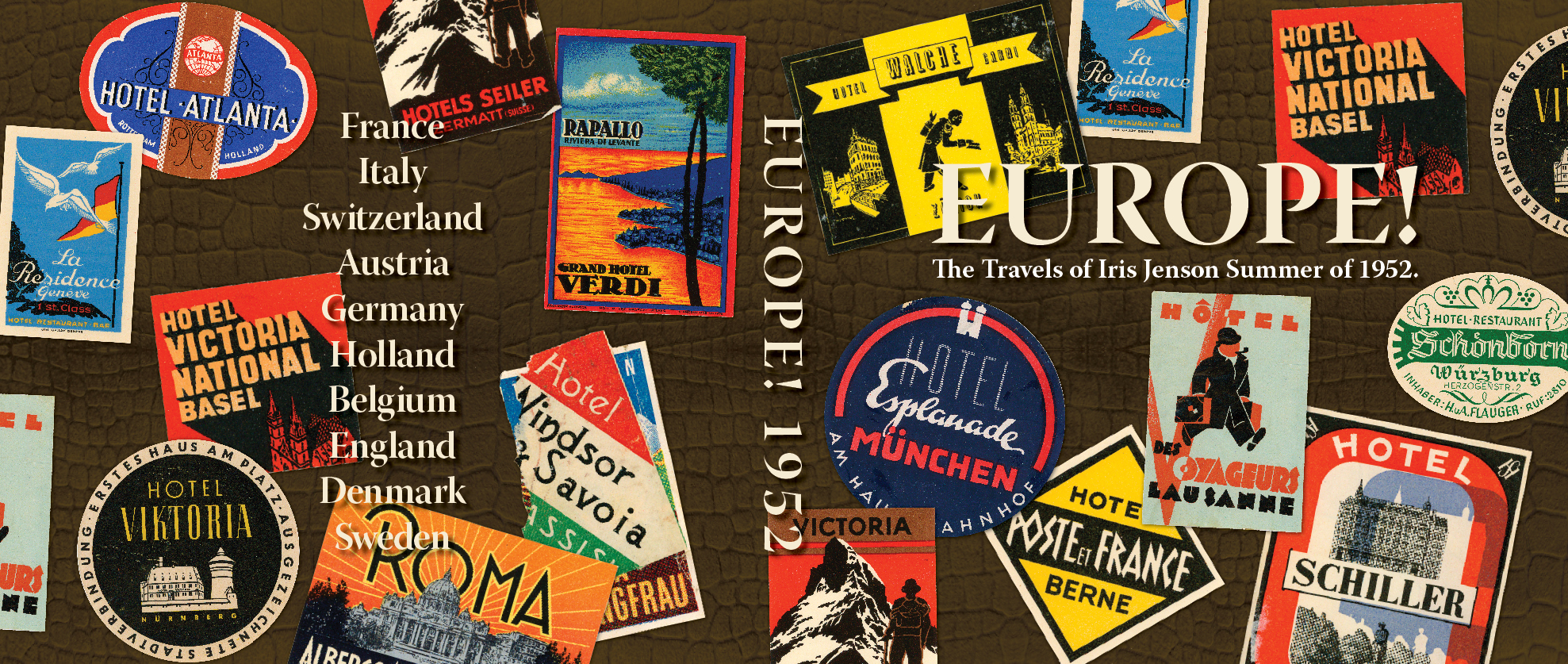
I wanted this cover to look like a small suitcase that I remember growing up, that my mom used on this trip. It was brown with an alligator texture and it had stickers from different places in Europe all over it. I originally thought I’d take a picture of the suitcase. But getting access to it wasn’t very convenient and when I found that my mom had extra stickers from her trip I decided that replicating it would probably get better results.

Crocodile Texture

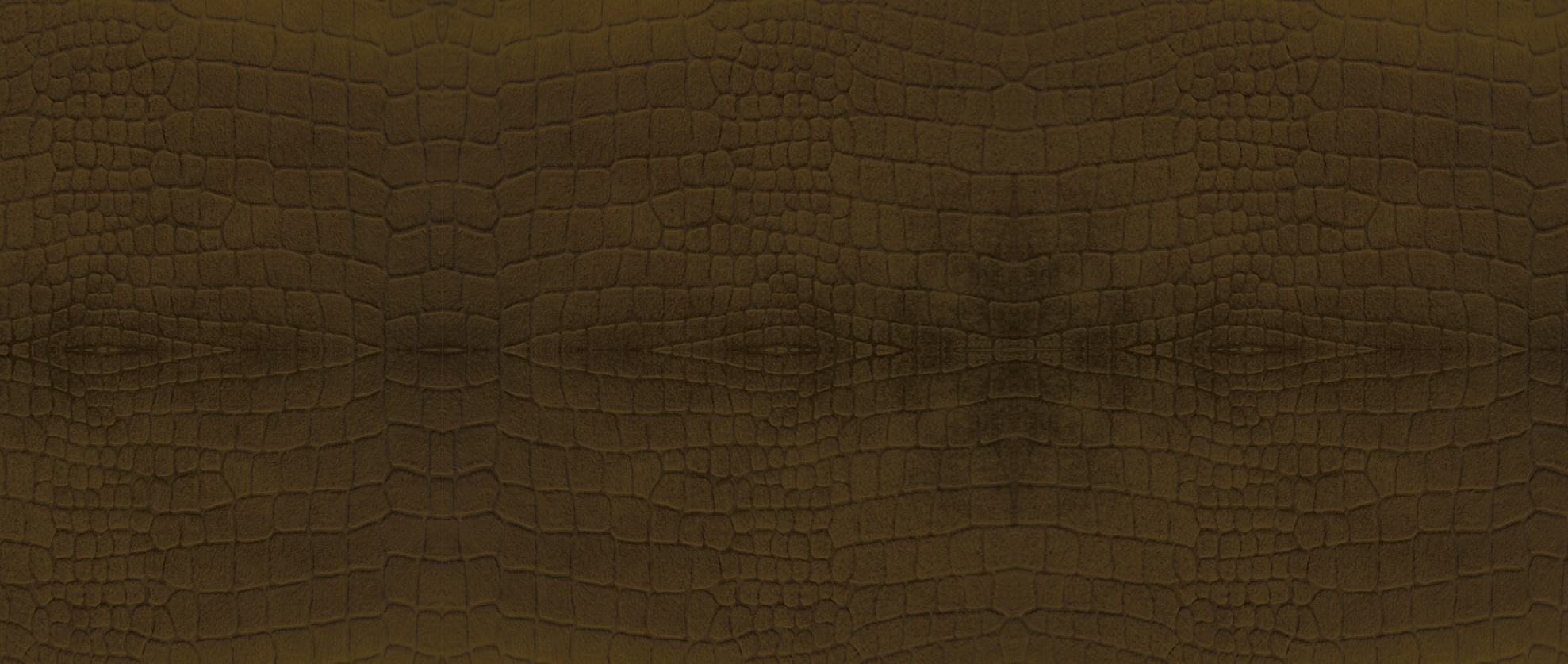
The first step was to find an image of an alligator texture. I ended up with a crocodile texture instead that I found at Lee Dyeing Company. It was perfect. They had an alligator texture too but the crocodile was more like the original suitcase.

original scan on left – converted to png on right

The next step was to scan in all the stickers. Then I erased the background and converted them to png files so that the background was transparent. I did this in Photoshop.

Now with the parts and pieces I needed gathered together it was time to make the cover. I used blurb’s template for Adobe InDesign to get the size right for my book. They now have a handy plug-in for InDesign instead of template. It takes into account not only the size of the book and the number of pages but also the type of paper it is printed on. When making the cover it is just one page that includes the front, spine and back cover along with the bleeds for wrapping the cover. The template shows you were these things are on the page. I love the image wrapped cover the blurb offers. I’ve tried the paper back and it looks good but it just isn’t very durable. They also offer a dust jacket option but I’ve never been tempted to try it.

cover with crocodile texture

I placed the crocodile texture first. It was large image but not long enough for this cover so I copied and flipped the image horizontally. Then placed another copy next to that to give me enough image to cover the page horizontally. I copied all three of those and flipped them vertically to finish covering the page. Otherwise I’d risk too low of  resolution and ending up with a poor quality image.

crocodile texture with brown overlay

Now I had my texture but not the desired color. So on another layer I made a box large enough to cover the entire cover and filled it with brown. I used Pantone 7519 PC. Then I changed the transparency in the effects pallet to multiply. That made it so the crocodile texture came through. I was getting rather excited at this stage because how much it was looking like my mother’s suitcase.

cover with stickers added

Next I was ready to place the stickers. This took some trial and error to get a good balance in color and shape. I also kept in mind where I would be putting the text on the front, spine and back. As you can see I used some of the stickers more than once. But since they are on the front and the back I doubt that anyone has noticed on the finished book.

small drop shadow added to the stickers

To add just a bit of depth to the stickers the next step was a drop shadow. I’m not sure that you can see it here. Instead of the default 7 pt. drop shadow these are just 1 pt. in offset on both the x and y axis.

cover with text

The next step was to add the text. The cream color and font (Warnick Pro) are consistent with what I used for the inside of the book. At this point I realized that the cover was too busy. The drop shadow on the text helped make it more readable but it wasn’t enough. So I added a box around the title text on the front and changed the main title to red. I also put a stroke on the box, inspired by several of the stickers. Along with a larger drop shadow.

cover with box around title

This was a big improvement and I thought I was done. But when it came back to it later I decided it was still too busy. How could I fix it? I was not willing to give up on the concept of replicating my mother’s suitcase but I was not happy with all between the stickers and the title both front and back. So I decided to tone down the stickers. I took a black box large enough to fill the cover. I placed it under the text but over the stickers. Then after experimenting the transparencies I figured out that at 36% and using the darken effect I got the stickers toned down so they didn’t compete with the title. Yeah! The design now worked.

finished cover

Next week I’ll go over how I designed the layout for the inside of the book and using master pages in InDesign. What fun covers have you seen or designed yourself? I’d love to hear about them.

60 Years Ago Today (and more)

4 to 12 September 1952:

And so to America. One day, in a boat, kind of ran into another. We couldn’t seem to find too much in common with the characters on the boat. Perhaps it was our fault, not theirs. But they seemed to spend the majority of their time smoking, drinking and playing cards. I did have a few interesting conversations and enjoyed the lectures I attended and symphony music in the nursery and the plays and the picture shows. About the fourth day out, the vibrations or jiggles as we called it found some reason for stopping. It was a most welcome relief. The galloping I could put up with but the jiggles interfered with everything and were fast ruining my last vestiges of sight. We had a Dutch waiter who talked and looked like he is from Brooklyn.

Saturday, 13 September:

Finally after almost ten days the boat docked on solid ground. It felt so good to be back in the good old US. What an amazing trip! I’m so glad that I got the opportunity to see so many things.

Impressions of Scandinavian Countries Given in Final Report on European Tour

Editor’s Note:
The following are Mrs. George H. Hansen’s impressions of Denmark and Sweden, the last countries on their tour of Europe. Mrs. Hansen and other members of the party arrived home Monday morning. This is the 20th and final installment of Mrs. Hansen’s interesting and highly descriptive reports from abroad.

“Three kingdoms are welded together in unity and cooperation to form the charm of Scandinavia,” so said our guide book. But I heard a Dane say, “Oh those stupid Swedes.” And I heard a Swede say, “Oh, those stubborn Danes.” So even in the world’s most homogeneous group, there is likely a healthy competition and rivalry.

All three countries, Denmark, Sweden and Norway, boast of a democratic monarchy, cooperative enterprises and even distribution of the good things in life and social laws which are fair in conception and administration.

Because of a time limit, we had a taste of the hospitable friendliness of only Denmark and Sweden, where the sand and sea seem to be their only natural resources. The Folk Schools play a great part in the development and maturity of the people.

Seeing the cleanliness and orderliness of city and country, of shape and homes, we almost felt that the people live to be clean. With their passion for cleanliness comes also a deep spirituality and a pride in their Royal family.

Freed of Royalty
In Copenhagen, before going to the opening performance of their opera season, our hotel manager pridefully said to us, “You don’t have a King and Queen in America.” Aside from seeing and hearing Carmen sung in Danish we had the pleasure of seeing a King and Queen for the first time. The audience rose to their feet as King Frederick IX and Queen Ingrid came to view in the Royal box, on the top of which was a huge gold colored crown. With a gentle smile and a bow they seated themselves and the performance began.

The king and queen are young and have three young daughter, which may necessitate the changing of laws, in order that one of them may someday rule, in leu of no prince in the Royal family.

Castles and estates in Scandinavia have a hominess and rustic beauty, most appropriate to the country. With white-washed walls and red tile roofs they are cosily nestled near lakes or surrounded by moats which reflect their color and charm.

Peaceful Country
At Svendborg Castle in Sweden, walking leisurely beside the clear water, over a wooden foot bridge, along a winding path, we heard the singing of birds in the trees, and saw a tiny frog leaping through the grass. It rested near a healthy patch of red clover, from which grew a proverbial spot of good luck, a four-leaf clover. Amid such peaceful beauty in such a lovely country, what better luck could I have than just being there, I pondered, as I put the leaf in my book.

The next day, alone on my way home, to the hotel, from Sunday School, I decided to go into a certain milk bar to eat lunch. Just inside, to my great surprise was Attache and Mrs. Oliver Peterson (Mrs. Ester Eggertson Peterson). They had come about 400 miles from Stockholm to be in that milk bar in Malmo when I walked in. Malmo is about the size of Salt Lake City. It was just one of those super magic situations which thrilled all three of us. It must have been the luck of that four-leaf clover. Of course the main reason for them being there was for Attache Peterson to talk at a meeting of the Swedish American Society. Would that I could have accepted their generous invitation to go home with them and partake further of their Swedish hospitality which is so enticing.

Quiet Moment
Going early to church one summer evening in the far north country offered another opportunity of quiet restfulness, on the green along the shore of the Baltic Sea. Sitting to watch a young boy toss sticks for his dog to catch, as the crimson sun slid slowly through the clouds, behind the ships which were so noiselessly sailing to and fro over the receding reflections in the water, what a most happy moment at the end of a long summer’s journey. The scene was worthy of the miles traveled.

The next day began a 19 hour journey over sea and rail to reach Rotterdam, and from there to America.

On the Groote Beer we counted the rolling and pitching days until we were home. These days were full of the usual interest on a student ship. Students and professors, cooperate in a program of education and entertainment. Stage shows, musical concerts, athletic contests and discussion forums, kept us well occupied. Professors from England, Netherlands, France, Canada and the U.S. have led in discussions on politics, history, philosophy, education and language, from a world-wide point of view.

Comments were most interesting from one group of students who had spent seven days in Yugoslavia.

The student travel project, begun in Holland and participated in by students from the world over, cannot help but result in a clearer understanding of our world neighbors, and a broader point of view for everyone concerned. The chief requisite for such an experience is an open mind.
It is interesting to note that a threat of removal of this opportunity hung over the students from South Africa, because it appeared that they were discriminating against students with dark skin. The few colored students on the Groote Beer seemed to be of the highest type.

A storm at sea was a new development. In order to avoid the center of the hurricane, we were off the regular course and on the way to Newfoundland. However, we arrived safely and believe me it is an experience we will long remember.

Things Remembered:

  • The Gothic Cathedral in Rouen
  • Notre Dame
  • St. Chappelle
  • Strausborg
  • Paris and Lyon from distance
  • Frenchmen staring at our pedal pushers
  • Andre came to our aide with baggage
  • Arc de Triomphe
  • 12 Avenue radiating from Tomb of Unknown Soldier
  • Sacre Coeur’s Byzantine architecture
  • The Latin quarter of Paris
  • Sorbonne – all the universities in Europe are modeled after Sorbonne
  • Rhone Valley to Lyon, one of most beautiful drives
  • Andre complained cause we took long pretty route and many of us slept
  • The large aqueduct – Avignon pont du guard
  • Roman monuments in this particular area so well constructed that they withstood many invasions
  • Vienne Early Home of Christianity – Cathedral St. Maurice
  • Temples of Olivia and Augustine
  • Ruins of Old Roman Forum with automatic washing machine across the Street
  • Triumphal Arch
  • Roman Theatre
  • Avignon Papal Palace Cathedral

Birchermussli

Raw (old fashioned) oatmeal
All kinds of fruit (no peel) which has been ground
Yogurt
Brown Sugar
Add brown sugar to yogurt. Mix everything together thoroughly.