60 Years Ago Today

Sunday August 24, 1952:

Today we indulged in a double-decker bus ride and experienced the Changing of the Guard at Buckingham Palace. It was an impressive ceremony which lasted for one and a half hours. We stood on the steps opposite the Changing of the Guard for over two hours. We talked to Americans from New York who mentioned that our English was better than theirs.

Next we visited Westminster Abbey. We caught the services there and the voices of the choir which were so beautiful. Then our next stops were the National Art Gallery, which was an art museum on Trafalgar Square, and the National Portrait Gallery, an art gallery which houses portraits of historically important and famous British people. Our last visit was to the Nightingale Lane Church which was so lovely.

60 Years Ago Today

Saturday August 23, 1952:

Today we started a guided tour of London, which was 698 square miles. There were bombed out buildings with all the debris cleared away. First we saw Trafalgar Square, National Gallery of Art, Savoy, Bush House, statue of William Gladstone, St. Clement Eastcheap Church, building of Lesser Courts, Fleet Street, and Cheshire Cheese. Strangely it was legal to drive on the right hand side of the road and so different than what I am used to. Crazy!

On our tour, Tom Collins was our guide and we passed by more bomb damage, St. Paul’s Cathedral, Cannon Street, an old London stove, a narrow winding street, East Cheap Street, Tower of London, and All Hallows-by-the-Tower Church where John Quincy Adams, the U.S. sixth president was married.

We emptied the bus to stand in line to see the Crown Jewels. It was the real deal with the largest cut diamond in the world at 513 carats. There was a round display case which was built to a point. We viewed the Royal Scepter, Imperial State Crown with a Cullinan II Diamond, Black Prince’s Ruby, Queen Elizabeth’s Crown for the Queen Mother, Queen Mary’s Crown, and St. Edwards’ Crown which was less bejeweled with only a few earlier monarchs crowned with it. Later, it was used only for display at the coronations. Unfortunately, in 1649 a.d. Cromwell confiscated and melted down most of the Crown Jewels.

As our tour continued we saw an ampulla, which was a small nearly globular flask or bottle with two handles. It contained oil which the sovereign was anointed with. Then there were salts which were placed on a coronation banqueting table where people would sit in front of or behind according to rank. Then we viewed the Maundy dish, which originally were six silver dishes used to hold the gifts. Now Maundy money, specially minted, was distributed to the poor of Westminster.

Next we learned about the Most Noble Order of the Garter, founded in 1348 a.d., which was the highest order of chivalry, or knighthood, existing in England. And there was a legendary old 13th century wall that the English didn’t even know existed till World War II bomb damage revealed it.
We arrived at the Tower of London, the bloody tower where untold unofficial executions took place. And from the 3rd century to 1820 there were many political prisoners there as well. Sir Walter Raleigh spent 30 years there in prison under James I and was visited by Prince Henry.

Finally, he was executed at the Palace of Westminster in 1618 a.d. Archbishop Laud, who was Archbishop of Canterbury from 1633 a.d. to 1645 a.d., was held in the Tower of London. He leaned out from the Tower of London and blessed Charles I Earl of Stratford.

At the Tower of London, Beefeaters were ceremonial guardians of the Tower of London and acted as tour guides. The walls of the White Tower were 15 feet thick and earlier it was used as a prison. On display was the uniform coat of Duke of Wellington, an Irish-born British soldier and statesman, who was one of the leading military and political figures of the 19th century. Anne Boleyn, second wife of Henry VIII, was tried for treason with trumped up charges and beheaded at the Tower of London. Jane Seymour, the third wife of Henry VIII, died in childbirth. Catherine Howard, the fifth wife of Henry VIII of England, was also tried for treason for committing adultery while married to the King and was beheaded in the Tower of London as well. Lady Jane Grey, who was a prisoner at the Tower of London during her nine day reign was convicted of treason, let go, and died later in the Wyatt’s Rebellion.

The ravens of the Tower of London comprised of at least seven individuals (six required, with a seventh in reserve). The presence of the ravens was traditionally believed to protect the Crown and the Tower. A superstition suggests that “If the Tower of London ravens are lost or fly away, the Crown will fall and Britain with it.” It was pointed out how the Tower Bridge center rises to allow boats to come through.

After the Tower of London, we headed to Tooley Street while we learned that the population of London was 8,300,870. Then we went down Duke Hill Street and to Nancy’s Steps that led to the London Bridge. Next we caught sight of the English stock market, Bank of England in Windsor, Princess Street, Moorgate Street, garden at the bottom of bombed out building, St. Gill’s Church where Oliver Cromwell was married, a congested area, Cheapside Street, a bombed out warehouse, and an office building section. We also observed the dome of St. Paul’s Cathedral which was architect, Sir Chris Wren’s, masterpiece. There were eight scenes painted on the dome showing the life of St. Paul.

There was a book which holds 28,000 names of U.S. military men who had lost their lives in military operations from the British Isles. There were pictures of a presentation of a book to Dwight D. “Ike” Eisenhower which was dedicated on July 2, 1951. Continuing on there was a statue of Queen Anne in front of a building that used to be at St. Paul’s Cathedral. At this time a fire engine buzzed by us.

At 1:30 p.m. we were at Trafalgar Square and started off to St. James Park, Buckingham Palace, statue of Queen Victoria, Queen Mary’s house, Marlboro House, Hyde Park corner, War Memorial, and Park Lane. Benjamin Disraeli, a British Prime Minister, lived at Grosvenor Square, a large garden square. It was the end of the morning tour.

In the afternoon, our tour resumed to Dickens Old Curiosity Shop, Lincoln’s Inn, Covent Gardens, Long Acre Street, Little America, Roosevelt’s Statue, Oxford Street, Wallace Collection Museum, and Marble Arch, which was built to be a white Carrara marble monument entrance to Buckingham. It now stands on a large traffic island on Oxford Street. Soon after was the smallest house in London where special smaller furniture had been made for it. And in Hyde Park there was a dog cemetery.

Then we drove by Kensington Gardens, Serpentine swimming pool, Prince Albert Concert Hall, Albert Memorial, Royal Palace of Kensington, Queen’s site gate, University of London, Science Museum, Natural History Museum with a petrified tree in the garden in front of it, Sloan Street, Edgar Allen Poe’s school where he went, park for old soldiers, Chelsea Barracks, apartment houses for workers, fashionable Dolphin Square, St. George’s Square, apartments for workers with all different colored doors, Tate Gallery, Parliament with a picture from Lambeth Bridge, St. Thomas’ Hospital, Big Ben, County Hall, red brick Scotland Yard, and Statue of Richard the Lionhearted.

We ended back at Westminster Abbey and waited for a few minutes before we could go through. Since services were being held the choir was singing. Then a prayer was said, organ music was played and everyone stood. Kipling, Handel, and Scott were just a few of the many distinguished literary people that were buried there. Oh, oh! There were no shoes inside the church. Oh well! What can one say. It was too late.

Then we ended up on 10 Downing Street where the Prime Minister of the United Kingdom works with over 100 rooms. There was a British red telephone booth on the sidewalk. I forgot to push the buttons. We called Halliday Hall about getting tickets, but no soap.

Later Lucile, Betty Lou, Carol, Elo, and I squeezed in for standing room only for The Millionairess staring Katharine Hepburn. When it was time to go home, we got on the tube. After awhile we wondered about being on the wrong train, because we were the only people left except for one other man.

Finally, a conductor came up to us and told us we would never get home this way, because this train was going to bed, I guess. We hadn’t heard him call to change tubes. So he told us exactly which train to take to get to Clapham South. After following his instructions, we made it back to the hotel safely for a good night’s rest.

This week in 1856 – Arrival in Florence – Mary Taylor


From Samuel Openshaw’s Journal

19 August 1856:

We started at twenty minutes to 8 o’clock, and traveled until 11 o’clock, when we stopped two hours for dinner. Started again, traveled 21 miles and pitched our tents at 6 o’clock, close by the River.

20 August 1856:

We started at 8 o’clock from the Jordan Creek and passed through Nobotomy, and over Silver Creek. Stopped on hour for dinner at Mud Creek. We started again at one o’clock, traveled 21 miles and pitched our tents at 5 o’clock at Keg Creek.

21 August 1856:

We started at 8 o’clock from Keg Creek and traveled 9 miles. Stopped for dinner at the Big Mosquito Creek, upon the same spot where the Saints were driven from Nauvoo in the depths of winter, without food or house or anything to shelter them from the inclemency of the weather. When the American’s demanded from the Saints five hundred men, to enlist in the American cause for the Mexican war, it was from Council Bluffs, about 7 miles. Camped about 7 o’clock, where we found a beautiful spring.

22 August 1856:

We started at 8 o’clcok, and traveled about four miles when we arrived at the Missouri River, where we were ferried across to Florence. We went to the top of a hill where we could view the country all aournd, and the Missouri River to a great distance. Every place we came through, we were admired by the people very much. Some looked upon us as if we were deceived, others who were old apostates, came with all the subtilty of the devil, and all the cunning they have gained by their own experience, trying to turn the Saints to the right hand or to the left, but thanks be to God, few or none adhered to their advice.

23 August 1856:

Rested here today.

24 August 1856:

Sunday. A cow was killed today, and was divided among us, one half pound each. A meeting at 11 o’clock, and 4 o’clock. Elder Wheelock and others addressed us.

25 August 1856:

About one p.m., we moved about three miles and passed over the spot of land where so many Saints died, and were buried, after being driven from Nauvoo in the depths of winter. Men, women and children, driven on these plains to die from starvation. Their bodies are now moulding in the dust while their spirits are done to await the day of recompense and reward. Camped in sight of the Missouri River.

From John Jacques:

The company left Florence on the 25th of August, to make a journey of 1,000 miles, half of it over the mountainous backbone of the continent, in an inclement season of the year, with an early and severe mountain winter rapidly approaching.


60 Years Ago Today

Friday August 22, 1952:

In the morning our hotel included a big breakfast. Afterwards I dashed down the street to see about tickets with L.O. and just barely made it back in time for our tour. I left Betty feeling low.
Our guide told us that there were definite class distinctions with many British born snobs. First on the agenda was Oxford. It was a pretty town and the university had 27 schools or colleges with buildings scattered all over town. I took pictures at Christ’s Church College, one of the largest constituent colleges of the University of Oxford. John Wesley (1636–1678) was an English nonconformist minister who was a student at Oxford.

Next was the Trinity College which was another college at Oxford and I snapped some pictures of it. I viewed the first work of Christopher Wren. He studied at Oxford and was one of the most highly acclaimed English architects in history. Soon after we saw the Bedouin Library with broken bottles on the walls. Each student bedroom had a sitting room.

As we left Oxford we drove by Blenheim Palace, the home of Sir Winston Churchill. It was in a small town, Woodstock, that was eight miles northwest of Oxford in Oxfordshire, England. The palace was 2700 acres and walled. I noticed a vegetable garden between the wall and road with scarecrows and unusual haystacks.

Later we stopped for pictures of the countryside in Warwickshire. We also discovered thatched roofs which had lasted over 400 years and one church that had shrubs in the shape of bottles. Back on the road I caught sight of flax fields and a waterfall that was a miniature Niagara.

We learned one of the earliest discoveries of England was by Pytheas of Massalia, who was a Greek geographer and explorer from the Greek colony around 300 B.C. During this time the Celts, which had inhabited most of Western Europe, arrived in England. The Celts were fair haired and wore bright colored clothes with brilliant colored necklaces. Also, Druidism, a religion, was practiced by offering human sacrifices at this time.

In the middle of the 2nd century Rome conquered the Celts and built big walls to keep the Picts and other enemies out of England. In the 5th century Roman’s military withdrew and left Britain open to invasion primarily by the Angles, Saxons, Jutes, and Hoards who initially settled in the eastern part of the country. The Hoards wiped out Christianity, but it was reestablished in the 6th century by Augustine, a Roman philosopher and theologian. In the 580 A.D. King Ethelburt was the first English king to convert to Christianity.

During 871-899 A.D. Alfred the Great was noted for his defence of the Anglo-Saxon kingdoms of southern England against the Vikings. Danelaw was used to define the treaties, boundaries, and kingdoms between the English king, Alfred the Great, and the Danish warlord, Guthrum. Then from 1042-1066 Edward the Confessor was one of the last Anglo-Saxon kings of England that helped to restore order. He was the founder of Westminster Abbey which was later demolished in 1245 A.D. to make way for Henry III’s new building, which still stands today.

Before his death in 1066 A.D. Edward the Confessor mishandled the succession issue of whether William the Conqueror or Harold II of England would ascend to the English throne after his death. Harold II ended up taking the throne, but Edward’s dangerously indecisive actions contributed to the eventual Norman conquest of England by William the Conquerer at the Battle of Hastings.
During William the Conqueror’s reign he built the Tower of London with the Gothic arch which had been started in Northern France. At this time Charlemagne reigned and united much of Western and Central Europe. In the 14th century Joan of Arc, a peasant, heroine of France and a Catholic saint, was burned at the stake by the British in Rouen, France. She paved the way for the coronation of Charles VII through her divine guidance in many important victories in the Hundreds’ Year War. Charles VII crowned at Reims, France helped remove the English elite and replaced them with a new French-speaking aristocracy. And their speech had a profound and permanent effect on the English language.

Soon we arrived at the 14th century Warwick Castle with a moat and drawbridge. There was a picture of Warwick on the grounds and in the chapel of the castle there was a blind guide who was a war veteran. The oldest piece of painted glass in the window near the rear of the castle. Then I saw a Virgin Mary painting by Perugino, an Italian painting of 14 bishops, and a portrait of Lord Warwick’s family in the hall.

There were portraits of the Earl’s great great grandson, Lord Brooke by Morrison, and of the coronation of Queen Victoria in 1837, who reigned the United Kingdom of Great Britain and Ireland. In the dining room there was a portrait of Charles I by Van Dyke at other end of the great hall. I glimpsed swords, armor, tapestries, a long table, Italian carpet, chairs, Oliver Cromwell’s helmet and carvings and a painting by Rubens. The last royalty to use these rooms was the Countess of Warwick.

As we continued through the Warwick castle, I identified a portrait of Frances Evelyn, an Italian marriage chest, an English bottom drawer, an American hope chest, a cedar drawing room, and an Italian decoration. There were Van Dyke paintings with the middle painting taller than the others. I learned that Robert Rich had been Earl of Warwick in 1918. The green room was the music room and there were Rubens portraits and paintings of Princess Margaret, Lady Brook, Richard Dumbleby, a Spanish warrior, and Earl of Stratford.

Our tour progressed to Queen Anne’s bedroom with paintings of her over the mantle piece and bed. There was a replica of the crown at the head of the bed. She weighed 14 stones or 308 lbs. and had 17 children, who all died before her death. Next was the balcony and a painting by Hobey of Henry VIII at age 45 hanging over a fireplace. I noticed a little clock which had belonged to Marie Antoinette and a bronze. There was a little round painting located through the wall and down some stairs.

Then on to Stratford-upon-Avon where Anne Hatheway, 26, and Shakespeare, 18, got married. It was the third birthplace we have visited of some of the greatest writers. Previously on the trip we saw the birthplaces of Goethe and Dante. Along with Shakespeare’s living room, there was a museum in what used to be his father’s workshop. This was where Shakespeare’s printed works, early quartos, and folios were put together.

With a Holy Trinity Church nearby, an old ferry traveled across the River Avon. There was a U.S. Army Field Band giving a concert in front of a new theater.
Next on the tour we saw the Memorial Park and extra iron ore sitting in the middle of the field. There was a spot for tea and cakes where we found another bus load of kids. We had punch and banbury cross buns. We all sang, the bus load of kids sang, we sang, they sang, we sang. They clapped and we clapped. It was so much fun! I spotted a new kind of car which was a one seater. What a great day!

From 1154-1189 A.D. Henry II, who was born in France, brought reformation as he ruled as King of England. At various times, he controlled parts of Wales, Scotland and western France. Richard the Lion, the next English king, had a great reputation as a great military leader and warrior. In 1191 A.D. he took 8,000 of his men to Palestine to help a family friend to try and retain the kingship of Jerusalem. Then around 1649-1660 A.D. there were six Stuart monarchs who ruled both England and Scotland as well as Ireland.

In 1215 the Magna Carta was the first document that was forced upon a English king by a group of his subjects, the feudal barons. It was an attempt to limit his powers by law and protect their privileges. In total fifteen Plantagenet monarchs, including those belonging to cadet branches, ruled England from 1154 until 1485. It was a royal house that originated in France. King Edward I of England, who ruled from 1272-1307, gave his son Prince Edward, later King Edward III, the title Prince of Wales. Wales was subsequently annexed by England under the Laws in Wales Acts in the 1500’s. Then King Henry VIII ruled from 1509-1545 A.D. During this time Martin Luther challenged the Catholic Church and helped provide an atmosphere for the Church of England to flourish. Also, from 1523-1534 A.D. a Medici, Pope Clement VII, was Pope.

60 Years Ago Today

Thursday, August 21, 1952:

While ever so happy about a bath in our hotel room, I noticed it was still raining for our last jaunt on this continent. We had a lecture on England en route to Dunkirk, France.

Now back to the drive we saw Belgian soldiers on field maneuvers. We stopped near Bruge, Belgium to see a windmill, elevator bridge, and Ostend Cathedral. It was a beautiful, lacy cathedral. Then I caught my first glimpse of the North Sea coast. We stopped for pictures at the lovely beach where I caught sight of a land soil boat among the war fortifications along the coastline of sand dunes and grass. Farther on I noticed an overgrown graveyard with crosses.
I spotted a hotel that was built like a boat amidst the sand dunes by the shore of the North Sea. At 3 p.m. we said goodbye to Belgium and hello to France. As we left the Belgium border it was a cinch with no red tape at all.

Then at the French border I observed an inspector looking over some meat which was hanging in a big truck. The French border was just as easy as the Belgium border due to a little grease on the job by American Express. The inspector came on the bus and looked at Andre’s passport and asked if we had ours. Andre asked him if we could get out of their country and up went the gate. And we got through fairly easy with no bags opened. Andre was happy to be back in his own country and the mob livened up as we greeted Marseille, France.

Then we reached Dunkirk where the British had been pushed into the sea. Under blue skies Dunkirk still looked like it was at war. There were rows of houses with red tiled roofs as we stopped by a monument to Dunkirk and had our last dinner on the bus. We indulged with a can of pickles that we have had since Venice. Remember how some of the sailors we met there had given us food from their ship? We also had a big surprise: cookies. We cut bread and made sandwiches on our laps as per old times.

We reached Calais at 1:30 p.m. A Liberty ship had collided with another ship farther out in the channel and was sinking in the harbor. Part of the ship had drifted and the other half sank. After we got out of the bus some French Marines posed for pictures for us. At the dock there were touching good byes to Andre, our bus driver. I shed a couple of tears.

Touring Students Near End of Extensive European Journey

(Editor’s note: This is another in a series by Mrs. Afton A. Hansen of Provo on her experiences with a group of students touring Europe.)

Dear Friends,
The small countries of Holland and Belgium are none the less significant in European history and must have been important to those ambitious Romans who seem to have preceded this Brigham Young University tour by several years, and left their mark in statuary and stone as well as in ideas and laws. In every country, thus far, we have heard the story of “when the Romans were here.” Of course, it took the Romans nearly 900 years to achieve their purpose, while ours has been done in three months.

Entering Holland from Germany, we were immediately aware of the verdant beauty, which plenty of water brings, and the comfortable looking homes which come from economic stability. Large brick homes, many with thatched roofs, are surrounded by spacious gardens and groves.
Amsterdam in Holland is a thriving, homey city, called the Venice of the north because of its canals and waterways throughout the city. In a large glass-topped motor boat we made our customary inspection of the city and found everything to be clean, ship-shape and in good working order. That is, everything but the pulley bars anchored to the fancy gables of some of the older homes. They were used in times past to hoist merchandise from the waterway to the third floor storage room. It seems that it was a very good way to avoid those narrow, steep stairways inside the house.

One typical house, with red shutters and a light burning in the second story window, was said to be the place where Rembrandt lived. This revered old gentleman stands alone in the park just across from our hotel. Right now a pigeon is resting comfortable on the top of his artist’s beret.
Because Holland is below sea level, the dykes are strong and wide enough to support our big blue bus as we travel out in the country for a better view of the windmills. It is somewhat strange to see the land so low on one side while the sea is higher on the other side. Across the green fields can be seen the black and white cows grazing and the white sail boats apparently sailing on the pasture. From the distance the water in the canal is not visible. The slow moving arms of the windmill indicate that water is being pumped into the canals which carry it to the sea, whence it came.

There are no bridges across the larger canals, but a ferry-boat transports people, cars and our big blue bus on our way to the Island of Marken, where the inhabitants retain old traditions in living and in dress. For work and for dress up—the men wear long black bloomer-like pants made of heavy woolen with a tight skirt of the same material. Wooden shoes of course, are part of the picture but not everyone wears them. The ladies and children wear full, dark skirts, colorfully decorated above the hemline. A white blouse, colored bodice, a white lace cap and wooden shoes complete their costume.

A little old man, leaning on the close bottom half of his door, seemed to invite us, with his toothless smile, into his house, which like all the houses on the island is built on piles. On the walls of his cozy, but simply furnished room, were hung a collection of plates of which he was most proud. He was a man after my own heart, so to speak, for I have been collecting plates too. You may come to my home most any day now to have pie and see my plates and spoons.

“The Hague” is the capital of Holland. In passing through this beautiful clean city where in the Peace Palace, the World Court of Justice convenes, we could only wish for a longer stay. Of necessity we had to hurry to Rotterdam, where we were to leave our heavy bags, until going aboard ship for the return voyage.

Brussels in Belgium is a crowded city of 1,300,000 population much like any crowded American city. Kind, availability and prices of merchandise are also about the same as in America.
That , which in Belgium is most unique is the delicate and beautiful hand-made lace, which may soon become a lost art, because the young girls do not care to learn this intricate skill. With needle, bobbin and hand loom, the deft fingers of older women produce designs with linen thread which are called Rose Point, Pearl Point Dutchess and Princess. It is quite expensive.

Brussels is also crowded with huge, massive, impressive buildings in a variety and conglomeration of style and architecture. Statues of royalty and nobility have their story to tell, as well as the statue of the brave young mother who led the resistance movement during World War I, and when shot by the Germans, so bravely said, “I’ll show you that a Belgian mother is not afraid to die.”

Stopping at the gates of the Palace of King Leopold III we saw the changing of the guard. Through the pickets of the iron fence, during a rainstorm, a few pictures were taken. The formality and stiffness of the ceremony almost equaled the stiffness of the fence. True to form, however these girls tried to catch a movable expression in the faces of the handsomely uniformed guards. From the bus, they waved and smiled, with not a flicker of an eye cast from the guards, until in order to get out, we passed them the second time, and then the lone sentry outside the gate responded with a vigorous wink of one eye, much to the delight of the girls.

Parks and driveways around Belgium are beautiful with castles, cathedrals, formal gardens and a great variety of trees—beech, walnut, chestnut, elm, oak and maple. There seems to be as many windmills in Belgium as in Holland.

At Ghent in Belgium we held a farewell party for Andre, our French bus driver who chauffeured us through traffic thick and thin in France, Italy, Germany, Switzerland, Holland and Belgium.

Whenever anything irregular happened Andre’s appropriate remark, with his French accent, was “experience.” Leaving him next morning at Calais, over the border in France was a sad “experience,” as he sped on to his home in Paris and we took the steamer across the English channel to Dover and thence to London.

See you there,
Afton A. Hansen

As we got on the boat we were handed a white slip to fill out for English Customs and directed to “D” deck in the third class section of the ship. We went across the Straits of Dover in a pretty little white ship. It was beautiful weather with a lot of English marines aboard.

As we approached England, the White Cliffs of Dover were not quite as white or as high as I had imagined them. At 5:20 p.m. we landed in Dover and had no trouble with customs.

My first glimpses of the English country side was from the train as we rode toward London. It was pretty and green with lots of orchards. But there were so many chimneys. It seemed there must be one chimney pot for each room on the roofs of the houses. I watched red roofed cottages, green countryside between smoky tunnels, and huge apartment houses. I could see the Thames River and the train station. Then I noticed double-decker buses driving on the wrong side of road. Crazy!

An American Express bus came to the train station to pick us up. A big fat driver took us to our hotel. He had never heard of the hotel and had a rough time finding it. Halliday Hall, the hotel, was in a residential area where there were separate rooms and baths. Alice, Elo, Carol, Alene, and I left the hotel pronto to find London via the tube. South Clapham Station was not far and it took only 12 minutes from the hotel to get to the center of London. We explored Piccadilly Square and the vicinity surrounding it as we ate hot dogs.

60 Years Ago Today

Wednesday, 20 August 1952:

In the morning we were off to see Brussels in the bus. As we were sightseeing from the bus there was a 50th anniversary for one monument and 100th anniversary for a large exposition building from 1930’s. At the Royal Palace of Brussels the Changing of the Guard wasn’t too showy. However, the Palace of Justice building was a huge monstrosity with almost every architectural style combined in one building. While driving around it was hard for me to resist the beautiful lace and linens in this city.

Then we left for Ghent which was much older looking than Brussels. When we arrived about 5:30 p.m. it was still raining. We found Hotel Flandria where we stayed and went out to buy stuff for our lunches. Later we had a farewell party for Andre in a nice café down the street from the hotel. He had a beer while everyone else ate big beautiful banana splits. Thankfully each of us gave him a dollar while the directors gave him ten dollars for his navigating and driving efforts.

60 Years Ago Today

Tuesday. 19 August 1952:

It was gray and drippy as we left for Belgium the next morning. We traveled through the Holland Tunnel again, along a large dyke, and by a 21 Windmill section. All of us ate Dr. Rogers’ apples as we crossed the Rhine again and the North Sea Dykes.

We reached the Belgium border around 2 p.m. There was a beautiful tree-lined road with big houses and thatched roofs. Later on there were lovely fields of begonias. We drove into a Flemish speaking section of Antwerpen where there were narrow buildings and a big opera house with a Rococo decorated arch. Then we got to see the Royal Palace grounds with guards all around it.

Next we continued driving to Brussels, which was two hours from Antwerp, where we were to present a program for LDS members at 8 p.m. However, I had a sore throat and wasn’t feeling too hot, so I decided to goof off. So instead of doing the program, I enjoyed a nice rest in the hotel room.

50 for 50 #33 – Swiss Chocolate

Lindt milk chocolate

This week, to celebrate turning 50 years old this year, I decided to eat some Swiss chocolate. I picked up a bar of Lindt classic milk chocolate from the grocery store. The package stated that it was actually made in New Hampshire but that the quality was guaranteed by Lindt & Sprungli of Switzerland. So it wasn’t actually Swiss chocolate but it was still yummy.

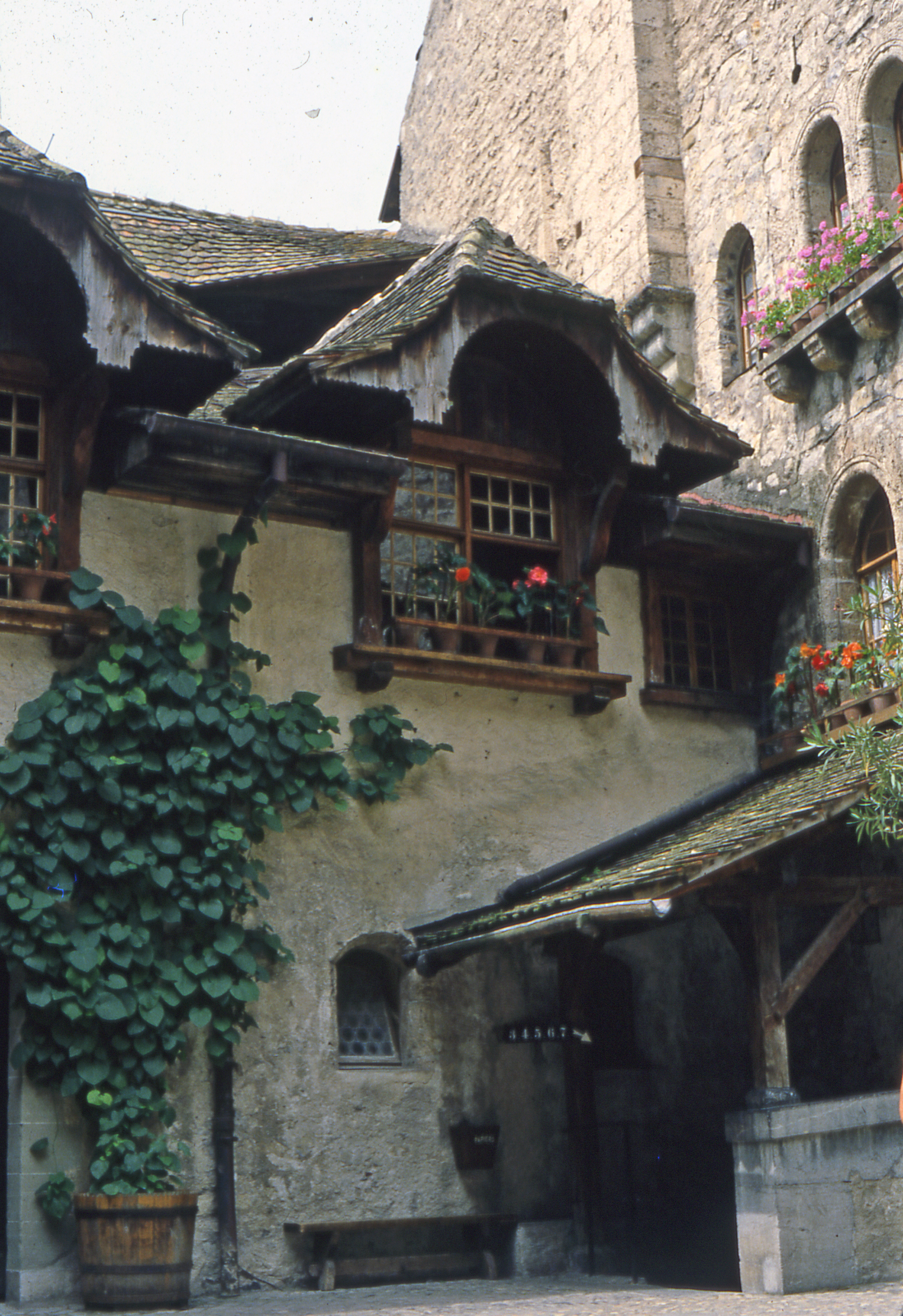
Almost 30 years ago, while I was playing volleyball at BYU, we took a month-long trip to Europe. One of the stops on our tour was Switzerland. I remember seeing the Chateau de Chillon with its stone walls by the lake, Bern and the LDS temple there, and finally the beauty and quiet of Interlaken. I’d love to visit Switzerland again some day.

Chateau de Chillon – 1983

60 Years Ago Today

Monday, 18 August 1952:

At 6 a.m. the hotel desk called us too early. Horrors! We scurried back to bed till 7 a.m. or so for more sleep. Breakfast was at 7:30 a.m. and we didn’t have time to shower, but the kids on the top floor did however.

Then it was time to decide whether we wanted to go on a boat trip at 9:15 a.m. or an art museum at 10 a.m. I decided on the latter along with Elo. With our extra time we trotted around trying the doors of shops until we finally found one open. I purchased a pencil, which I’m using right now, and a little tablet dealy.

Elo and I got a clue about Rembrandt’s house so we proceeded to try and find it. We picked up a guide at the Clock Tower and as a result got there in a round about fashion. I identified a likely spot where Brother Avery might have gone barreling in the mossy brine of the canal. Along the way we passed canal barges loaded with junk scrap metal. At the market place they sold all kind of junk instead of food like most others we had seen.

As Rembrandt’s house was closed when we got there we gazed at the outside, which was quite unpretentious. Then we got rid of our guide and looked for a spot to catch the trolley and ended up at Neve Market. After we caught trolley 11 and thence transferred to trolley 7 we got off practically at the door of the museum with 10 minutes to spare.

We caught sight of Virginia down the street gazing in a window, so we ducked in a doorway and stood there grinning from ear to ear when she came by. We had to wait a few minutes to get in the museum, so we walked through the big archway to see the back of the building.

It was a pretty big museum. As a crowd was waiting to get in the museum we saw that several other members of our mob found their way here too. The famous paintings we saw inside are listed in the back of my Amsterdam guide book.

During the tour we unfortunately discovered that the Van Gogh paintings were in another museum, Stedibjk Municipal Museum to be exact. Our time was almost gone as we hurriedly tried to find the other museum according to the guides information. However, there were many buildings behind the museum and we didn’t know which building it was. I asked a couple of ladies, but they turned out to be tourists too.

Then we found a lady that wasn’t a tourist. She didn’t understand at first, but soon we came to a mutual understanding and she directed us to the right building. It was a miracle. We found it! So we had a running jump through the museum, but not clear through it. Though we did see most of the Van Gogh paintings and some other important artists.

A girl at information directed us to a trolley. We were already ten minutes late so we ran to catch the trolley when we discovered it was going the wrong way. The next trolley going the right way came soon after. Here we were right across from the Kursael or Concert Hall. It seemed like an awfully slow trolley. When we finally came running and puffing into the dining room most of the kids were on their second course. At any rate, due to the good timing by the waiter, with a delay in serving desserts for the rest of the mob, we ended up finishing at the same time together.

At about 1 p.m. or shortly thereafter we were off to Rotterdam. We stopped at American Express across from the Royal Palace. Bev had a letter from Elder Elton about tapestries, but he had been transferred. We picked up Ione at the Hague. The Hague which means hunting grounds, was the capital of Netherlands and the seat of the World Court.

Ione was waiting with Claire right by the Peace Palace. I ran over and stuck my nose inside the Peace Palace which was built in 1913. A man wanted us to pay even for that small privilege. A donation was given by Carnegie for the overall cost of the Peace Palace. He gave 1½ million to help build the beautiful gardens, marble staircases and an elaborate lobby. It is older than the League of Nations. Over three million people live around the Hague.

As we came into Rotterdam we passed through a large housing district and sighted our hotel before we had wandered half as far as we usually do. We were staying at the Atlanta Hotel, but first we had to deal with our baggage problem.

Afterwards, we found out there was an American Express just down the street. I thought I was following Herr Rogers and Watkins to the said American Express, but I found myself down the street in the wrong direction. An accommodating young man helped to get me started in the right direction. In fact, he practically walked me to the door. Just for kicks, I asked for mail in the mail depot. Well, whatta ya know! A big fat surprise with a letter from the Hoyts.

Then I found my way back to the bus. Not everyone was there, but we went anyway. We traveled through the Maas Tunnel which was a fine example of Dutch engineering skill. There were six tunnels with two tunnels each for cars, bikes, and pedstrians with each tunnel going one way.
En route we ran into a little unexpected difficulty as Andre came close enough to almost hit a little girl either on foot or on a bike. When our baggage problem was finally taken care of we went back to our “neaty” hotel. There was a bathtub in each room. Yea!

From our short travels through Rotterdam I could see that the heart of the city had been completely destroyed by Hitler and vast reconstruction was in process. This was the birthplace of Erasmus, a classical theologian scholar and celebrated philosopher. We ended up at an open cute little restaurant, Erasmus, which was not far from the hotel. There was an Erasmus statue in front of the restaurant and I had a fish dish called Erasmus. Funny heh? Near the hotel I noticed An American in Paris was playing at a movie theater. Then I lost one of my one ounce copper earrings and went back to the cafe looking for it.

One Year Old – Yakira

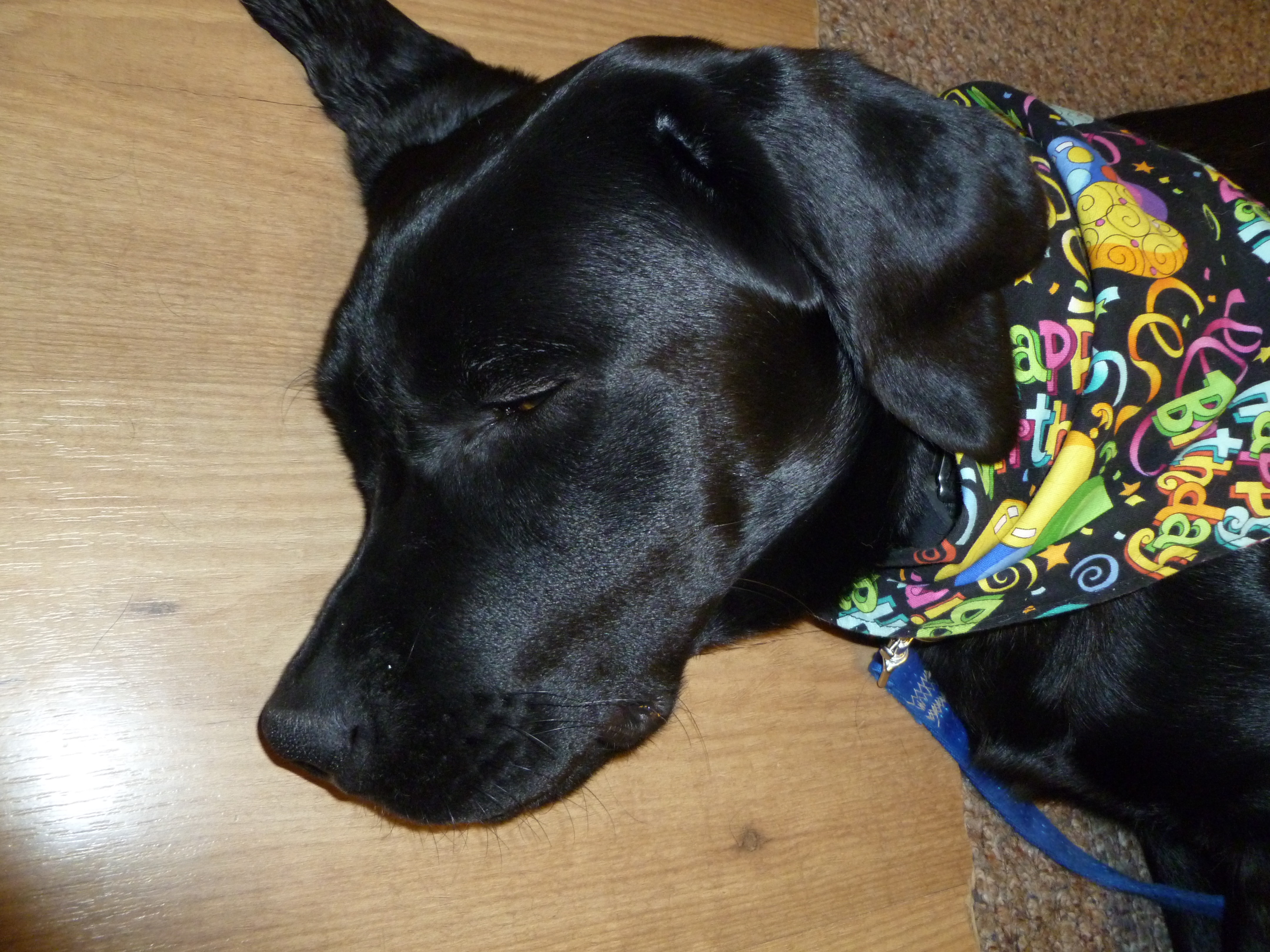
Yakira in the birthday bandana

This week marked Yakira’s first birthday. This is a big milestone in a puppies life. Now we switch her over to adult food. So I got out a bunch of small storage containers and measured out all the food for the next week so that she can make a smooth transition without any digestive upset. I like to do it this way instead of trying to keep track of how much of each food she is supposed to eat each day. Plus it makes it easier for Bill, who usually feeds the pups their breakfast. Usually we are also finishing off the last of the puppy food so then once it is all measured out I can tell when to actually start the transition and not end up with a bunch of puppy food to store until we get the next puppy. With Zodiac here I didn’t have to worry about that.

The other side of Yakira’s birthday is that her time with us is coming to a close. She will probably head back to guide dogs in two months. It could be longer depending on the timing of puppy trucks and what the needs of the breeding department is. Last year Casey’s return was delayed a couple of months because the breeding department had too many dogs to evaluate already that they didn’t want her yet. Yakira is a sweet and wonderful dog and she is “very well put together” as the CFR (Community Field Representative) put it when she evaluated her in July. Because of this she sent a note to breeding to keep an eye out for Yakira. That put together with her diverse lineage from outside of GDB, I’m guessing they would really like for her to be a breeder if she passes all the other tests.

So we have entered the final leg of raising Yakira. I’m sure the time for her to get on the truck will be here too soon. At the same time I always look forward to finding out what the future brings for our dear sweet Yakira. Plus in many ways I am looking forward to being a one dog household again.