Gift Idea #6 – Old Family Letters

A project I would like to do in the future as a gift to my extended family has to do with the love letters my grandparents wrote to each other before they got married. I’d like to transcribe them but also scan them so that everyone could see what the originals looked like but also make it easier to read them.

This project could be easily shared on a cd or dvd. But it would also be nice in a book format with the image of the letter on one page and the transcription on the facing page. I think reading these old letters would help today’s generation have a whole new understanding of their great-grandparents.

You could do the same thing with letters from a family member while away at school or war or some other common theme for a series of correspondences.

Gift Idea #5 – Collection of Family Photos

Most families have someone who is the keeper of the photos. Somehow that task has fallen to me. So last Christmas I gathered up the images I have. Scanned the ones that hadn’t been scanned. Then cleaned them up and label them consistently. I just did the ones connected with my mom’s parents from their childhood through their deaths. I cut DVD‘s for my mom’s siblings. For all of my cousins I sent a link to the SmugMug gallery that I set up with the same photos. That way they can get access to and download them as desired. This is a great project because it gives everyone access to those precious photos plus it distributes copies in more places to make sure they are preserved in case of disaster. An added bonus is that now they don’t have to come to me when they want a photo.

My advice on a project like this?

  • Pick a time frame. Don’t feel like you have to do it all. Make it something doable. You can always add to it later.
  • Pick a logical naming convention.
  • Make sure you scan them at 300 dpi or higher. If it is a really small photo I like to do 600 dpi or more so that it can be blown up larger than the original.
  • For long-term storage tiff is a better format than jpeg, because jpeg is a lossy compression and over time with opening and saving and opening and saving you lose data. But most people are more comfortable with jpegs. So you could scan as tiffs and then save a copy to jpeg for sharing with your family.
  • Find an easy way to distribute them among your family.


Gift Idea #4 – Personalized Planner

Last year I made one of Blurb.com‘s weekly planners for a friend. It turned out really nice with a photo for each month and the front and back covers. This year they have even more options and with their BookSmart tool it is an afternoon or evening project. There are other planners out there that you can customize with photos but in my searching I didn’t find one that will let you add important dates.

Of course you can design your own planner from top to bottom in Adobe InDesign but that isn’t an afternoon project and BookSmart gives a surprising amount of control. Which ever route you take I think it would be fun to put together a family planner with historic photos and important dates from the past. Click on the image below to a Blurberati Blog post about their weekly planner.

Gift Idea #3 – Infographic

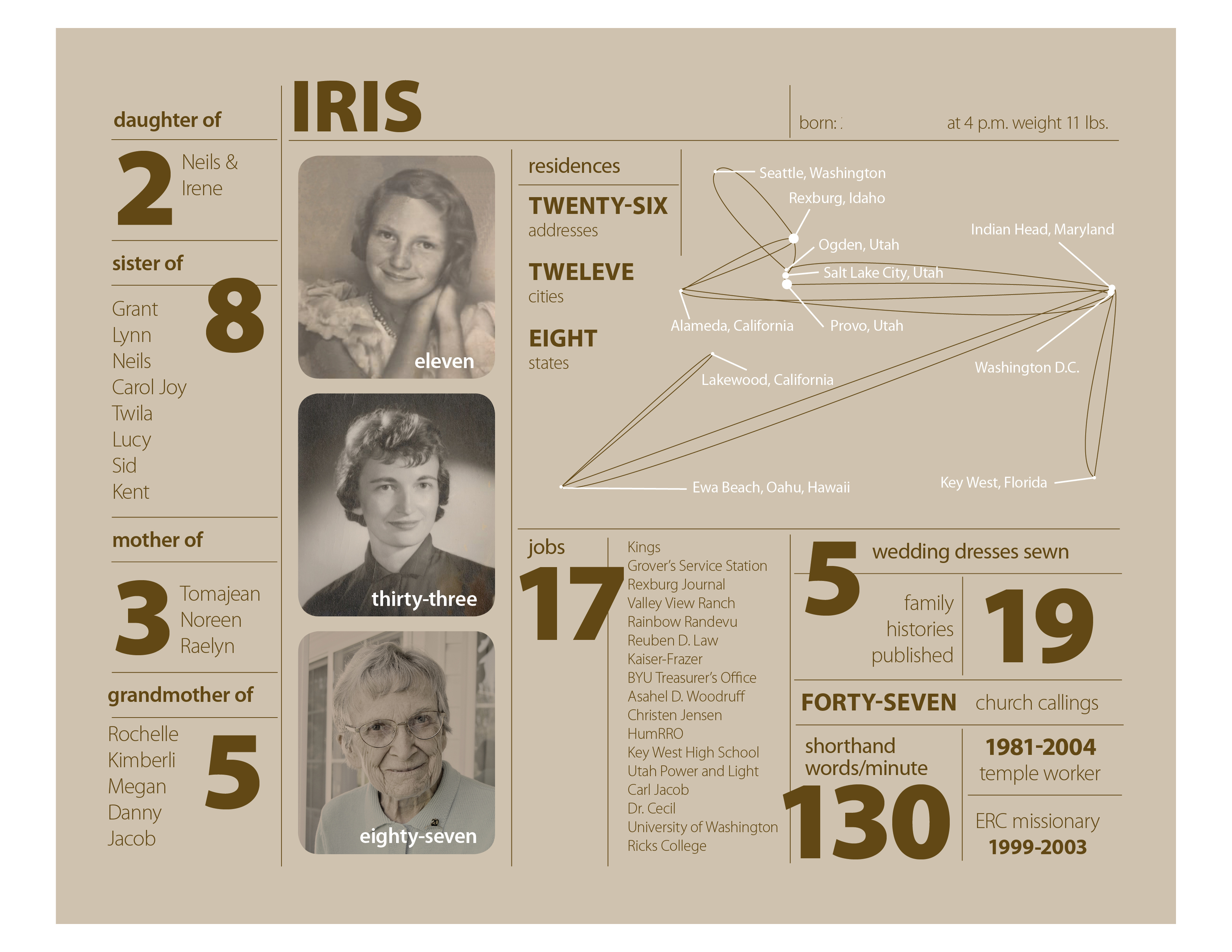
When we think of doing a history of someone it usually feels like an overwhelming project that we just don’t have time for, especially when it comes to the holiday season. So I suggest taking on a bite sized project of an infographic about an ancestor or family member to give as a gift. Infographics are a way to communicate some of the more important information about something in a quick to understand way. You can put it into a frame or turn it into a tradition and pick a new person each year and give each person a binder or scrapbook to collect all the info-graphics in. I did a post about the infographic I did for my mom for Mother’s Day. It will help you get started. You will need to gather some information about the person and a few photos or other images. Clip art can also be helpful. Just have some fun and see how this project can come together.

Mother’s Day Project for Iris

I found this example of a family infographic today. It is pretty cool because it is customizable and comes in three colors schemes and five sizes. If you want a family infographic but don’t want to tackle the design yourself this is a great option.

“by the numbers” by Kristen Smith at minted.com


Gift Idea #2 – Family History Conference

If someone in you family would love to expand their knowledge on how to do family history why not give register them for a conference or a class on family history. If you are the one, then why not give it to yourself for Christmas! There is a great one here in Utah in March called RootsTech. I went last year and loved it because it has so many different kinds of classes from the technology side to traditional research. They have added a new “Getting Started” that is only $19 for a one-day pass. Full 3-day Passes are now $149 with the early bird discount. If Salt Lake is too far away for the budget, then do some research and find a local class or conference you can give. What better way to help tell your families tales than to learn how to find more family members to tell stories about. Maybe I’ll see you at RootsTech.


Gift Idea #1 – Have an Ancestor to Dinner

This idea is inspired by the tradition of having a special birthday plate that is only used on birthdays by the person whose birthday it is. In my version wrap a special plate, either one you already have or one that you make or buy just for this purpose. Then you have a family dinner and set an extra place at the table with this plate. During the meal you talk about the ancestor or family member that is the special guest for dinner. Someone could be ready with stories about you special guest or family members could share memories about that person, depending on the situation. You could even invite someone to come in costume as the ancestor and play the role for the night.

These special dinners could be held monthly or on or near the birthday of the ancestor or whatever works for your family. You could place card by the special plate with the guest of honors name and a photo would be a nice touch. If you know a favorite food of the guest, it would be fun to serve that as part of the meal. This is just a starting point. The same idea would work for living members of your family and use it as a way to honor the talents and accomplishments of the guest of honor.

If you Google custom plates there are tons of options of plates you can buy with a family name or other images. There are many ways to decorate a glass or ceramic plate yourself. Below are a few links to give you some ideas and get you started on this project.

Glass Plate Craft

How to Use Porcelain Paint Pens

Decoupage Dinner Plate

Family Name Platter

Etched Glass Dinner Plate

Personalized Melamine Plate

50 gift ideas challenge

I’ve decided to challenge myself to come up with 50 gift ideas that will help you to tell your family tales by Christmas. I’ve done some brainstorming and I think I can do it but it isn’t going to be easy. 50 is just such a nice number, especially in this my 50th year. So stay tuned over the next five weeks and see if any of my ideas give you some inspiration for gifts for your family and friends. I’ll post my first idea soon!

This Week in 1856 – Rocky Ridge to Bear River – Mary Taylor

From John Jacques:

By this time, the shoes of many of the emigrants had “given out,” and that was no journey for shoeless men, women and children to make at such a season of the year, and trudge it on foot. As the emigrants proceeded on their terrible journey, there was no appreciable mitigation of the piercing wintry cold, but its intensity rather increased. The Rocky Ridge and the South Pass were crossed on the 18th of November, a bitterly cold day.

Mary received a pair of shoes from one of the rescuers. Her shoes had long since worn out and she wrapped her feet in canvas from discarded tents.

From John Jacques:

The snow fell fast and the wind blew piercingly from the north. For several days, the company had been meeting more relief teams, which had been urged on by the Joseph A. Young express, and as the company was crossing the South Pass, there was a sufficiency of wagons, for the first time, to carry all the people, and thenceforth, the traveling was more rapid. But it was much colder to ride in a wagon than to follow afoot, and a few of the sturdier of the emigrants preferred to hold on to the wagons and walk behind them. One stubborn pedestrian held out as long as he was allowed to do so. The driver repeatedly urged on him to get up and ride. “Oh, I shall freeze, if I do,” he replied. “Well, we are going to drive faster, and you’ll be left behind,” said the driver. Finally, with such argument, the emigrant was persuaded to get into the wagon. When he was seated, the driver said, “There now, you don’t get out to walk anymore.”

William Bert Simmons, one of the rescuers, put Mary in his wagon. She was semiconscious at times and half frozen.

From John Jacques:

That night, the company camped in the willows at Pacific Springs, about four miles west of the South Pass. The snow was still falling furiously, with one or two feet of it on the ground. Here, Robert T. Burton took charge of the relief companies.

On the 19th, the company camped at Little Sandy, having sage brush for fuel, and on the 20th, on the Big Sandy.

While camping on the Big Sandy, it seemed impossible to get warm, sleeping in a wagon. It was warmer sleeping with beds on the ground, where if the biting, frosty air got the upper hand of you, it could not get the underside of you as well, but it could do both in a wagon.

The handcart company all riding, was now traveling at the rate of twenty-five to thirty miles a day, and my narrative will naturally proceed more rapidly. On the 21st, the company camped at Green River, on the 22nd, near the junction of Ham’s and Black’s forks; on the 23rd, at Bridger; on the 24th, in the cedars on the Muddy, were good fires were had; and on the 25th at Bear River.

At this camp there was an abundance of dry and fallen timber, and great camp fires were made of a cor or more of logs and branches. Here Joseph Young and his brother Brigham were in camp.

This Week in 1856 – Ephraim Hanks – Mary Taylor

From John Jacques:

While on the Sweetwater Ephraim Hanks was met one day. He had left his wagon behind him and came on alone, on horseback, and he managed to kill a buffalo. Some of the others of the relief parties, further this way, had come to the conclusion that the rear companies of the emigration had perished in the snow, but Ephraim was determined to go along, even though alone, and see for himself.

From Ephraim K. Hanks:

Ephraim Hanks, a prominent member of the 19th-...

Ephraim Hanks, a prominent member of the 19th-Century Latter Day Saint movement, a Mormon pioneer and a well known leader in the early settlement of Utah. (Photo credit: Wikipedia)

Being deeply concerned about the possible fate of the emigrants, and feeling anxious to learn of their condition, I determined to start out on horseback to meet them, for this purpose, I secured a pack-saddle, and two animals from Brother Allred, and began to make my way slowly through the snow, alone.

After traveling for some time, I met Joseph A. Young, and one of the Garr boys, two of the relief company which had been out from Salt Lake City, to help the companies. They had met the emigrants, and were now returning with important dispatches from the camps, to the headquarters of the church, reporting the awful condition of the companies.

In the meantime, I continued on m lonely journey, and the night after meeting Elders Young and Garr, I camped in the snow in the mountains. As I was preparing to make a bed in the snow, with the fe articles that my pack animal carried, I though how comfortable a buffalo robe would be on such an occasion, and also how I would relish a little buffalo meat for supper. Before lying down for the night, I asked the Lord to send me a buffalo. Now, I am a firm believer in the efficiency of prayer, and after praying as I did on that lonely night, on the South Pass, I looked around me and spied a buffalo bull, within fifty yards of my camp. I had certainly not expected so immediate an answer to my prayer. . . taking deliberate aim at the animal, my first shot brought him down. . . I was soon busily engaged skinning my game.

Early the next morning, I was on my way again, and soon reached what is known as the Ice Springs bench. There, I happened upon a herd of buffalo, and killed a nice cow. . . I was impressed to do this, although I did not know why until a few hours later, but the thought occurred to my mind, that the hand of the Lord was in it, as it was a rare thing to find buffalo herds around that place, at this late part of the season. I skinned and dressed the cow, then cut up port of it’s meat, in long strips, and loaded both my horses with it. Thereupon, I resumed my journey and traveled on till towards evening.

I think the sun was about an hour high in the west,w hen I spied something in the distance, that looked like a black streak in the snow. As I go near to it, I perceived it moved; then, I was satisfied that this was the long looked for handcart company, led by Captain Edward Martin. I reached the ill-fated train just as the emigrants were camping for the night.

The sight that met my gaze as I entered their camp, can never be erased from my memory. The starved forms and haggard countenances of the poor suffers, as they moved about slowly, shivering with cold, to prepare their scanty evening meal, was enough to touch the stoutest heart. When they saw me coming, they hailed me With joy inexpressible, and when they further beheld the supply of fresh meat I brought into their camp, their gratitude knew no bounds. Flocking around me, one would say, “Oh, please, give me a small piece of meat,” another would exclaim, “My poor children are starving, do give me a little,” and children with tears in their eyes would call out, “Give me some, give me some.” At first, I tried to wait on them, and handed out the meat as they called for it, but finally, I told them to help themselves. Five minutes later, both my horses had been release of their extra burden, the meat was all gone, and the next few hours found the people in camp busily engaged cooking and eating it with thankful hearts.

A prophecy had been made by one of the brethren, that the company should feast on buffalo meat, when their provisions might run short. My arrival in their camp, loaded with meat, was the beginning of the fulfillment of that prediction, but only the beginning, as I afterwards shot and killed a number of buffalo for them as we journeyed along.

This Week in 1856 – Martin’s Cove – Mary Taylor

From John Jacques:

The great object now was, to save as many of the people as possible, to which everything else must give way, and the lives of the people depended in great degree, on the lives of the teams so it was essential to spare the animals all unnecessary labor.

Under this arrangement, the company started from Devil’s Gate, westward, and about three miles away, crossed the Sweetwater to the north side, and camped at a place, since known as Martin’s Ravine.

It is not exactly a ravine, but a recess, or opening in the mountains, which here ran along near the river. The passage of the Sweetwater at this point, was a severe operation to many of the company. It was the worst river crossing of the expedition. It was the last ford that the emigrants waded over. The water was not less than two feet deep, perhaps a little more in the deepest parts, but it was intensely cold. The ice was three or four inches thick, and the bottom of the river, muddy or sandy. I forget exactly how wide the stream was there, but I think thirty or forty yards. It seemed a good deal wider than that to those who pulled their handcarts through it. Before the crossing was completed, the shades of evening were closing around, and, as everybody knows, that is the coldest hour of the twenty-four, or at least it seems to be so, in a frosty time, and it seemed so then, for cold enough it was.

From Samuel Openshaw:

We traveled about two miles, crossed over the Sweetwater,  some on the ice and others waded through, which was about 3 1/2 feet deep. James Lord and myself pulled the handcart across the creek. The women and children were all carried across by some of the brethren who had come from the valley.

From John Jacques:

The teams, wagons, handcarts, and some of the men forded the river. A son of Heber C. Kimball, and a son of George D. Grant, and I believe several others of the relief party, waded the river, helping the handcarts through, and carrying the women and children, and some of the weaker of the men over. If I were certain of the names of all those brave waders, I would insert them here.

The handcart company rested in Martin’s ravine two or three or more days, though under the shelter of the northern mountains, it was a cold place. One night, the gusty wind blew over a number of the tents, and it was with difficulty some of the emigrants kept from freezing.

At length, preparations having been completed for a final start from Devil’s Gate and vicinity, the handcart company left the ravine. The precise date I cannot give, but I think it must have been about the 19th of November.  I cannot remember the handcarts after leaving the ravine, and my impression is that none were taken from there, but some persons of the company think that a few carts were taken along several days longer.

Be that as it may, by this time, there was a sufficiency of wagons to take in most, if not all, of the baggage of the company, and to carry some of the people.

It was a trying time, that day in leaving the ravine. One perplexing difficulty was to determine who should ride, for many must still walk, though, so far as I recollect, and certainly for most of the company, the cart pulling occupation was gone. There was considerable crying of women and children, and perhaps a few of the men, whom the wagons could not accommodate with a ride. One of the relief party remarked that in all the mobbings and drivings of the “Mormons” he had seen nothing like it. Cyrus H. Wheelock could scarcely refrain from shedding tears, and he declared that he would willingly give his own life if that would save the lives of the emigrants.

After a time, a start was effected and the march was recommenced along the valley of the Sweetwater, toward the setting sun.

From Samuel Openshaw:

Having to leave all the flour that it was thought we could do without [to supply the 20 men staying behind with the freight etc.] until we should meet a fresh supply from the valley, we now realized that such low rations and our bodily strength having been so much reduced by our former privations, and being such cold and inclement weather, a great many died. However, we made another start, some with bundles on their backs, a number of others would join together and put them on a handcart. Some would be crying, others singing, and thus went trudging along as best we could.

According to family tradition Mary’s mother, Harriet Taylor, died and was buried in Martin’s Cove on November 10th with just brush and snow as a covering because the ground was frozen too hard to dig a decent grave. Now it was Mary was alone with Cousin Eliza having lost her first her father, than her husband and now her mother.