60 Years Ago Today

Friday, 11 July 1952:

The bed was too wonderful! Even more comfortable than when I first crawled into it. I had to get up though. There were new fields to conquer. First on the list was the post office where I mailed five cards for 2.75 francs. Looking around I discovered that the Matterhorn was at its best. The sky was crystal clear blue and peak free of clouds.

As we tried to catch the train, there was not enough room on the train for us. Herr Rogers explained that there were 36 of us so the train workers rolled the baggage car onto the next track and put on another car. Herr Rogers helped. We experienced the same beautiful scenery on the way down or maybe even more so. It kind of grew on you.

As we reached the Stalden station, we were confused whether or not to get off. Andre where art thou? Nope, stay on. Herr Rogers breathlessly came dashing in with more tickets to go on to Visp. Andre couldn’t get through. We prayed that he was at Visp. We were captivated once again with more picturesque scenery of the kind that defied description. One had to see it to appreciate it.
Visp was coming up. Could anyone see Andre? Yes, yes, there he was. Whatta reunion! Never were we so glad to see Andre. Fifteen “rahs” for Andre! Another fifteen rahs because our baggage was all repacked and ready to go. I’ll bet Andre felt like the hen who just found his 36 chicks. Cause we swarmed around him just like chicks around a mother hen.

More beautiful countryside ahead, in stark contrast to tank barriers and mined roads. I spotted a landing strip on both sides of a tree-lined road. It rounded and crossed the road at one end. The hanger was camouflaged with straw.

We traveled through Rhone Valley where it was warmer. We viewed ruins of an old castle on a hilltop, this was the French section of Switzerland. They irrigated by sprinklers. Everyone had lunch on the road again. It included cherry jam sandwiches, an apple, and a cookie. When we crossed the Rhone River, it was a tight squeeze getting the bus onto the bridge. Then there was a sharp turn, but Andre always came through. At 1 p.m. we arrived at Lake Geneva with its beautiful blue water. Later we ran into some road repair.

Castle of Chillon, built in 1256 by Peter of Savoy, was where Byron got his inspiration for the Prisoner of Chillon, a 659 line narrative poem. We walked down the road to the castle and saw a camouflaged gun mounted in a wall along the road. The castle bore the emblem of Berne from 1536 a.d. and was built to guard the road and collect toll taxes.

There was a Gothic prison downstairs with stone slabs for those condemned to death and a hole where some prisoners were thrown down and forgotten. Also I saw the gallows and windows where prisoners were thrown into the lake with a stone tied to them. Byron’s poem described the trials of a lone survivor of a family. He spent four years in prison and was almost blind. Byron visited him and carved his name in the stone.

The guide said that a big banquet was scheduled there for that evening. Candles were at each place setting. What an atmosphere! We saw banquet halls with heavy old pewter ware, swords, and other weapons. Then we proceeded through the torture chambers. We had a good English speaking guide. She was an Italian looking lady with dark hair and a pleasant voice. I noticed her beautiful ivory necklace.

Next on the tour was the old moat, towers and places where they poured boiling hot water on their attackers. I didn’t have my notebook with me and couldn’t remember everything she told us. I bought a souvenir, book of Chillon, at the little shop outside the gate. Then it was back to the bus and off to the hotel.

The hotel turned out to be a large, pretty place right along the highway overlooking the Lac Leman on the outskirts of Montreux. It had a beautiful lobby downstairs, game room, and a pleasant girl at the front desk. When I asked her a question about the concert, the phone rang. She lifted the receiver and kept talking to me until she had finished.

The hotel, though it had seen better days, was still nice. And it turned out to be the only hotel so far without running water in the rooms. We had huge pitchers of water, large basins, a “dealy” in which to pour the waste water, and a big long soap dish. All of this was flowered crockery. I got lost almost every time I left my room with too many twists and turns. I cleaned up slightly to go visiting. Herr Watkins, Alicia, Henry and I took off for Montreux Proper to find the folks of Herr’s home teacher back home in Orem. We decided to walk instead of using the train so we had a chance to window shop on the way.

One store had darling little dresses. Herr Watkins finally succumbed and ended up with one for his little girl. After wandering around in a couple of circles, we found the right street and number. Up some stairs we went and knocked on the door. A little, slightly stooped man peered over his glasses at us. Herr Watkins explained to him in German who we were. I guess we took him by surprise because he seemed a little at a loss. He asked us to come back at 7:30 p.m. when his wife, who spoke English, would be home. Before we left, his kids squirted us with their water guns.

After saying adieu to Art and Henry, we went window shopping for awhile. Then we searched for a likely eating spot. We finally settled for a tea room that looked more French than Swiss. It was cool and pleasant. I had a plate of assorted cold meat and a milk shake. Ha! Ha! They should let us show them how to make milk shakes. After I went to a perfume shop and “john” at the big station.

Later we went back to visit Herr’s friend’s parents. They were thrilled to see us and had been crying for fear that we wouldn’t come back. They had a dressmaker and tailor shop in their home. They once had a dressmaking shop under our hotel, in the days when it was Montreux’s biggest and best, that catered to royalty. Their flat was clean and nice, but quite modest.
We looked at pictures, talked a little German with them and they showed us around. We went for a boat ride around the lake and, unfortunately, saw a crowd at the side of the lake that was looking for a drowned man’s body.

As we passed Chillon, it was all lit up. People at the banquet waved to us as we circled around the lake. What a beautiful night and city with weeping willows everywhere. They insisted on taking us to the casino for a drink. The casino insisted on charging 2.50 for drinks plus 15 cents cover. I had a really jippy ginger ale. There was a New York band with an interesting floor show. Other entertainment included: four ballet dancers, comedy team, and a Spanish number. The roulette table was quite a temptation for me. Later we walked home with them and then back to the hotel ourselves.

60 Years Ago Today

Thursday, 10 July 1952:

I just gained consciousness at 12:15 p.m. in the afternoon. What a wonderful 12 hours or more of sleep! It was the most sleep I had had since long before I can remember—long before I left the USA that’s for sure.

Wow! I realized I could eat a horse to put it mildly. A crowd of kids in front of the hotel directed us to their favorite restaurant. The restaurant was a red shuttered deal down the street in a charmingly typical village. Everyone seemed to be on their way to hike or returning from a hike. They wore coats by the way. Guess we didn’t lug ours all this way for nothing.

The waitress wore a Swiss costume. They even let us take their picture. I had a delicious dinner for 4.50 franc. I filled my soup bowl twice and there was still enough left for a third time. It was in a copper warmer on legs with candles inside. My platter included a pile of fluffy mashed potatoes on top of two pork chops, bowl of salad, and turnips. There was enough for several servings of each. But I had to gulp down the delicious ice cream because there went the mob around the bend to the ski lift. That made us tail-enders again.

Such a picturesque trail with all kinds of little chalets. There was a saying that Zermatt had the population of 1000 inhabitants and 7000 tourists. The natives were almost exclusively engaged in taking care of the visitors. I was glad that we made it in time to go with the mob because it saved me 1.50 franc, net cost 3.50 franc. Alicia and I were next to last in line. Herr Rogers and Mrs. Rogers brought up the rear after seeing that everyone was duly taken care of. It was my first ride on a ski lift! And it was quite a thrill with a wonderful view of the countryside. I went over the top of the first hill just to see another hill beyond that. The lift ended on the top. A sign on the bar that held us in the lift said “Do Not Swing.”

We hiked on up from the lift house and waited for the clouds to clear in order to take pictures of the Matterhorn. On the trail we met many Swiss German, Swiss French, and Swiss Italians. I tried to talk to them, but found it a little difficult. However, I managed to get a few ideas across. People were very friendly and most of them spoke several languages which usually included French and German.

We topped a couple of hills and returned to the lift. Then I had a great big bottle of orangeade. Now I was ready for the return ride. Halfway down the lift I had a tremendous urge to take a picture, but I had used my last picture up on the mountain. I had to curb that urge.

Back on the street, I saw a lady milking a cow. She was very friendly and lived above the barn. Next stop was the hotel. After a quick break to lighten our load, we took off for an excursion to the village. We picked up a bunch of food—apple, pear, box of raisins, delicious Swiss chocolate—as we left. We washed the fruit in the first watering trough. There were people returning from the mountains on every trail. It seemed all trails led back to Zermatt.

Switzerland was really international as you could hear any tongue your heart desires. Most of the people were dressed comfortably, but not richly with heavy shoes and socks, often long wool socks. I had picked up a picture of a beautiful waterfall at the hotel, so we inquired how to find our way to the real thing.

As we left for the waterfall we met people coming back from the fields with their scythes and forks. It was hay making time. Then we made our way to Gorner’s Villa, a little inn upon the mountainside. Around the corner a frau was waiting for us by a sign. It cost 1 franc to go by. Wouldn’t you know it! The man at the hotel didn’t mention this. Well if it was worth charging for, it must be worth seeing. I guess? Far be it from me to turn back now.

There were stairs going down to a bridge. The path was built right into the side of the perpendicular gorge. Another bridge went across the gorge with water foaming angrily below it. The waterfall was cutting its way through the mountain. A man came along behind us and explained that the rushing water had cut the gorge out of the mountain over a period of years. Now the gorge was deep. I chanced a couple of pictures even though the light was poor.

I think we missed the trail on the way back because we ended up in a hay field. A farmer stopped his work of turning hay and talked to us. In addition to his occupation as a farmer, he was a guide and professional skier. He was a farmer through the summer months in order to grow feed for the other nine months of the year. The cattle were put out to graze during the summer months. He tilled the same land ancestors had tilled for the last 600 years. Furthermore, he spoke very good English in addition to several other languages.

Now that we had found our way back on the pathway, we discovered a crossroad with several paths leading back to Zermatt. We tried to find out which path was the prettiest. “They were all pretty” was the answer. We chose by the eenie meenie miney mo method to decide our direction.
We ended up going back by the church graveyard, where all those who had been conquered by the Matterhorn were resting their bones. It was quite an imposing area of tombstones with some rather recent tombstones as well. Those who wanted to attempt to climb the Matterhorn should visit here first. Then perhaps they would exercise every precaution in their attempt to conquer the Matterhorn.

The graveyard was peaceful and beautiful. Flowers were growing on almost every grave with lots of big wreaths of little colored beads, trees, and shrubs. Many other natives of the village rest here along with the daring mountain climbers. I ate pretzels on the way home.

As we went back to Hotel Victoria everyone was all excited. A lady down the street was offering a 15% discount if our group bought $200 worth of merchandise. Most everyone succumbed to this deal as witnessed by the loot that was brought back later. From reports I gathered our mob had driven the shop lady slightly mad. Carol and Alene had succumbed earlier, as well, and both were sporting quite beautiful Swiss specimens. Carol and I crawled down through the village to see what was brewing, but things seemed relatively quiet.

So we returned and drooled over the loot before returning to our luscious beds. I would love to take this bed with me wherever I go. I received mail from my parents at each mail stop so far. I wrote them about Zermatt and the Matterhorn. It was as beautiful in its own way as Venice, Florence or Rome.

60 Years Ago Today

Wednesday, 9 July 1952:

I had a delicious cold shower this morning. We had been staying on the top floor of a boys’ dorm. A little man had locked our door from the outside during the night and had stood guard all night long to presumably protect us from the men. I took my bag down from our room on the top floor. We were miles away from where the rest of our crew were staying. Our group was really separated this time. Across the street I got fruit for lunch where oranges were 300 lire a kilo. Then we left and had little trouble finding our way out of Milano.

We traveled on Autostrada, a toll road. I caught sight of Lake Magiore. It looked like a wonderful place to spend a lifetime. There was an island out in the middle like Venezia. As the mountains got higher, the air cooled. Switzerland was coming up! We stopped at a small town about 12 miles from the border, Domodossola, to unload the last lire. It was one U.S. cent for the “john”.

We were definitely leaving the low country now. The sheer mountain peaks were rising abruptly as we left our last stop. I felt the Swiss influence or maybe it was the influence of the mountains. There were swift running streams, little rock houses, and winding mountain roads with patches of snow. The border buildings were unimpressive. In between all of this I saw a 1952 Studebaker.

There wasn’t any red tape on the Italian border, but at the Swiss border our passports were checked. As we journeyed into Switzerland, there was a swift moving stream between our bus and the sheer rugged cliffs. Herr Watkins commented that we were leaving behind the academic part of our tour and entering the esthetic portion.

Everyone was excited about going into Switzerland—such breathtaking scenery! Beautiful meadows stretched right up to the edges of the snow. Families were outside making hay on the hillsides. I saw a little boy under an umbrella on a hill by Simplon Pass. Also I saw the movie Heidi relived on the mountainside in my mind. All of us were shooting pictures out of the window.

There were fortifications in several places along the way. We found out the roads were mined and were ready to be blown up at a moment’s notice. This was in case of an invasion. Meanwhile the bus had clutch trouble, so we stopped at the next rest stop.

While we were at the rest stop, Carmela was busy gathering bugs with Henry’s milk bottle. At the same time Henry was searching madly for his bottle to get milk from a Swiss farmer. The current topic of conversation was milking cows. As we continued there was more snow visible in the mountains and it was much cooler, so bringing our coats hadn’t been for naught.

The water was finding its way down the mountain in little rivulets. Herr Rogers gave a Swiss lecture about how mountains play a big part in Swiss life. The Alps and Jero Range helped form a border between France and Switzerland. These mountain barriers helped the Swiss people maintain their independence. Switzerland with few natural resources was dependent upon tourist trade.

We hit a 12 mile tunnel, Simplon Pass, where the passes were mined and fortified. Then I saw a valley meadow with an old church where workers were removing the mines along the road. There was a free shower outside. When I saw little kids herding cows, it reminded me of my childhood. Switzerland had 22 cantons, a small administrative division of the country, which occupied distinct valleys.

As we stopped for gas and milk I saw a large statue of an eagle on a hill top at the summit pass. SOS casa contoniera is the Swiss’ rest stop. Back on the bus there were colored mountain goats on the inclines and little clouds hanging down between the huge mountain walls on the east side. Beautiful waterfalls dotted the mountains as well. What terrific scenery!

Herr Watkins yelled out and asked a man if he knew his great grandmother. Then there was some kind of bottleneck ahead. All the men jumped out to investigate. The rain had washed the bridge away. We couldn’t wait for it to be fixed or we would miss the train to Zermatt.

So we had a council of war with a decision to be made. I guess we were going on a cross country hike to the bridge. We got our suitcases down. The kids opened them on the road in the rain to get their supplies out for two nights. We definitely got our raincoats and boots out as well. With big suitcases back inside the bus, we bid adieu to Andre.

Whatta sight! Thirty-six characters with different kinds of garb and bags on a cross country hike. As we met the road again, Herr Rogers buzzed by in a car in order to make arrangements ahead of us. Bonnie had a big suitcase and Helen’s suitcase was not so small. We thumbed a ride and everyone piled in with suitcases.

As the rain stopped, we could see the car’s tires going down so Helen and I got out and walked. We shed our coats and brought up the rear. It was a beautiful refreshing walk in the Swiss countryside. As we strolled into the town of Brig, a little boy leaned out of a three-story window to wave. Brig had clean streets and shops.

At the railroad station, I changed my first traveler’s check into Swiss francs. My insides were groaning with hunger. We found a café in the station that provided a delicious meal for 4.25 francs plus tip. I had spaghetti and pork. It was time for the train, so the waitress put the fruit for dessert in a sack and we ran out.

Somehow I got out on the wrong side of the depot. Probably because there were train tracks all over the place. I ran around madly trying to find a sortie. In the process I darted into the same office twice and finally remembered the stairs I had used to get to the café. It was past time for the train to leave as I dashed frantically out the right door onto the right track.

No one was in sight. I couldn’t see a train on the track and a sinking feeling set in. I asked the first person I came to if the train for Zermatt had gone. “No, it’s right there,” as they pointed to the next track. I peered in the windows. Yep! There they were. What a relief!

It was an interesting train ride to Zermatt. I practiced a little German with servicemen on leave from Frankfurt. The scenery was rugged with magnificent meadows right up to the snow line. The water and waterfalls were trickling down the mountainsides in unexpected places with a view of little houses with rock shingles. My first glimpse of the Matterhorn was impressive with its stark rugged peak above all the rest and clouds hung all around it.

We made it to Zermatt! All out. Hotel where art thou? It was right across the street. First class too. My room 14 was right off a beautiful lobby. OOOh! The bed looked positively luscious with a beautiful fluffy silk comforter on top. It felt like we may need it here. There were double sinks that were big enough to take a bath in if necessary, plus overstuffed chairs. Gee it was quiet. There were no cars.

First job on the docket was to remove the dirt of Mount Vesuvius from our tresses. Believe it or not, my hair hasn’t had a real shampoo other than the swimming on the first night in Rome when I went to the concert with wet hair. I went out to the desk to check on maps and events. Then I crawled into bed to write. Whatta farce! I should have known better than that. I fell asleep as soon as my head hit the pillow.

60 Years Ago Today

Tuesday, 8 July 1952:

My, the days were going by in a hurry. No bag to pack for me this morning. It was really wonderful to travel light! Breakfast was the same kind today. Well, well, we had some loot this morning! It seemed that some of our crew encouraged a few of the Rodman crew to raid the ship’s larder. We received large canned ham, bread, pickles, and more. Picnic today for lunch!

American Express, who planned our trip, was right on time with the little motor boats or fast taxis to take us down to the Grand Canal to see the biggest bus garage in Europe. I snapped last minute pictures on our way of a gondola, Rialto Bridge, and the pretty white bridge by the station. I caught sight of a gondola food market and house of gold along the Grand Canal. Gee, I hated to leave Venice! I wanted to come back. This trip improved each day and would surely reach the summit soon.

Suitcases were pulled out and flung onto the top of the bus. I succumbed to another silk scarf for 500 lire this time. The man came down from 517 lire. Herr Watkins succumbed too. Guess what—Helen and Margaret got left! We didn’t have to wait for them long though. By the time the luggage was bagged, they came putting along with the canned ham in tow.

I dropped off to sleep not long after we got started. Somehow bus riding was conducive to sleeping. However I jolted awake each time my neck came to a 90 degree angle to my head. Then I took a peak at the gorgeous green landscape and drifted back to sleep.

We journeyed back to Padova, then on to Verona past the beautiful Garda Lake region, and through an interesting beautiful old archway that was high enough for our bus. Somewhere between Milan and Verona we stopped for our picnic near an ANAS (Italian Roads and Motorways National Agency) which was short for Casa Cantoniera. The lunch committee went to work and soon we were munching on bread, ham, and pickles. Our meal ended with a chunk of pastry and a drink from the ANAS.

Then on to Milan. They certainly made use of the psychology of repetition in their billboard signs in Italy. Just like in France there were two or three great big identical signs in a row. We crossed a beautiful clear river, but we were not sure which one. About 8:30 p.m. we were coming into Milan where there was a big new white oblong tenement house. It loomed like a house project on an apartment size scale. I glimpsed a big arch of something similar to Paree Arch de Triomph, spires of Milano Cathedral, and big cathedral square with somebody’s statue. There was a gold statue on the top of the building. Actually it looked like Angel Moroni. This cathedral was really covered with statues and ornate carvings.

During a WC run, I had delicious orangeade and about four glasses of water while waiting for the my turn. I went down to the end of square for a couple of shots of the cathedral. The inside of the cathedral was the most huge, massive church we had seen. It even seemed more overpowering than St. Peter’s Basilica of Rome. I tried to talk to three Italian ladies. It was definitely Gothic and had spires like the Salt Lake Temple. Milan looked quite progressive and clean, at least the section we went through.

Tonight we got the opportunity to stay in a youth hostel. Halfway to the hostel we decided we would like to see the 15th century mural Last Supper first. It would close soon so we decided to go. Everybody was wearing peddle pushers, so we couldn’t get inside the churches. Quickly we traded skirts around and ended up using coats. It turned out to be no cause for alarm, because it wasn’t functioning as a formal church. The church, Santa Maria delle Grazie, was a small bare church that cost 200 lire to enter. It was hit with a World War II bomb, and the Italians were trying to rebuild and revitalize it.

Miraculously Leonardo da Vinci’s mural, Last Supper, was still intact and recognizable. However, it was badly in need of restoration. It seemed that the man who posed as Christ for da Vinci could possibly have been the same man who modeled for Judas a couple years later. The church was bombed badly, but it was still very much alive and inspiring despite the ravages of war and time. Eventually we went back to the cathedral. We had an hour and a half to eat and look around.

Alicia and I found an underground public rest room at the end of the square. It cost 25 lire to use the toilette and an additional 25 lire for towel and soap. The men’s rest room was open with no charge—not fair! We strolled around the Victor Emmanuel Gallery which was very beautiful. The building was like a huge intersection with a glass roof completely covering it. There were shops of all kinds, including restaurants, bars that lined each side of the wide streets.

At the square two tall Italian men in white jackets and dark trousers with sabers on their hips really looked sharp. I found out later they were the special police for the square. We asked them in Italian where we could find a good place to eat. They saluted and tried to help us in French. Then they saluted as we left. We wandered around looking in ristorantes and shops. Finally we came back to a bar ristorante where we could sit at the counter and see what the food looked like. It was delicious. Then I wandered into a book shop—my downfall. I found an interesting language book with a few rudiments of the 25 languages of Europe.

We dashed back to the bus and thought we would be late, but everyone else was later. Whew! Finally the bus pulled up in front of a student hostel. That was what the sign said and believe me there were lots of students around our bus when we stopped—all of the male sex. It took quite some time to find a bed for everyone.

Then we began our Italian language and culture lesson for the evening by speaking with the students in the hostel. Most of the students spoke French and Italian and I felt like an illiterate. Other students spoke Deutch, Spanish and so on. But there was only one boy from Holland who spoke English well. My part of the conversation became a mixture of English, Spanish, German, Italian and French all in one sentence.

Our rooms were on the top floor of a six story building with no elevator. I stayed in room 550. We discovered hard beds, warm rooms, and cold water. Andre and the rest of the crew had to go to another hostel. There were only about 12 of us staying here. We went back down the umpteen flights of stairs to wait for our bags to come. There was a delay because Andre rebelled and got something to eat. Since the day before he had had nothing to eat except for two pieces of bread and wine.

We were surrounded by men of all nationalities, but most were Italian. We had plenty of time to try out our meager store of languages on them. It was a good lesson for all of us. Finally, we went inside to sit down in the terrace off the dining room. I ran back to our room to get the new 25 language book. So guess what just happened? When I returned the fellows came up the stairs carrying our bags. I wouldn’t let them go past the door of the courtyard. Which meant that we carried the luggage up the last five flights of stairs.

It was too hot to stay in the room, so I went back down to go walking with Valentino, an Italian hostel worker. Valentino had finished training to become an architect. He plans to come to America in 1953 to see American architecture. He helped us get bread at the cafeteria and then we went around the corner to the sidewalk café to get orangeade.

A small tornado came up that blew dust all over us. Everyone was rushing inside the hostel just as the lights went out. We all calmed down and went on a tour of the university with flashing lightning on all sides of us. I had another orangeade by a dancing place and resisted the temptation to go dancing. The entire family of the fellow Alicia was talking with was killed by Americans during the war. He lost faith in everything except himself.

60 Years Ago Today

Monday, 7 July 1952:

I had a continental breakfast with the same dinner napkins from last night. Then I went down to the American Express office. I was the first one in line for the mail. Almost everybody was happy. Likewise I was quite lucky myself with letters from Mom, Twila, Craig and Caroline. Next stop was the bell tower, Campanile of St. Marks Square. It was the new one from 1912 as the old tower tumbled down in 1902. I even got to feed the pigeons in the square.

Then we were off to the cathedral, which was ornate inside and out, and had been rebuilt many times. I learned that the water came right into the building during the high winter sea. In the Venetian Museum of Art, every decade had left its own water mark. The original style was lost and now it seemed overburdened with too much stuff. In 832 a.d. the original structure was created, destroyed in 900 a.d., rebuilt in 978 a.d., and built larger in 1063 a.d. with materials from older structures. Venice had reached its splendor about 1492. There were mosaics in the interior. The building was progressively sinking with the body of St. Mark preserved under the altar. The cathedral was built in the form of a Greek cross.

Next on the agenda was the Ducal Palace that was the seat of the governor for the Venetian Republic and home of Doge, the chief magistrate. There were subterranean prisons inside. However, the importance of the palace was exclusively artistic and its history began in the 9th century. In the 13th century the palace was burned and then reconstructed. It housed the largest oil painting Tintoretto’s Paradise and a remarkable golden stairway of nobility. The stucco ceilings were designed by one of Michelangelo’s pupils. The ceiling of the next room was by Oslagio and had paintings by Titan. There was a room with medieval armor and another with swords and guns with eight to ten barrels each. Some of the rooms were large and others were small. They were decorated with Tintoretto’s dark paintings, I believe. I went onto the balcony where there were busts of Dukes, Dante, Marco Polo, and most everybody it seemed.

The subterranean state prisons were next. We came out and water was coming under the door from the canal. Everybody hurriedly rushed through a door and rushed right out again. It was the WC.

We proceeded to a glass factory. We watched the heating and shaping process of a vase. And then we saw the showrooms. It seemed like a block of the rooms were filled with the most beautiful, colorful, original, and expensive glassware and dishes one can imagine. We drooled over them, but kept our money for the most part. I nosed around the shops on our way back to the hotel for lunch. It sure took a lot of will power to look and not buy, cause there were so many pretty things.

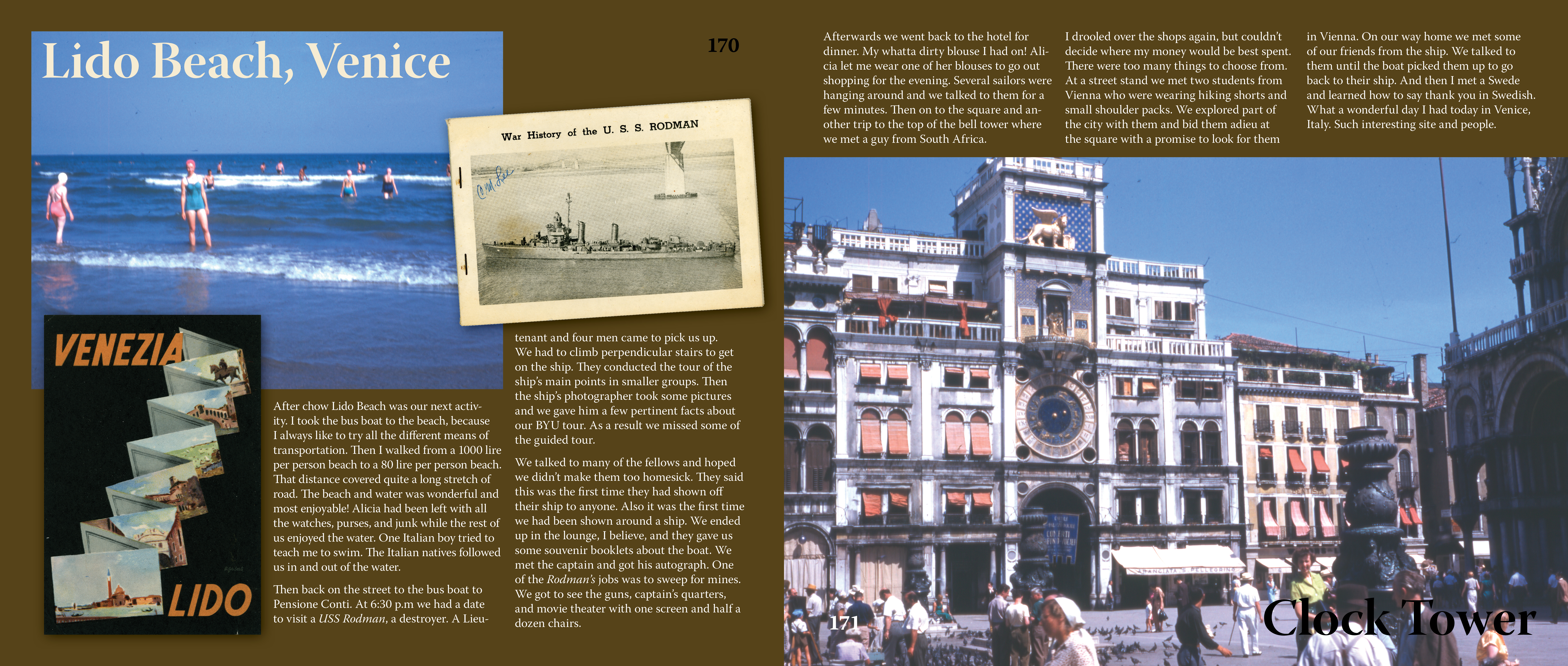
After chow Lido Beach was our next activity. I took the bus boat to the beach, because I always like to try all the different means of transportation. Then I walked from a 1000 lire per person beach to a 80 lire per person beach. That distance covered quite a long stretch of road. The beach and water was wonderful and most enjoyable! Alicia had been left with all the watches, purses, and junk while the rest of us enjoyed the water. One Italian boy tried to teach me to swim. The Italian natives followed us in and out of the water.

Then back on the street to the bus boat to Pensione Conti. At 6:30 p.m we had a date to visit a USS Rodman, a destroyer. A Lieutenant and four men came to pick us up. We had to climb perpendicular stairs to get on the ship. They conducted the tour of the ship’s main points in smaller groups. Then the ship’s photographer took some pictures and we gave him a few pertinent facts about our BYU tour. As a result we missed some of the guided tour.

We talked to many of the fellows and hoped we didn’t make them too homesick. They said this was the first time they had shown off their ship to anyone. Also it was the first time we had been shown around a ship. We ended up in the lounge, I believe, and they gave us some souvenir booklets about the boat. We met the captain and got his autograph. One of the Rodman’s jobs was to sweep for mines. We got to see the guns, captain’s quarters, and movie theater with one screen and half a dozen chairs.

Afterwards we went back to the hotel for dinner. My whatta dirty blouse I had on! Alicia let me wear one of her blouses to go out shopping for the evening. Several sailors were hanging around and we talked to them for a few minutes. Then on to the square and another trip to the top of the bell tower where we met a guy from South Africa.

I drooled over the shops again, but couldn’t decide where my money would be best spent. There were too many things to choose from. At a street stand we met two students from Vienna who were wearing hiking shorts and small shoulder packs. We explored part of the city with them and bid them adieu at the square with a promise to look for them in Vienna. On our way home we met some of our friends from the ship. We talked to them until the boat picked them up to go back to their ship. And then I met a Swede and learned how to say thank you in Swedish. What a wonderful day I had today in Venice, Italy. Such interesting site and people.

Paintings of Great Masters Viewed in Tour of Florence

Editor’s note: This is the eighth in a series of letters written by Mrs. Afton A. Hansen of Provo on her impressions of an European tour she is making with a group of 36 college students from Weber and BYU.

Dear Friends;
It is only a day since we left Italy, but we are still talking about how much we like these people and their country—those curiously friendly people who so adeptly mix the human and sublime, as is shown in the name of a commercial bank in Rome—”Bank of the Holy Spirit.”
Wouldn’t you like to know something about Venice (Venezia) and Florence (Firenze)?

The city of Firenze is not beautiful at first sight, and we wondered why so many tourist loved it so much. The beauty, so rare and excellent of this old city is found in its treasures of art. It is the world’s greatest art center, and in the 13th century was the greatest money market.

Big money often makes bad art, but the historically prominent Medici family of Florence loved beautiful things and knew them when they saw them.

They made Florence a beautiful city. Their vast collection and creations are possessed now by the Italian government for the world to enjoy.

da Vinci Sketches
San Lorenz, the private church built by the Medici family contains rare and original manuscripts of the masters. In the chapel are the pen sketches of Leonardo da Vinci. He is perhaps the greatest of the masters of his time. The world is still paying tribute to this genius born 500 years ago.
In a small church in Milan, (Santa Maria de la Grazie) we saw what is now left of da Vinci’s painting The Last Supper. The building itself, bombed during the war, is now reconstructed. The painting though somewhat protected from bombs is being restored. It is told that when da Vinci was searching for a model for Judas in the picture, he found him on the street and approached him. The man answered, “Yes, I will pose for you. It is I who posed for you many years ago when you painted Christ.”

Leonardo da Vinci’s pen sketches of art subjects, music, architecture, engineering and science still hold good. In the library of the San Lorenz church are original manuscripts of Dante’s Inferno, Petarch and Laura and account books dating back to B.C., choral books with their square notes and four-lined staff, a wise sayings book by Cecco D’ Ascoli, a book of Greek poetry by Boctchio and Sappho.

The palace where the Medici lived, called Petti Pallzzio, has since been used for government office, but now houses the rare and costly treasures which the Medici used to show their guests when entertaining.

Works of Masters
We stood aghast at the vases, bowls, goblets, etc., which were made of semi-precious stones and decorated with gold, rubies and pearls. Figurines carved from ebony, ivory, coral and shell were numerous. Original paintings from da Vinci, Michelangelo, Rembrandt, del Sorto Murillio and others adorned the walls. It was breath-taking. On the ceiling in one room were scenes from the Iliad, done in such superbly rich colors that we felt like lying down on the huge covered ebony table beside the statue of sleeping infants to gaze forever at the ceiling.

The choice picture for me was of young John the Baptist by Murillio. Sometime, maybe, my newly found lady friend, who is a copiest of masterpieces will do one for me. She was a delightful person who was doing a reproduction of del Sorte’s Madonna.

Reluctantly leaving Pitti Palazzio, we walked across the oldest bridge the Arno river. It was protected from bombs during the war by sentiment and by blowing up the entrance to the bridge. Shops on either side of the street on the bridge have for more than 300 years now bought and sold some of the most alluring merchandise in silk, linen, wool, silver, leather, etc., that anyone could ever imagine. All we needed to more thoroughly enjoy it was more money.

Up the steps to Michelangelo Square, we stood near another statue of David (the original of which we saw in the Academy and Tribune of David) to see the city of Florence and locate the various spots of interest we had seen.

Impressions as well as expression come thick and fast on such a trip as this. Writing seems so slow compared to experience, but recollections are always enjoyable.
What a commotion we cause in Milano (Milan) when our bus load of 32 American girls and four men were unloaded in front of a boy’s dormitory — Casa delo Students! The boys were eating their evening meal at the time, but soon their severe dining room was buzzing with excitement, and then it was practically empty for about 54 of them came out to talk to the 12 girls and two men who were left. The others were to stay a block away. The manager of the dorm was concerned so he stayed up all night patrolling the corridor. The girls enjoyed good conversation with these fine college students who were studying engineering. We were on our way again by 7 a.m. Venezia (Venice) with its waterways and gondolas, 100 islands and 400 bridges, was enchanting. It took six gondolas to transport our group from bus to hotel, but what delightful transportation. Gliding smoothly along in a cushioned carpeted gondola, made of some kind of dark wood, we noticed the pretentious buildings, somewhat rusty and adorned with moss. White marble steps so close to the water were draped with green moss.

Sinking City
Parts of the city seem to be sinking into the Adriatic sea. One American benefactress, noting this has collected money for supports for San Marco church were Saint Mark is supposedly buried.
Gondolas anchored to blue and white striped poles conveniently await the lady for her shopping tour, to get fresh vegetables or other household supplies. Her private gondolier calls a warning as he approaches an intersection, or turns a corner. We would hardly believe our eyes, seeing directional street light anchored in the water— red, yellow, green, stop and go.

Transportation by motor boat is faster, but not nearly so interesting.

Docked in port was a ship flying the American flag. Cheers from the girls soon brought all hands on deck. “Hi-ho, anyone there from Arizona?” —”Yes, and Utah too.” It didn’t take long to get acquainted with these sailors from Trieste. They entertained the group on board ship the next day.

We’ll soon be in Switzerland gazing at the Matterhorn.

Afton A. Hansen

P.S.—Having received some of the first copies of these articles printed in the Herald, I notice the names of Senator and Mrs. Arthur V. Watkins were inadvertently missing. They did so many nice things for this group including opening their office to us where we parked our suitcases and bags. They took all 36 of us to dinner in the senate private dining room, gave each of us a souvenir menu card, directed us to the senate in session where Senator Watkins gave a nice speech about Provo, the BYU and this tour. They also arranged for six private cars to take us on a tour of the city. They were most generous and gracious.

60 Years Ago Today

Sunday, 6 July 1952:

We were off at 6:30 a.m. in the morning. We really were starting to get on the ball. We said we were going to leave early and we did! Florence, it was goodbye! It was definitely a fun place to experience. We started to take the road to Bologna across the Apennine Mountains, climbing gradually. There was beautiful scenery and green vegetation covering the mountains. Patchwork fields dotted all through the valleys. This area reminded me of Mexico.

Oh, oh! I guess the bus couldn’t quite handle the big load. We stopped. Andre let the engine cool and tinkered around a little bit. Then our four men got out and pushed. That was what the bus needed, because the bus started up and the men had to run and jump to get on the bus.

We were on to more picturesque mountains, valley farms, men shocking grain by the road on Sunday, and men putting up hay in another field. Oh, oh! As we were nearing the summit, another contest between the bus and grade. And the grade won. Andre backed down to a more level spot in the shade and got himself all dirty under the bus giving it a once over. Finally the bus was ready to go again.

Where was Herr Watkins? About five minutes later he appeared with an interesting story to tell. Luckily we had trouble at the right spot for him in order to pick him up from visiting his friends. He was back visiting Italy after spending about eight months here during the war.

Herr had sent a note ahead of time saying that he would stop to see his friends if it were at all possible. They had been waiting for him since yesterday with wine and food. During the meal his Italian friends asked if he had a bad stomach because he hadn’t drunk any wine, only water. He gave us a detailed account over the public address system in the bus, so we could all hear about it.

He also told us about how the American soldiers impressed the Italian people as compared with the English and German soldiers. He shared their weekly system of getting clean uniforms, equipment, and personal baths.

I saw Bologna with a big swimming pool and green milky water right by the road. There were wide streets with beautiful new buildings done with a brocaded look on the outside. Later I saw a big gold courtyard and palace looking building. Then I spotted a municipal building with huge pillars, public square, and a huge round villa or monastery on the hill. We learned that Bologna was the home of oldest university in Europe.

We continued down into Po Valley that was the most fertile section of Italy. The landscape was dotted with rows of trees, tree fences and fields. We surely left Po valley in a hurry though. I guess we had hit the edge of it. Once again we were back to the drier country mountains. However, after awhile Andre stopped to talk to some men. Whatta ya know we were going the wrong way! We started to head back to Bologna again!

As we turned around in the yard of a farmhouse two little girls stood watching us. Mrs. Hansen reached out the window and gave them some gum. We have really been lucky. This was only the second time on this trip that we have missed our road. Seems like everything happens to us on Sunday though. I couldn’t decide whether it’s just coincidental or chastisement. I noticed skull and cross bones for railroad crossing again.

Back in Bologna again. There were not very many cities we got to see twice on this trip. We stopped this time for a rest stop. It wasn’t such a hot spot with long waiting lines. It was a bad day for Alicia. She was not feeling well. We found lemonade at a corner stand. I guess it wasn’t such a bad spot after all. Vamos!

Back on the road again we passed fields looking suspiciously like sugar beets. Then I noticed some tall stuff. I recognized this plant from before but couldn’t remember what they used it for. Then I saw an irrigation system. Next was a strange looking rectangular and pale green pond affair with several piles of rocks. A canal that ran along the road had a milky appearance like irrigation water. The canal was really low and kinda slimy green looking.

I missed the tree lined roads on the drive that I was used to. However, there were double rows of trees on one side and a newly planted double row of trees on the other side. We crossed an almost dried up river. It looked like a drought this season in Po Valley. I kept seeing casa cantoniera which means rest area, at regular intervals so the Italians hadn’t forgotten the poor travelers in need.

Then we ventured onward to Ferrara, Padua and Venice. On our way we crossed the Po River with weeping willow trees on the banks. I noticed road construction as we passed kids playing in a big swimming hole and then back to tree lined roads again with pyramid shaped hills. One hill had tall dark slender trees along the road winding around to the top. Again there were kids swimming in a big canal along side the road. Like Padua there were sidewalks along the canal. There were many big churches there.

We took the Autostrada, the main highway system in Italy, into Venice. My glasses were giving me a bad time and kept crawling down on my nose. Finally the bus went over the causeway connecting us to the Island of Venice.

In Venice there were little boats and people bathing in the water that stretched out on both sides of us. We arrived and then had a conference to decide what to do about our big suitcases. It resulted in suitcases opened all over the sidewalks and a major traffic jam in the bus. Eventually we got out what we needed and left the large suitcases in the bus.

And soon we were off to the gondola. We ran into some kind of bottleneck on the money angle and had to wait for American Express to clear us. There was a man with a motorboat! All of us took a slight jaunt down to the docks to the motorboat. No! The coupon says gondola, so we go back again. Someone made a phone call and finally we get in a gondola. One more first for me, a gondola. That’s me. Tis the life!

Hey what was this? A traffic light on the canal and a bridge with white iron work. This canal crossed another canal into an intersection. What! A garage held two boats. Most of the front sides of buildings had little balconies on the water. There weren’t any porches unless they were inside the door or gate. I believed this must be the grand canal we were going down, because it was pretty wide. In Venice the gondolas were the slow taxis, small motor boats were the fast taxis, and big motor boats were the buses.

The big bridge came up. Lord Byron called it the Bridge of Sighs. It came from the suggestion that prisoners would sigh at their final view of beautiful Venice out the window before being taken down to their cells.Wrong bridge, that was another one! This was the Rialto Bridge.

Our gondola didn’t go under the bridge and went down an alley and came out on what looked like a lake, too big for a canal. I saw a navy boat with American sailors. We waved and asked if “Anybody was from Utah?” No one was from Utah it appeared.

There were beautiful facades on these waterfront buildings. It seemed to be the center part of the city. Someone spied our hotel, Conte Pensione. Meals were included with the hotel and were we ever ready for dinner. There was a monastery room overlooking the alley. Dinner was at 8 p.m. Everybody was on time and eager to chow down.

After dinner we took a stroll and found three American servicemen stationed in Trieste. Everyone crowded around them. As more of the mob came by, it was a U.S. reunion. Then we went on to St. Mark Square.

Venice at night was so enchanting and too beautiful to describe. On the island there were sidewalks between the buildings, but between the islands were canals. There were no wasted spaces with every inch in use.

I took another gondola ride with a song from the gondolier. What a delicious spot for a honeymoon! Need I say more? As we glided past the blue grotto there was divine music and atmosphere. But where wasn’t there atmosphere here? People were wandering back home down our alley into the night singing and chatting.

60 Years Ago Today

Saturday, 5 July 1952:

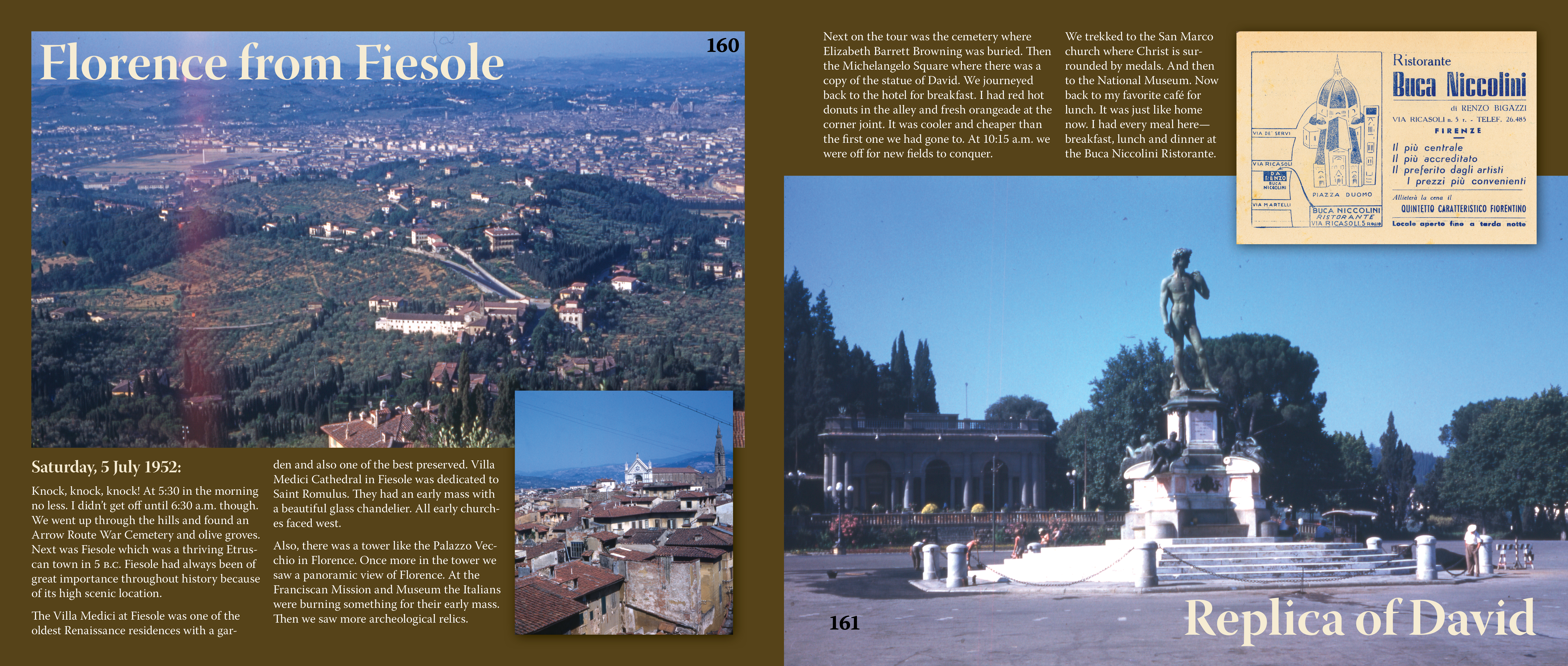
Knock, knock, knock! At 5:30 in the morning no less. I didn’t get off until 6:30 a.m. though. We went up through the hills and found an Arrow Route War Cemetery and olive groves. Next was Fiesole which was a thriving Etruscan town in 5 b.c. Fiesole had always been of great importance throughout history because of its high scenic location.

The Villa Medici at Fiesole was one of the oldest Renaissance residences with a garden and also one of the best preserved. Villa Medici Cathedral in Fiesole was dedicated to Saint Romulus. They had an early mass with a beautiful glass chandelier. All early churches faced west.

Also, there was a tower like the Palazzo Vecchio in Florence. Once more in the tower we saw a panoramic view of Florence. At the Franciscan Mission and Museum the Italians were burning something for their early mass. Then we saw more archeological relics.

Next on the tour was the cemetery where Elizabeth Barrett Browning was buried. Then the Michelangelo Square where there was a copy of the statue of David. We journeyed back to the hotel for breakfast. I had red hot donuts in the alley and fresh orangeade at the corner joint. It was cooler and cheaper than the first one we had gone to. At 10:15 a.m. we were off for new fields to conquer.

We trekked to the San Marco church where Christ is surrounded by medals. And then to the National Museum. Now back to my favorite café for lunch. It was just like home now. I had every meal here—breakfast, lunch and dinner at the Buca Niccolini Ristorante.

Dante’s Inferno hit us as we stepped onto the sidewalk. We passed the Palazzo Vecchio. David Neplone and the rest of the crew were standing ready to greet us. Still there were buildings that were mined by the Germans in World War II. The bombs were electronically controlled under buildings, streets, cathedrals. I saw a man repairing the street with bricks. We drooled over the luscious shops built along both sides of Vecchio Bridge.

Then we moved to the Pitti Palace where the pillars were painted to look real in room one. There was a green huge marble Medici bathtub in the middle of room four and later a jewel case presented to Catherine II. In room seven there was a stunning chandelier.

Along the river we passed kids swimming in the Arno River. Some of us went back to the hotel and six of us took off for Santa Croce. However, I decided to follow an American speaking guide around. He opened a painting to show old murals behind the painting. He also pointed out all the graves of the famous men buried here.

Then Henry acted as a guide to get us back to the hotel. One street over from the cathedral I bought a pencil at a street-side shop. Left behind I had to find my own way back. I went through a street market covering several blocks clear to the hotel corner. The kids were waiting in the lobby to go with Herr Watkins to visit his teacher.

I decided to stay back and get things done. I went for a bath and the bathtub water gushed out really strong. I managed to squeeze in the small bathtub (Italians are much smaller) and washed clothes before leaving for the concert at 8:30 p.m.

We found our enclosed way across Ponte Vecchio to Pitti Palace. It was 250 lire for non pesti or enclosed seats. There was a beautiful huge yellow moon that hung just at the corner of the building. It looked like a magnificent painting itself.

The concert had Italian music with three soloists singing under a concrete arch. The conductor played the piano as well as leading the orchestra. The concert didn’t start till almost 10 p.m. We met some art students from Stevens College who were spending most of their time in Florence. It turned out to be a nice evening.

60 Years Ago Today

Friday, 4 July 1952:

In the morning we hurried off to the fruit market. Afterwards we journeyed to see the San Lorenzo Church of Medici, Old Sacristy Cloister and library. The library had a 500th anniversary of Leonardo da Vinci with an exhibition of his works. He was an Italian painter, sculptor, architect, scientist, mathematician, engineer, inventor, and writer.

Leonardo da Vinci’s designs were really ahead of his time. He painted many self portraits and there were study sketches of pictures, Madonna on the rocks, and proportions of human body, face, and eyes. I saw designs of battles, weapons, and tanks. Other works included: Design for the Cathedral at Paris, study for horse equestrian statue, sketches for Santa Anna, manuscript of Divine Comedy, writing done backwards in mirror to keep it secret, study of Christ going to Calvary, sketches of Ceasar Borgia a friend, study of the flight of birds, manuscript of Divine Comedy, study for the last supper, wooden carved ceiling, manuscripts collected by Medicos family, pictures of Laura Petrarch, original poem written on vase by Sappho who was an ancient Greek poet, and huge music books written by monks from the 15th century.

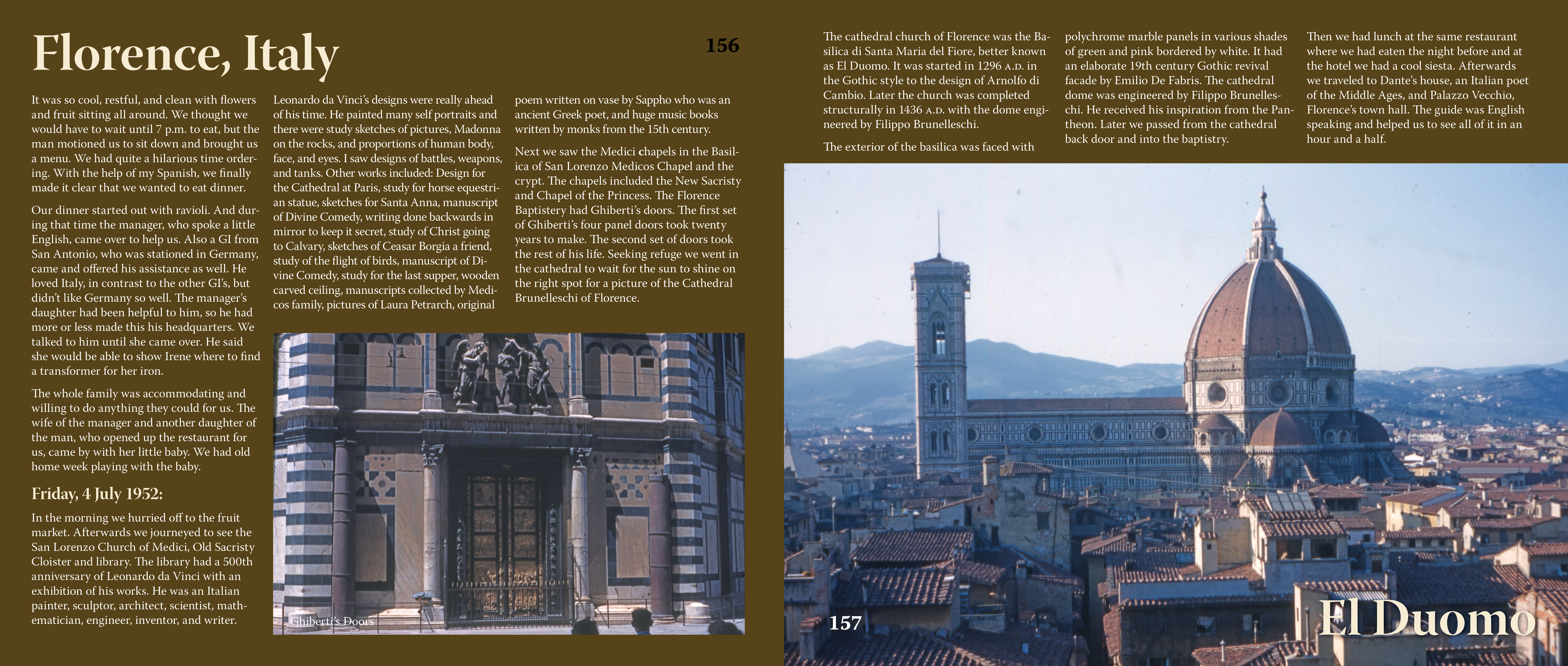
Next we saw the Medici chapels in the Basilica of San Lorenzo Medicos Chapel and the crypt. The chapels included the New Sacristy and Chapel of the Princess. The Florence Baptistery had Ghiberti’s doors. The first set of Ghiberti’s four panel doors took twenty years to make. The second set of doors took the rest of his life. Seeking refuge we went in the cathedral to wait for the sun to shine on the right spot for a picture of the Cathedral Brunelleschi of Florence.

The cathedral church of Florence was the Basilica di Santa Maria del Fiore, better known as El Duomo. It was started in 1296 a.d. in the Gothic style to the design of Arnolfo di Cambio. Later the church was completed structurally in 1436 a.d. with the dome engineered by Filippo Brunelleschi.

The exterior of the basilica was faced with polychrome marble panels in various shades of green and pink bordered by white. It had an elaborate 19th century Gothic revival facade by Emilio De Fabris. The cathedral dome was engineered by Filippo Brunelleschi. He received his inspiration from the Pantheon. Later we passed from the cathedral back door and into the baptistry.

Then we had lunch at the same restaurant where we had eaten the night before and at the hotel we had a cool siesta. Afterwards we traveled to Dante’s house, an Italian poet of the Middle Ages, and Palazzo Vecchio, Florence’s town hall. The guide was English speaking and helped us to see all of it in an hour and a half.

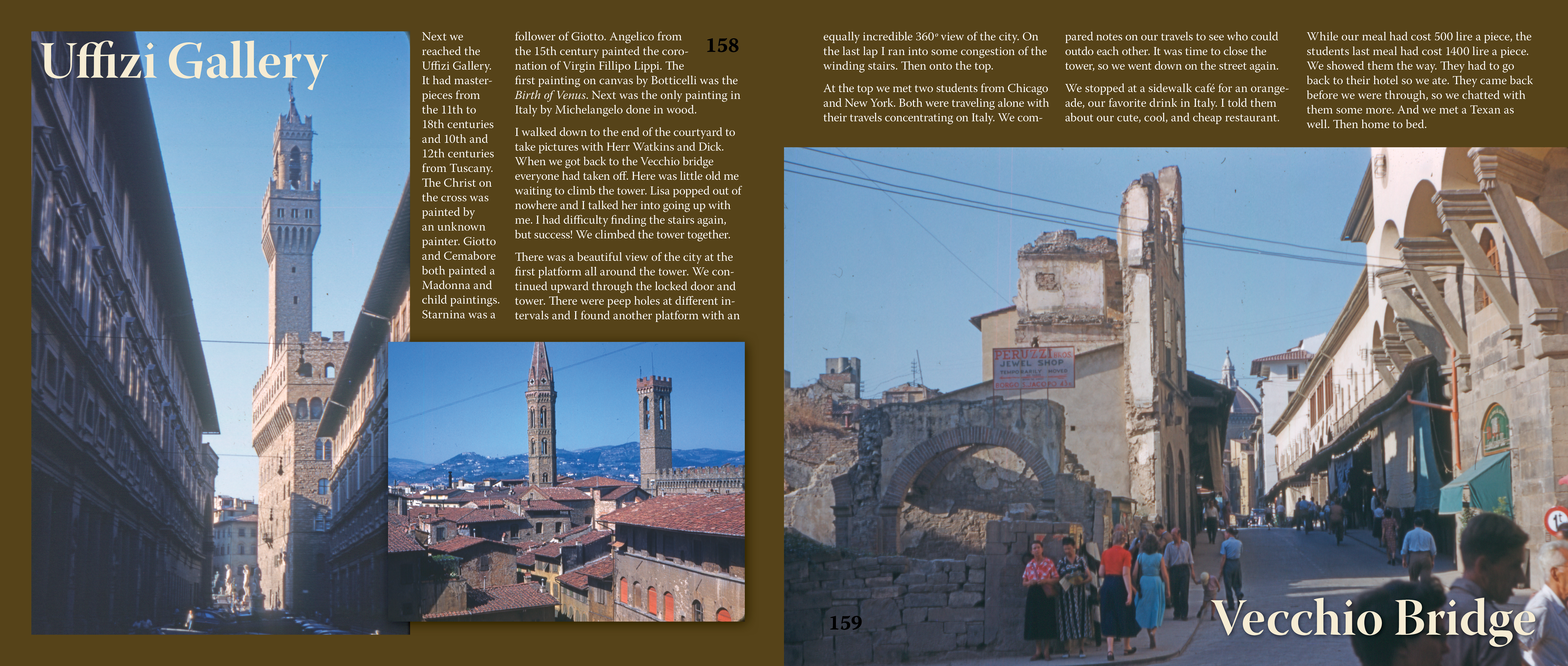
Next we reached the Uffizi Gallery. It had masterpieces from the 11th to 18th centuries and 10th and 12th centuries from Tuscany. The Christ on the cross was painted by an unknown painter. Giotto and Cemabore both painted a Madonna and child paintings. Starnina was a follower of Giotto. Angelico from the 15th century painted the coronation of Virgin Fillipo Lippi. The first painting on canvas by Botticelli was the Birth of Venus. Next was the only painting in Italy by Michelangelo done in wood.

I walked down to the end of the courtyard to take pictures with Herr Watkins and Dick. When we got back to the Vecchio bridge everyone had taken off. Here was little old me waiting to climb the tower. Lisa popped out of nowhere and I talked her into going up with me. I had difficulty finding the stairs again, but success! We climbed the tower together.

There was a beautiful view of the city at the first platform all around the tower. We continued upward through the locked door and tower. There were peep holes at different intervals and I found another platform with an equally incredible 360º view of the city. On the last lap I ran into some congestion of the winding stairs. Then onto the top.

At the top we met two students from Chicago and New York. Both were traveling alone with their travels concentrating on Italy. We compared notes on our travels to see who could outdo each other. It was time to close the tower, so we went down on the street again.

We stopped at a sidewalk café for an orangeade, our favorite drink in Italy. I told them about our cute, cool, and cheap restaurant. While our meal had cost 500 lire a piece, the students last meal had cost 1400 lire a piece. We showed them the way. They had to go back to their hotel so we ate. They came back before we were through, so we chatted with them some more. And we met a Texan as well. Then home to bed.

60 Years Ago Today

Thursday, 3 July 1952:

In the morning my breakfast in the hotel included a really soft six minute boiled egg. Then we started the day by visiting a church that was built over St. Francis’ grave. In the middle of the church the frescos began with a beautiful mural by Giotto and another artist. Giotto’s mural had a bright blue background with his characteristic holes.

Then we went down into the lower church and into the crypt where I saw an ornamental iron grave. At the crypt there was a German speaking monk. Another monk came up to us as we were leaving and asked for change. He had lots of small change in American money and wanted to change it for American dollars, so we obliged. Next on the tour was the upper church. It was Gothic even more so than the middle church.

Soon after it was back to the bus and off to Florence. The bus climbed up to Perugia, which was one of the most beautiful hill cities, and then down to the shores of Lake Trasimeno. With Florence coming up I napped.

I couldn’t tell for sure about this place yet. It was pretty hot! We were all anxious to get out, relax, and cool off somehow. We reached Atlantico Hotel. My first thought was for a drink of water. The lobby looked fairly nice, but the room was not as nice as last night. However we had a bath nearby.

Mrs. Hansen, Mrs. McDonald, and I decided to go shopping, but I lost them quite soon. I found Mrs. McDonald talking to a couple of American servicemen from Maryland that were stationed in the woods near Leghorn. They shared with us that they don’t like Italy, because it’s too dirty. Also they warned us not to drink or eat any of the dairy products, because several of the boys from their unit had gotten spinal meningitis. Furthermore they felt the Italian Communists were out for anything they could get. One soldier liked Austria and Germany much better than Italy. All the soldiers were anxious to get home to the United States.

I wandered around a book shop reading the books before buying them. I ended up with a book about Florence and Rome. Then I ran into Irene, Hermine, and Betty. Eventually we located a little restaurant that wasn’t open until 7 p.m. We were standing there wondering what to do when a cute little gray haired man came and opened the door. We followed the man inside to take a look and see what kind of place it was.

It was so cool, restful, and clean with flowers and fruit sitting all around. We thought we would have to wait until 7 p.m. to eat, but the man motioned us to sit down and brought us a menu. We had quite a hilarious time ordering. With the help of my Spanish, we finally made it clear that we wanted to eat dinner.

Our dinner started out with ravioli. And during that time the manager, who spoke a little English, came over to help us. Also a GI from San Antonio, who was stationed in Germany, came and offered his assistance as well. He loved Italy, in contrast to the other GI’s, but didn’t like Germany so well. The manager’s daughter had been helpful to him, so he had more or less made this his headquarters. We talked to him until she came over. He said she would be able to show Irene where to find a transformer for her iron.

The whole family was accommodating and willing to do anything they could for us. The wife of the manager and another daughter of the man, who opened up the restaurant for us, came by with her little baby. We had old home week playing with the baby.

60 Years Ago Today

Wednesday, 2 July 1952:

I took my bag down to breakfast. Herr Rogers called me down for not bringing it sooner. I was too late! The bus was all packed. After breakfast, I carried my own bag to the bus and with Mrs. Hansen’s help I put it on the top myself. I had Andre check the strap for me though.

Soon we were off for Assisi! Evidently we have to go back through Naples. While there we stopped at the hotel to pick up some stuff the kids had left. Then we raided a fruit shop and got back on the road to Rome via Cassino. It seems all roads to Rome must be tree lined.

Cassino was at one time the most bombed out place of World War II. Germans used Cassino as a stronghold and Americans finally had to bomb them out. Herr Watkins fought here. The most bitter fighting in Italy took place here and it became a no man’s land for a while.Since then it has been reconstructed. A documentary movie, San Pietro, was filmed in the area in 1945.

Then as we left Cassino we passed a former town on a hillside that was completely in ruins. A new town had been built below. We had lunch on the road. In Rome we stopped back to pick up Betty’s coat and get a drink of water in the public horse trough. We passed several monuments and huge buildings that I didn’t see when we were here before. We saw the Etruscan Capitaline Wolf statue from the 5th century, who had rescued Remus and Romulus, Rome’s mythological twin founders, from death.

I observed the big stadium and the Tiber River which was a beautiful green. Some of the scenery looked a lot like Utah. One section of land had sugar cane or something that looked like it. Today was kind of a lost day. It was really hot and Bev had heat exhaustion or something of the sort. I missed the scenery for some well needed napping and writing.

Our next rest stop was at Turin. I snapped a picture of oxen and a man with a donkey cart who posed for us. By the time we left there was a huge crowd around the bus. Dusk was coming on as we met the hilly and windy roads. We caught sight of the Assisi Arched Gateway like in the picture shots we saw in Italy.

We stopped to stay at a beautiful hotel where the section we were in was probably once an old monastery. I talked to a girl from Nebraska and found a little book about Assisi for 250 lire. Then we ate dinner at a restaurant down a little street from the hotel.

Soon after it was time for bed. My only mistake was laying down on the bed before getting undressed. At 3:30 a.m., I finally got undressed and climbed under the covers.