60 Years Ago Today

Friday, 27 June 1952:

The group had breakfast at the hotel. Then I spent 715 lire to mail two letters and five cards. Via del Corso, the main street running through the historical center of Rome, used to have horse races. We crossed the Tiber River. Then we identified the Caesar Augustus Old Mausoleum, Palazzio Justice Renaissance building or Hall of Justice, courthouse, Castle St. Angelo the former burial place of emperors, and Berssini’s colonnades which was the latest addition added about 130 years after the church was started.

Then we finally ended up at St. Peter’s Basilica and discovered fountains that had been working for over 700 years and an obelisk weighing 500 tons in the center of the square. Here we actually walked up to St. Peter’s door and looked at the statue of Charlemagne through iron doors. Then I saw bronze doors that were copied from some bronze doors in Florence. The northernmost door is the “Holy Door” which, by tradition, was walled-up with bricks, and opened only for holy years such as the Jubilee year by the Pope. The present door is bronze and was designed by Vico Consorti in 1950. The southern door, the Door of the Dead, was designed by 20th century sculptor Giacomo Manzù. Popes and others exited here for their funeral processions.

I caught sight of La Pieta, a statue by Michelangelo, which depicts the Virgin Mary cradling the dead body of Jesus. La Pieta was much smaller than most of his other statues, and it was the only statue he ever signed. Then there was a beautiful mosaic of Pope Clement VIII holding the key to the Jubilee door. In the right aisle is a monument to Christina of Sweden who renounced Protestantism and became Catholic.

Then I saw another monument to Leo 12th and later the Chapel of St. Sebastian, which was named after the subject of the mosaic above the altar. Other sites included: Tomb of Innocent XII, tomb of Countess Matilda, tomb of Gregory XII, tomb of Gregory XIV, painting of The Mass of St. Basil for the altar of St. Basil, monument to Benedict XIV, and painting of Martyrdom of St. Erasmus.
As we continued our tour in St. Peter’s Basilica, a man came up and called us down on our vulgar dress. After that experience we continued by viewing the eleven chandeliers that hung down on strings from every corner. The chandeliers came to an arch or a point above a central arch. Michelangelo redesigned the dome in 1547 when he was 72. The weight of St. Peter’s dome rests on four big pillars. The huge main altar was made of bronze from the Pantheon. There were 92 lamps burning and St. Peter was buried right under the mantle. Big maroon booth things decorated each huge pillar for special ceremonies. I saw a lady kiss the toe of St. Peter. His toes were worn down from people kissing them. St. Peter had the keys of authority in his hand that were supposedly found in his original shrine.

We proceeded through St. Peter’s Basilica with St. Andrew statue, St. Veronica statue, St. Longinus statue by Bernini, St. Linus statue, monument to Paul III, tomb of Urban VIII (Mafeo Barberini), monument to Benedict XIV and St. Helen statue who was the mother of Constantine. She converted to Christianity and became a devout Christian. She brought part of the true cross from Jerusalem.

Next was the entrance to St. Peter’s crypt where Peter was buried. The rounded domes were Renaissance architecture. There was a copy of the painting Sacred Heart. And later a list of all the 143 popes was on a marble plaque. The Chapel of Immaculate Conception was next with a beautiful mosaic.

Then we climbed the stairs to the top. It cost 50 lire on the way up and I saw autographs on most of the tombs. There were plaques commemorating the days when important figures came to visit the current popes. St. Peter’s Basilica was partially built over the same site of the earlier Nero’s Circus where St. Peter had been killed there in 67 a.d. during the Christians martyrdom.

The obelisk was the only existing structure from that time period. The first level of the dome had a mosaic all around it and was clear to the top. It was made of little stones and looked down on the main altar. There were narrow winding stairs to the top with autographs all over the place.
Later I snuck two pictures from the first level of the Chapel of Immaculate Conception.

Afterwards I snuck a couple more shots of the Vatican gardens from on top. Then we sang O Suzannah with two Roman boys on the way down. We talked to them at the bottom as well. We were tired of trying to get the Italian guards to let us take pictures of the Swiss guards. No soap! Their uniforms were beautiful and elaborate costumes.

Later we followed Herr Watkins to find some food. We found a lady and man fighting over our patronage. It was quite a circus! We split up and gave them both a break. The salt and pepper in this place are not in shakers, but in little round tin bowls. There were things with toothpicks sticking up between the salt and pepper.

A cute waiter brought us cherries, apricots and plums. Finally I snapped a picture of a Swiss Guard. He was not supposed to smile, but he couldn’t help it. There are 90 Swiss Guards that represent an honor guard from the nobility.

We viewed a tunnel where the Pope escaped to St. Angelo Castle in the 16th century. A Swiss Guard died protecting the Pope. There was an old mote around St. Angelo. It was originally built as a mausoleum and burial place for emperors and family members. St. Angelo was built of gleaming white marble that was later stripped off.

We found wide open “dealies” along the street with not even as much protection as in Paris. Afterwards it started to sprinkle. We waited under a tree for it to stop. There was a little garden down along the Tiber River. Little boys were swimming in the river and gambling on the streets.
Old Roman ruins were preserved in the midst of new buildings. Little kids were playing on the ruins. I was mobbed by little boys when I brought out my pack of gum. They ran after the other kids to see if they could get more gum.

Huge lemons were at a streetside stand. Caesar Augustus’ Mausoleum had withstood the ravages of time. Gardens were replanted around it. Then I saw Rendezvous of Poets and a silk shop that was mentioned in Fielding which sells ties and silk scarves.

American Express popped up on the next corner so I left a forwarding address. Then I stopped in a book shop and drooled over a book about Italy. I was too tired to talk to a fellow working in the store about literature. I stopped in the silk shop to see what it was like. The kids were wondering what happened to me.

Alene, Lucy and I went down to Economico for dinner. The manager brought chips over to us, but we didn’t understand. All of us ordered spaghetti and soup because we couldn’t read the menu. We discovered from watching others that we were supposed to buy chips before we got what we wanted.

At 9 p.m. we spent the night on the town in Rome. At the Trivi Fountain I threw five lire in the pond and also drank the water. A traditional legend states that if visitors throw a coin into the fountain, they are ensured a return to Rome. Guess I’m coming back for sure. [Yes! And I returned in July of 1983.]

A policeman in a white spotless uniform had a spotlight on him in the middle of the square in front of the monument to Victor Emanuel II, Italy’s great king. Victor was born in Turin, Italy and claimed Nice during the last war. I saw his tomb in the Pantheon. At the Tomb of the Unknown Soldier we discovered something new. By pushing a button something would come up from the underground. While there we caught the changing of the guard at the Tomb of the Unknown Soldier.

We proceeded to Palazzo Venezia, a residential papal palace, which was a building belonging to the Venetian Republic. Mussolini had had an office there and used the balcony for many of his notable speeches. Napoleon’s mother had lived centuries earlier on a corner across from Mussolini’s office. From there we progressed to the Tor di Valle that was an important and large horse racing venue of the city of Rome.

Next was the Trajan Forum which was a forum for Caesar and Circus Maximus that was an ancient Roman chariot racing stadium and mass entertainment venue. Palatine Hill, one of the most ancient parts of the city, was on the right. Then we caught sight of the Temple of Vesta and Temple of Fortune Virale.

And we discovered the Theatre of Marcellus, an ancient open-air theatre, that was the second largest seating capacity in ancient Rome. Then we passed over the oldest Roman bridge, Ponte Fabricio, still in its original state from 62 b.c. It spanned the Tiber River.The little Church of St. Bartholomew and hospital was next. There was a four headed statue on the other side of bridge. There was a baby that was born in ancient Rome with four heads so the Italians made a statue of the baby. Another bridge, Pons Cestius, was a Roman stone bridge spanning the Tiber River as well.

Then we caught sight of the House of Dante, a major Italian poet of the Middle Ages. He stayed here when in Rome. We rode over Gianicolo Hill that was the second tallest hill in Rome.
Next we observed the monument to Giuseppe Garibaldi in Piazza don Minzoni Square. It was sculpted by Angelo Viotti in 1884 and dedicated on 6 September 1885. Giuseppe Garibaldi was to Italy what Washington was to America. There was a cannon at the base of the monument that had been fired from the hill every night. About 15 years ago the Italians stopped shooting the cannon.
At St. Peter’s Basilica, Bernini, a prominent Italian artist, built colonnades around St. Peter’s Basilica and got both fountains going.

The light was on in the apartment of the Pope. Papa Pius XII, the current pope, was 74 or 75 years old. Tomorrow at 12:15 p.m. we get to meet him. Everyone was in bed—except me! I snuck around trying to wash my clothes at midnight.
60 Years Ago Today

Thursday, 26 June 1952:

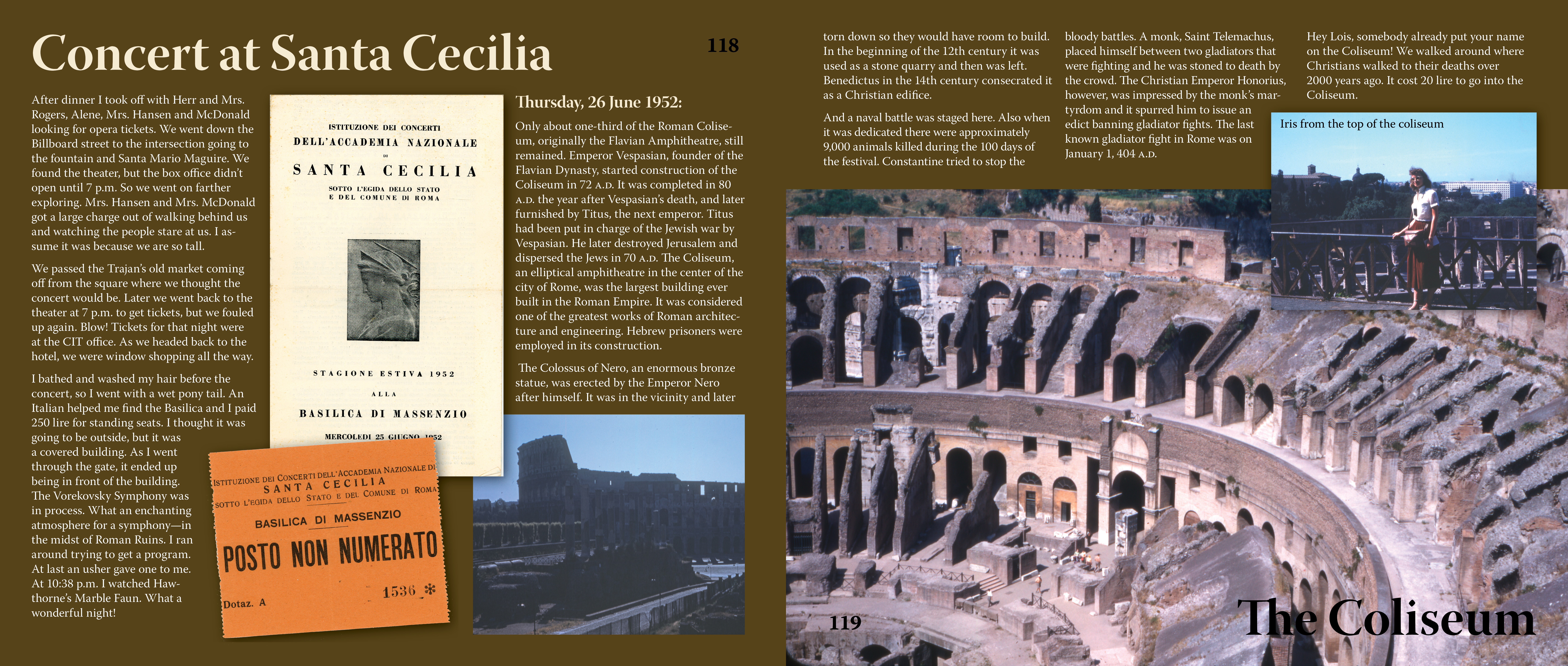
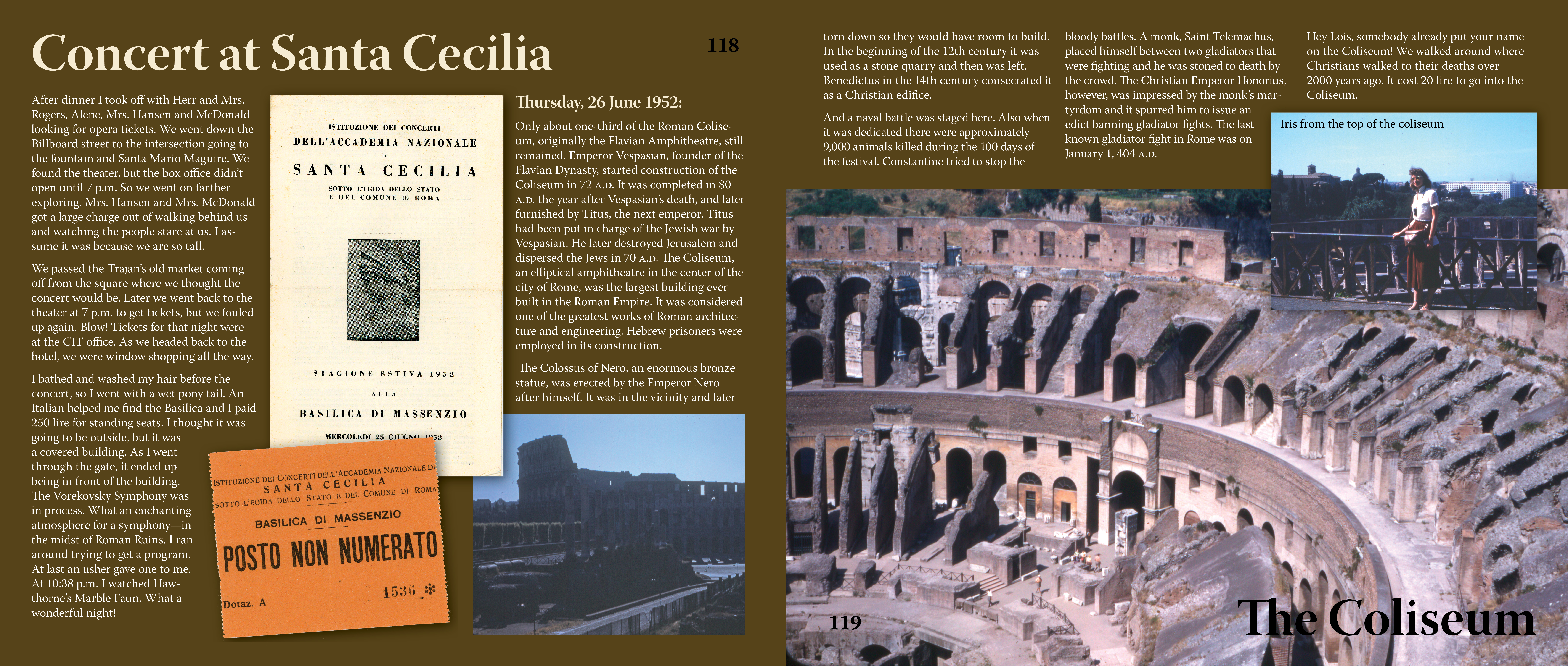
Only about one-third of the Roman Coliseum, originally the Flavian Amphitheatre, still remained. Emperor Vespasian, founder of the Flavian Dynasty, started construction of the Coliseum in 72 a.d. It was completed in 80 a.d. the year after Vespasian’s death, and later furnished by Titus, the next emperor. Titus had been put in charge of the Jewish war by Vespasian. He later destroyed Jerusalem and dispersed the Jews in 70 a.d. The Coliseum, an elliptical amphitheatre in the center of the city of Rome, was the largest building ever built in the Roman Empire. It was considered one of the greatest works of Roman architecture and engineering. Hebrew prisoners were employed in its construction.

The Colossus of Nero, an enormous bronze statue, was erected by the Emperor Nero after himself. It was in the vicinity and later torn down so they would have room to build. In the beginning of the 12th century it was used as a stone quarry and then was left. Benedictus in the 14th century consecrated it as a Christian edifice.

And a naval battle was staged here. Also when it was dedicated there were approximately 9,000 animals killed during the 100 days of the festival. Constantine tried to stop the bloody battles. A monk, Saint Telemachus, placed himself between two gladiators that were fighting and he was stoned to death by the crowd. The Christian Emperor Honorius, however, was impressed by the monk’s martyrdom and it spurred him to issue an edict banning gladiator fights. The last known gladiator fight in Rome was on January 1, 404 a.d.

Hey Lois, somebody already put your name on the Coliseum! We walked around where Christians walked to their deaths over 2000 years ago. It cost 20 lire to go into the Coliseum.

It seemed that a church marked every corner. And there was a man holding a pan of bread on his head while riding a bike. I caught sight of the Trajan’s Column and Forum which commemorates the Roman Emperor Trajan’s victory in the Dacian Wars.

Next we discovered the Arch of Constantine, a triumphal arch in Rome, situated between the Coliseum and the Palatine Hill. The arch was constructed to commemorate victory in 312 a.d. I stood on its original pavement.

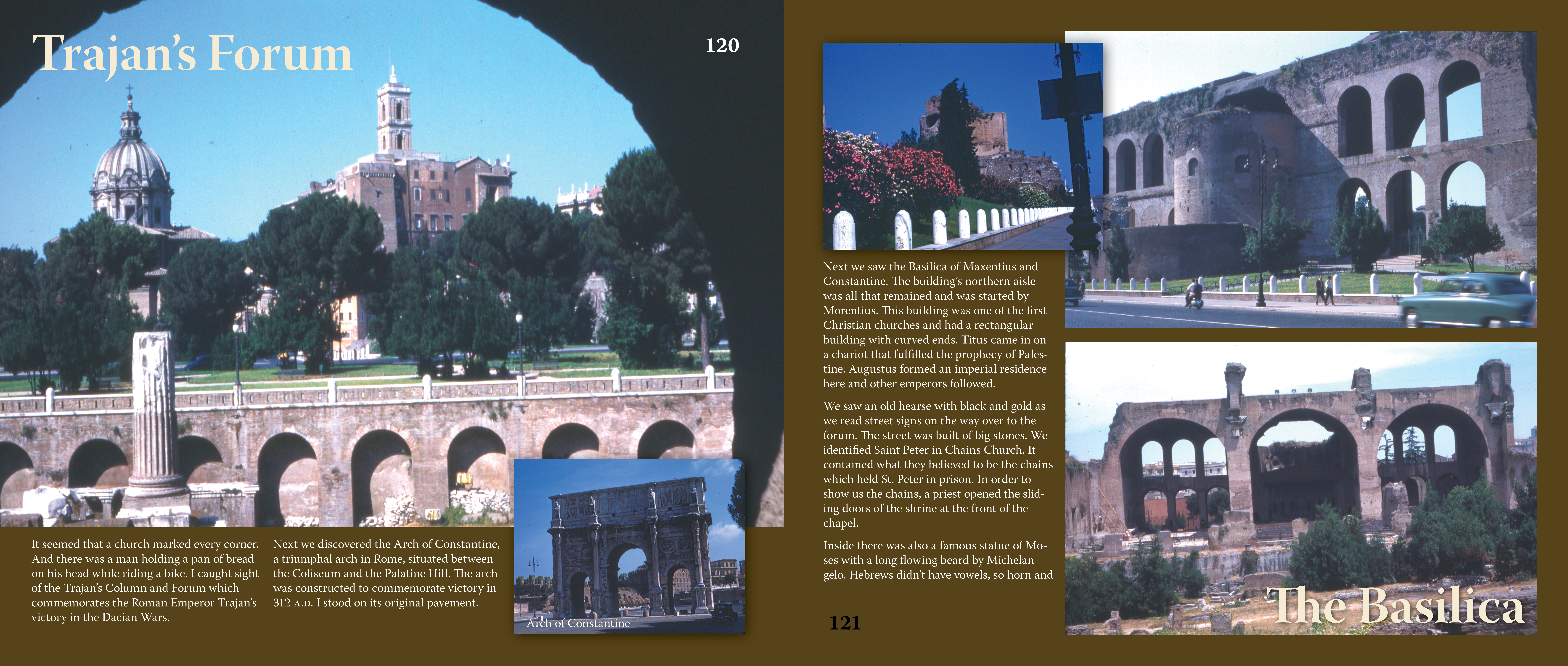
Next we saw the Basilica of Maxentius and Constantine. The building’s northern aisle was all that remained and was started by Morentius. This building was one of the first Christian churches and had a rectangular building with curved ends. Titus came in on a chariot that fulfilled the prophecy of Palestine. Augustus formed an imperial residence here and other emperors followed.

We saw an old hearse with black and gold as we read street signs on the way over to the forum. The street was built of big stones. We identified Saint Peter in Chains Church. It contained what they believed to be the chains which held St. Peter in prison. In order to show us the chains, a priest opened the sliding doors of the shrine at the front of the chapel.

Inside there was also a famous statue of Moses with a long flowing beard by Michelangelo. Hebrews didn’t have vowels, so horn and light were written the same. Michelangelo misunderstood it and put horns on the statue of Moses. It was the apex of sculpturing with Rachel and Leah on each side of Moses. I noticed an iron gate along the front of the building.

Soon after we discovered the Temple of Venus and of Rome which was near the Coliseum. Then the Arch of Titus, which was built for Emperor Titus in 70-81 a.d., stood in a slightly elevated position at the entrance to the Roman Forum. Its religious significance lay in its depiction of Titus’ victories which included the sacking of Jerusalem. Three young priests told us about Circus Maximus which was the largest stadium in ancient Rome and like a modern racetrack. At one point the Circus could seat 300,000 people. As I spotted a red robed priest from Germany the marble path was caved in and crumbling. Next was the Temple of Romulus which still had its original door. It was green, made of bronze, and still had its original lock.

Then we reached the white marble Arch of Septimius Severus at the northeast end of the Roman Forum, a triumphal arch dedicated in 203 a.d. to commemorate the Parthian victories of Emperor Septimius Severus and his two sons. Mamertine Prison, state prison of ancient Rome, was located on the northeastern slope of the Capitoline Hill, where St. Paul and Peter were imprisoned. There were two upper cells but the lower cell was probably the most ancient prison in Rome. The church of San Giuseppe dei Falegnami now stands above the Mamertine Prison.

At the Tombs of Romulus there were pansies growing all over the grassy area. Later there was a large platform called the rostrum that was built facing the Senate building. It was where people would stand and make their proclamations. SPQR was from a Latin phrase, Senatus Populusque Romanus which means Senate and People of Rome, referring to the government of the ancient Roman Republic.

Next on the tour was the Basilica Ulpia which was an ancient Roman civic building located in the Forum of Trajan. Ulpia was the name of Empress of Trajan. There was this most unique Ulpia Restaurant in Rome. Antiquities were in the basement and the manager was Senore Conti. There was a statue of Nero. In 1840 the basement was excavated and cleaned out and fixed up in 1870. Another statue of Nero was in the Vatican by a bar on an old Roman street. It was dedicated as a place to burn incense before going out into the forum.

As we moved on there was an obelisk at the end of the Trajan’s Forum which the obelisk in Paris was copied from. Next we saw the Tomb of the Unknown Soldier, a national monument in Italy. Before entering through the doors there were round circular stone stairs. This same pattern was repeated in four or five areas on surrounding buildings for emphasis.

Then we journeyed to the Pantheon which was a temple to all the gods of ancient Rome, the glory of the Eternal City. It was commissioned by Marcus Agrippa on this sight as a temple and rebuilt by Emperor Hadrian in about 126 a.d. The Pantheon used to be the national church of all Italians. The bronze was taken from here to construct the altar at St. Peters. Also, the dome at the Pantheon was a model for St. Peter’s Basilica dome and a dome in Florence. The Pantheon was preserved because it was changed into a Christian Church. It was the largest pagan church still standing with the original bronze door with autographs on the doors.

At the Pantheon was the tomb of Victoire Emmanuel II. He became the second father of the Fatherhood and assumed the title King of Italy to become the first king of a united Italy. An artist Raphael was buried at the Pantheon also. A round hole in the top always represented the open tomb of Raphael. One of his pupils created a statute of Raphael with a dove. Margherita was a promised wife for Raphael.

I bartered for a souvenir picture of Rome for 1400 lire with a few postcards thrown in. Then we walked past the National Parliament that was in session. The actress, Ingrid Bergman, was at every newsstand. She had had twins on June 18, 1952. Carol and I stopped at a book shop, because we were still trying to find a tour guide of Europe. We then lost the group and found our way to American Express. After finding it I got a letter from Mom. We had pizza pie on the way back to the hotel. Then we walked around and window shopped.

I was excited because the opera was tonight. I read the story of La Traviata to the kids. We left early so Carol and Alene could get tickets. As we went we stopped in a Pasticceria for a little Italian pastry. I got one soaked in rum or something similar.

At 8:30 p.m. the rope was still across the entrance to the opera. I climbed over and sat on the stairs to write letters. Eventually at 9 p.m. they let us in. It was not elaborate. However, I enjoyed the opera although the tenor had his eyes glued on his hands. The soprano carried the show.

60 Years Ago Today

Wednesday, 25 June 1952:

I was up earlier than normal today. I was ready to go. It was either Rome or bust today. I learned policemen stayed in the hotel as well as Capone’s brother a long time ago. Finally we were ready to go but Dick and Henry’s passports were missing. They were not at the hotel desk. The manager was quite excited about it and said, “I don’t want to go to America. I’ve already been.” Everybody checked for the passports and Joyce had all of them.

On our way again, the country was flatter with a few hills. We followed the seacoast for a ways. I noticed a Singer sewing center sign and the biggest haystack that I’ve ever seen before. The haystack was still in a teepee shape with a pole in the middle. The farmers cut slices off the sides to use. Soon after there were groves of toadstool trees, flower and tree-lined roads, white strips painted on the trees, and a few women gleaning in harvested fields. Next the countryside had grapevines planted along the side of the railroad tracks and an orchard with a vineyard planted beneath the trees. I spied ox teams loading hay.

This plain country was drier and didn’t have such heavily luxurious growth as farther north did. I found striped road barriers at the railroad tracks. When the train whizzed by, the gates came up. Next I saw a lady carrying water up the steps of the farmhouse. The water in the river beds was low and the grass and weeds were high.

And I noticed the grains came in long shocks rather than in high piles. There were wild poppies growing amidst the stubble while other grain fields came in round shocks. The grain shocks were between rows of trees and grape vines. Later we passed an olive orchard, a little hedge between the trees, Oleander bushes alongside the road, and a really modern new service station. We waited for two trains, a passenger train and a freight train.

We didn’t have enough food hanging from the window baskets, so we stopped at a small town for something to eat. The mob descended upon a poor little alimentari shop, which was the Italian’s combination grocery, deli and cafe. It was one of the largest shops we had found so far.
When the bus was back on the road again, we passed a large auto van transporting about a dozen new little European cars. The little cars got better gas mileage, one of the main reasons for their widespread use here in Europe. I identified different shaped stacks of grain. Next was a cornfield, windmill by a farmhouse, and barbed wire fences. It was the first time I recalled seeing wire fences in Europe. This part of Italy looked somewhat like our dry farms. Then we went down by the Mediterranean again.

Next we crossed a river or canal or something. I couldn’t find on the map. Men working in field waved to us, just like we used to do in Idaho when we were out hoeing beets. Along the way I caught sight of a combination orchard, cornfield, wheat field and vineyard. I noticed rectangular two story houses with outside stone stairs going up to the second story. The little village looked like a ship sitting on top of a hill.

Our plans for Rome were to spend the first day at the Vatican, second day in the central part of the old city, and the catacombs the last day. The Vatican, the world’s smallest country, was a small independent state. A 400 ton obelisk was in the center of the square. It was the only remnant of Nero’s Circus where the obelisk would preside over Nero’s countless brutal games and Christian executions. The Vatican had two long colonnades on the side of the square that represented outstretched arms. Bernini had been the architect. Railroads, considered the shortest tracks in the world, were created to lead into the Vatican.

In this small country the Vatican had its own post office and guards. All the priests in the Vatican must be unmarried and within a certain age range. Also, there was a covered passageway which still connected St. Angelo Castle to the Vatican. St. Angelo sat along the river and was close to the main road leading to the Vatican. Often St. Peter’s Square at the Vatican was full of people for many different occasions. The Catholic Church, the wealthiest church, had sold many indulgences to pay for it.

I took a nap and missed part of the lecture. Lunch was crazy. Whatta circus! As we sped down the road, I chawed on an old dry bunch of Italian bread trying to get a little cheese or jam to stay on it! What an experience and it happened almost everyday. I was going to have strong teeth or none at all. The cross country bicycle race passed us going the other way, while we were eating. I wonder if Italy’s top cyclist was participating. The cyclists had jockey suits on and were eating and drinking while riding.

I just had a scare! I reached into my bag to put a plastic bag away and missed my travelers checks. A little voice with not so calm thinking thought it might be in my suitcase. I hope it was! Then we passed several bus loads of sailors. Inside the bus we waved at them and they whistled back.

I observed big white farmhouses with green shutters and orange roofs. And all the houses were built about the same. Italy looked drier and felt hotter than France. At spaced intervals we saw houses with the sign casa cantoniera. Later I found out they provided shelter for road workers and travelers in need. Another advertising sign showed baby baths that looked just like the thing we call foot baths in our hotel rooms.

We came into Rome from the northwest corner and there were big apartment houses on the outskirts. We spotted the dome of St. Peters and towers to the Vatican radio station. They sent messages all over the world. Next we passed the wall around the Vatican City. We observed a watering trough in which a man and horse were both drinking out of the same place. Nasty! Soon after I identified black robed priests and a bus load of priests.

Finally! We were in Rome which was 2700 years old. White uniformed police were in the middle of the streets. Then we went through a long tunnel and across a beautiful bridge called the Tibre. St. Angelo Castle, built in 150 a.d., was stripped of marble and turned into a fortress. Popes have taken refuge there.

Then we entered into the older part of the city. We passed old Roman ruins about 12 feet below the present level of Rome. The most modern monument, Tomb of the Unknown Soldier, was part of the forum. Next was the Palazia Venezzia, formerly Palace of St. Mark, in central Rome just north of the Capitoline Hill. It was the balcony Mussolini used to speak from. I spied the Roman Colliseum for one moment.

We stopped at the American Express building only to find out they were closed until 3 p.m. We immediately went to our hotel, the Hotel Angelo American. It was unimpressive from the front but nice inside. I had room six with Carol and Alene. The bathroom had everything with all the trimmings except for the soap. I found my traveler’s checks and other important stuff in my bag. What a relief! We hurried down to American Express again for mail call.

It was wonderful to receive mail from Twila, Lucy, Loy, Cleo, and Dean Woodruff. I would like to write letters so I can receive more mail. We found a little tiny restaurant and had a good dinner. It consisted of tomato soup, roast veal, orange, and fruit. It cost 750 lire which included the cover and service.

After dinner I took off with Herr and Mrs. Rogers, Alene, Mrs. Hansen and McDonald looking for opera tickets. We went down the Billboard street to the intersection going to the fountain and Santa Mario Maguire. We found the theater, but the box office didn’t open until 7 p.m. So we went on farther exploring. Mrs. Hansen and Mrs. McDonald got a large charge out of walking behind us and watching the people stare at us. I assume it was because we are so tall.

We passed the Trajan’s old market coming off from the square where we thought the concert would be. Later we went back to the theater at 7 p.m. to get tickets, but we fouled up again. Blow! Tickets for that night were at the CIT office. As we headed back to the hotel, we were window shopping all the way.

I bathed and washed my hair before the concert, so I went with a wet pony tail. An Italian helped me find the Basilica and I paid 250 lire for standing seats. I thought it was going to be outside, but it was a covered building. As I went through the gate, it ended up being in front of the building. The Vorekovsky Symphony was in process. What an enchanting atmosphere for a symphony—in the midst of Roman Ruins. I ran around trying to get a program. At last an usher gave one to me. At 10:38 p.m. I watched Hawthorne’s Marble Faun. What a wonderful night!

60 Years Ago Today

Tuesday, 24 June 1952:

This had been such a charming spot. It was hard to leave. So far I would say France and Italy were quite similar, except it was my impression that Italy was less expensive, had cleaner restaurants, and had more war damage. The people seemed to be in greater need because they had more street peddlers. Perhaps I may change my mind on these things later. Also the shops had hoola doors which were kind of oriental like. We left the beautiful city of Rapallo climbing upward along the seashore, then down again to the next town, and up again towards the mountains which was between us and the sea. There were impressive winding roads and mountainous territory to view.

While learning about Rome on the bus, we passed Volterra which was an ancient town. We learned Rome was founded by Romulus and Remus according to legend. These twins were left to die in the wild by their uncle, but were found and suckled by a mother wolf. Later in life Romulus killed Remus in a quarrel and named the new city Rome after himself.

Herr Watkins’ notes about Rome said that it was the center of Italian civilization. Roman architecture contributions included the round arch and dome, the Pantheon and Coliseum. Many characteristics were called Roman culture by the Greeks. Roman abstract justice was one of their greatest contributions. There was a gradual degradation of the Roman ruins.

Now back to the scenery around us with pine trees, fields terraced on the mountains, and dotted thatched homes up the mountainside. The country was much like Yellowstone I thought. There were grapevines on the edge of each terraced level with plants next to the mountain. I saw funny haystacks with a pole down the middle of the haystack that was tapered to the top like a teepee.

There were many hair-raising turns on the way down into LaSpezia. Andre had to back up on one curve to make it around the curve. LaSpezia was a seacoast city on a hill. I observed a building with dozens of white plaques covered with names on the outside. The whole town formed a military guard in front. I spied an old moat, some red and white flowers grouped around the plaza, and rows of palm trees along the beach. Later I caught sight of the seaport with flower stalls on the road. Then the valley widened and the road straightened out.

As soon as we stopped to pick up some food to eat I ran all over creation trying to find bread. A little boy showed us to a little paneria or bakery down an alley. We had to try eating on the moving bus—with dirty hands. Whatta mess! At the same time we tried to watch the scenery and Dr. Rogers told us about Pisa.

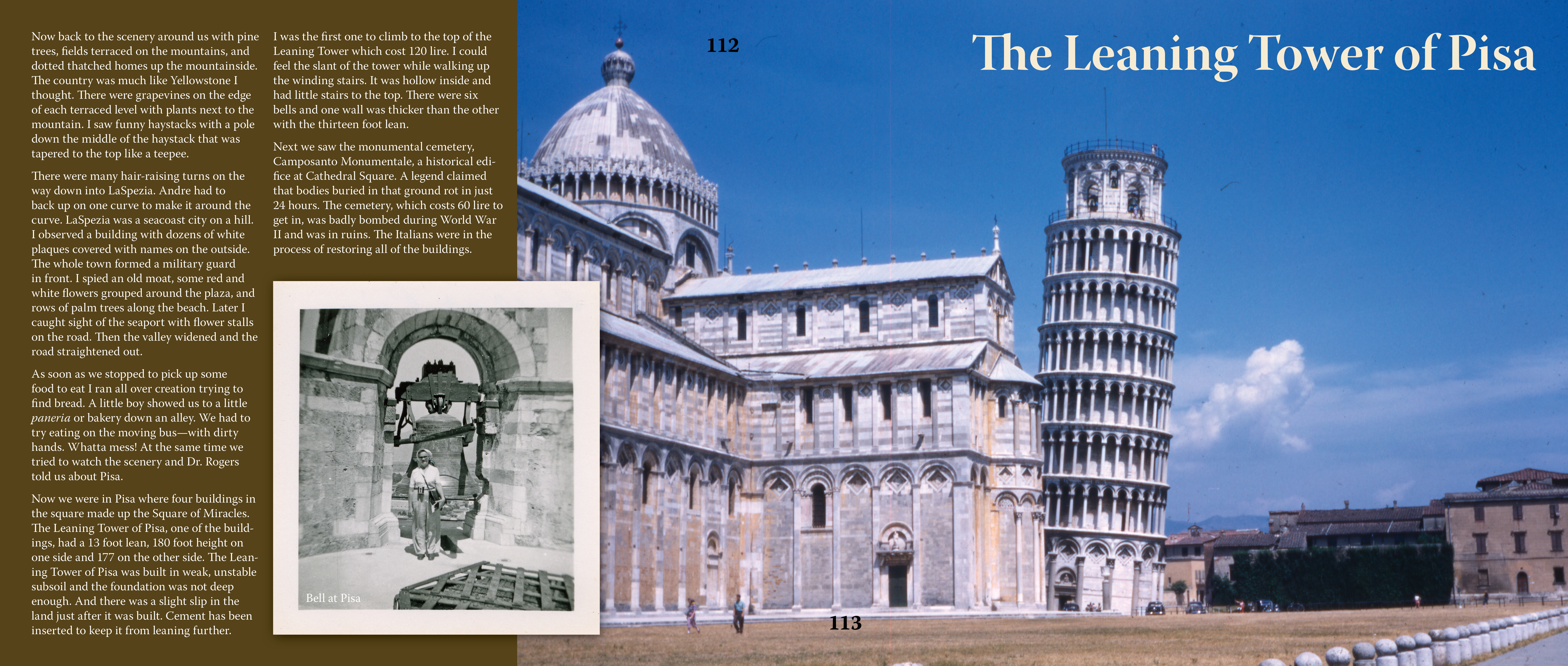
Now we were in Pisa where four buildings in the square made up the Square of Miracles. The Leaning Tower of Pisa, one of the buildings, had a 13 foot lean, 180 foot height on one side and 177 on the other side. The Leaning Tower of Pisa was built in weak, unstable subsoil and the foundation was not deep enough. And there was a slight slip in the land just after it was built. Cement has been inserted to keep it from leaning further.

I was the first one to climb to the top of the Leaning Tower which cost 120 lire. I could feel the slant of the tower while walking up the winding stairs. It was hollow inside and had little stairs to the top. There were six bells and one wall was thicker than the other with the thirteen foot lean.
Next we saw the monumental cemetery, Camposanto Monumentale, a historical edifice at Cathedral Square. A legend claimed that bodies buried in that ground rot in just 24 hours. The cemetery, which costs 60 lire to get in, was badly bombed during World War II and was in ruins. The Italians were in the process of restoring all of the buildings.

At one time the monumental cemetery walls were completely covered with murals. There were only traces of some of them left now. Many works of art were ruined from World War II as well. Original murals were being measured to make sure they were restored to their original condition. There were tombs all along the side walls of different shapes and sizes.

We talked to some workmen about the bombings. They said “the Americans did it.” Obviously they didn’t think we were Americans. Some statues had escaped damage but tourists had written their names all over them. Just like on the top of Pisa, names were written and carved everywhere.

The Baptistry of the Cathedral, the third building, was the largest baptistry in Italy. There were round holes on the round podium for baptisms and the balcony up above was a dome. Going through I noticed it had an echo. Echoes of one man sounded like a whole chorus.

Finally we discovered the cathedral which was in the middle of the plaza and the last of the four buildings. It was one of the foremost monuments of Medieval architecture in the world. Made in the shape of a Latin cross, the cathedral was devoted to the Virgin Mary and was built entirely in marble. It was Gothic Romanesque and Renaissance combination, I think, with some stained glass. It had beautiful murals and interesting ceilings. The cathedral had about four or five different altars. Outside there were funny toadstool trees. But we barely had time to step inside the cathedral because we had a feeling the mob was ready to go.

Once again we were back on tree-lined roads with lily ponds, weeping willows, grain fields, and grain piled in big stacks. Signs on the sidewalk still said “U.S. Go Home. Ridgway la peste.” We eventually stopped at Livorno (Leghorn) for our own spot for the night.

We drove down through the narrow streets and even right past the hotel. The hotel was hidden by its similarity to all the other buildings around it. It was quaint and interesting. I had room three on the ground floor which opens onto a beautiful patio. There was green paint on the French doors.

We found two big bathtubs on the next floor but there was only cold water. We went down to the beach in shorts and caused the usual or a little more than usual stir of attention. The beach was a poor man’s beach. It was smelly and had poor little kids on the beach. It cost 70 lire at the first entrance and 50 lire at the next one. The mob gathered around and piled up their belongings between two of the kids sunbathing. Some of the kids crawled through the rocks and moss and cut their feet. A few of us rented a blue ski boat for 150 lire. And Henry rowed a boat which almost capsized. Later Betty Lou, Eloise and I sunbathed. Finally we rowed out to the island. An Italian man in a rowboat hovered close around and we called him our guardian angel. There were ships in the harbor and sailboats.

We created a major commotion in getting back to the hotel. Carol was in a bathing suit, Eloise in a bathing suit and pedal pushers, and Betty and I were in shorts. People were running out of doors and hanging out of the windows to look at us. We were four pied pipers with a troupe of kids following us.The people on bikes rode past us several times and must have passed the word along, because it was the longest walk we ever took. The hotel was a welcome sight.

The group with Herr Watkins had a similar experience. He was wearing his shorts and people thought he was out in his underclothes. Back at the hotel I had a cold bath. Brrr! I got ready for dinner which was several blocks downtown. Once again we were still the center of attention. I guess they’re not used to seeing tall girls.

Dinner consisted of spaghetti, ice cream, and an orange for 480 lire. Cherries were thrown in for extra. We talked to an American civilian working at the army base here. As we chatted to John from Tennessee and Maria from Italy, they told us the hotel was in the midst of communism. They said Italian people were better off than the other European countries from World War II. And that the U.S. had such a poor propaganda system, the Italians didn’t even know who was helping them. The manager then asked us to go inside. Namely because too many people were gathering on the street.

So we went inside and had a round table discussion. John told us that the Italian people do not analyze things and that they pass from one party to the next. The Italians were easily aroused. It just depended on who was helping them get work.

60 Years Ago Today

Monday, 23 June 1952:

I had my bags down at 7:30 a.m. and then I went foraging for breakfast. The Italians stared even more openly than the French. I decided I liked Italian bread better than French bread.
We began the day with the Beghin Lido beach with a striped beach house. Farther down there were school kids doing callisthenics on the beach. Another beach had a tank barrier and a woman washing clothes in an almost dried up stream. Everywhere there were dozens of blue and white round signs.

Next was Genova, population 330,000, which had five harbors wrecked during World War II. This area became important during the Renaissance period. It grew rapidly and compelled commercialism with Venice and Florence. There were battle scars mixed in with some new modern buildings.

Christopher Columbus was born and lived here. There were five monuments here in honor of Columbus. The highest culture in Europe was found in Italy in the republic cities during the time of Columbus. Then we discovered the chapel of John the Baptist and one of the most ambitious cemeteries with many fine monuments and tombs. The tomb of Magzona, a famous Italian writer, was here.

The Italians stopped the blasting and were trying to reclaim and rebuild the bombarded buildings. There were crowded narrow streets everywhere with signs of Gillette Blue Blades, even in Italy. Italians were repairing and rebuilding streets, wharves and warehouses. This city really had been pummeled. Even now the city was in tremendous ruins. The harbor had been almost totally reconstructed. A big ship had just come into the port.

Gilosde Genova had a huge granary near the wharves. There were marks between old scarred buildings, clothing hanging from the windows of the buildings, big gates of old city walls, and a street named after Petrach. A beautiful fountain was in the center of the square. In modern Genova there was a definite contrast between ancient and modern. Genova imported from four to six times more products than they exported.

The vines were growing all over Columbus’ house in the center of the city. The wall of the city in 1249 a.d. had dirt and filth inside the wall. We stopped at the street named Dante right along by Columbus’ home and a bank. Those Italian eyes were really boring holes in us.

France and Italy rivaled each other in population. Italy had a larger immigration than any other country in Europe. Italy’s huge population was counterbalanced with the lack of opportunity available for its citizens. Rome used to control the entire Mediterranean world. In the 1800’s Garibaldi, an Italian military and political figure, who sailed from Genova and landed at Palermo, sought to gather volunteers for his impending campaign here.

As we drove high on a hill above the sea coming out of Genova, we gradually came down again and then up again past an old castle and estate by the sea. Trees grew out of the bank at a horizontal angle. We crossed a bridge which looked like it was only partially built. Whew! We made it! In looking back at the bridge, it didn’t look very substantial. We passed a church by the sea with a big clock on each side of the tower. There was an ugly red house with green shutters and beautiful gardens between the road and sea. There were more trees growing at an angle above the sea. I spied a beautiful castle down by the sea.

Rapallo, a city in Italy, was coming up. This was a short trip and we spent the afternoon on the beach. Our Verdi Hotel was high on a hill overlooking the town and the sea not far from the beach. I had room 46 with Alene. We were the first ones to our rooms.

We had a balcony in our room. Everyone who had a balcony promptly used it as a communication with everyone else with a balcony. It caused quite a commotion. Afterwards we ventured down to the beach via the little trails. There were steps and paths between the buildings. It cost 100 lire for the beach and bath houses. The water was warm and fairly clean as we played water baseball and catch. When we returned, I had a cold bath in Helen’s room.

Then we went out to eat dinner. However, no one served food until 6 p.m. We wandered around the shops, and met another bunch of kids including Eloise from Utah, who had just eaten at a pensione or guesthouse across the bridge. Phew—smelly river! Finally we had dinner at Mello’s. It consisted of spaghetti and later some pastries, like in France. Afterwards we met bunches of kids at a movie where it was 150 lire for my second pastry. It was a nice theater, but not a large clientele. We crawled through the dark to find our seats and sat down just as the lights went on.

The lights turned on subsequently after every short trailer and intermissions. The movie, Incantesimo Tragico, had a very dramatic plot which we were able to follow for the most part. We were slightly confused on some of the side plots, however. It was a tragedy, but we couldn’t tell for sure whether the heroine died or not.

All of us ended up at Mello’s for more spaghetti later on. The manager showed us how to eat spaghetti. The delicious bread veal cutlets with potatoes and beans was even better than the spaghetti before the cinema. There wasn’t a cover charge, just 10% service for the two big baskets of fruits the waiter brought in for dessert. Andre came in to eat as well.

Afterwards we talked to an Italian looking lady. However, she ended up being an English lady from London, who was non-Italian speaking with an Italian friend. She had purchased for her little girl a pair of wooden-soled sandals and the little girl squealed with delight for everyone to hear. They seemed to be friends of the manager.

When we were so stuffed with food that we could scarcely move, we noticed it was dark outside and we were too scared to leave. Finally, we decided to go. When we crossed the bridge and street to Hotel Verdi, it was dark and windy. We kept imagining noises with the little lights here and there in the dark that looked like lit cigarettes. Gratefully they turned out to be fireflies. But we ran the last stretch to the hotel and found a maid waiting at the door.

60 Years Ago Today

Sunday, 22 June 1952:

Breakfast was in our room again. At 8:30 a.m. we had our bags down and then we had chorus practice. Afterwards we wandered around the streets until we went to church. In the church the fan had to be turned off in order to hear anything. And it was so warm in there! I shook hands with everyone—so wonderful too! Two members gave talks and then we took over the program and repeated “Paree.” At the conclusion we shook hands with everyone again. Margaret Brown gathered some francs to give to the missionaries for some of the poorer members. Instead of going to dinner we hurried back to the amphitheater to take pictures and see the marines marching. We stopped and picked up dry ham sandwiches and ate them on the way.

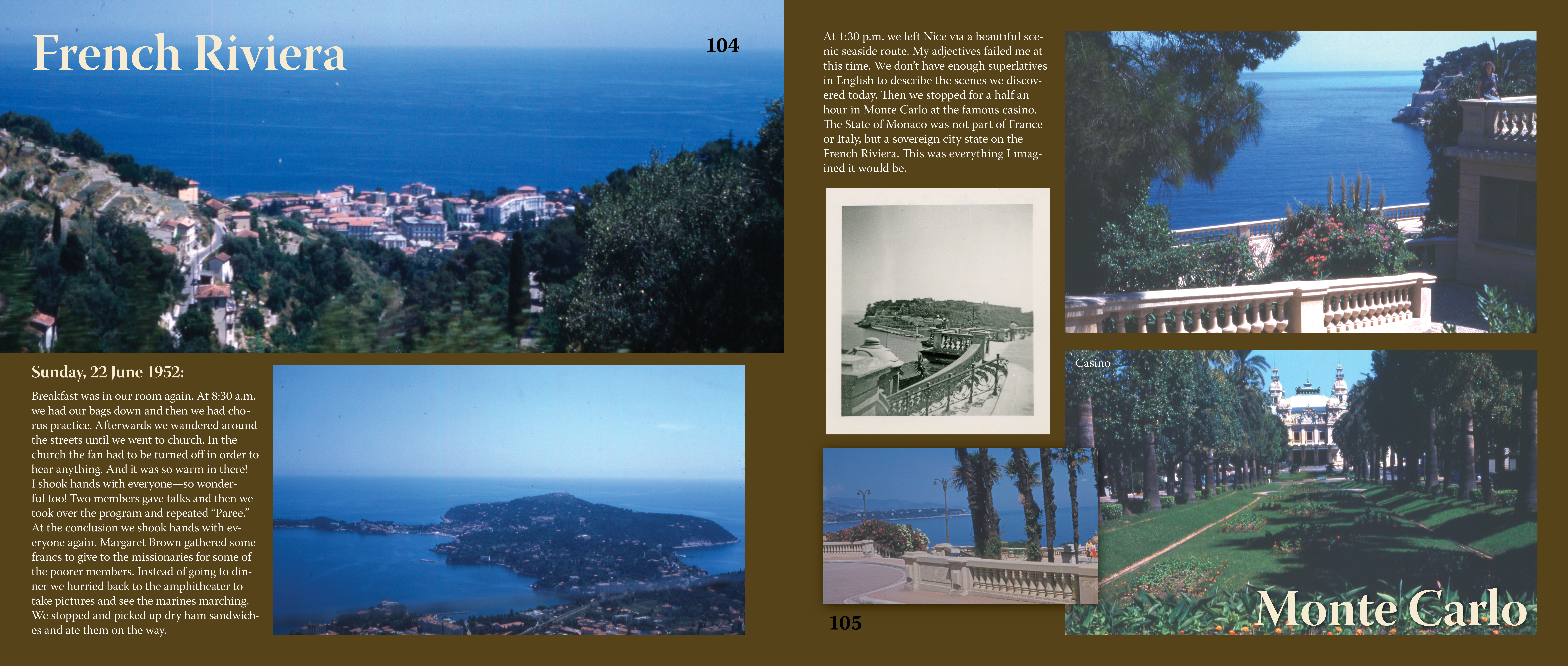
At 1:30 p.m. we left Nice via a beautiful scenic seaside route. My adjectives failed me at this time. We don’t have enough superlatives in English to describe the scenes we discovered today. Then we stopped for a half an hour in Monte Carlo at the famous casino. The State of Monaco was not part of France or Italy, but a sovereign city state on the French Riviera. This was everything I imagined it would be.

As the French and Italian border came up, Herr Watkins collected our passports. A French customs agent stamped our whole lot and passed them back down to us. We drove a little ways and then two Italian officials came on the bus to check our passports individually. They were nice and courteous. A little farther down the road we came to some more officials where we had to declare our cash. Dick took a list into the customs office and we were off to see Italy.

The first thing I noticed In Italy was the ruins of the bombed buildings. The buildings were pock marked with shells among the terraced fields, which were not sloping like in Mexico. A great black cloud appeared in contrast to the pure blue of the water. Then a long black train emerged from the smoke below.

We traveled from high to low and up high we could see the roads across the water. Herr Watkins said it marked the shallow spots. The water near the shoreline was transparent and it took on different hues depending on the sea floor. I lost track of the towns, because I was too busy absorbing the beauty of the coastline.

We passed through Mignon, Vertimighlia, Imperia, Alsesai, and Albengia before reaching Savona. And along this gorgeous drive we looked at beautiful fields of roses, local patches of maroonie-purplish flowers along the fences, and flowers hanging from the walls of the mountains. We were taken back to World War II by the shelled buildings in almost every town. There were more winding picturesque roads.

Later we saw a bicycle race and a group of boys and girls dressed alike with short, striped shirts apparently going home from school. In one town, they had flags of all different colors flying and a Navy band marching. It must be some kind of celebration. Some place along our way someone yelled to us and Andre discovered we were leaking gas or oil.

We stopped at the next town and spent some time there getting a new gasket. I took a nap just before we got there, so I missed some of the excitement. When I woke up I spotted a beautiful Italian girl. On our way again as dusk fell, we sang all the old famous hymns starting with America. We passed through several tunnels as the road followed the beach closely.

It was after nine at night when we started coming into Savona. After winding through the dark streets, we came to a stop on a street. I couldn’t tell which door was the Hotel Alberto. Herr Watkins warned us to watch our bags and travel in large groups for safety.

At the hotel we went through the café to the hotel desk where 18 of us were staying. The rest of us were in another hotel through the street. The room looked much better than the facade would have indicated. The WC wasn’t so hot though, but this was more like what we had been expecting all along.

The maid insisted on taking all of our passports. Yours truly was bound and determined not to give it up, but I did! We had a good laugh out of it later. This was what happens all over Italy in registering at a hotel.

The dinner in the hotel café was good. I had spaghetti, meat, salad and fruit for 60 lire. I dropped into bed exhausted. It was creaky, but felt wonderful.

60 Years Ago Today

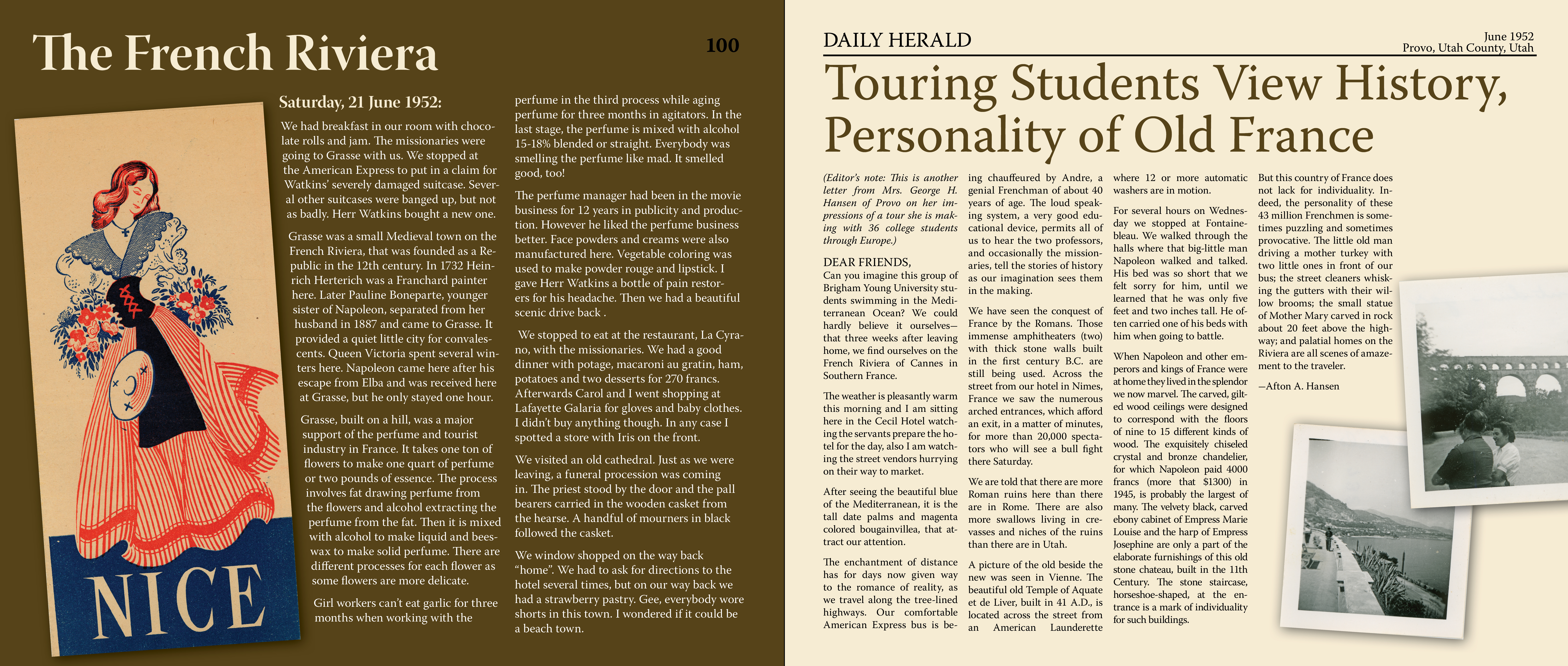
Saturday, 21 June 1952:

We had breakfast in our room with chocolate rolls and jam. The missionaries were going to Grasse with us. We stopped at the American Express to put in a claim for Watkins’ severely damaged suitcase. Several other suitcases were banged up, but not as badly. Herr Watkins bought a new one.

Grasse was a small Medieval town on the French Riviera, that was founded as a Republic in the 12th century. In 1732 Heinrich Herterich was a Franchard painter here. Later Pauline Boneparte, younger sister of Napoleon, separated from her husband in 1887 and came to Grasse. It provided a quiet little city for convalescents. Queen Victoria spent several winters here. Napoleon came here after his escape from Elba and was received here at Grasse, but he only stayed one hour.

Grasse, built on a hill, was a major support of the perfume and tourist industry in France. It takes one ton of flowers to make one quart of perfume or two pounds of essence. The process involves fat drawing perfume from the flowers and alcohol extracting the perfume from the fat. Then it is mixed with alcohol to make liquid and beeswax to make solid perfume. There are different processes for each flower as some flowers are more delicate.

Girl workers can’t eat garlic for three months when working with the perfume in the third process while aging perfume for three months in agitators. In the last stage, the perfume is mixed with alcohol 15-18% blended or straight. Everybody was smelling the perfume like mad. It smelled good, too!

The perfume manager had been in the movie business for 12 years in publicity and production. However he liked the perfume business better. Face powders and creams were also manufactured here. Vegetable coloring was used to make powder rouge and lipstick. I gave Herr Watkins a bottle of pain restorers for his headache. Then we had a beautiful scenic drive back .
We stopped to eat at the restaurant, La Cyrano, with the missionaries. We had a good dinner with potage, macaroni au gratin, ham, potatoes and two desserts for 270 francs. Afterwards Carol and I went shopping at Lafayette Galaria for gloves and baby clothes. I didn’t buy anything though. In any case I spotted a store with Iris on the front.

We visited an old cathedral. Just as we were leaving, a funeral procession was coming in. The priest stood by the door and the pall bearers carried in the wooden casket from the hearse. A handful of mourners in black followed the casket.

We window shopped on the way back “home”. We had to ask for directions to the hotel several times, but on our way back we had a strawberry pastry. Gee, everybody wore shorts in this town. I wondered if it could be a beach town.

Touring Students View History, Personality of Old France

(Editor’s note: This is another letter from Mrs. George H. Hansen of Provo on her impressions of a tour she is making with 36 college students through Europe.)

Dear Friends,
Can you imagine this group of Brigham Young University students swimming in the Mediterranean Ocean? We could hardly believe it ourselves-that three weeks after leaving home, we find ourselves on the French Riviera of Cannes in Southern France.

The weather is pleasantly warm this morning and I am sitting here in the Cecil Hotel watching the servants prepare the hotel for the day, also I am watching the street vendors hurrying on their way to market.

After seeing the beautiful blue of the Mediterranean, it is the tall date palms and magenta colored bougainvillea, that attract our attention.

The enchantment of distance has for days now given way to the romance of reality, as we travel along the tree-lined highways. Our comfortable American Express bus is being chauffeured by Andre, a genial Frenchman of about 40 years of age. The loud speaking system, a very good educational device, permits all of us to hear the two professors, and occasionally the missionaries, tell the stories of history as our imagination sees them in the making.

We have seen the conquest of France by the Romans. Those immense amphitheaters (two) with thick stone walls built in the first century B.C. are still being used. Across the street from our hotel in Nimes, France we saw the numerous arched entrances, which afford an exit, in a matter of minutes, for more than 20,000 spectators who will see a bull fight there Saturday.

We are told that there are more Roman ruins here than there are in Rome. There are also more swallows living in crevasses and niches of the ruins than there are in Utah.

A picture of the old beside the new was seen in Vienne. The beautiful old Temple of Aquate et de Liver, built in 41 A.D., is located across the street from an American Launderette where 12 or more automatic washers are in motion.

For several hours on Wednesday we stopped at Fontaine-bleau. We walked through the halls where that big-little man Napoleon walked and talked. His bed was so short that we felt sorry for him, until we learned that he was only five feet and two inches tall. He often carried one of his beds with him when going to battle.

When Napoleon and other emperors and kings of France were at home they lived in the splendor we now marvel. The carved, gilted wood ceilings were designed to correspond with the floors of nine to 15 different kinds of wood. The exquisitely chiseled crystal and bronze chandelier, for which Napoleon paid 4000 francs (more that $1300) in 1945, is probably the largest of many.

The velvety black, carved ebony cabinet of Empress Marie Louise and the harp of Empress Josephine are only a part of the elaborate furnishings of this old stone chateau, built in the 11th Century. The stone staircase, horseshoe-shaped, at the entrance is a mark of individuality for such buildings.

But this country of France does not lack for individuality. Indeed, the personality of these 43 million Frenchmen is sometimes puzzling and sometimes provocative. The little old man driving a mother turkey with two little ones in front of our bus; the street cleaners whisking the gutters with their willow brooms; the small statue of Mother Mary carved in rock about 20 feet above the highway; and palatial homes on the Riviera are all scenes of amazement to the traveler.

-Afton A. Hansen

We took a nap at the hotel for a few minutes. Then we went on our way to a military concert around 8 p.m. We stopped at A La Riviera Department Store to get a piece of material to make a purse. We arrived at an intersection jammed with people. This must be the place. Then music started coming from down the street. The French Navy (at least that was our interpretation of their uniform) came marching into the center of the square. There was more music as the Marines marched in from another street. In competition with the Marines and Navy, the Army came in from still another street. The Air Corp. marched in last and took a position between the other two forming somewhat of a square in the middle.

They played several numbers together and then the Navy wearing berets marched off. They were followed by the Marines in Khaki. Then the Air Corps, which were wearing white hats, strolled toward the beach through a park. There seemed to be a crowd going in a certain direction, so we followed them and ended up at an outdoor amphitheater with the Navy on the stage getting ready to play. We recognized Aprea de ma Blonde and a medley of English tunes including Old Folks at Home. The Marines in khakis and white followed. Both of them played standing up. They brought chairs in for the French Air Corp. They had more of a concert type band with flutes.

Alice talked to the lady next to us and she said they are just marching through Nice for other parts of France. Gee, I really wish I had brought my camera with me. I could have gotten some great pictures as the sunset. Some people started leaving when the more classical numbers were being played by the Air Corp. The other two groups came back in for the finale. And each time before they started playing each group twirled their horns and trumpets together with flags hanging down from their horns and drums.

The amphitheater had an orchestra pit in front of the stage and above the stage were statues, flags, and hanging ferns. A big statue at the back of the arena was put there to celebrate the French Centennial by the maritime services from 1792-1803. Emblems of the crown of France and Navy were displayed at the front of the stage. There were white wooden folding chairs placed throughout for seats. Each level was covered with coarse grass and had a stone edge. We were hoping they would play the French National Anthem and they did! Everyone stood up for La Marseillaise and so did we. We watched the bands crawl into their trucks right in front of the beach and we waved to them. Soon after we strolled on down the beach as if nothing had happened.

After hearing music across the way, we followed it to the Hotel Ruhl. They had beautiful sidewalks and an inside restaurant bar with an orchestra. A sign near the entrance stated they were open all year long. We caught the sight of delicious silver platters of food through the doors of the restaurant. And there was a window display of beautiful clothes inside the lobby. Next was a huge lounge with plush red Victorian furniture and really big lamps with peach satin shades in all four corners. I mean really huge lamps! Then I sat down on the wooden bench outside the hotel to write these notes. Our stomachs were calling so we were off in search of food.

Guess what? Here is Le Cyrano again. It wasn’t too bad the first time so I guess we’ll give it another shot. I had hors-d’oeuvres, ham, potatoes, raspberry and apple butter. An English fellow at a table near ours wrote a note on his napkin “Did you get what you ordered?” He sent it over with the waitress. As he left he came by and talked to us for a moment and we thanked him for his concern. When we got to the two desserts, Alice ordered an orange. She peeled it and lo and behold it was red instead of orange. She asked the waitress how come she got a rouge orange. The waitress explained that she thought it was an orange sanguine from Spain. It was as red as blood.

Later we came down the dark alley from Lilygrass where there was a lady on the street with a dog. Then we cut back to the main thoroughfare, Victoire, even though it meant retracing our steps back to the hotel. At the hotel we crawled into bed as fast as possible.

60 Years Ago Today

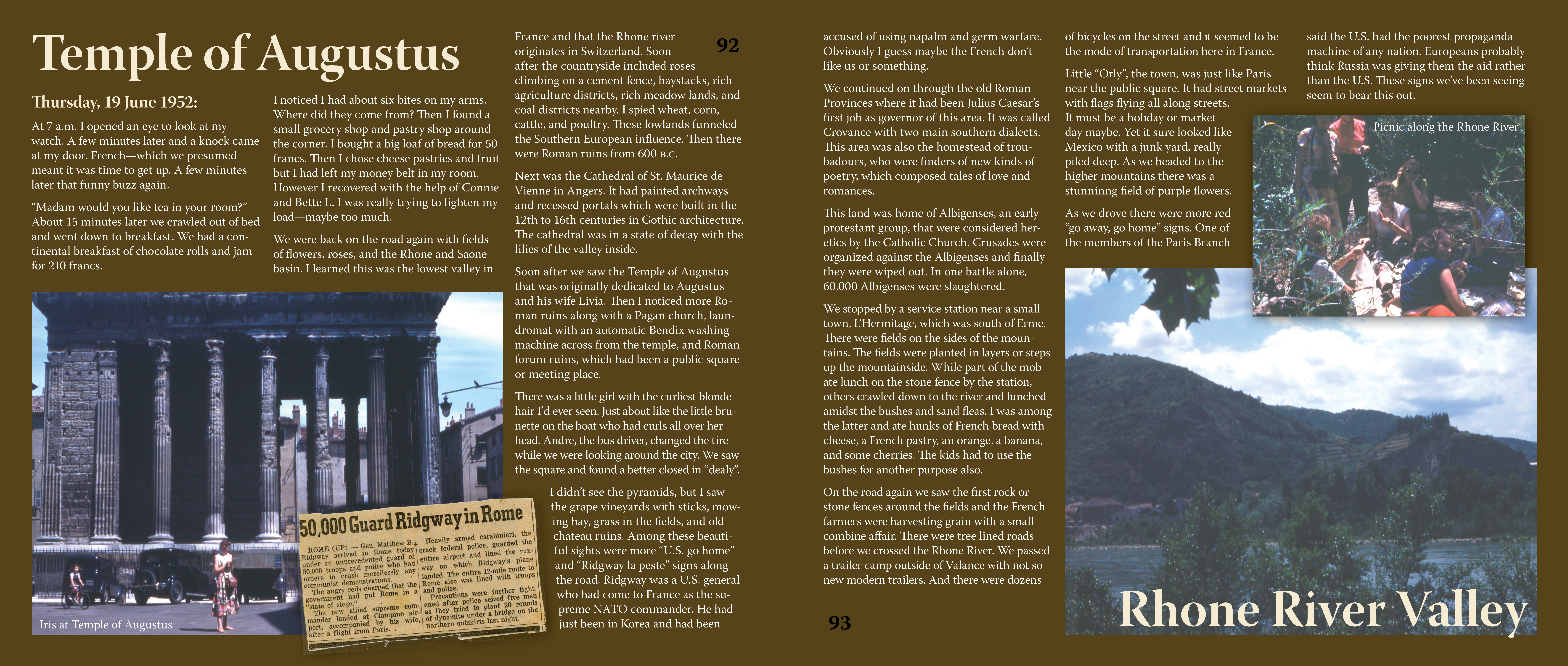
Thursday, 19 June 1952:

At 7 a.m. I opened an eye to look at my watch. A few minutes later and a knock came at my door. French—which we presumed meant it was time to get up. A few minutes later that funny buzz again.

“Madam would you like tea in your room?” About 15 minutes later we crawled out of bed and went down to breakfast. We had a continental breakfast of chocolate rolls and jam for 210 francs.
I noticed I had about six bites on my arms. Where did they come from? Then I found a small grocery shop and pastry shop around the corner. I bought a big loaf of bread for 50 francs. Then I chose cheese pastries and fruit but I had left my money belt in my room. However I recovered with the help of Connie and Bette L. I was really trying to lighten my load—maybe too much.
We were back on the road again with fields of flowers, roses, and the Rhone and Saone basin. I learned this was the lowest valley in France and that the Rhone river originates in Switzerland. Soon after the countryside included roses climbing on a cement fence, haystacks, rich agriculture districts, rich meadow lands, and coal districts nearby. I spied wheat, corn, cattle, and poultry. These lowlands funneled the Southern European influence. Then there were Roman ruins from 600 b.c.

Next was the Cathedral of St. Maurice de Vienne in Angers. It had painted archways and recessed portals which were built in the 12th to 16th centuries in Gothic architecture. The cathedral was in a state of decay with the lilies of the valley inside.

Soon after we saw the Temple of Augustus that was originally dedicated to Augustus and his wife Livia. Then I noticed more Roman ruins along with a Pagan church, laundromat with an automatic Bendix washing machine across from the temple, and Roman forum ruins, which had been a public square or meeting place.

There was a little girl with the curliest blonde hair I’d ever seen. Just about like the little brunette on the boat who had curls all over her head. Andre, the bus driver, changed the tire while we were looking around the city. We saw the square and found a better closed in “dealy”.
I didn’t see the pyramids, but I saw the grape vineyards with sticks, mowing hay, grass in the fields, and old château ruins. Among these beautiful sights were more “U.S. go home” and “Ridgway la peste” signs along the road. Ridgway was a U.S. general who had come to France as the supreme NATO commander. He had just been in Korea and had been accused of using napalm and germ warfare. Obviously I guess maybe the French don’t like us or something.

We continued on through the old Roman Provinces where it had been Julius Caesar’s first job as governor of this area. It was called Crovance with two main southern dialects. This area was also the homestead of troubadours, who were finders of new kinds of poetry, which composed tales of love and romances.

This land was home of Albigenses, an early protestant group, that were considered heretics by the Catholic Church. Crusades were organized against the Albigenses and finally they were wiped out. In one battle alone, 60,000 Albigenses were slaughtered.

We stopped by a service station near a small town, L’Hermitage, which was south of Erme. There were fields on the sides of the mountains. The fields were planted in layers or steps up the mountainside. While part of the mob ate lunch on the stone fence by the station, others crawled down to the river and lunched amidst the bushes and sand fleas. I was among the latter and ate hunks of French bread with cheese, a French pastry, an orange, a banana, and some cherries. The kids had to use the bushes for another purpose also.

On the road again we saw the first rock or stone fences around the fields and the French farmers were harvesting grain with a small combine affair. There were tree lined roads before we crossed the Rhone River. We passed a trailer camp outside of Valance with not so new modern trailers. And there were dozens of bicycles on the street and it seemed to be the mode of transportation here in France.

Little “Orly”, the town, was just like Paris near the public square. It had street markets with flags flying all along streets. It must be a holiday or market day maybe. Yet it sure looked like Mexico with a junk yard, really piled deep. As we headed to the higher mountains there was a stunning field of purple flowers.

As we drove there were more red “go away, go home” signs. One of the members of the Paris Branch said the U.S. had the poorest propaganda machine of any nation. Europeans probably think Russia was giving them the aid rather than the U.S. These signs we’ve been seeing seem to bear this out.

The next landscape scenery included the sprinkling system in the field, grain standing in piles of shocks, and a big gravel pit. There were colorful brushes, brooms, and dusters on the streets while going through the little town of Montelimar. I slept through part of this town. But as I awoke another sign said “US Go Home.” This is getting monotonous. Then there were more château ruins on the hill.

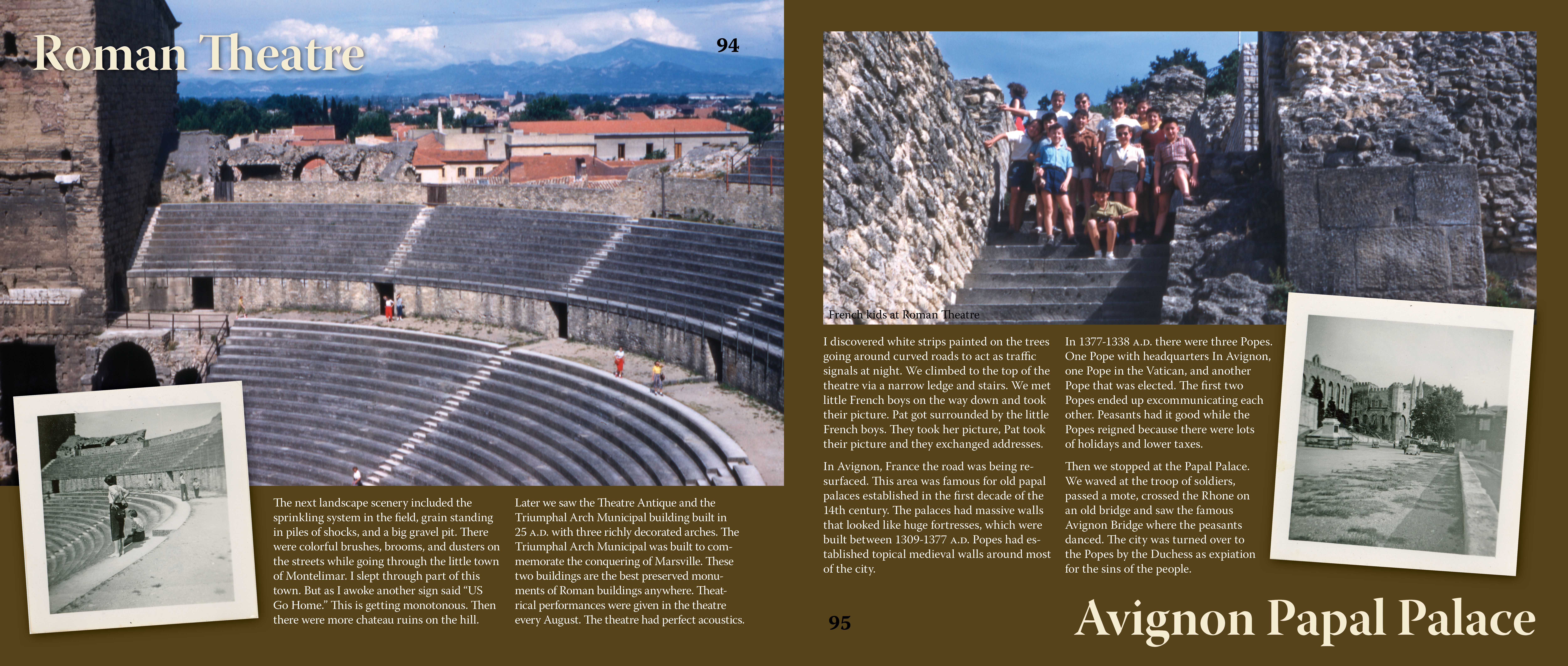
Later we saw the Theatre Antique and the Triumphal Arch Municipal building built in 25 a.d. with three richly decorated arches. The Triumphal Arch Municipal was built to commemorate the conquering of Marsville. These two buildings are the best preserved monuments of Roman buildings anywhere. Theatrical performances were given in the theatre every August. The theatre had perfect acoustics.

I discovered white strips painted on the trees going around curved roads to act as traffic signals at night. We climbed to the top of the theatre via a narrow ledge and stairs. We met little French boys on the way down and took their picture. Pat got surrounded by the little French boys. They took her picture, Pat took their picture and they exchanged addresses.

In Avignon, France the road was being resurfaced. This area was famous for old papal palaces established in the first decade of the 14th century. The palaces had massive walls that looked like huge fortresses, which were built between 1309-1377 a.d. Popes had established topical medieval walls around most of the city.

In 1377-1338 a.d. there were three Popes. One Pope with headquarters In Avignon, one Pope in the Vatican, and another Pope that was elected. The first two Popes ended up excommunicating each other. Peasants had it good while the Popes reigned because there were lots of holidays and lower taxes.

Then we stopped at the Papal Palace. We waved at the troop of soldiers, passed a moat, crossed the Rhone on an old bridge and saw the famous Avignon Bridge where the peasants danced. The city was turned over to the Popes by the Duchess as expiation for the sins of the people.

Soon after we observed one boat of girls and another boat of boys rowing on the river. Pont du Gard, which was one of the grandest Roman works in existence, had a bridge and aqueduct over the Gard River. It was 880 feet long by 160 feet high. Its system consisted of a system of three arches carrying water for 25 miles to Nimes. Other aqueducts copied Pont du Gard.

There was rocky country as we left Avignon and arrived at the Aqueduct. And the scenery included vineyards, tree lined roads, men harvesting grain with scythe, and another “US Go Home” sign. Maybe it was the communists who keep telling us to go home. I discovered spots to show the middle of the road.

We arrived at the aqueduct and climbed up the winding bush-lined trails. It was a massive structure. I took picture of the kids on the top with the aqueduct from the trail. It took 30 minutes to get to the top instead of 10 minutes. Next was a grove of olive trees, dry dock over some railroads, and houses with green, blue and yellow shutters.

At 7 p.m. we got into the city of Nimes. There was a Roman amphitheater that was built in 140 a.d. which held 20,000 spectators. It was one of the best preserved ancient arenas and it could be emptied in five minutes. This area contains more important well preserved ruins than any other city besides Rome.

Later on the bus ride was the Palais de Justice which was an old Gothic cathedral with flying buttresses. A physician lived here by the name of Nicot. He introduced tobacco in France and gave it his name. Next was the Temple of Maison Carree, considered one of the most beautiful temples of modern times. The French had bullfights in this arena.

Finally, we arrived at the Hotel Le Cheval Blanc. Its facade was nice looking. My room was 59 on the 4th floor. The suitcases were taken down early for tomorrow. I wasn’t able to sleep in my pajamas tonight. Carol and Eloise had difficulty with the door. Twila couldn’t get it to open either, but we finally got it open. The WC was at the other end of the hall. I cleaned up with a foot and spit bath combination. Then we dined at the hotel sidewalk café—omelet cambron and pomes frites for 15 francs. We had one omelet between the three of us.

We strolled down the boulevard in search of a French movie. We turned down one movie with Lucille Ball and then passed a street side cabaret deal with a small orchestra, but no one was dancing. People were sitting around watching each other. They really concentrated on us as long as we were in view. We found a movie Deux Sous de Violettes with Dany Robin. The heroine of the movie had so many heroes it was a little confusing, but quite amusing nonetheless. At the end of the day there was only one pillow on the bed.

60 Years Ago Today

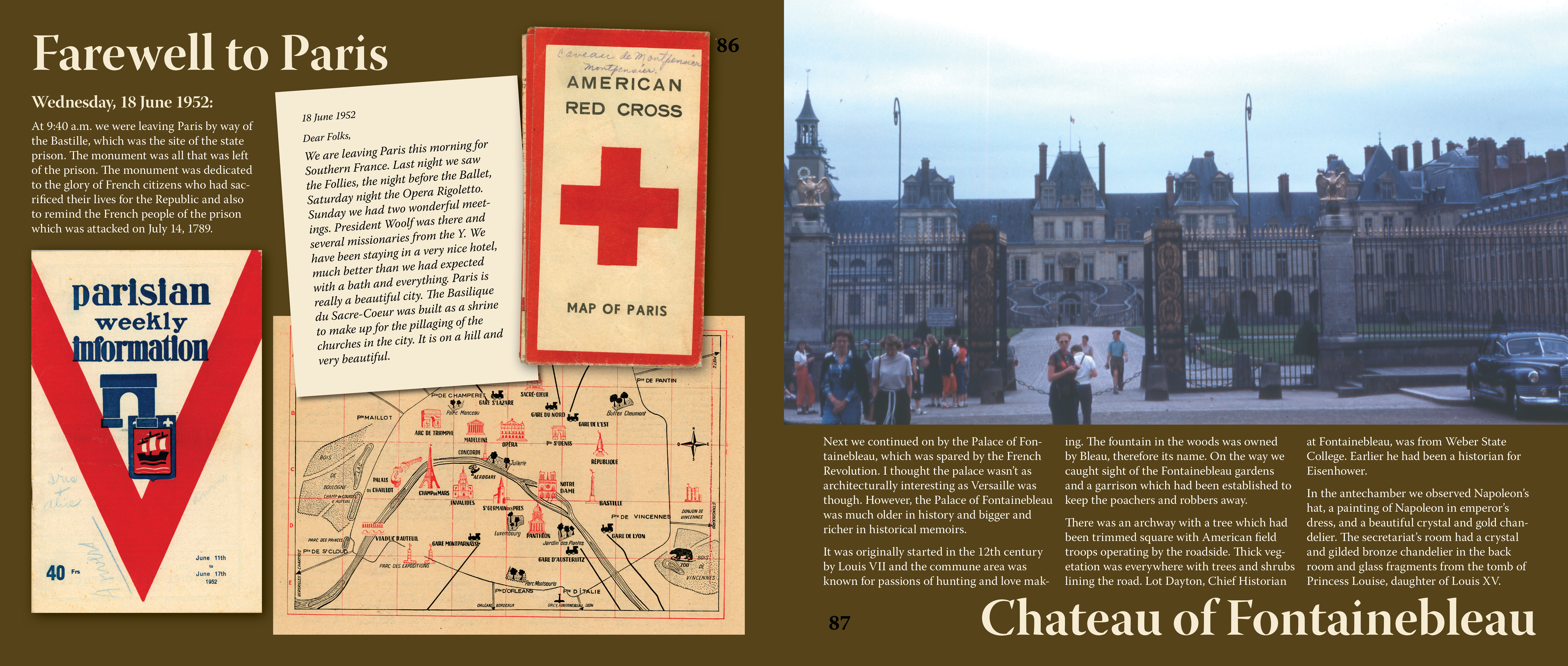
Wednesday, 18 June 1952:

At 9:40 a.m. we were leaving Paris by way of the Bastille, which was the site of the state prison. The monument was all that was left of the prison. The monument was dedicated to the glory of French citizens who had sacrificed their lives for the Republic and also to remind the French people of the prison which was attacked on July 14, 1789.

Next we continued on by the Palace of Fontainebleau, which was spared by the French Revolution. I thought the palace wasn’t as architecturally interesting as Versaille was though. However, the Palace of Fontainebleau was much older in history and bigger and richer in historical memoirs.

It was originally started in the 12th century by Louis VII and the commune area was known for passions of hunting and love making. The fountain in the woods was owned by Bleau, therefore its name. On the way we caught sight of the Fontainebleau gardens and a garrison which had been established to keep the poachers and robbers away.

There was an archway with a tree which had been trimmed square with American field troops operating by the roadside. Thick vegetation was everywhere with trees and shrubs lining the road. Lot Dayton, Chief Historian at Fontainebleau, was from Weber State College. Earlier he had been a historian for Eisenhower.

In the antechamber we observed Napoleon’s hat, a painting of Napoleon in emperor’s dress, and a beautiful crystal and gold chandelier. The secretariat’s room had a crystal and gilded bronze chandelier in the back room and glass fragments from the tomb of Princess Louise, daughter of Louis XV.

Next were the rooms where Napoleon abdicated the throne before going to Elba. There was a mural showing the power of justice as we continued to the rooms of the emperor where there was a replica of Napoleon’s cradle. The symbol of a general changed to a symbol of an eagle when he became emperor.

Louis XV had decorated these rooms. The Napoleon council room in the minister’s throne room had the bee as a symbol. When he had been a general, he had chosen the honeybee symbol which represented a hard working man. Soon after was a portrait (copy) of Louis XIII, priceless chandelier, 40,000 francs in Napoleon’s time, apartment of Marie Antoinette, present decorations from Louis XVIII, and bedroom of six different Marie’s including Marie Medici, Teresa, Antoinette, and Louise.

Farther on was Marie Antoinette’s bed, Marie Louise’s jewelry box, and Minerva painted on the ceiling, Then we continued on to Empress Josephine’s harp, a music room, and Napoleon III’s Empress Eugenia reception room. It had two original chairs in the different rooms for the lady of honor. Then we discovered the library that had been made for Diane and murals covering the rounded ceiling.

The Renaissance antechamber was where Frances I married Constantine. Then there were more Frances I rooms which had furnishings, a tapestry on chairs of Beauvais, an ivory box belonging to Anne of Austria, and the first glass introduced from the city of Venice in the 16th century. There was a room where Louis XVIII was born.

Next was a square tower room that was the oldest part of Fontainebleau from the 12th century. And all the kings from Francis I and later have added something to the palace. We proceeded on to see enamel incense burners, Henry IV on the horse that was sculptured in marble, , and hand carved ebony cabinets. I noticed Italian work was more ornate than the French. There were fifteen different kinds of wood in the floor and the floor and ceiling corresponded with a similar look.

Louis XV built a stairway as an entrance to other rooms and one of the rooms was the favorite of Francis I. Later the queen had coverings put over the nude statues. The ceiling was finished by Louis Philippe in 1830 and the gallery was completed by Henry II. The gallery room had last been used in 1930. Again there were nine kinds of wood in the floor. Then we noticed the room of the governess of Louis 14th, Salon of Madame du Manteneau. I could see the old entrance and gardens to the palace from the window.

We ate our lunches on the bus after leaving Fontainebleau. Gee—the food sure tasted good! We had sandwiches with some of Alene’s meat (spam, I believe). Then we had bananas, oranges, and a pastry to finish the meal.

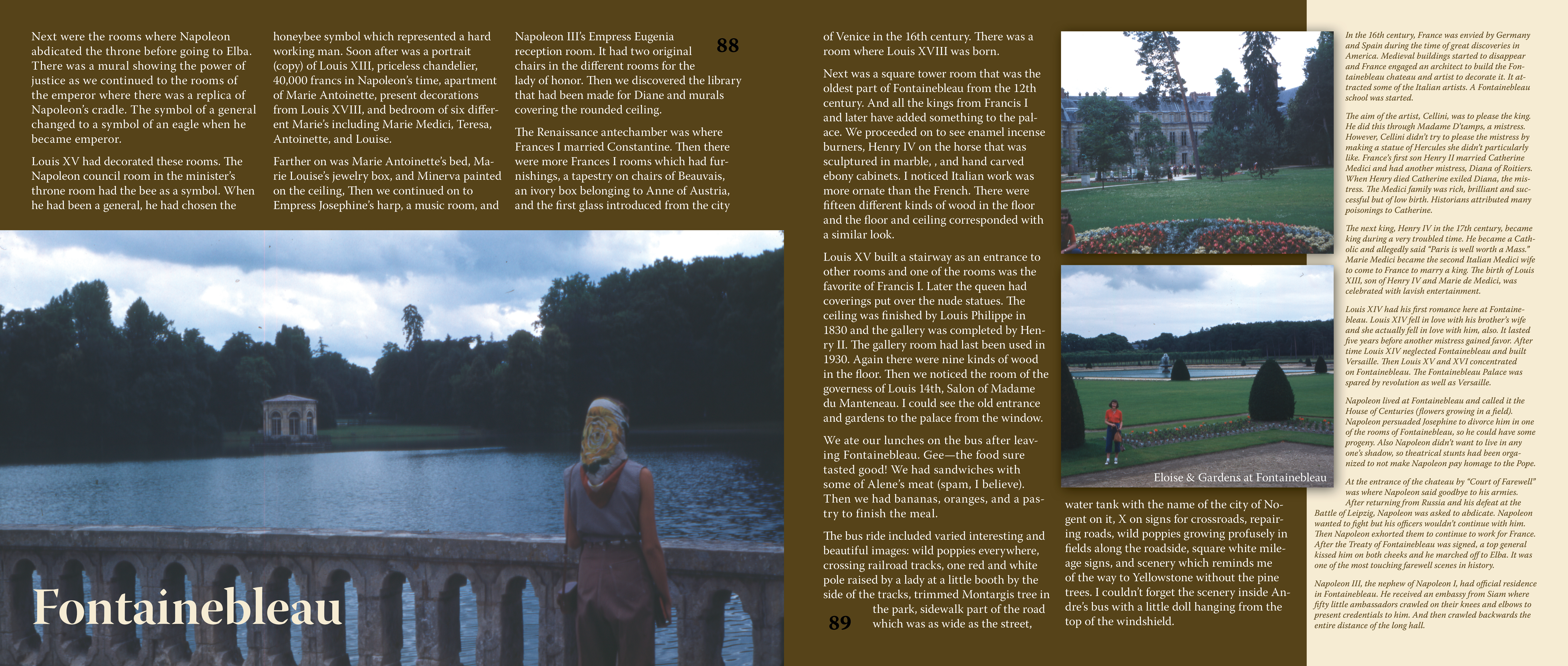
The bus ride included varied interesting and beautiful images: wild poppies everywhere, crossing railroad tracks, one red and white pole raised by a lady at a little booth by the side of the tracks, trimmed Montargis tree in the park, sidewalk part of the road which was as wide as the street, water tank with the name of the city of Nogent on it, X on signs for crossroads, repairing roads, wild poppies growing profusely in fields along the roadside, square white mileage signs, and scenery which reminds me of the way to Yellowstone without the pine trees. I couldn’t forget the scenery inside Andre’s bus with a little doll hanging from the top of the windshield.

As we continued traveling we passed the Briare Canal, a tributary of the Seine, and women working in the fields alone. I caught sight of a man on a bicycle with a cart behind him and another lady pulling her cart along the road as well. There was little traffic on the French roads. There was a gorgeous field of tall white flowers was used to make oil for salads. Then we went through a little town that had narrow winding streets like Mexican cities. We moved along a curbed road lined with trees with a valentine sign, a mowed swatch of grass along side the road, and some men working on the railroad Nuervy underpass. After awhile I started dozing. Then Andre hit his funny loud horn and I woke right up.

Along the roadside there was a beautiful grove of trees, load of hay, lumberyard, cut patch of grass raked and ready to bunch. I kept dozing. After my napping I came to realize there was a little horn and big horn that could jerk me quickly out of my sleep.

Now back to sightseeing. La Charite in Loire Valley dispersed on both sides of the River Allier. In the next village I spotted a house covered with climbing vines. Then we passed groves of trees still maturing, Nevers train station, Hotel Moderne, and some grass bunched along the road.
Soon we stopped at the railroad station. Was it really a “dealy” for the bathroom? However, I didn’t go in and walked down the street to the pastry shop. I enjoyed a fresh roll with raisins, an orange, and a drink. Yea, a clean toilette in the shop! Back on the road there was construction on both sides of road. Soon there were cattle in the fields, and then pigs, sheep, and cows.

In the city of Moiry there were cement telephone poles with rectangular squares. And we learned that each average French farm had 25 acres. The tobacco, utilities, armament, and matches industry were run by the government. If there was a fire, owners of the buildings had to pay for the expenses and damages. The franc was worth 25 cents to an American dollar before World War I and about 36 francs to a dollar before World War II.

The French in this area were Celtics. Their language related to Latin, Greek, Slavic. They were a tall fair-haired people that lived in tribes and had the Druid religion. The Romans wiped them out and ruled with no written law. Clovis was the first king to unite all the tribes in France and he became an important leader in France. He was Christian, so all warriors converted to Christianity. Clovis succeeded in driving out the Visigods from Southern France. In 350 a.d. the Franks in the north had headquarters in Paris and the Burgundians were in Southeastern France.
We saw the old Castle Orateau which was built during the Renaissance in the 9th century. As the Frankish kings became weaker, Charlemagne took over from 768-814 a.d. as a Frankish king and helped define Western and Central Europe. Also, Charlemagne protected the Pope while he knelt in prayer and as a result the Pope crowned him the King of the Renaissance.

The Carolingian Renaissance, in 843 a.d. , stands out as a period of intellectual and cultural revival in Europe. This was the beginning of the Romance languages. Later the Burgundians, a Eastern Germanic tribe, with their seat of government in Dijon, France and Geneva, Switzerland were subdued by the Franks. Afterwards, the fierce and warlike Normans came in the 9th and 10th centuries while Rouen was the capital of Normandy. Charles the Simple, the French king, gave his daughter to a Viking leader Rollo. Then the Normans accepted Christianity and became a vassal to the king.

Later the Normans in 1066 a.d. conquered England and the Normans took home with them the French language and culture, because they had forgotten their own. As a result the French language became the official language of Europe.

The Englishmen like action and wild behavior where the Frenchmen were more mind oriented, intellectual and not so sports minded. Also the French loved order and Frenchmen were more subtle in tastes and in expressing their opinions. However the Spanish were passionate. And the Germans loved romantic literature and had feelings of love. Romanticism came to prevail with Victor Hugo, a French playwright and author, for a short period of time.

Back to sightseeing we saw French peasants that were passing through the rich fertile farm area. In the Middle Ages, the French peasants were a little better off than the European peasants in general. They were quite satisfied with their lives as fifty percent had become land owners during the revolution. This status and high percentage was the best in Europe. In 1952 nearly all the land in France was owned by peasants. The peasants represented the one big obstacle to communism. However there were some sharecroppers in Southwest France that were breeding places of communism. Today France and England have the same form of government.

In the 19th century, peasants constituted 75% of the population. Whereas in 1952, 23% of the population were peasants. Tredita Agular lent money to the peasants. But there were no big supermarkets or tractors to be seen anywhere, because peasants disliked machines. When the peasants died out, the farms were given back to the government.

On the road I spied some road construction where the workmen wore wooden shoes. Then we stopped at a small town on the way for drinks and gas at 80 cents a gallon. Before we left we gave gum to two little girls in the restaurant.

Now back in the bus we gazed at the scenery which had beautiful rolling hills, checkerboard farms, and tombs in a cemetery. There were little tombs where people had been buried on top of each other.

Next on the drive was a basketball court, windmill, vineyard, red tile roofs, circus in Roanne, and Loire River. The night brought a beautiful rainbow and sunset. Coming up was Lyon, France which was the largest silk center and one of the leading car producing centers in Europe. It was the second largest city in France.

Finally we arrived at Hotel de Angleterre about 10:30 p.m. We were hungry and the dining room had just closed as we arrived. Can you believe I got a room 51 all by myself! It has a big double bed, plush red cover, and marble fireplace. Sadly Connie came down to sleep with me though.
In the bathroom I discovered a lavatory, foot bath, hot water, and a short bed with a canvas sheet on the bottom. It was a modern look with a roll pillow and big pillow on the bed. Mrs. Hansen and Dick were put in the same room. The hotel changed it when they realized what had been done.

60 Years Ago Today

Tuesday, 17 June 1952:

I t was a slow start as we discovered the Louvre was not open. Wouldn’t that frost you? And that was where I had planned to spend most of the day. Instead we stopped by an oculist (ophthalmologist) shop to get the ear piece on my sunglasses fixed. Thanks to Alicia, we were successful in getting the lady to understand us.

Then we left a forwarding address at the American Express for the next mail stop. Next was the Lafeyette Department Store that was just like an opera house. It had a dome of stained glass and ornate gold railings around each floor.

We had lunch on the terrace of the Lafayette Department Store after searching four floors to find it. We had a view of the apartment roofs. There were two table cloths, cloth napkins, ice water, and bread. I ordered an omelette and ham while I ate four pieces of bread. Alice got a rare steak, but by using her French she got it recooked some more.

Then we paid the cashier and left for Printemps, another department store, and cheaper restaurant. We found the toy department and bought Kleenex for 325 francs.

Outside again, a lady surprisingly stopped and asked me “ou est la metro?” We tried to help her and then we took the metro to the Seine River. We got off near Sarah Barnhardt’s Theatre and identified the Saint Jacques Tower. We traveled to see St. Chapelle but it was closed. Tuesday’s sure seemed to be the day for everything to be closed.

Instead we strolled down by the Seine River. Here we saw another side of Paris. People lived in river boats with their wash blowing in the breeze. Others seemed to live along the banks, although we didn’t see any shelter for them. One man was washing his clothes in the river while an old beggar was eating trash out of a dirty can. Others were laying by the side of the river sleeping or unconscious. Then we took pictures of some little children and gave them some gum.

We found the Pont Marie metro station to go to the Eiffel Tower. We changed lines five times in order to get to the Eiffel Tower by the shortest route. We switched once at Franklin D. Roosevelt Station, made a mistake, and had to come back to it from Etaile.

The newest and most modern show windows on the trains were of an aluminum looking material. The walls were covered with the same thing as well. It was really smoky and stuffy in the train. I missed a few scenes resting my eyes.

Afterwards, there was one interesting scene with a Negro nanny, daddy and little baby crying. Another scene showed a spinning pool on a stage. It was quite a trick with girls coming down from the ceiling. I took several good shots from the second Etage (story). I was going to walk up to see it but I didn’t have time. The metro was jammed with people going home from work. We literally rubbed shoulders with the people of France.

I met a cute little English man coming back from the Eiffel Tower to the hotel, and he helped us cross the street. He told us he worked at the auto races.

Then Dick guided us down several streets from the Montmartre metro to get to the Folles Theater at 8:30 p.m. The curtain went up just as we sat down with Dick, Henry, and about thirty women. Talk about luxurious costumes and shapely figures in the play. There were about four risque scenes, but nothing in particular happened when they were all dressed up. It was interesting.