60 Years Ago Today

Monday, 7 July 1952:

I had a continental breakfast with the same dinner napkins from last night. Then I went down to the American Express office. I was the first one in line for the mail. Almost everybody was happy. Likewise I was quite lucky myself with letters from Mom, Twila, Craig and Caroline. Next stop was the bell tower, Campanile of St. Marks Square. It was the new one from 1912 as the old tower tumbled down in 1902. I even got to feed the pigeons in the square.

Then we were off to the cathedral, which was ornate inside and out, and had been rebuilt many times. I learned that the water came right into the building during the high winter sea. In the Venetian Museum of Art, every decade had left its own water mark. The original style was lost and now it seemed overburdened with too much stuff. In 832 a.d. the original structure was created, destroyed in 900 a.d., rebuilt in 978 a.d., and built larger in 1063 a.d. with materials from older structures. Venice had reached its splendor about 1492. There were mosaics in the interior. The building was progressively sinking with the body of St. Mark preserved under the altar. The cathedral was built in the form of a Greek cross.

Next on the agenda was the Ducal Palace that was the seat of the governor for the Venetian Republic and home of Doge, the chief magistrate. There were subterranean prisons inside. However, the importance of the palace was exclusively artistic and its history began in the 9th century. In the 13th century the palace was burned and then reconstructed. It housed the largest oil painting Tintoretto’s Paradise and a remarkable golden stairway of nobility. The stucco ceilings were designed by one of Michelangelo’s pupils. The ceiling of the next room was by Oslagio and had paintings by Titan. There was a room with medieval armor and another with swords and guns with eight to ten barrels each. Some of the rooms were large and others were small. They were decorated with Tintoretto’s dark paintings, I believe. I went onto the balcony where there were busts of Dukes, Dante, Marco Polo, and most everybody it seemed.

The subterranean state prisons were next. We came out and water was coming under the door from the canal. Everybody hurriedly rushed through a door and rushed right out again. It was the WC.

We proceeded to a glass factory. We watched the heating and shaping process of a vase. And then we saw the showrooms. It seemed like a block of the rooms were filled with the most beautiful, colorful, original, and expensive glassware and dishes one can imagine. We drooled over them, but kept our money for the most part. I nosed around the shops on our way back to the hotel for lunch. It sure took a lot of will power to look and not buy, cause there were so many pretty things.
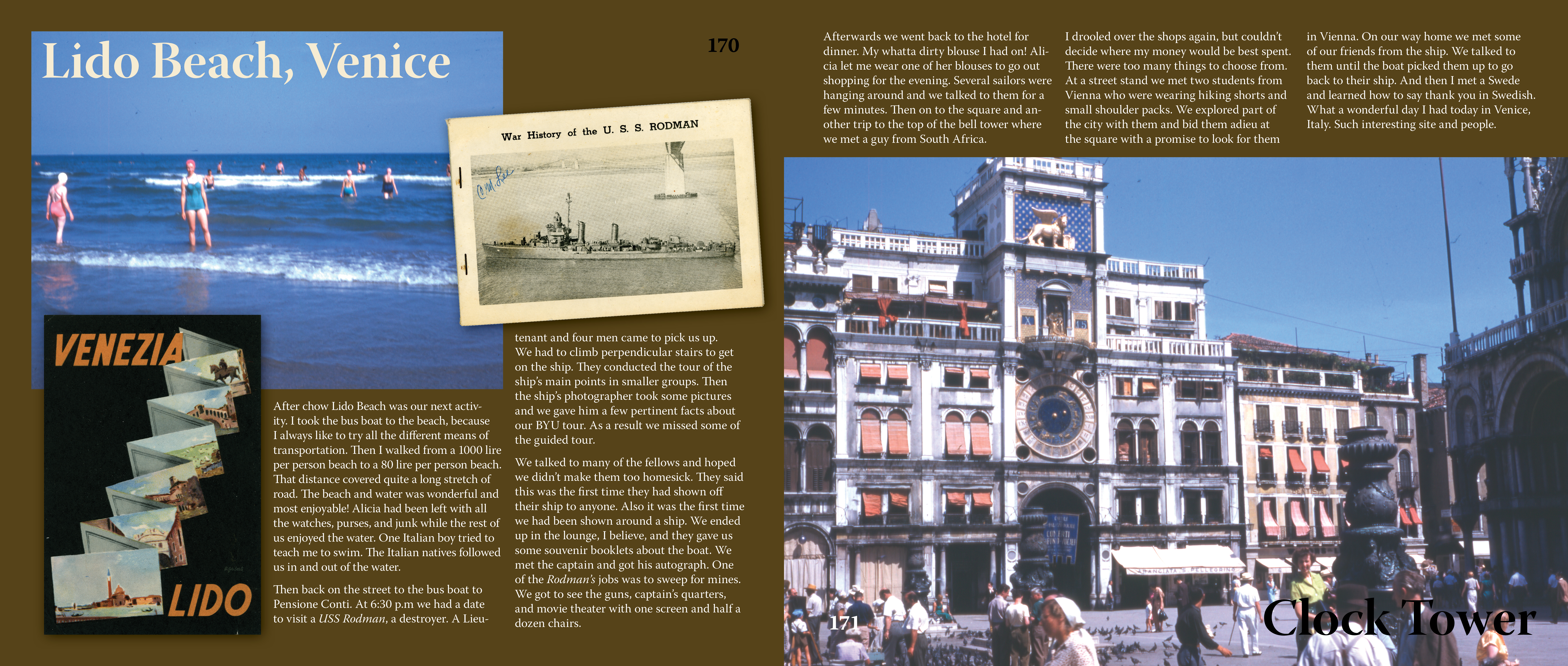
After chow Lido Beach was our next activity. I took the bus boat to the beach, because I always like to try all the different means of transportation. Then I walked from a 1000 lire per person beach to a 80 lire per person beach. That distance covered quite a long stretch of road. The beach and water was wonderful and most enjoyable! Alicia had been left with all the watches, purses, and junk while the rest of us enjoyed the water. One Italian boy tried to teach me to swim. The Italian natives followed us in and out of the water.

Then back on the street to the bus boat to Pensione Conti. At 6:30 p.m we had a date to visit a USS Rodman, a destroyer. A Lieutenant and four men came to pick us up. We had to climb perpendicular stairs to get on the ship. They conducted the tour of the ship’s main points in smaller groups. Then the ship’s photographer took some pictures and we gave him a few pertinent facts about our BYU tour. As a result we missed some of the guided tour.

We talked to many of the fellows and hoped we didn’t make them too homesick. They said this was the first time they had shown off their ship to anyone. Also it was the first time we had been shown around a ship. We ended up in the lounge, I believe, and they gave us some souvenir booklets about the boat. We met the captain and got his autograph. One of the Rodman’s jobs was to sweep for mines. We got to see the guns, captain’s quarters, and movie theater with one screen and half a dozen chairs.

Afterwards we went back to the hotel for dinner. My whatta dirty blouse I had on! Alicia let me wear one of her blouses to go out shopping for the evening. Several sailors were hanging around and we talked to them for a few minutes. Then on to the square and another trip to the top of the bell tower where we met a guy from South Africa.

I drooled over the shops again, but couldn’t decide where my money would be best spent. There were too many things to choose from. At a street stand we met two students from Vienna who were wearing hiking shorts and small shoulder packs. We explored part of the city with them and bid them adieu at the square with a promise to look for them in Vienna. On our way home we met some of our friends from the ship. We talked to them until the boat picked them up to go back to their ship. And then I met a Swede and learned how to say thank you in Swedish. What a wonderful day I had today in Venice, Italy. Such interesting site and people.

Paintings of Great Masters Viewed in Tour of Florence

Editor’s note: This is the eighth in a series of letters written by Mrs. Afton A. Hansen of Provo on her impressions of an European tour she is making with a group of 36 college students from Weber and BYU.

Dear Friends;
It is only a day since we left Italy, but we are still talking about how much we like these people and their country—those curiously friendly people who so adeptly mix the human and sublime, as is shown in the name of a commercial bank in Rome—”Bank of the Holy Spirit.”
Wouldn’t you like to know something about Venice (Venezia) and Florence (Firenze)?

The city of Firenze is not beautiful at first sight, and we wondered why so many tourist loved it so much. The beauty, so rare and excellent of this old city is found in its treasures of art. It is the world’s greatest art center, and in the 13th century was the greatest money market.

Big money often makes bad art, but the historically prominent Medici family of Florence loved beautiful things and knew them when they saw them.

They made Florence a beautiful city. Their vast collection and creations are possessed now by the Italian government for the world to enjoy.

da Vinci Sketches
San Lorenz, the private church built by the Medici family contains rare and original manuscripts of the masters. In the chapel are the pen sketches of Leonardo da Vinci. He is perhaps the greatest of the masters of his time. The world is still paying tribute to this genius born 500 years ago.
In a small church in Milan, (Santa Maria de la Grazie) we saw what is now left of da Vinci’s painting The Last Supper. The building itself, bombed during the war, is now reconstructed. The painting though somewhat protected from bombs is being restored. It is told that when da Vinci was searching for a model for Judas in the picture, he found him on the street and approached him. The man answered, “Yes, I will pose for you. It is I who posed for you many years ago when you painted Christ.”

Leonardo da Vinci’s pen sketches of art subjects, music, architecture, engineering and science still hold good. In the library of the San Lorenz church are original manuscripts of Dante’s Inferno, Petarch and Laura and account books dating back to B.C., choral books with their square notes and four-lined staff, a wise sayings book by Cecco D’ Ascoli, a book of Greek poetry by Boctchio and Sappho.

The palace where the Medici lived, called Petti Pallzzio, has since been used for government office, but now houses the rare and costly treasures which the Medici used to show their guests when entertaining.

Works of Masters
We stood aghast at the vases, bowls, goblets, etc., which were made of semi-precious stones and decorated with gold, rubies and pearls. Figurines carved from ebony, ivory, coral and shell were numerous. Original paintings from da Vinci, Michelangelo, Rembrandt, del Sorto Murillio and others adorned the walls. It was breath-taking. On the ceiling in one room were scenes from the Iliad, done in such superbly rich colors that we felt like lying down on the huge covered ebony table beside the statue of sleeping infants to gaze forever at the ceiling.

The choice picture for me was of young John the Baptist by Murillio. Sometime, maybe, my newly found lady friend, who is a copiest of masterpieces will do one for me. She was a delightful person who was doing a reproduction of del Sorte’s Madonna.

Reluctantly leaving Pitti Palazzio, we walked across the oldest bridge the Arno river. It was protected from bombs during the war by sentiment and by blowing up the entrance to the bridge. Shops on either side of the street on the bridge have for more than 300 years now bought and sold some of the most alluring merchandise in silk, linen, wool, silver, leather, etc., that anyone could ever imagine. All we needed to more thoroughly enjoy it was more money.

Up the steps to Michelangelo Square, we stood near another statue of David (the original of which we saw in the Academy and Tribune of David) to see the city of Florence and locate the various spots of interest we had seen.

Impressions as well as expression come thick and fast on such a trip as this. Writing seems so slow compared to experience, but recollections are always enjoyable.
What a commotion we cause in Milano (Milan) when our bus load of 32 American girls and four men were unloaded in front of a boy’s dormitory — Casa delo Students! The boys were eating their evening meal at the time, but soon their severe dining room was buzzing with excitement, and then it was practically empty for about 54 of them came out to talk to the 12 girls and two men who were left. The others were to stay a block away. The manager of the dorm was concerned so he stayed up all night patrolling the corridor. The girls enjoyed good conversation with these fine college students who were studying engineering. We were on our way again by 7 a.m. Venezia (Venice) with its waterways and gondolas, 100 islands and 400 bridges, was enchanting. It took six gondolas to transport our group from bus to hotel, but what delightful transportation. Gliding smoothly along in a cushioned carpeted gondola, made of some kind of dark wood, we noticed the pretentious buildings, somewhat rusty and adorned with moss. White marble steps so close to the water were draped with green moss.

Sinking City
Parts of the city seem to be sinking into the Adriatic sea. One American benefactress, noting this has collected money for supports for San Marco church were Saint Mark is supposedly buried.
Gondolas anchored to blue and white striped poles conveniently await the lady for her shopping tour, to get fresh vegetables or other household supplies. Her private gondolier calls a warning as he approaches an intersection, or turns a corner. We would hardly believe our eyes, seeing directional street light anchored in the water— red, yellow, green, stop and go.

Transportation by motor boat is faster, but not nearly so interesting.

Docked in port was a ship flying the American flag. Cheers from the girls soon brought all hands on deck. “Hi-ho, anyone there from Arizona?” —”Yes, and Utah too.” It didn’t take long to get acquainted with these sailors from Trieste. They entertained the group on board ship the next day.

We’ll soon be in Switzerland gazing at the Matterhorn.

Afton A. Hansen

P.S.—Having received some of the first copies of these articles printed in the Herald, I notice the names of Senator and Mrs. Arthur V. Watkins were inadvertently missing. They did so many nice things for this group including opening their office to us where we parked our suitcases and bags. They took all 36 of us to dinner in the senate private dining room, gave each of us a souvenir menu card, directed us to the senate in session where Senator Watkins gave a nice speech about Provo, the BYU and this tour. They also arranged for six private cars to take us on a tour of the city. They were most generous and gracious.

60 Years Ago Today

Sunday, 6 July 1952:

We were off at 6:30 a.m. in the morning. We really were starting to get on the ball. We said we were going to leave early and we did! Florence, it was goodbye! It was definitely a fun place to experience. We started to take the road to Bologna across the Apennine Mountains, climbing gradually. There was beautiful scenery and green vegetation covering the mountains. Patchwork fields dotted all through the valleys. This area reminded me of Mexico.

Oh, oh! I guess the bus couldn’t quite handle the big load. We stopped. Andre let the engine cool and tinkered around a little bit. Then our four men got out and pushed. That was what the bus needed, because the bus started up and the men had to run and jump to get on the bus.

We were on to more picturesque mountains, valley farms, men shocking grain by the road on Sunday, and men putting up hay in another field. Oh, oh! As we were nearing the summit, another contest between the bus and grade. And the grade won. Andre backed down to a more level spot in the shade and got himself all dirty under the bus giving it a once over. Finally the bus was ready to go again.

Where was Herr Watkins? About five minutes later he appeared with an interesting story to tell. Luckily we had trouble at the right spot for him in order to pick him up from visiting his friends. He was back visiting Italy after spending about eight months here during the war.

Herr had sent a note ahead of time saying that he would stop to see his friends if it were at all possible. They had been waiting for him since yesterday with wine and food. During the meal his Italian friends asked if he had a bad stomach because he hadn’t drunk any wine, only water. He gave us a detailed account over the public address system in the bus, so we could all hear about it.

He also told us about how the American soldiers impressed the Italian people as compared with the English and German soldiers. He shared their weekly system of getting clean uniforms, equipment, and personal baths.

I saw Bologna with a big swimming pool and green milky water right by the road. There were wide streets with beautiful new buildings done with a brocaded look on the outside. Later I saw a big gold courtyard and palace looking building. Then I spotted a municipal building with huge pillars, public square, and a huge round villa or monastery on the hill. We learned that Bologna was the home of oldest university in Europe.

We continued down into Po Valley that was the most fertile section of Italy. The landscape was dotted with rows of trees, tree fences and fields. We surely left Po valley in a hurry though. I guess we had hit the edge of it. Once again we were back to the drier country mountains. However, after awhile Andre stopped to talk to some men. Whatta ya know we were going the wrong way! We started to head back to Bologna again!

As we turned around in the yard of a farmhouse two little girls stood watching us. Mrs. Hansen reached out the window and gave them some gum. We have really been lucky. This was only the second time on this trip that we have missed our road. Seems like everything happens to us on Sunday though. I couldn’t decide whether it’s just coincidental or chastisement. I noticed skull and cross bones for railroad crossing again.

Back in Bologna again. There were not very many cities we got to see twice on this trip. We stopped this time for a rest stop. It wasn’t such a hot spot with long waiting lines. It was a bad day for Alicia. She was not feeling well. We found lemonade at a corner stand. I guess it wasn’t such a bad spot after all. Vamos!

Back on the road again we passed fields looking suspiciously like sugar beets. Then I noticed some tall stuff. I recognized this plant from before but couldn’t remember what they used it for. Then I saw an irrigation system. Next was a strange looking rectangular and pale green pond affair with several piles of rocks. A canal that ran along the road had a milky appearance like irrigation water. The canal was really low and kinda slimy green looking.

I missed the tree lined roads on the drive that I was used to. However, there were double rows of trees on one side and a newly planted double row of trees on the other side. We crossed an almost dried up river. It looked like a drought this season in Po Valley. I kept seeing casa cantoniera which means rest area, at regular intervals so the Italians hadn’t forgotten the poor travelers in need.

Then we ventured onward to Ferrara, Padua and Venice. On our way we crossed the Po River with weeping willow trees on the banks. I noticed road construction as we passed kids playing in a big swimming hole and then back to tree lined roads again with pyramid shaped hills. One hill had tall dark slender trees along the road winding around to the top. Again there were kids swimming in a big canal along side the road. Like Padua there were sidewalks along the canal. There were many big churches there.

We took the Autostrada, the main highway system in Italy, into Venice. My glasses were giving me a bad time and kept crawling down on my nose. Finally the bus went over the causeway connecting us to the Island of Venice.

In Venice there were little boats and people bathing in the water that stretched out on both sides of us. We arrived and then had a conference to decide what to do about our big suitcases. It resulted in suitcases opened all over the sidewalks and a major traffic jam in the bus. Eventually we got out what we needed and left the large suitcases in the bus.

And soon we were off to the gondola. We ran into some kind of bottleneck on the money angle and had to wait for American Express to clear us. There was a man with a motorboat! All of us took a slight jaunt down to the docks to the motorboat. No! The coupon says gondola, so we go back again. Someone made a phone call and finally we get in a gondola. One more first for me, a gondola. That’s me. Tis the life!

Hey what was this? A traffic light on the canal and a bridge with white iron work. This canal crossed another canal into an intersection. What! A garage held two boats. Most of the front sides of buildings had little balconies on the water. There weren’t any porches unless they were inside the door or gate. I believed this must be the grand canal we were going down, because it was pretty wide. In Venice the gondolas were the slow taxis, small motor boats were the fast taxis, and big motor boats were the buses.

The big bridge came up. Lord Byron called it the Bridge of Sighs. It came from the suggestion that prisoners would sigh at their final view of beautiful Venice out the window before being taken down to their cells.Wrong bridge, that was another one! This was the Rialto Bridge.

Our gondola didn’t go under the bridge and went down an alley and came out on what looked like a lake, too big for a canal. I saw a navy boat with American sailors. We waved and asked if “Anybody was from Utah?” No one was from Utah it appeared.

There were beautiful facades on these waterfront buildings. It seemed to be the center part of the city. Someone spied our hotel, Conte Pensione. Meals were included with the hotel and were we ever ready for dinner. There was a monastery room overlooking the alley. Dinner was at 8 p.m. Everybody was on time and eager to chow down.

After dinner we took a stroll and found three American servicemen stationed in Trieste. Everyone crowded around them. As more of the mob came by, it was a U.S. reunion. Then we went on to St. Mark Square.

Venice at night was so enchanting and too beautiful to describe. On the island there were sidewalks between the buildings, but between the islands were canals. There were no wasted spaces with every inch in use.

I took another gondola ride with a song from the gondolier. What a delicious spot for a honeymoon! Need I say more? As we glided past the blue grotto there was divine music and atmosphere. But where wasn’t there atmosphere here? People were wandering back home down our alley into the night singing and chatting.

60 Years Ago Today

Saturday, 5 July 1952:

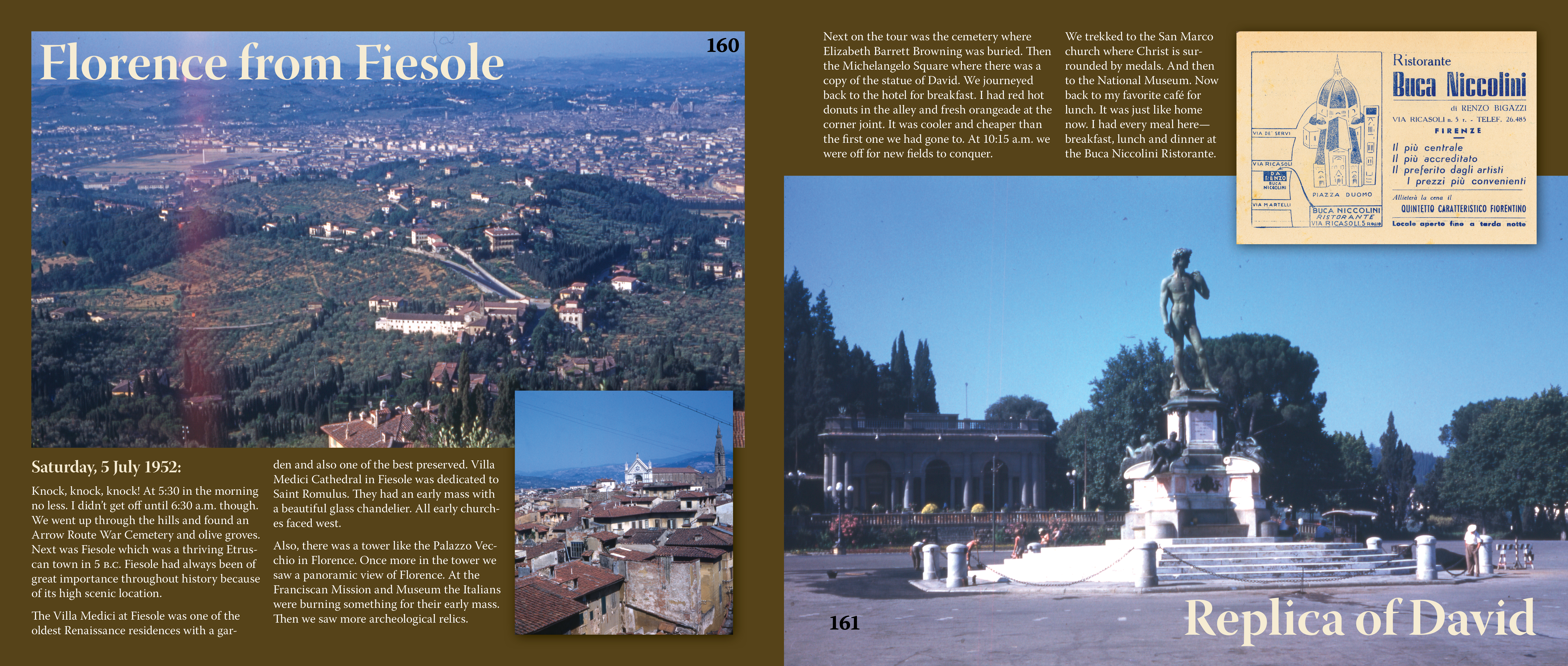
Knock, knock, knock! At 5:30 in the morning no less. I didn’t get off until 6:30 a.m. though. We went up through the hills and found an Arrow Route War Cemetery and olive groves. Next was Fiesole which was a thriving Etruscan town in 5 b.c. Fiesole had always been of great importance throughout history because of its high scenic location.

The Villa Medici at Fiesole was one of the oldest Renaissance residences with a garden and also one of the best preserved. Villa Medici Cathedral in Fiesole was dedicated to Saint Romulus. They had an early mass with a beautiful glass chandelier. All early churches faced west.

Also, there was a tower like the Palazzo Vecchio in Florence. Once more in the tower we saw a panoramic view of Florence. At the Franciscan Mission and Museum the Italians were burning something for their early mass. Then we saw more archeological relics.

Next on the tour was the cemetery where Elizabeth Barrett Browning was buried. Then the Michelangelo Square where there was a copy of the statue of David. We journeyed back to the hotel for breakfast. I had red hot donuts in the alley and fresh orangeade at the corner joint. It was cooler and cheaper than the first one we had gone to. At 10:15 a.m. we were off for new fields to conquer.

We trekked to the San Marco church where Christ is surrounded by medals. And then to the National Museum. Now back to my favorite café for lunch. It was just like home now. I had every meal here—breakfast, lunch and dinner at the Buca Niccolini Ristorante.

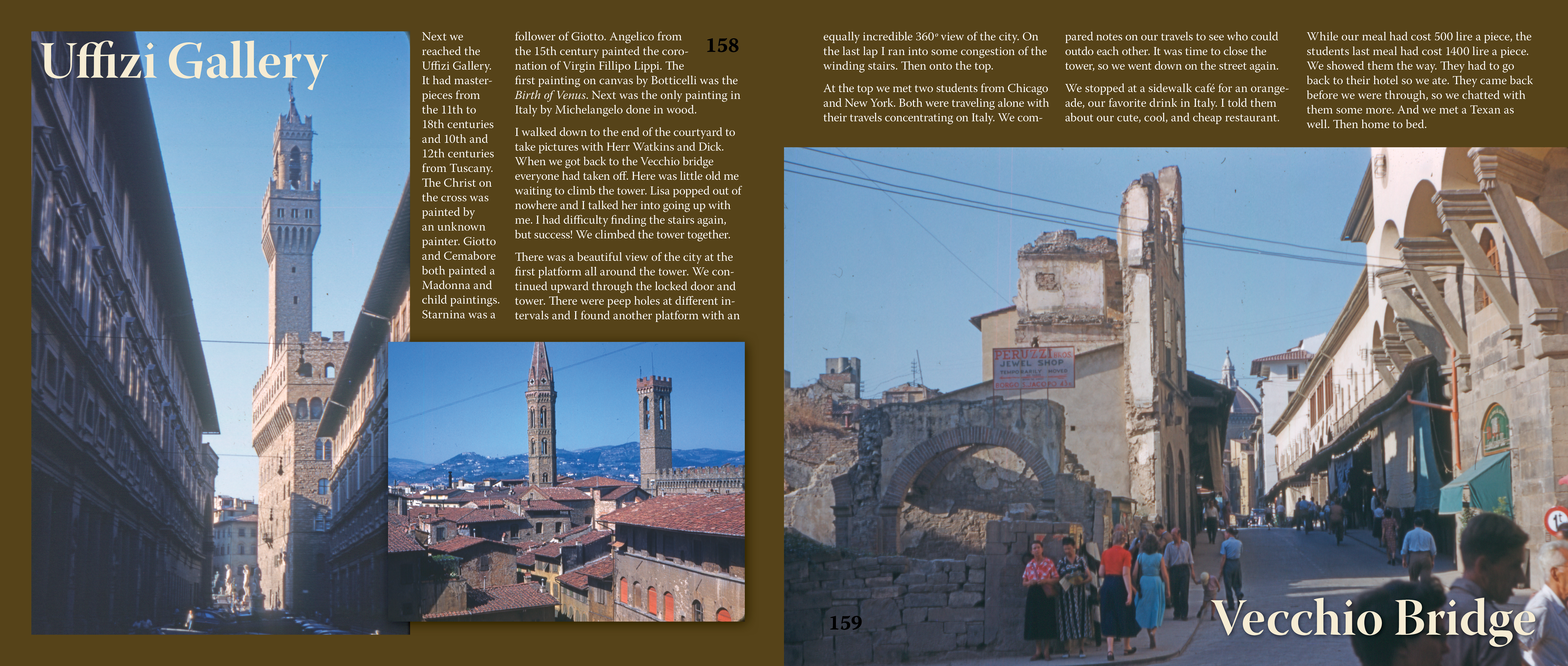
Dante’s Inferno hit us as we stepped onto the sidewalk. We passed the Palazzo Vecchio. David Neplone and the rest of the crew were standing ready to greet us. Still there were buildings that were mined by the Germans in World War II. The bombs were electronically controlled under buildings, streets, cathedrals. I saw a man repairing the street with bricks. We drooled over the luscious shops built along both sides of Vecchio Bridge.

Then we moved to the Pitti Palace where the pillars were painted to look real in room one. There was a green huge marble Medici bathtub in the middle of room four and later a jewel case presented to Catherine II. In room seven there was a stunning chandelier.

Along the river we passed kids swimming in the Arno River. Some of us went back to the hotel and six of us took off for Santa Croce. However, I decided to follow an American speaking guide around. He opened a painting to show old murals behind the painting. He also pointed out all the graves of the famous men buried here.

Then Henry acted as a guide to get us back to the hotel. One street over from the cathedral I bought a pencil at a street-side shop. Left behind I had to find my own way back. I went through a street market covering several blocks clear to the hotel corner. The kids were waiting in the lobby to go with Herr Watkins to visit his teacher.

I decided to stay back and get things done. I went for a bath and the bathtub water gushed out really strong. I managed to squeeze in the small bathtub (Italians are much smaller) and washed clothes before leaving for the concert at 8:30 p.m.

We found our enclosed way across Ponte Vecchio to Pitti Palace. It was 250 lire for non pesti or enclosed seats. There was a beautiful huge yellow moon that hung just at the corner of the building. It looked like a magnificent painting itself.

The concert had Italian music with three soloists singing under a concrete arch. The conductor played the piano as well as leading the orchestra. The concert didn’t start till almost 10 p.m. We met some art students from Stevens College who were spending most of their time in Florence. It turned out to be a nice evening.

60 Years Ago Today

Friday, 4 July 1952:

In the morning we hurried off to the fruit market. Afterwards we journeyed to see the San Lorenzo Church of Medici, Old Sacristy Cloister and library. The library had a 500th anniversary of Leonardo da Vinci with an exhibition of his works. He was an Italian painter, sculptor, architect, scientist, mathematician, engineer, inventor, and writer.

Leonardo da Vinci’s designs were really ahead of his time. He painted many self portraits and there were study sketches of pictures, Madonna on the rocks, and proportions of human body, face, and eyes. I saw designs of battles, weapons, and tanks. Other works included: Design for the Cathedral at Paris, study for horse equestrian statue, sketches for Santa Anna, manuscript of Divine Comedy, writing done backwards in mirror to keep it secret, study of Christ going to Calvary, sketches of Ceasar Borgia a friend, study of the flight of birds, manuscript of Divine Comedy, study for the last supper, wooden carved ceiling, manuscripts collected by Medicos family, pictures of Laura Petrarch, original poem written on vase by Sappho who was an ancient Greek poet, and huge music books written by monks from the 15th century.

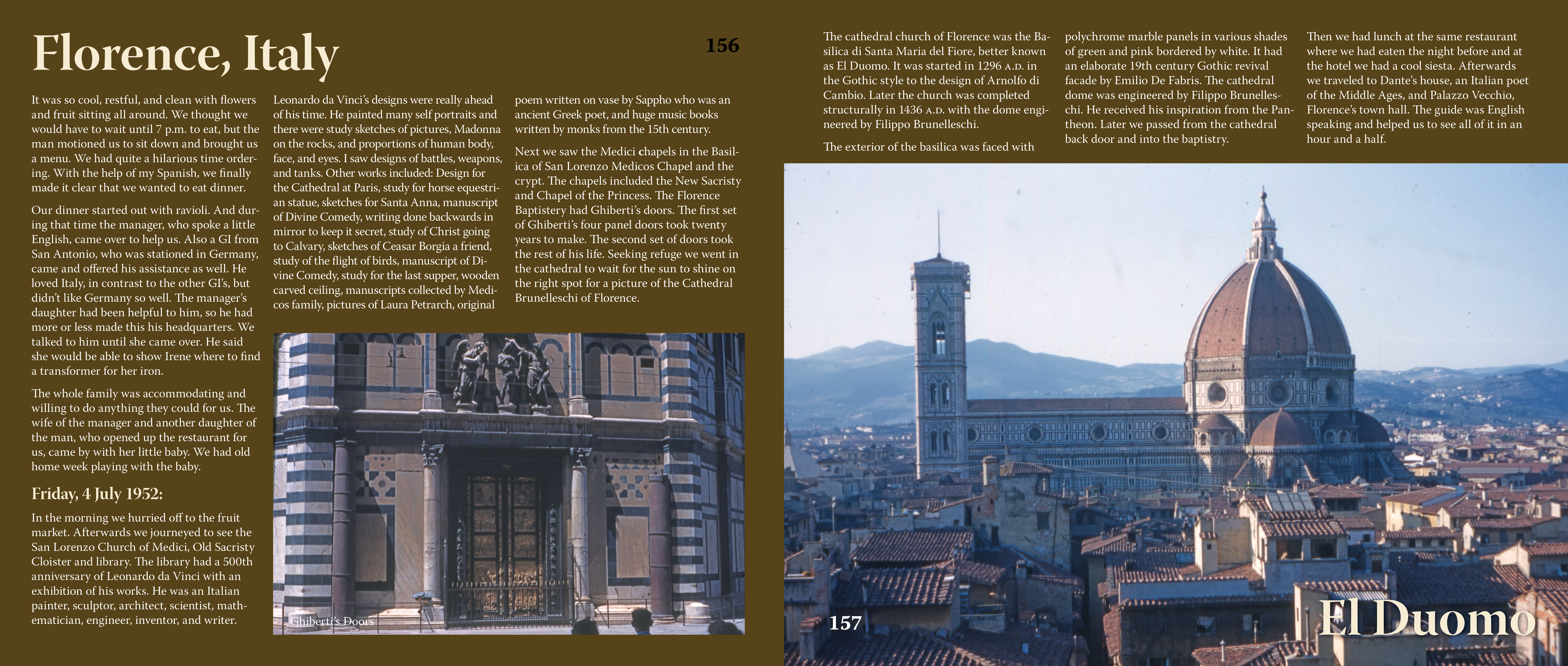
Next we saw the Medici chapels in the Basilica of San Lorenzo Medicos Chapel and the crypt. The chapels included the New Sacristy and Chapel of the Princess. The Florence Baptistery had Ghiberti’s doors. The first set of Ghiberti’s four panel doors took twenty years to make. The second set of doors took the rest of his life. Seeking refuge we went in the cathedral to wait for the sun to shine on the right spot for a picture of the Cathedral Brunelleschi of Florence.

The cathedral church of Florence was the Basilica di Santa Maria del Fiore, better known as El Duomo. It was started in 1296 a.d. in the Gothic style to the design of Arnolfo di Cambio. Later the church was completed structurally in 1436 a.d. with the dome engineered by Filippo Brunelleschi.

The exterior of the basilica was faced with polychrome marble panels in various shades of green and pink bordered by white. It had an elaborate 19th century Gothic revival facade by Emilio De Fabris. The cathedral dome was engineered by Filippo Brunelleschi. He received his inspiration from the Pantheon. Later we passed from the cathedral back door and into the baptistry.

Then we had lunch at the same restaurant where we had eaten the night before and at the hotel we had a cool siesta. Afterwards we traveled to Dante’s house, an Italian poet of the Middle Ages, and Palazzo Vecchio, Florence’s town hall. The guide was English speaking and helped us to see all of it in an hour and a half.

Next we reached the Uffizi Gallery. It had masterpieces from the 11th to 18th centuries and 10th and 12th centuries from Tuscany. The Christ on the cross was painted by an unknown painter. Giotto and Cemabore both painted a Madonna and child paintings. Starnina was a follower of Giotto. Angelico from the 15th century painted the coronation of Virgin Fillipo Lippi. The first painting on canvas by Botticelli was the Birth of Venus. Next was the only painting in Italy by Michelangelo done in wood.

I walked down to the end of the courtyard to take pictures with Herr Watkins and Dick. When we got back to the Vecchio bridge everyone had taken off. Here was little old me waiting to climb the tower. Lisa popped out of nowhere and I talked her into going up with me. I had difficulty finding the stairs again, but success! We climbed the tower together.

There was a beautiful view of the city at the first platform all around the tower. We continued upward through the locked door and tower. There were peep holes at different intervals and I found another platform with an equally incredible 360º view of the city. On the last lap I ran into some congestion of the winding stairs. Then onto the top.

At the top we met two students from Chicago and New York. Both were traveling alone with their travels concentrating on Italy. We compared notes on our travels to see who could outdo each other. It was time to close the tower, so we went down on the street again.

We stopped at a sidewalk café for an orangeade, our favorite drink in Italy. I told them about our cute, cool, and cheap restaurant. While our meal had cost 500 lire a piece, the students last meal had cost 1400 lire a piece. We showed them the way. They had to go back to their hotel so we ate. They came back before we were through, so we chatted with them some more. And we met a Texan as well. Then home to bed.

60 Years Ago Today

Thursday, 3 July 1952:

In the morning my breakfast in the hotel included a really soft six minute boiled egg. Then we started the day by visiting a church that was built over St. Francis’ grave. In the middle of the church the frescos began with a beautiful mural by Giotto and another artist. Giotto’s mural had a bright blue background with his characteristic holes.

Then we went down into the lower church and into the crypt where I saw an ornamental iron grave. At the crypt there was a German speaking monk. Another monk came up to us as we were leaving and asked for change. He had lots of small change in American money and wanted to change it for American dollars, so we obliged. Next on the tour was the upper church. It was Gothic even more so than the middle church.

Soon after it was back to the bus and off to Florence. The bus climbed up to Perugia, which was one of the most beautiful hill cities, and then down to the shores of Lake Trasimeno. With Florence coming up I napped.

I couldn’t tell for sure about this place yet. It was pretty hot! We were all anxious to get out, relax, and cool off somehow. We reached Atlantico Hotel. My first thought was for a drink of water. The lobby looked fairly nice, but the room was not as nice as last night. However we had a bath nearby.

Mrs. Hansen, Mrs. McDonald, and I decided to go shopping, but I lost them quite soon. I found Mrs. McDonald talking to a couple of American servicemen from Maryland that were stationed in the woods near Leghorn. They shared with us that they don’t like Italy, because it’s too dirty. Also they warned us not to drink or eat any of the dairy products, because several of the boys from their unit had gotten spinal meningitis. Furthermore they felt the Italian Communists were out for anything they could get. One soldier liked Austria and Germany much better than Italy. All the soldiers were anxious to get home to the United States.

I wandered around a book shop reading the books before buying them. I ended up with a book about Florence and Rome. Then I ran into Irene, Hermine, and Betty. Eventually we located a little restaurant that wasn’t open until 7 p.m. We were standing there wondering what to do when a cute little gray haired man came and opened the door. We followed the man inside to take a look and see what kind of place it was.

It was so cool, restful, and clean with flowers and fruit sitting all around. We thought we would have to wait until 7 p.m. to eat, but the man motioned us to sit down and brought us a menu. We had quite a hilarious time ordering. With the help of my Spanish, we finally made it clear that we wanted to eat dinner.

Our dinner started out with ravioli. And during that time the manager, who spoke a little English, came over to help us. Also a GI from San Antonio, who was stationed in Germany, came and offered his assistance as well. He loved Italy, in contrast to the other GI’s, but didn’t like Germany so well. The manager’s daughter had been helpful to him, so he had more or less made this his headquarters. We talked to him until she came over. He said she would be able to show Irene where to find a transformer for her iron.

The whole family was accommodating and willing to do anything they could for us. The wife of the manager and another daughter of the man, who opened up the restaurant for us, came by with her little baby. We had old home week playing with the baby.

60 Years Ago Today

Wednesday, 2 July 1952:

I took my bag down to breakfast. Herr Rogers called me down for not bringing it sooner. I was too late! The bus was all packed. After breakfast, I carried my own bag to the bus and with Mrs. Hansen’s help I put it on the top myself. I had Andre check the strap for me though.

Soon we were off for Assisi! Evidently we have to go back through Naples. While there we stopped at the hotel to pick up some stuff the kids had left. Then we raided a fruit shop and got back on the road to Rome via Cassino. It seems all roads to Rome must be tree lined.

Cassino was at one time the most bombed out place of World War II. Germans used Cassino as a stronghold and Americans finally had to bomb them out. Herr Watkins fought here. The most bitter fighting in Italy took place here and it became a no man’s land for a while.Since then it has been reconstructed. A documentary movie, San Pietro, was filmed in the area in 1945.

Then as we left Cassino we passed a former town on a hillside that was completely in ruins. A new town had been built below. We had lunch on the road. In Rome we stopped back to pick up Betty’s coat and get a drink of water in the public horse trough. We passed several monuments and huge buildings that I didn’t see when we were here before. We saw the Etruscan Capitaline Wolf statue from the 5th century, who had rescued Remus and Romulus, Rome’s mythological twin founders, from death.

I observed the big stadium and the Tiber River which was a beautiful green. Some of the scenery looked a lot like Utah. One section of land had sugar cane or something that looked like it. Today was kind of a lost day. It was really hot and Bev had heat exhaustion or something of the sort. I missed the scenery for some well needed napping and writing.

Our next rest stop was at Turin. I snapped a picture of oxen and a man with a donkey cart who posed for us. By the time we left there was a huge crowd around the bus. Dusk was coming on as we met the hilly and windy roads. We caught sight of the Assisi Arched Gateway like in the picture shots we saw in Italy.

We stopped to stay at a beautiful hotel where the section we were in was probably once an old monastery. I talked to a girl from Nebraska and found a little book about Assisi for 250 lire. Then we ate dinner at a restaurant down a little street from the hotel.

Soon after it was time for bed. My only mistake was laying down on the bed before getting undressed. At 3:30 a.m., I finally got undressed and climbed under the covers.

60 Years Ago Today

Tuesday, 1 July 1952:

At the continental breakfast we had marmalade and chocolate. I lost count of how many slices of bread we ate. Later I tried to brush my teeth without water. Today we’re off to the island of Capri. All of us walked down to the same pier we had gone to the night before and climbed through three boats to get to ours—a cutie speed boat. I climbed on top of the boat to sun bathe or burn.

As we rounded the bend, Capri’s blue shadow gradually grew larger. After approximately an hour there was a crowd of boats ahead. We sat rockin’ like a rocking chair waiting to go into Blue Grotto cave, one of the biggest draws on the island. Several kids got quite seasick and “tossed their breakfast.” It included Nelda, Carol S., Carmela, Betty Lou, and Joyce.

We had to get down low in the bottom of the boat to get through the hole into Blue Grotto cave. It was a huge cave with clear crystal blue water. It was absolutely indescribable as we swam in the water close to the boat—so refreshing!

Eventually we got back in the boat and everyone was trying to change back into their clothes. The men were first as they held a towel in front of the cabin door. Then it was the girls’ turn. What a circus! I wore my swimsuit underneath my clothes so it was a cinch for me. I just left my wet suit underneath.

Then we went back around the island to dock. We had three more boats to go through again to reach the shore. There were convertible open buses waiting for us. We enjoyed a wonderful dinner on the terrace of a beautiful hotel overlooking the Mediterranean Sea. Dinner consisted of spaghetti, breaded veal, potato chips, salad, and fruit. After I took pictures from the terrace.
We piled aboard a bus for a 300 lire per person ride around Capri. We wound round and round past the little shrine and beautiful white villas. I saw a pensione once owned by Caesar Augustus. At the top we stopped at a village of little shops for our benefit. We walked past the shops to a beautiful view of the Mediterranean Sea, a part of the island of Capri, and the mainland. I took a couple more pictures of the sea.

Then we proceeded back through the Nastri Gelati marketplace. And I couldn’t resist a couple of scarves. I talked the Italian man down from 2800 lire to 2300 lire for both scarves. Next we followed Herr Watkins up to view the rocks of Capri and its gardens. I spotted a chateau in the distance. On the way back I got lost in the shops and succumbed to some bathing shoes for 1600 lire. I hope I’m not sorry. Then back to the square again to catch the bus and then the boat.

We got on a big boat this time–but heavens, it rocked more than the little boat. Water came over the sides and got the kids wet near the rail. Nelda, Betty and Carmela got sick again. An accordion player played for us and went around asking for alms. Again we passed over three boats to the shore. Then we climbed up the road and finally the stairs to the hotel.

Some Italian ladies and girls knocked themselves out laughing at us in a rather rude way. I don’t know for sure what brought it on, but we sensed ridicule in it. Perhaps it was the Levi’s, shorts, and peddle pushers they found so hilarious. One of the ladies stopped Alicia to tell her about her son who is in America in a very high and harried voice.

At the hotel I dashed up and stripped down to my bathing suit. I took 100 lire with my soap down to the beach for a swim and shower while Alicia had a bath in the wash basin. Then we dressed for dinner.

I scraped my soup bowl until the waiter asked me if I wanted more. He hardly had gotten through asking me when I was ready for more soup. It was mighty delicious tomato soup. White fish, pastry roll, and fruit followed the soup. Afterwards I walked down to look around the shops and the people. Back at the lobby I fell asleep trying to write. Once again we slept on the terrace.

60 Years Ago Today

Monday, 30 June 1952:

I had a good continental breakfast with the seething masses of people already up early. There were all kinds of vehicles. We proceeded to an ancient church built in 1600 a.d. that was restored. It had 54 silver statues with each one representing a saint. Our guide told us about the parade and feast day with different floats sent from each church. We found a sculpture in silver created in 1695 a.d. that weighed 45,000 pounds. It was St. Michael with a dragon. A large and ancient baptismal font was used to baptize by immersion. We passed through a section of the city that had been attacked during World War II and people were living among the ruins.

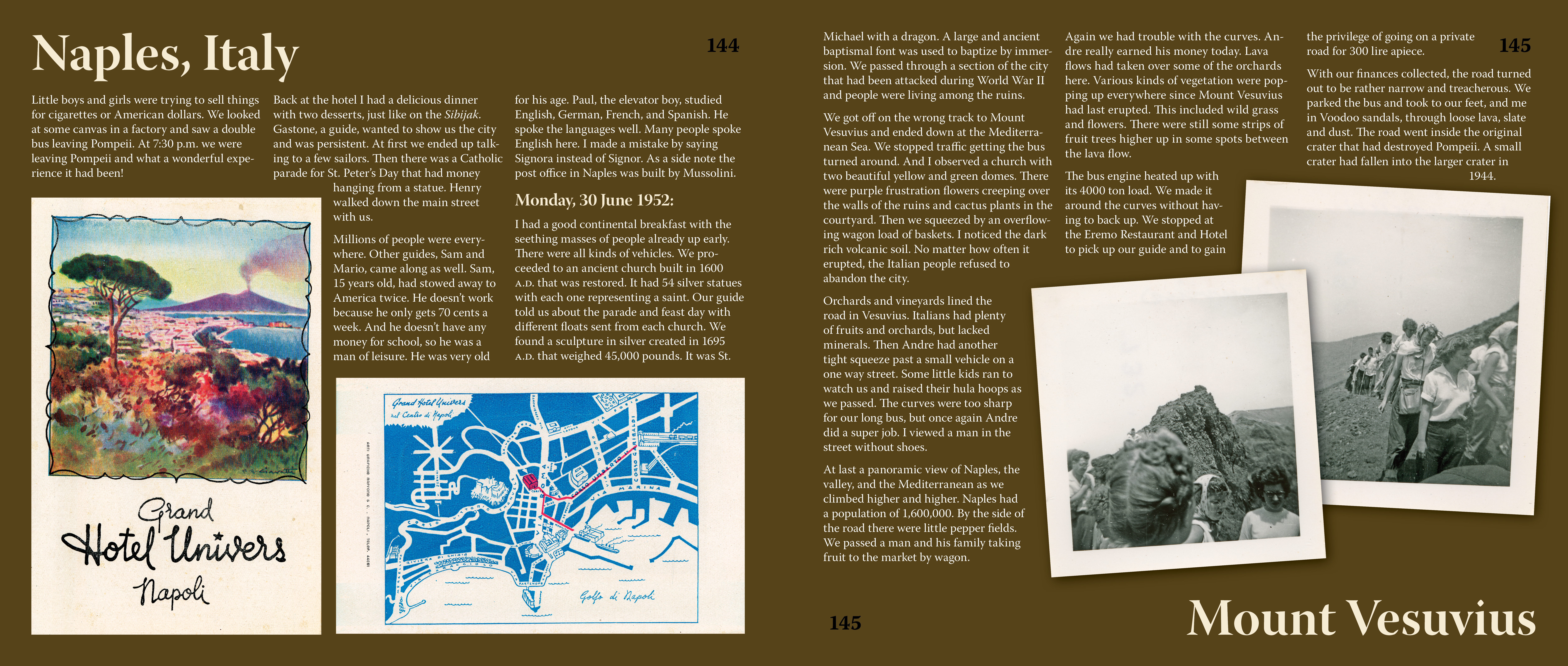
We got off on the wrong track to Mount Vesuvius and ended down at the Mediterranean Sea. We stopped traffic getting the bus turned around. And I observed a church with two beautiful yellow and green domes. There were purple frustration flowers creeping over the walls of the ruins and cactus plants in the courtyard. Then we squeezed by an overflowing wagon load of baskets. I noticed the dark rich volcanic soil. No matter how often it erupted, the Italian people refused to abandon the city.

Orchards and vineyards lined the road in Vesuvius. Italians had plenty of fruits and orchards, but lacked minerals. Then Andre had another tight squeeze past a small vehicle on a one way street. Some little kids ran to watch us and raised their hula hoops as we passed. The curves were too sharp for our long bus, but once again Andre did a super job. I viewed a man in the street without shoes.

At last a panoramic view of Naples, the valley, and the Mediterranean as we climbed higher and higher. Naples had a population of 1,600,000. By the side of the road there were little pepper fields. We passed a man and his family taking fruit to the market by wagon.

Again we had trouble with the curves. Andre really earned his money today. Lava flows had taken over some of the orchards here. Various kinds of vegetation were popping up everywhere since Mount Vesuvius had last erupted. This included wild grass and flowers. There were still some strips of fruit trees higher up in some spots between the lava flow.

The bus engine heated up with its 4000 ton load. We made it around the curves without having to back up. We stopped at the Eremo Restaurant and Hotel to pick up our guide and to gain the privilege of going on a private road for 300 lire apiece.

With our finances collected, the road turned out to be rather narrow and treacherous. We parked the bus and took to our feet, and me in Voodoo sandals, through loose lava, slate and dust. The road went inside the original crater that had destroyed Pompeii. A small crater had fallen into the larger crater in 1944.

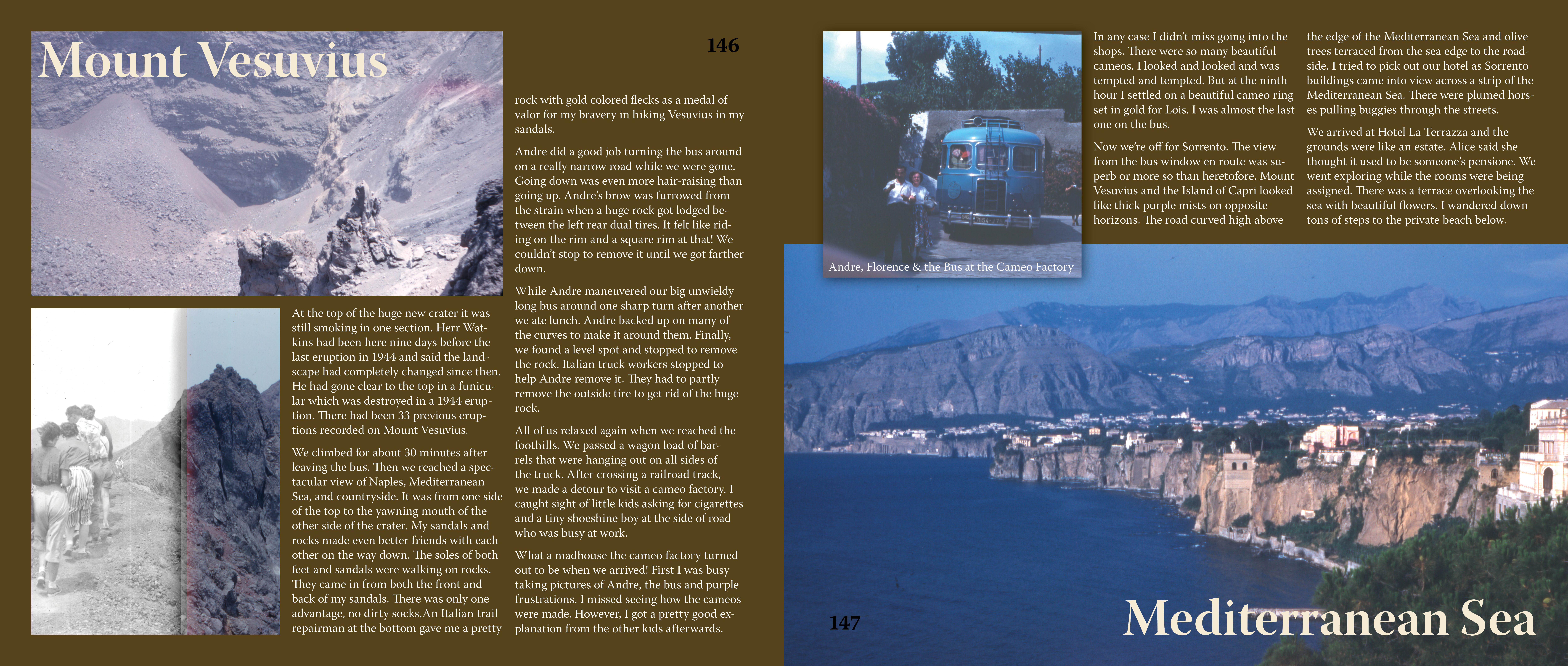
At the top of the huge new crater it was still smoking in one section. Herr Watkins had been here nine days before the last eruption in 1944 and said the landscape had completely changed since then. He had gone clear to the top in a funicular which was destroyed in a 1944 eruption. There had been 33 previous eruptions recorded on Mount Vesuvius.

We climbed for about 30 minutes after leaving the bus. Then we reached a spectacular view of Naples, Mediterranean Sea, and countryside. It was from one side of the top to the yawning mouth of the other side of the crater. My sandals and rocks made even better friends with each other on the way down. The soles of both feet and sandals were walking on rocks. They came in from both the front and back of my sandals. There was only one advantage, no dirty socks.An Italian trail repairman at the bottom gave me a pretty rock with gold colored flecks as a medal of valor for my bravery in hiking Vesuvius in my sandals.

Andre did a good job turning the bus around on a really narrow road while we were gone. Going down was even more hair-raising than going up. Andre’s brow was furrowed from the strain when a huge rock got lodged between the left rear dual tires. It felt like riding on the rim and a square rim at that! We couldn’t stop to remove it until we got farther down.

While Andre maneuvered our big unwieldy long bus around one sharp turn after another we ate lunch. Andre backed up on many of the curves to make it around them. Finally, we found a level spot and stopped to remove the rock. Italian truck workers stopped to help Andre remove it. They had to partly remove the outside tire to get rid of the huge rock.

All of us relaxed again when we reached the foothills. We passed a wagon load of barrels that were hanging out on all sides of the truck. After crossing a railroad track, we made a detour to visit a cameo factory. I caught sight of little kids asking for cigarettes and a tiny shoeshine boy at the side of road who was busy at work.

What a madhouse the cameo factory turned out to be when we arrived! First I was busy taking pictures of Andre, the bus and purple frustrations. I missed seeing how the cameos were made. However, I got a pretty good explanation from the other kids afterwards.

In any case I didn’t miss going into the shops. There were so many beautiful cameos. I looked and looked and was tempted and tempted. But at the ninth hour I settled on a beautiful cameo ring set in gold for Lois. I was almost the last one on the bus.

Now we’re off for Sorrento. The view from the bus window en route was superb or more so than heretofore. Mount Vesuvius and the Island of Capri looked like thick purple mists on opposite horizons. The road curved high above the edge of the Mediterranean Sea and olive trees terraced from the sea edge to the roadside. I tried to pick out our hotel as Sorrento buildings came into view across a strip of the Mediterranean Sea. There were plumed horses pulling buggies through the streets.

We arrived at Hotel La Terrazza and the grounds were like an estate. Alice said she thought it used to be someone’s pensione. We went exploring while the rooms were being assigned. There was a terrace overlooking the sea with beautiful flowers. I wandered down tons of steps to the private beach below.

First thing on the docket for me was a dip in the Mediterranean Sea. It cost 100 lire and I was the first one in. What fun I had riding the waves! I played water ball and talked to Puerto Rican girls who knew the kids on the Sibijak. I found a warm shower on the beach, my bath for today.

Afterwards there was a long trek up just like climbing the steps of Notre Dame.
We dressed for dinner on the terrace. We had sliced bread, water, soup with a little macaroni, hamburger with a cheese topping, and cheese rolled in pepper skins. The meal was 300 lire and dessert was a potato-like ice cream or pastry cake fruit.

Then we went downstairs to the square called the Bagalella. A boy from the hotel showed us the way to the native Tarantella dances. This traditional Italian folk dance had a fast upbeat tempo and used tambourines like castanets. There were beautiful costumes, a blues singer, and musicians wearing black and white striped shirts.

Another group of American girls were there from Roanoke, Virginia. They were really dressed up. I sat by a man and his wife and daughter from Buenos Aires, Argentina. He pronounced thousand as Susan. Alicia talked to the daughter and a small Italian man asked me to dance. He was a good dancer and smooth, but so short.

We sat down to talk and he asked me what “ice block” meant. He had a letter from a girl signed “ice block.” I tried to explain. Then another character came over. I decided it was time to bid them adieu before things got involved. They both had spoken pretty good English though.
On the way to the hotel one of them followed us on a motorbike and offered to give us a ride. I said okay if the two of us could come. Eloise hung tightly to him and I to her for a hair-raising ride to the pier. We rounded the curves laying on one side of the motorbike. We climbed up on the pier and talked for a few minutes.

Then another bike roared up the hill. It sure looked liked a “put up job.” He asked permission to introduce us. I said “You can introduce us but that’s all.” The second bike left and I decided that we best get out of there. No! He said he’d take us home in a few minutes.

But before a few minutes were up the other bike came back. Then the other guy came up and talked to us. We convinced both of the bikers that we don’t smoke or drink and must get back to the hotel. We insisted on going back together, but they swore so sincerely to take us back to the hotel that we relented. We arrived at the door safe and sound, but the manager complained about the noise of the motorcycles.

It was a gorgeous view from our room. However, there was no water stopper in the tub which made taking a bath challenging. Margaret, Helen, Alicia and I took our mattresses out on the terrace to sleep under the stars.

60 Years Ago Today

Sunday, 29 June 1952:
I was up early at 6:30 a.m. Alice didn’t really think I would get up early, so she wasn’t ready. Around 8 a.m. we finally went straight up our street to Saint Magiore Cathedral and past Peter in Chains to the Coliseum. At the Coliseum I had to get up higher to get a better picture. I kept wandering inside the forum and the guard continued to kick me out again. However I begged him to let me take a picture and then I quickly took off, climbed the rocks, and got the picture while Alice tried to calm him down. I practically ran all the way back so he wouldn’t be upset.

As we drove out of town we passed the Coliseum again and then went through modern Rome. We kinda got lost and turned down a beautiful tree-lined boulevard. I really hated to leave Rome. It was so beautiful.

Next we journeyed past gorgeous greens at a golf course that had rough grass in between the greens. We continued near a railroad that was right next to the highway. The highway and railroad were as close as the two could get. Then there were many beautiful well kept vineyards and soon after an intersection with a road to Tegis.

The bus proceeded to Anzio and its beachhead. We went over a bridge to a city on a hill. A public watering place and a beautiful valley greeted us. What captivating sights: checkerboard fields, fairly new trees lining the streets, trees that curbed each side of the road and railroad, another small town, busy market place, and trees growing out of the pavement along the main street.

This part of the country seemed much more fertile here than coming into Rome from the north. There were ladies with big loads on their heads and modern irrigation of a big canal. It helped explain the greater fertility here in Italy. Then there were huge fields of wild poppies, mountains rising on the left, orchards, and villages and towns built part way up. The name of the highway was Via Appia.

The city of Terracina was next. As we entered the city the Mediterranean Sea was at the side of the street coming into town. Purple frustration flowers were everywhere with a high wall between us and the mountain. The beach tapered out to leave just enough room for the road between the mountain and the sea. Then the beach widened again for a beautiful vineyard and palm trees between the road and Mediterranean Sea. We sang church hymns. What a beautiful way to spend Sunday, soaking in this magnificent scenery and singing!

What’s up? Cars were lined up for over a quarter mile. Around the curve of the road, the men took off to get the scoop of what was happening. We proceeded to eat lunch with dry tuna on dry biscuits, pastries and oranges.

A boy with the scoop biked around the line of cars. He said a boy riding a bike was hit by a truck in a semi-phore or a four way intersection. Unfortunately he was killed. We drove past the little boy’s body. It was covered up, lying on the road with blood and gore spread around him. His family was huddled by the rail. I didn’t feel much like singing anymore.

There were mules and donkeys, reminiscent of Christ’s time. A whole family was in a cart behind one mule and a tiny girl was carrying a basket on her head. Oleanders, an evergreen shrub, were alternating with trees along side the road. Whatta picture!

There was a spectacular double row of trees. I wish I could have captured it all with my camera. I spied a little canvas covered truck with a mother, child, and household belongings in the back. Next were fields of strange looking hay? We stopped at a railroad crossing and Herr Watkins asked a man what kind of hay it was. It was cannibas hay, which was used to make clothing.

At 2:30 p.m. we reached Naples, that was supposed to be the dirtiest city in Italy. The green, white and red, Italian flags were hanging in the corners of the city square with the obelisk in the center. I strained to get my first view of Mount Vesuvius. There were herds of goats on the side of the road with signs pasted on walls down the street.

We proceeded down the main street of Naples, via Roma, to our Hotel Albergo Universo. It was pretty centrally located. Three bell boys met us with smiles and little kids gathered around us. The hotel facade wasn’t bad. The hotel had a beautiful lobby, slow elevators, and nice rooms.
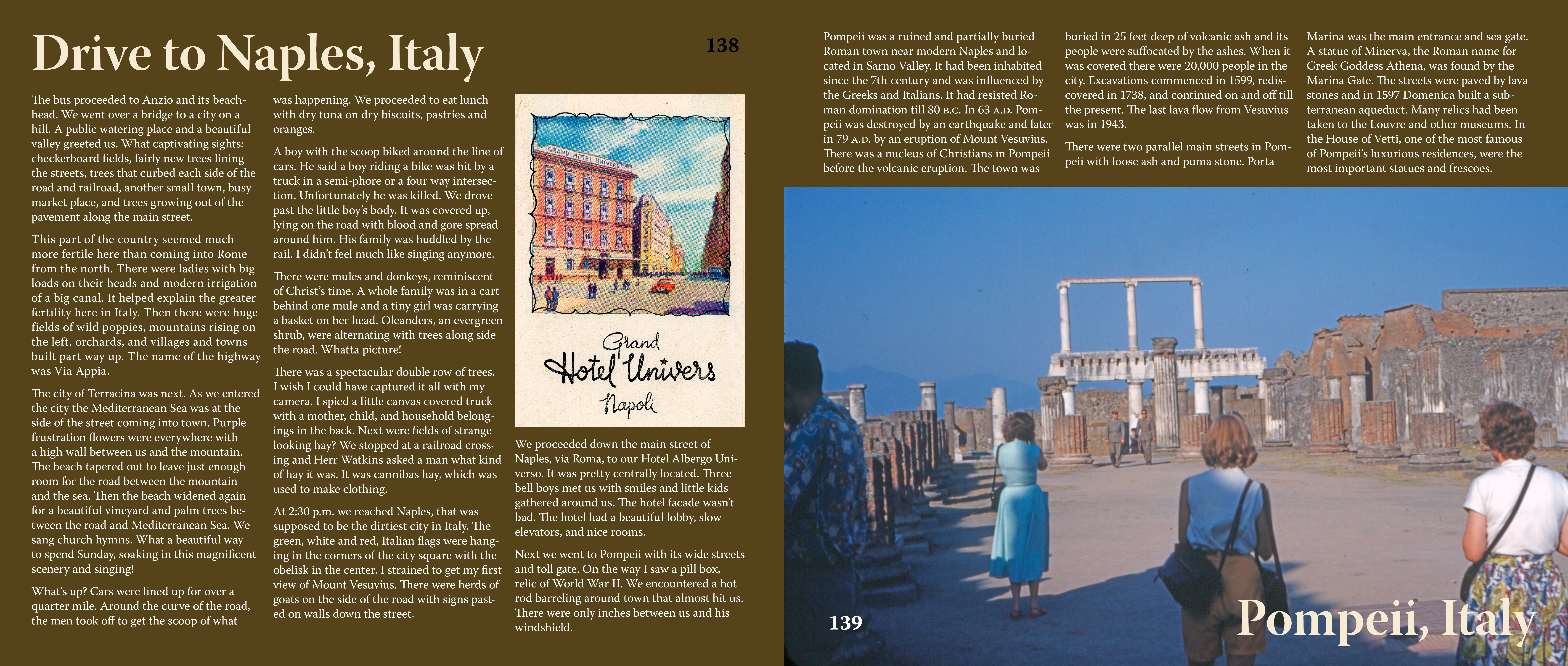
Next we went to Pompeii with its wide streets and toll gate. On the way I saw a pill box, relic of World War II. We encountered a hot rod barreling around town that almost hit us. There were only inches between us and his windshield.

Pompeii was a ruined and partially buried Roman town near modern Naples and located in Sarno Valley. It had been inhabited since the 7th century and was influenced by the Greeks and Italians. It had resisted Roman domination till 80 b.c. In 63 a.d. Pompeii was destroyed by an earthquake and later in 79 a.d. by an eruption of Mount Vesuvius. There was a nucleus of Christians in Pompeii before the volcanic eruption. The town was buried in 25 feet deep of volcanic ash and its people were suffocated by the ashes. When it was covered there were 20,000 people in the city. Excavations commenced in 1599, rediscovered in 1738, and continued on and off till the present. The last lava flow from Vesuvius was in 1943.

There were two parallel main streets in Pompeii with loose ash and puma stone. Porta Marina was the main entrance and sea gate. A statue of Minerva, the Roman name for Greek Goddess Athena, was found by the Marina Gate. The streets were paved by lava stones and in 1597 Domenica built a subterranean aqueduct. Many relics had been taken to the Louvre and other museums. In the House of Vetti, one of the most famous of Pompeii’s luxurious residences, were the most important statues and frescoes.

There were plaster casts of the city as it was at the time of the erupting volcano. There also were plaster casts of just about everything: Dead people, dead animals, wheels, money box, huge steel deal, fish hooks, cameos, ring stone, pearls, scissors, fish scales, vases, bread, wine, press, dentist instruments, gold and silver coins, cake molds, strainer, locks, keys, little stoves, and taps. One third of the city had not yet been excavated.

Excavated items included earrings, springs, bones from San Marzano, statue from 500 b.c., pottery with art work, tufa stones, sculpture with little figures on a dish, baby jewelry, silver cups, bronze hooks, little statuettes, needles, jewelry, dice, and mill out of lava stones for making olive oil.

There were statues in the museum in Naples, including the statue of Livia. The original sidewalks and walls the Romans had constructed were still there as well. The walls were made of webbed tufa stones. Next we discovered pillar of bricks, wine shops, sliding doors, families living behind the shops, and imitation marble decorations. As we continued we saw the Apollo Temple, statue of Drana, Magistrate of Pompeii, and Palace of Justice Tribunal.

The forum, main square, included the religious and political center of the city. The Temple of Jupiter had marble carving on its gateway. The people washed their clothing with their feet. In the Temple of Augustus the walls were covered with marble and had its original altar. There were money changers, food markets, and big wine jars. Blocks were put up to stop traffic.

Then we went to the Temple of Fortune which had a chapel shrine inside and the triumphant arch of Nero. The public baths were like a club with Terne el torre Mosaic floors. The cold baths were open to the sky with frieze around the top of the walls. The Temple of Fortune still had its original marble floors, beautiful decorations, and locker area for the tepid bath. The hot bath had marble mosaic floors with a round dome of steam falling down on the side. A big wash bowl was there for washing hands and face.

I spied a wine shop across from the bath houses on the main street. Pompeii was symmetrical just like some modern cities. Also, we went to Casa del Poetatregica, the House of the Tragic Poet, with the infamous cave canem inscription which means beware of the dog. I discovered some lizards there.

Next the House of Dancing Fauns, built during the 2nd century b.c. was one of the largest, and most impressive private residences in Pompeii. The house had a fruit and flower garden and filled one whole city block.

Then to the House of Vetti, another important home, had large blocks with coats of plaster and original gargoyles. It was well preserved. The bedroom was so small there was only space for the bed. And there were high doors and a Roman bowl that dated back to 15-20 years before Christ. Some of the paintings were well preserved as we caught sight of paintings by Mercury, Juno, and Isis. In the dining room there were Pompeii red figures on a black background.

Other art included two money boxes, cupid breaking medicine, and paintings of Gods. There was a slab of lead to keep out the dampness around the floor. We walked through one sitting room for mom and pop and another one for the kids. In the kitchen were copper looking apparatus’, lead pipes, and fountains out of mosaic.

During our tour we found out that our guide had been in the movie September Affair and spoke four languages. He took us through the butcher shop, soap factory with a mill stone, and by the beautiful statue of Nero. I noticed that the pharmacy symbol was represented by snakes. Also, I caught sight of a rock that had a hole in it in order to tie the horses during that time period. The Doric columns in Pompeii were dated to 600 B.C.

Next on the tour was the ancient Roman city of Stabiae which was destroyed in the eruption. Then the Greek style theater, which seated 5,000 people, which opened upwards to the sky. On rainy days they put up an awning and on hot days they put water on the awning to cool themselves.

Picturesque Towns of Italy Swarmed With Tourists From All Parts of World

Editor’s note: This is the seventh of a series of letters written by Mrs. Afton A. Hansen giving her impressions of a trip through Europe she is making with a group of 35 Utah college students. This one was written on July 7 in Italy.

Dear Friends;
From one end of Italy to the other—from north to south and back again, we have traversed this strange land—along its blue Mediterranean coast, over the dry summer hills, to the rim of Mt. Vesuvius, which was so dry and windy that workmen went ahead of us to clear the trail of wind blown dirt and rolling rocks.

Throughout the country we find construction work going on in roadway and building. It is said that Italy is using her lend lease money [post WWII economic aid from the US] for reconstruction of their country to attract the tourist who provides a major part of the national income. These lovely towns are swarmed with tourists from all parts of the world.

Our first stop in Italy was somewhat disappointing. Expecting some romantic Romeo to serenade us with song, or hear a street cleaner singing an aria, we were almost alarmed when looking through the hotel window to see four dismal looking characters playing cards. Unkempt, dirty and mostly toothless, they were pounding the table in vigorous competition of the game.

Felt Like Emigrants
Having been repeatedly warned to watch our baggage, I was much concerned when an Italian gentleman attempted to help with my heavy suitcase. Although I said “No, No!” he insistently carried my bag to my door and went down stairs laughing. Indeed we looked like we might need help as we trudged from bus to hotel with bags and bundles.

A few of us with scarfs on our heads looked and felt like emigrants sitting on all our worldly possessions.

The next hotel in which we stayed—Grand Verde, in Rapolic—held the romance of situation on the hilbarde, overlooking the beautiful Mediterranean from a balcony window. No Romeo’s yet though.

Not until we came to our noisy Atlantico Hotel in Florence did we hear street singing. Two boys on a bicycle, in working clothes at 5 a.m. were lustily singing an Italian “ditty.” The little girl, strolling along with her parents in the warm summer evening singing to her heart’s content, was unnoticed, except by us Americans.

Enjoy Laughter
Italian like the French seem uninhibited, stopping anyplace on the street to discuss and gesticulate. They seem to enjoy laughter and a good joke.

The country of Tuscany affords picturesque traveling. Our 30-mile-per-hour bus permits good seeing. The hill tops are crowned with old medieval castles, walls and fortifications, while below them are ripening grain fields, trees and gardens. Highways are lined with Oleander trees, fig, olive and pomegranate trees.

For centuries, women here have trudged to the water well with jugs on heads. I am anxious to try out, with brush and paint some of the sketches I have of a young lady balanced on a donkey with heavily laden baskets on either side, and the family coming home from market in a large two-wheeled cart drawn by two white oxen.

There is a variety of interest in every city we visit. Even the ancient dead city of Pompeii had an amazing silent story to tell. Two thousand years ago it was a thriving commercial and agricultural city on the side of the hill near the Mediterranean. For nearly 10 centuries before Christ the nearly 25,000 inhabitants traded with Greece. One day they heard a deep earth rumbling and their beautiful city was shaken with an earthquake. Then on a warm August day at about 1 p.m. in the year 79 A.D., the nearby Mt. Vesuvius erupted, spreading ashes and pumice over the entire area, covering Pompeii in a depth of 30 feet. It remained covered until about 60 years ago when the excavation began. One third of the city’s 161 acres still remains to be uncovered.

Ancient Wheel Ruts
As we were guided along the stone sidewalks, two and three feet wide, we noticed the ruts in the narrow stone streets made by the many chariot wheels rumbling along thousands of years ago. We saw the shops along the main streets, stores, snack bar, stock exchange, wool market, dye shops, palace of justice and fountains on the corner where we quenched our thirst.

In one house, once lived two rich merchants, perhaps father and son with their family. A sign on the entrance read — “Care Canni” — which means “Beware of the dog.” In the vestibule were marble columns, benches and low chests. The house had many so-called modern conveniences such as a central heating system for warm and cold air. Bath tubs were of Carrara marble. A huge wash basin of Egyptian Chipolena marble, was put there at a cost of $60,000,000.

This size basin would be convenient for a large family for it could easily accommodate eight people at once. The stone stove in the kitchen could bake 89 loaves of bread at one time.

Glorious Past
This dead city tells of a glorious past, with only one inner yard being kept alive with flowers, shrubs, grass and vases.

Don’t you wonder what these people did, when the volcanic ash began to spread over their city? Of course many of them left the city when the earthquake occurred, but about 3000 victims have been uncovered from the ruins. From the position of their bodies we can be almost sure that they did what we have been told to do in case of an atomic bomb attack. They threw themselves to the ground covering their faces with their arms. One man sat in a corner protecting his face with his hands. A dog was found in an agonizing position.

Bodies Restored
We wondered how they could recover these bodies with such detail even to eye lids, folds of the skin and expression of the face. The guide told us that the ashes and pumice hardened as it poured over the bodies. In time the flesh decayed, leaving a cavity containing bones, skull and teeth. Into this cavity was poured a thin plaster which was left to harden for several months.

With small picks and a brush, the ash was cleared away, leaving the perfect shape of a victim of suffocation. The same process was employed in recovering furniture.
In the houses have been found furniture—kitchen utensils, cereal, cloth, water faucets, ring, money, surgical instruments, oil press, wine press and other things which would indicate their activity. So much could be told of Pompeii as well as many other places which are so interesting by we who see them but could become tiresome on paper.

Let me tell you a little about the schools. For more than an hour we visited with an elementary grade school teacher and her sister who teaches piano lessons. They were delightful ladies who discussed education in Italy through our interpreter Dr. Watkins.

From the readers and work books which we saw, we were pretty sure that an Italian child of seven or eight in the second or third grade was two to three years ahead of our youngsters the same age and grade in the reading, writing, arithmetic and ability and quality of work.

Even in these young grades they learn to sing songs from the opera. The program of Verdi’s work put on by these youngsters was very good, according to the teachers and principal. These youngsters of course have an opportunity to visit these museums, so full of history. Their penmanship is excellent.

We wondered, if, in our mania for freedom we have lost some thing in basic values. This would be worthy of further investigation. One choice idea from this visit was old but always worth repeating: “Keep the avenues of expression and conversation open between you and the child.” These people love to converse.

Afton A. Hansen

Little boys and girls were trying to sell things for cigarettes or American dollars. We looked at some canvas in a factory and saw a double bus leaving Pompeii. At 7:30 p.m. we were leaving Pompeii and what a wonderful experience it had been!

Back at the hotel I had a delicious dinner with two desserts, just like on the Sibijak. Gastone, a guide, wanted to show us the city and was persistent. At first we ended up talking to a few sailors. Then there was a Catholic parade for St. Peter’s Day that had money hanging from a statue. Henry walked down the main street with us.

Millions of people were everywhere. Other guides, Sam and Mario, came along as well. Sam, 15 years old, had stowed away to America twice. He doesn’t work because he only gets 70 cents a week. And he doesn’t have any money for school, so he was a man of leisure. He was very old for his age. Paul, the elevator boy, studied English, German, French, and Spanish. He spoke the languages well. Many people spoke English here. I made a mistake by saying Signora instead of Signor. As a side note the post office in Naples was built by Mussolini.

60 Years Ago Today

Saturday, 28 June 1952:

Today we got to see the tombs of Keats, Shelley, and the Pyramid of Porta San Palo, an ancient tomb. But first we saw the Piazza Colonnade, Italian Senate, and Obelisk of Marcus Valerius. He was a Roman general, author and patron of literature and art.

While walking around the wall of the Vatican Museum, a man was washing his clothes in the fountain in St. Peter’s Square. There was a thick ornate bronze spiral staircase with large shallow stairs. Next was the Vatican Library, one of the oldest libraries in the world, that holds books and manuscripts behind locked cabinets. I observed gold miniatures of the Basilica of St. Anthony.
It was time to go to the Sistine Chapel, the official residence of the Pope. There were lit windows in the passageway. Pope Sixtus IV built the Sistine Chapel in 1470, 22 years before the discovery of America. There were frescoes, a type of painting done on plaster, representing Christ and Moses, which were begun in 1481 a.d. The frescoes included the circumcision and baptism of Christ by Pinturicchio, and the story of Moses and Christ by Botticelli.

In 1508 a.d. Julius II ordered Michelangelo to paint the ceiling in four years. Michelangelo began working on the Last Judgment three decades after finishing the ceiling of the chapel. It took four years to finish as well. The chapel was filled with groups of people crowded around their guides. Huh….this is certainly a contrast to our temples to which the public was not admitted.

Then we saw Raphael’s four rooms which form a suite of reception rooms for the public part of the papal apartments. School of Athens was one of Raphael’s most famous paintings. There was an optical illusion on the ceiling with John the Baptist’s head by Raphael. And the ceiling and the mosaic floors were elaborate. We viewed the sculpture Laocoon and His Sons. Laocoon was a figure in Greek and Roman mythology where the father and sons were killed by a snake.

We had to dash quickly through to make the appointment with the Pope. At the door we were met by the guards. Then the usher asked for our invitation and we entered a room almost full of people waiting for the Pope. The ushers were dressed in red costumes in the red-walled rooms. Many of us were left standing so we were ushered into another smaller room that was not quite so elaborate. I noticed paintings of all the popes on the walls.

Here we sat like bumps on logs, not knowing what to expect or what to do. I was anxious to see how the Pope handled us as an audience of curious students from BYU. Herr Watkins had a Book of Mormon autographed by each of us to give to the Pope. We thought perhaps we would be in a large group with others who were Catholics, but here we were pretty much by ourselves. Wrong clue! Now back into the main receiving room where everyone was standing in a circle. We looked like a bunch of peasants with our scarves.

The Pope, dressed in white, came in with his assistants. He was 77 years old with a pleasant manner. He shook hands with everyone and gave us each a little remembrance. Some of the Catholics kissed his hand and knelt before him. There were several monks in the audience and he spoke to them for several minutes. He had a pleasant personality.

Herr Rogers was one of the last to meet the Pope. He presented our scriptures to him. We all watched intently to see how he would receive it. The Pope asked if we wanted the book blessed, but Herr Rogers told him no. However, we would like him to put it in the Vatican Library. His secretary looked at it rather queerly and handled it gingerly.

After the Pope had talked to everyone individually, he spoke a few words to everyone collectively. Afterwards a photographer came in and took two pictures of the Pope and his audience. And if you put your name on a slip of paper, they would deliver a picture to your hotel for 500 lire. Talk about commercializing the Catholic Church!

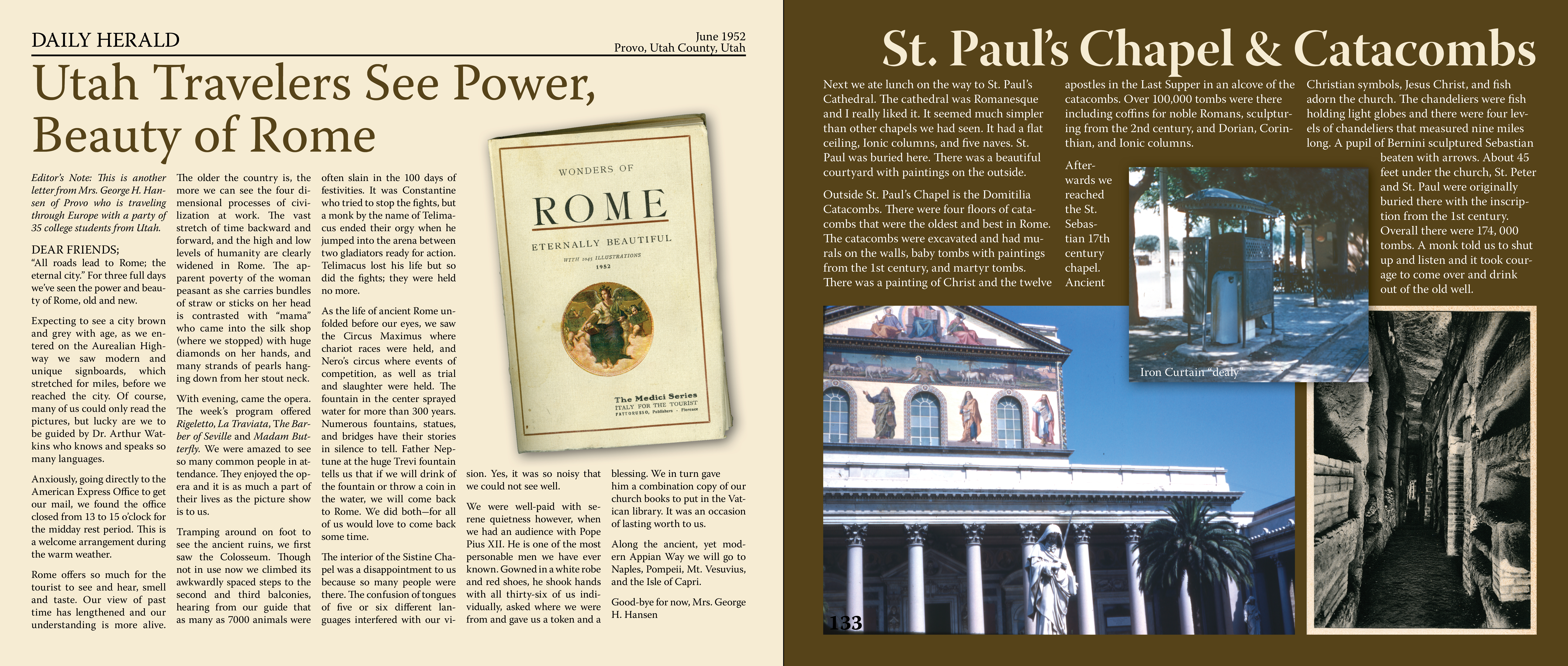
Next we ate lunch on the way to St. Paul’s Cathedral. The cathedral was Romanesque and I really liked it. It seemed much simpler than other chapels we had seen. It had a flat ceiling, Ionic columns, and five naves. St. Paul was buried here. There was a beautiful courtyard with paintings on the outside.

Outside St. Paul’s Chapel is the Domitilia Catacombs. There were four floors of catacombs that were the oldest and best in Rome. The catacombs were excavated and had murals on the walls, baby tombs with paintings from the 1st century, and martyr tombs. There was a painting of Christ and the twelve apostles in the Last Supper in an alcove of the catacombs. Over 100,000 tombs were there including coffins for noble Romans, sculpturing from the 2nd century, and Dorian, Corinthian, and Ionic columns.

Afterwards we reached the St. Sebastian 17th century chapel. Ancient Christian symbols, Jesus Christ, and fish adorn the church. The chandeliers were fish holding light globes and there were four levels of chandeliers that measured nine miles long. A pupil of Bernini sculptured Sebastian beaten with arrows. About 45 feet under the church, St. Peter and St. Paul were originally buried there with the inscription from the 1st century. Overall there were 174, 000 tombs. A monk told us to shut up and listen and it took courage to come over and drink out of the old well.

Utah Travelers See Power, Beauty of Rome

Editor’s Note: This is another letter from Mrs. George H. Hansen of Provo who is traveling through Europe with a party of 35 college students from Utah.

Dear Friends;
“All roads lead to Rome; the eternal city.” For three full days we’ve seen the power and beauty of Rome, old and new.

Expecting to see a city brown and grey with age, as we entered on the Aurealian Highway we saw modern and unique signboards, which stretched for miles, before we reached the city. Of course, many of us could only read the pictures, but lucky are we to be guided by Dr. Arthur Watkins who knows and speaks so many languages.

Anxiously, going directly to the American Express Office to get our mail, we found the office closed from 13 to 15 o’clock for the midday rest period. This is a welcome arrangement during the warm weather.

Rome offers so much for the tourist to see and hear, smell and taste. Our view of past time has lengthened and our understanding is more alive. The older the country is, the more we can see the four dimensional processes of civilization at work. The vast stretch of time backward and forward, and the high and low levels of humanity are clearly widened in Rome. The apparent poverty of the woman peasant as she carries bundles of straw or sticks on her head is contrasted with “mama” who came into the silk shop (where we stopped) with huge diamonds on her hands, and many strands of pearls hanging down from her stout neck.

With evening, came the opera. The week’s program offered Rigeletto, La Traviata, The Barber of Seville and Madam Butterfly. We were amazed to see so many common people in attendance. They enjoyed the opera and it is as much a part of their lives as the picture show is to us.

Tramping around on foot to see the ancient ruins, we first saw the Colosseum. Though not in use now we climbed its awkwardly spaced steps to the second and third balconies, hearing from our guide that as many as 7000 animals were often slain in the 100 days of festivities. It was Constantine who tried to stop the fights, but a monk by the name of Telimacus ended their orgy when he jumped into the arena between two gladiators ready for action. Telimacus lost his life but so did the fights; they were held no more.

As the life of ancient Rome unfolded before our eyes, we saw the Circus Maximus where chariot races were held, and Nero’s circus where events of competition, as well as trial and slaughter were held. The fountain in the center sprayed water for more than 300 years. Numerous fountains, statues, and bridges have their stories in silence to tell. Father Neptune at the huge Trevi fountain tells us that if we will drink of the fountain or throw a coin in the water, we will come back to Rome. We did both-for all of us would love to come back some time.

The interior of the Sistine Chapel was a disappointment to us because so many people were there. The confusion of tongues of five or six different languages interfered with our vision. Yes, it was so noisy that we could not see well.

We were well-paid with serene quietness however, when we had an audience with Pope Pius XII. He is one of the most personable men we have ever known. Gowned in a white robe and red shoes, he shook hands with all thirty-six of us individually, asked where we were from and gave us a token and a blessing. We in turn gave him a combination copy of our church books to put in the Vatican library. It was an occasion of lasting worth to us.

Along the ancient, yet modern Appian Way we will go to Naples, Pompeii, Mt. Vesuvius, and the Isle of Capri.

Good-bye for now, Mrs. George H. Hansen

Next we went down the road to Naples via Appian Way. We were in the old Roman Campagna, which was a low-lying area surrounding Rome. Soon after we saw part of an old aqueduct, a tomb of Cecilia, fragments of an old Roman road, and remains of monuments all along the road leading into the city.

There was one spot with the original stones of the Appian Way, one of the earliest and strategically most important Roman roads of the ancient republic. Italian people used to live in the old mausoleum along the Appian Way. Today they live on streets with billboards and signs. Next was an old aqueduct and a woman thrashing with a broom.

Andre, drove down the wrong side of a four lane road. He turned around and went back along the new Appian Way. There were eleven aqueducts and modern Rome still used three of them. Again we saw acres with white stripes. Next were the ruins of the Baths of Caracalla which were the most extensive baths in ancient Rome. The Romans came to bathe everyday as part of their social life. Open air operas were still held here in July.

We spotted the Aurelian wall that was the last big wall built in the beginning of the 2nd century by Marcus Aurelius. Rome didn’t feel secure, so a wall was built for protection. We passed the Pyramid of Cestius that was built for himself as a burial place. It stands in a fork between two ancient roads and was erected in the last years of the republic on Piazzale Ostrense. There was a family of cats living at the base of the pyramid.

In a cemetery next to the Pyramid we proceeded to the gravesite of Percy Bysshe Shelley who died at age 30 in 1822. He drowned in a sudden storm while sailing back from Livorno to Lerici in his schooner in Italy. Percy, one of the major English Romantic poets, was critically regarded among the finest lyric poets in the English language. Edward J. Trelawny, a friend of Shelley’s, died in England and was buried next to him. His grave stone quotes from Shakespeare’s Tempest:

Nothing of him that doth fade
But doth suffer a sea-change
Into something rich and strange.

John Keats, a famous English poet, was also buried in the same cemetery. He was 25 years old when he died of tuberculosis. His last request was to be buried under a tombstone, without his name, and bearing only the legend in pentameter. Joseph Severn, devoted friend of John Keats, was buried next to him. The plaque on the wall near John Keat’s grave states:

This Grave contains all that was Mortal,
of a Young English Poet, Who,
on his Death Bed in the Bitterness of his Heart,
at the Malicious Power of his Enemies,
Desired these Words to be engraven on his Tomb Stone
Here lies One Whose Name was writ in Water.
24 February 1821

John Keats epitaph tombstone states:

Keats! if thy cherished name be “writ in water”
Each drop has fallen from some mourner’s cheek;
A sacred tribute: such as heroes seek,
Though oft in vain-for dazzling deeds of slaughter
Sleep on! Not honoured less for epitaph so meek!

Next was the tomb of Goethe’s son, August. After that I spotted a fellow running and jumping on a street car. The streets were wider here with modern buildings. Then we passed an anchor in front of a Navy building. We learned that the Italian government had tried to buy the Barberini Palace by our hotel. Then we saw the buildings and a stadium that the Fascist, Mussolini erected. At the end of World War II, Mussolini and his mistress, Petracchi, were shot and hung by their heels from the roof of a service station near Milano. His body was buried in a secret place.

Then we observed a monument to the Balilla youth organization, mosaic in a courtyard, and big rest camp for the 5th Army in 1945. Piazza Del Popolo, a city square, was to Rome what Place de la Concorde was to Paris. The name in modern Italian literally means piazza of the people. It was historically derived from the populus in Latin, pioppo in Italian. The Church of Santa Maria del Popolo was in the northeast corner of the Piazza.

Afterwards was the Banco di Santo Spirits, which was the first national bank in Europe founded by Pope Paul V. It was typical of the city eternal with spiritual and commercial mixed together.
We ate standing up at the cafeteria just around the corner from the hotel. One must see it before you can eat it! I had an egg salad and spaghetti—not bad. It was my turn to fix lunch for tomorrow so I went down the street with Alice to the bread, fruit, and pastry shops.

That night I had an interesting evening concert with Kay, Dean, and Dixon. The music included Bach, Mozart and Brahams. I think the atmosphere of the ruins and Basilica made the music sound better. At intermission we met American and English speaking Italian artists. They walked home with us and were interesting to talk to. It gave us a little more insight into the Italian people. Armando, one of the artists, claimed Italy hadn’t forgotten America. That they loved all of the United States. In fact, they were going to New York in December.