60 Years Ago Today

Friday, 27 June 1952:

The group had breakfast at the hotel. Then I spent 715 lire to mail two letters and five cards. Via del Corso, the main street running through the historical center of Rome, used to have horse races. We crossed the Tiber River. Then we identified the Caesar Augustus Old Mausoleum, Palazzio Justice Renaissance building or Hall of Justice, courthouse, Castle St. Angelo the former burial place of emperors, and Berssini’s colonnades which was the latest addition added about 130 years after the church was started.

Then we finally ended up at St. Peter’s Basilica and discovered fountains that had been working for over 700 years and an obelisk weighing 500 tons in the center of the square. Here we actually walked up to St. Peter’s door and looked at the statue of Charlemagne through iron doors. Then I saw bronze doors that were copied from some bronze doors in Florence. The northernmost door is the “Holy Door” which, by tradition, was walled-up with bricks, and opened only for holy years such as the Jubilee year by the Pope. The present door is bronze and was designed by Vico Consorti in 1950. The southern door, the Door of the Dead, was designed by 20th century sculptor Giacomo Manzù. Popes and others exited here for their funeral processions.

I caught sight of La Pieta, a statue by Michelangelo, which depicts the Virgin Mary cradling the dead body of Jesus. La Pieta was much smaller than most of his other statues, and it was the only statue he ever signed. Then there was a beautiful mosaic of Pope Clement VIII holding the key to the Jubilee door. In the right aisle is a monument to Christina of Sweden who renounced Protestantism and became Catholic.

Then I saw another monument to Leo 12th and later the Chapel of St. Sebastian, which was named after the subject of the mosaic above the altar. Other sites included: Tomb of Innocent XII, tomb of Countess Matilda, tomb of Gregory XII, tomb of Gregory XIV, painting of The Mass of St. Basil for the altar of St. Basil, monument to Benedict XIV, and painting of Martyrdom of St. Erasmus.
As we continued our tour in St. Peter’s Basilica, a man came up and called us down on our vulgar dress. After that experience we continued by viewing the eleven chandeliers that hung down on strings from every corner. The chandeliers came to an arch or a point above a central arch. Michelangelo redesigned the dome in 1547 when he was 72. The weight of St. Peter’s dome rests on four big pillars. The huge main altar was made of bronze from the Pantheon. There were 92 lamps burning and St. Peter was buried right under the mantle. Big maroon booth things decorated each huge pillar for special ceremonies. I saw a lady kiss the toe of St. Peter. His toes were worn down from people kissing them. St. Peter had the keys of authority in his hand that were supposedly found in his original shrine.

We proceeded through St. Peter’s Basilica with St. Andrew statue, St. Veronica statue, St. Longinus statue by Bernini, St. Linus statue, monument to Paul III, tomb of Urban VIII (Mafeo Barberini), monument to Benedict XIV and St. Helen statue who was the mother of Constantine. She converted to Christianity and became a devout Christian. She brought part of the true cross from Jerusalem.

Next was the entrance to St. Peter’s crypt where Peter was buried. The rounded domes were Renaissance architecture. There was a copy of the painting Sacred Heart. And later a list of all the 143 popes was on a marble plaque. The Chapel of Immaculate Conception was next with a beautiful mosaic.

Then we climbed the stairs to the top. It cost 50 lire on the way up and I saw autographs on most of the tombs. There were plaques commemorating the days when important figures came to visit the current popes. St. Peter’s Basilica was partially built over the same site of the earlier Nero’s Circus where St. Peter had been killed there in 67 a.d. during the Christians martyrdom.

The obelisk was the only existing structure from that time period. The first level of the dome had a mosaic all around it and was clear to the top. It was made of little stones and looked down on the main altar. There were narrow winding stairs to the top with autographs all over the place.
Later I snuck two pictures from the first level of the Chapel of Immaculate Conception.

Afterwards I snuck a couple more shots of the Vatican gardens from on top. Then we sang O Suzannah with two Roman boys on the way down. We talked to them at the bottom as well. We were tired of trying to get the Italian guards to let us take pictures of the Swiss guards. No soap! Their uniforms were beautiful and elaborate costumes.

Later we followed Herr Watkins to find some food. We found a lady and man fighting over our patronage. It was quite a circus! We split up and gave them both a break. The salt and pepper in this place are not in shakers, but in little round tin bowls. There were things with toothpicks sticking up between the salt and pepper.

A cute waiter brought us cherries, apricots and plums. Finally I snapped a picture of a Swiss Guard. He was not supposed to smile, but he couldn’t help it. There are 90 Swiss Guards that represent an honor guard from the nobility.

We viewed a tunnel where the Pope escaped to St. Angelo Castle in the 16th century. A Swiss Guard died protecting the Pope. There was an old mote around St. Angelo. It was originally built as a mausoleum and burial place for emperors and family members. St. Angelo was built of gleaming white marble that was later stripped off.

We found wide open “dealies” along the street with not even as much protection as in Paris. Afterwards it started to sprinkle. We waited under a tree for it to stop. There was a little garden down along the Tiber River. Little boys were swimming in the river and gambling on the streets.
Old Roman ruins were preserved in the midst of new buildings. Little kids were playing on the ruins. I was mobbed by little boys when I brought out my pack of gum. They ran after the other kids to see if they could get more gum.

Huge lemons were at a streetside stand. Caesar Augustus’ Mausoleum had withstood the ravages of time. Gardens were replanted around it. Then I saw Rendezvous of Poets and a silk shop that was mentioned in Fielding which sells ties and silk scarves.

American Express popped up on the next corner so I left a forwarding address. Then I stopped in a book shop and drooled over a book about Italy. I was too tired to talk to a fellow working in the store about literature. I stopped in the silk shop to see what it was like. The kids were wondering what happened to me.

Alene, Lucy and I went down to Economico for dinner. The manager brought chips over to us, but we didn’t understand. All of us ordered spaghetti and soup because we couldn’t read the menu. We discovered from watching others that we were supposed to buy chips before we got what we wanted.

At 9 p.m. we spent the night on the town in Rome. At the Trivi Fountain I threw five lire in the pond and also drank the water. A traditional legend states that if visitors throw a coin into the fountain, they are ensured a return to Rome. Guess I’m coming back for sure. [Yes! And I returned in July of 1983.]

A policeman in a white spotless uniform had a spotlight on him in the middle of the square in front of the monument to Victor Emanuel II, Italy’s great king. Victor was born in Turin, Italy and claimed Nice during the last war. I saw his tomb in the Pantheon. At the Tomb of the Unknown Soldier we discovered something new. By pushing a button something would come up from the underground. While there we caught the changing of the guard at the Tomb of the Unknown Soldier.

We proceeded to Palazzo Venezia, a residential papal palace, which was a building belonging to the Venetian Republic. Mussolini had had an office there and used the balcony for many of his notable speeches. Napoleon’s mother had lived centuries earlier on a corner across from Mussolini’s office. From there we progressed to the Tor di Valle that was an important and large horse racing venue of the city of Rome.

Next was the Trajan Forum which was a forum for Caesar and Circus Maximus that was an ancient Roman chariot racing stadium and mass entertainment venue. Palatine Hill, one of the most ancient parts of the city, was on the right. Then we caught sight of the Temple of Vesta and Temple of Fortune Virale.

And we discovered the Theatre of Marcellus, an ancient open-air theatre, that was the second largest seating capacity in ancient Rome. Then we passed over the oldest Roman bridge, Ponte Fabricio, still in its original state from 62 b.c. It spanned the Tiber River.The little Church of St. Bartholomew and hospital was next. There was a four headed statue on the other side of bridge. There was a baby that was born in ancient Rome with four heads so the Italians made a statue of the baby. Another bridge, Pons Cestius, was a Roman stone bridge spanning the Tiber River as well.

Then we caught sight of the House of Dante, a major Italian poet of the Middle Ages. He stayed here when in Rome. We rode over Gianicolo Hill that was the second tallest hill in Rome.
Next we observed the monument to Giuseppe Garibaldi in Piazza don Minzoni Square. It was sculpted by Angelo Viotti in 1884 and dedicated on 6 September 1885. Giuseppe Garibaldi was to Italy what Washington was to America. There was a cannon at the base of the monument that had been fired from the hill every night. About 15 years ago the Italians stopped shooting the cannon.
At St. Peter’s Basilica, Bernini, a prominent Italian artist, built colonnades around St. Peter’s Basilica and got both fountains going.

The light was on in the apartment of the Pope. Papa Pius XII, the current pope, was 74 or 75 years old. Tomorrow at 12:15 p.m. we get to meet him. Everyone was in bed—except me! I snuck around trying to wash my clothes at midnight.
60 Years Ago Today

Thursday, 26 June 1952:

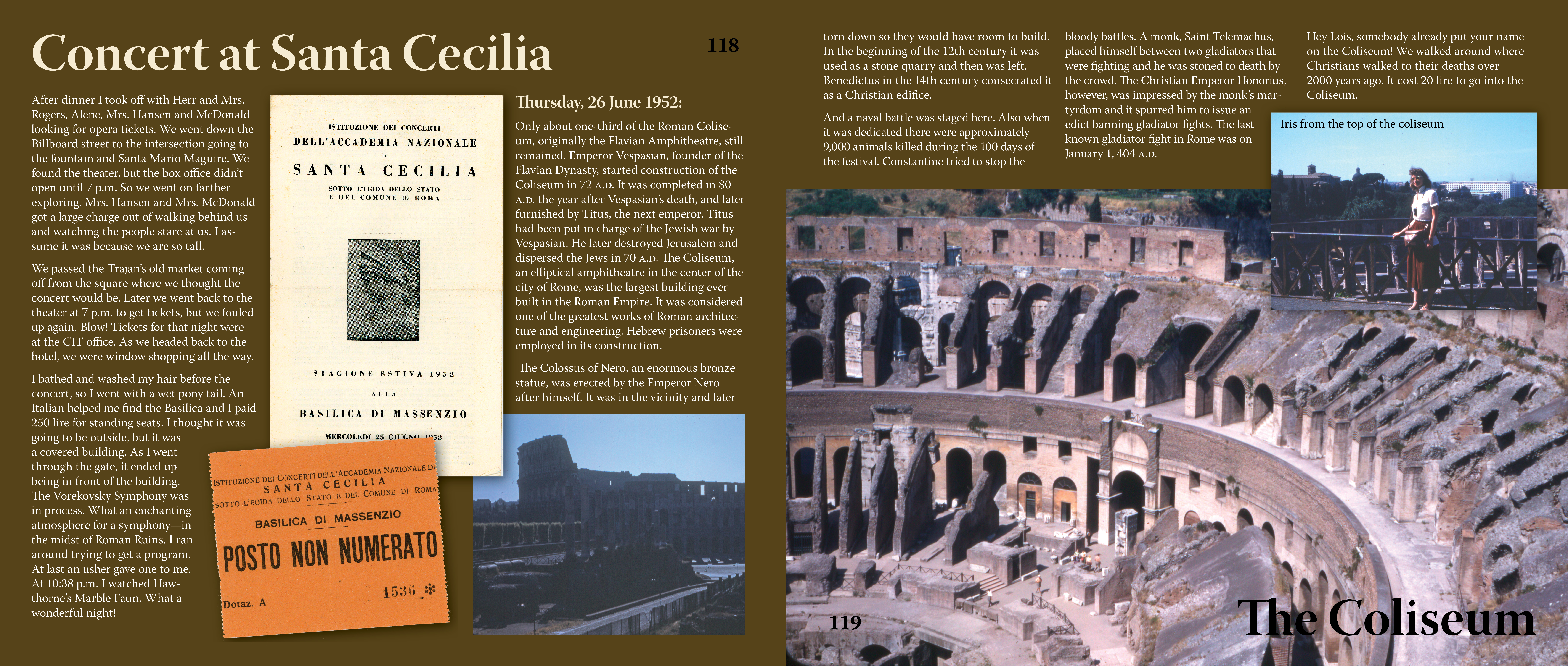
Only about one-third of the Roman Coliseum, originally the Flavian Amphitheatre, still remained. Emperor Vespasian, founder of the Flavian Dynasty, started construction of the Coliseum in 72 a.d. It was completed in 80 a.d. the year after Vespasian’s death, and later furnished by Titus, the next emperor. Titus had been put in charge of the Jewish war by Vespasian. He later destroyed Jerusalem and dispersed the Jews in 70 a.d. The Coliseum, an elliptical amphitheatre in the center of the city of Rome, was the largest building ever built in the Roman Empire. It was considered one of the greatest works of Roman architecture and engineering. Hebrew prisoners were employed in its construction.

The Colossus of Nero, an enormous bronze statue, was erected by the Emperor Nero after himself. It was in the vicinity and later torn down so they would have room to build. In the beginning of the 12th century it was used as a stone quarry and then was left. Benedictus in the 14th century consecrated it as a Christian edifice.

And a naval battle was staged here. Also when it was dedicated there were approximately 9,000 animals killed during the 100 days of the festival. Constantine tried to stop the bloody battles. A monk, Saint Telemachus, placed himself between two gladiators that were fighting and he was stoned to death by the crowd. The Christian Emperor Honorius, however, was impressed by the monk’s martyrdom and it spurred him to issue an edict banning gladiator fights. The last known gladiator fight in Rome was on January 1, 404 a.d.

Hey Lois, somebody already put your name on the Coliseum! We walked around where Christians walked to their deaths over 2000 years ago. It cost 20 lire to go into the Coliseum.

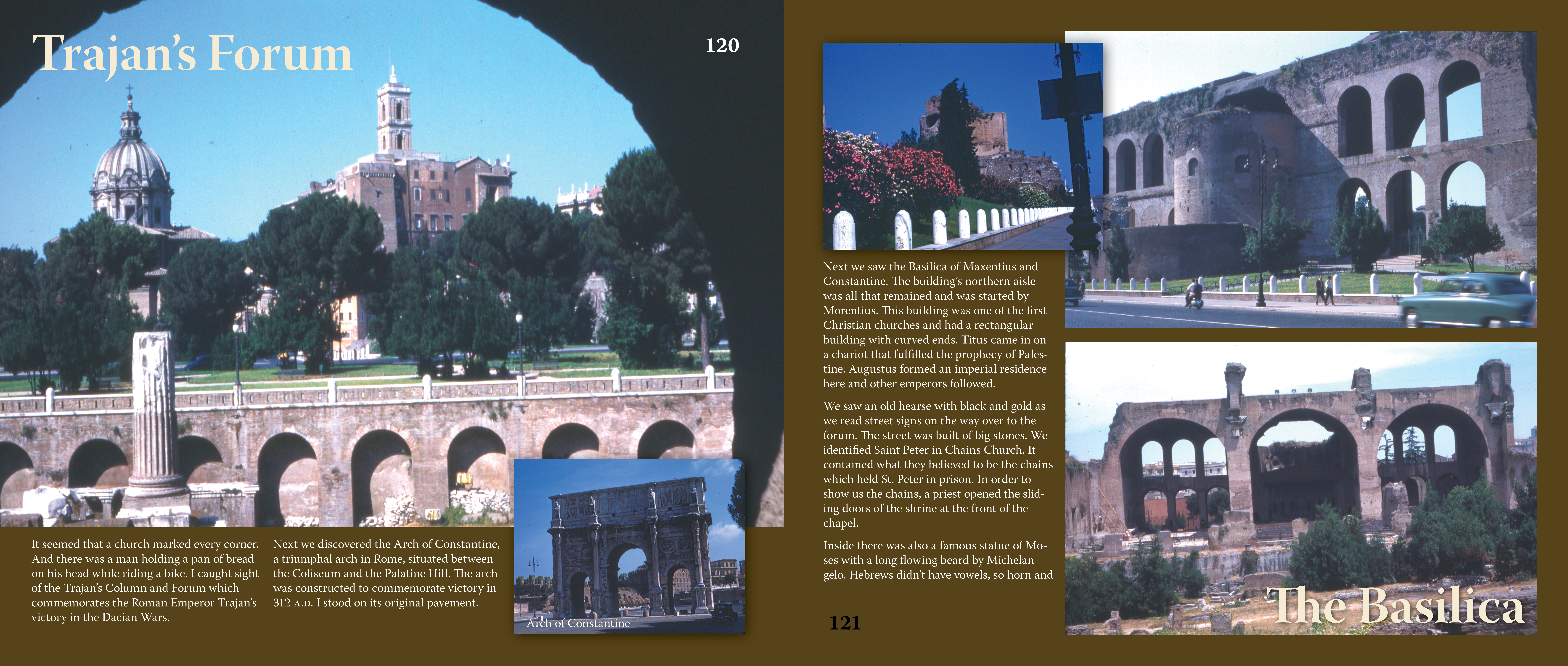
It seemed that a church marked every corner. And there was a man holding a pan of bread on his head while riding a bike. I caught sight of the Trajan’s Column and Forum which commemorates the Roman Emperor Trajan’s victory in the Dacian Wars.

Next we discovered the Arch of Constantine, a triumphal arch in Rome, situated between the Coliseum and the Palatine Hill. The arch was constructed to commemorate victory in 312 a.d. I stood on its original pavement.

Next we saw the Basilica of Maxentius and Constantine. The building’s northern aisle was all that remained and was started by Morentius. This building was one of the first Christian churches and had a rectangular building with curved ends. Titus came in on a chariot that fulfilled the prophecy of Palestine. Augustus formed an imperial residence here and other emperors followed.

We saw an old hearse with black and gold as we read street signs on the way over to the forum. The street was built of big stones. We identified Saint Peter in Chains Church. It contained what they believed to be the chains which held St. Peter in prison. In order to show us the chains, a priest opened the sliding doors of the shrine at the front of the chapel.

Inside there was also a famous statue of Moses with a long flowing beard by Michelangelo. Hebrews didn’t have vowels, so horn and light were written the same. Michelangelo misunderstood it and put horns on the statue of Moses. It was the apex of sculpturing with Rachel and Leah on each side of Moses. I noticed an iron gate along the front of the building.

Soon after we discovered the Temple of Venus and of Rome which was near the Coliseum. Then the Arch of Titus, which was built for Emperor Titus in 70-81 a.d., stood in a slightly elevated position at the entrance to the Roman Forum. Its religious significance lay in its depiction of Titus’ victories which included the sacking of Jerusalem. Three young priests told us about Circus Maximus which was the largest stadium in ancient Rome and like a modern racetrack. At one point the Circus could seat 300,000 people. As I spotted a red robed priest from Germany the marble path was caved in and crumbling. Next was the Temple of Romulus which still had its original door. It was green, made of bronze, and still had its original lock.

Then we reached the white marble Arch of Septimius Severus at the northeast end of the Roman Forum, a triumphal arch dedicated in 203 a.d. to commemorate the Parthian victories of Emperor Septimius Severus and his two sons. Mamertine Prison, state prison of ancient Rome, was located on the northeastern slope of the Capitoline Hill, where St. Paul and Peter were imprisoned. There were two upper cells but the lower cell was probably the most ancient prison in Rome. The church of San Giuseppe dei Falegnami now stands above the Mamertine Prison.

At the Tombs of Romulus there were pansies growing all over the grassy area. Later there was a large platform called the rostrum that was built facing the Senate building. It was where people would stand and make their proclamations. SPQR was from a Latin phrase, Senatus Populusque Romanus which means Senate and People of Rome, referring to the government of the ancient Roman Republic.

Next on the tour was the Basilica Ulpia which was an ancient Roman civic building located in the Forum of Trajan. Ulpia was the name of Empress of Trajan. There was this most unique Ulpia Restaurant in Rome. Antiquities were in the basement and the manager was Senore Conti. There was a statue of Nero. In 1840 the basement was excavated and cleaned out and fixed up in 1870. Another statue of Nero was in the Vatican by a bar on an old Roman street. It was dedicated as a place to burn incense before going out into the forum.

As we moved on there was an obelisk at the end of the Trajan’s Forum which the obelisk in Paris was copied from. Next we saw the Tomb of the Unknown Soldier, a national monument in Italy. Before entering through the doors there were round circular stone stairs. This same pattern was repeated in four or five areas on surrounding buildings for emphasis.

Then we journeyed to the Pantheon which was a temple to all the gods of ancient Rome, the glory of the Eternal City. It was commissioned by Marcus Agrippa on this sight as a temple and rebuilt by Emperor Hadrian in about 126 a.d. The Pantheon used to be the national church of all Italians. The bronze was taken from here to construct the altar at St. Peters. Also, the dome at the Pantheon was a model for St. Peter’s Basilica dome and a dome in Florence. The Pantheon was preserved because it was changed into a Christian Church. It was the largest pagan church still standing with the original bronze door with autographs on the doors.

At the Pantheon was the tomb of Victoire Emmanuel II. He became the second father of the Fatherhood and assumed the title King of Italy to become the first king of a united Italy. An artist Raphael was buried at the Pantheon also. A round hole in the top always represented the open tomb of Raphael. One of his pupils created a statute of Raphael with a dove. Margherita was a promised wife for Raphael.

I bartered for a souvenir picture of Rome for 1400 lire with a few postcards thrown in. Then we walked past the National Parliament that was in session. The actress, Ingrid Bergman, was at every newsstand. She had had twins on June 18, 1952. Carol and I stopped at a book shop, because we were still trying to find a tour guide of Europe. We then lost the group and found our way to American Express. After finding it I got a letter from Mom. We had pizza pie on the way back to the hotel. Then we walked around and window shopped.

I was excited because the opera was tonight. I read the story of La Traviata to the kids. We left early so Carol and Alene could get tickets. As we went we stopped in a Pasticceria for a little Italian pastry. I got one soaked in rum or something similar.

At 8:30 p.m. the rope was still across the entrance to the opera. I climbed over and sat on the stairs to write letters. Eventually at 9 p.m. they let us in. It was not elaborate. However, I enjoyed the opera although the tenor had his eyes glued on his hands. The soprano carried the show.

60 Years Ago Today

Wednesday, 25 June 1952:

I was up earlier than normal today. I was ready to go. It was either Rome or bust today. I learned policemen stayed in the hotel as well as Capone’s brother a long time ago. Finally we were ready to go but Dick and Henry’s passports were missing. They were not at the hotel desk. The manager was quite excited about it and said, “I don’t want to go to America. I’ve already been.” Everybody checked for the passports and Joyce had all of them.

On our way again, the country was flatter with a few hills. We followed the seacoast for a ways. I noticed a Singer sewing center sign and the biggest haystack that I’ve ever seen before. The haystack was still in a teepee shape with a pole in the middle. The farmers cut slices off the sides to use. Soon after there were groves of toadstool trees, flower and tree-lined roads, white strips painted on the trees, and a few women gleaning in harvested fields. Next the countryside had grapevines planted along the side of the railroad tracks and an orchard with a vineyard planted beneath the trees. I spied ox teams loading hay.

This plain country was drier and didn’t have such heavily luxurious growth as farther north did. I found striped road barriers at the railroad tracks. When the train whizzed by, the gates came up. Next I saw a lady carrying water up the steps of the farmhouse. The water in the river beds was low and the grass and weeds were high.

And I noticed the grains came in long shocks rather than in high piles. There were wild poppies growing amidst the stubble while other grain fields came in round shocks. The grain shocks were between rows of trees and grape vines. Later we passed an olive orchard, a little hedge between the trees, Oleander bushes alongside the road, and a really modern new service station. We waited for two trains, a passenger train and a freight train.

We didn’t have enough food hanging from the window baskets, so we stopped at a small town for something to eat. The mob descended upon a poor little alimentari shop, which was the Italian’s combination grocery, deli and cafe. It was one of the largest shops we had found so far.
When the bus was back on the road again, we passed a large auto van transporting about a dozen new little European cars. The little cars got better gas mileage, one of the main reasons for their widespread use here in Europe. I identified different shaped stacks of grain. Next was a cornfield, windmill by a farmhouse, and barbed wire fences. It was the first time I recalled seeing wire fences in Europe. This part of Italy looked somewhat like our dry farms. Then we went down by the Mediterranean again.

Next we crossed a river or canal or something. I couldn’t find on the map. Men working in field waved to us, just like we used to do in Idaho when we were out hoeing beets. Along the way I caught sight of a combination orchard, cornfield, wheat field and vineyard. I noticed rectangular two story houses with outside stone stairs going up to the second story. The little village looked like a ship sitting on top of a hill.

Our plans for Rome were to spend the first day at the Vatican, second day in the central part of the old city, and the catacombs the last day. The Vatican, the world’s smallest country, was a small independent state. A 400 ton obelisk was in the center of the square. It was the only remnant of Nero’s Circus where the obelisk would preside over Nero’s countless brutal games and Christian executions. The Vatican had two long colonnades on the side of the square that represented outstretched arms. Bernini had been the architect. Railroads, considered the shortest tracks in the world, were created to lead into the Vatican.

In this small country the Vatican had its own post office and guards. All the priests in the Vatican must be unmarried and within a certain age range. Also, there was a covered passageway which still connected St. Angelo Castle to the Vatican. St. Angelo sat along the river and was close to the main road leading to the Vatican. Often St. Peter’s Square at the Vatican was full of people for many different occasions. The Catholic Church, the wealthiest church, had sold many indulgences to pay for it.

I took a nap and missed part of the lecture. Lunch was crazy. Whatta circus! As we sped down the road, I chawed on an old dry bunch of Italian bread trying to get a little cheese or jam to stay on it! What an experience and it happened almost everyday. I was going to have strong teeth or none at all. The cross country bicycle race passed us going the other way, while we were eating. I wonder if Italy’s top cyclist was participating. The cyclists had jockey suits on and were eating and drinking while riding.

I just had a scare! I reached into my bag to put a plastic bag away and missed my travelers checks. A little voice with not so calm thinking thought it might be in my suitcase. I hope it was! Then we passed several bus loads of sailors. Inside the bus we waved at them and they whistled back.

I observed big white farmhouses with green shutters and orange roofs. And all the houses were built about the same. Italy looked drier and felt hotter than France. At spaced intervals we saw houses with the sign casa cantoniera. Later I found out they provided shelter for road workers and travelers in need. Another advertising sign showed baby baths that looked just like the thing we call foot baths in our hotel rooms.

We came into Rome from the northwest corner and there were big apartment houses on the outskirts. We spotted the dome of St. Peters and towers to the Vatican radio station. They sent messages all over the world. Next we passed the wall around the Vatican City. We observed a watering trough in which a man and horse were both drinking out of the same place. Nasty! Soon after I identified black robed priests and a bus load of priests.

Finally! We were in Rome which was 2700 years old. White uniformed police were in the middle of the streets. Then we went through a long tunnel and across a beautiful bridge called the Tibre. St. Angelo Castle, built in 150 a.d., was stripped of marble and turned into a fortress. Popes have taken refuge there.

Then we entered into the older part of the city. We passed old Roman ruins about 12 feet below the present level of Rome. The most modern monument, Tomb of the Unknown Soldier, was part of the forum. Next was the Palazia Venezzia, formerly Palace of St. Mark, in central Rome just north of the Capitoline Hill. It was the balcony Mussolini used to speak from. I spied the Roman Colliseum for one moment.

We stopped at the American Express building only to find out they were closed until 3 p.m. We immediately went to our hotel, the Hotel Angelo American. It was unimpressive from the front but nice inside. I had room six with Carol and Alene. The bathroom had everything with all the trimmings except for the soap. I found my traveler’s checks and other important stuff in my bag. What a relief! We hurried down to American Express again for mail call.

It was wonderful to receive mail from Twila, Lucy, Loy, Cleo, and Dean Woodruff. I would like to write letters so I can receive more mail. We found a little tiny restaurant and had a good dinner. It consisted of tomato soup, roast veal, orange, and fruit. It cost 750 lire which included the cover and service.

After dinner I took off with Herr and Mrs. Rogers, Alene, Mrs. Hansen and McDonald looking for opera tickets. We went down the Billboard street to the intersection going to the fountain and Santa Mario Maguire. We found the theater, but the box office didn’t open until 7 p.m. So we went on farther exploring. Mrs. Hansen and Mrs. McDonald got a large charge out of walking behind us and watching the people stare at us. I assume it was because we are so tall.

We passed the Trajan’s old market coming off from the square where we thought the concert would be. Later we went back to the theater at 7 p.m. to get tickets, but we fouled up again. Blow! Tickets for that night were at the CIT office. As we headed back to the hotel, we were window shopping all the way.

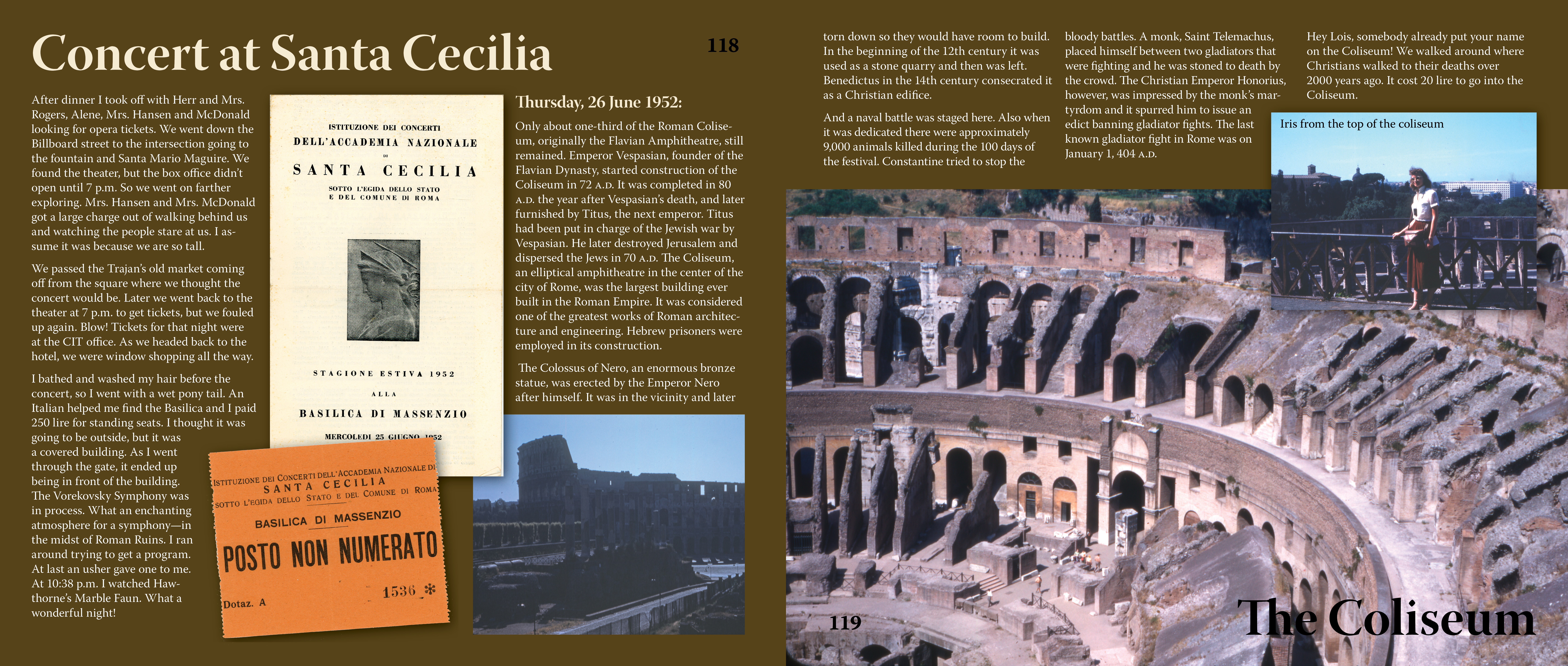
I bathed and washed my hair before the concert, so I went with a wet pony tail. An Italian helped me find the Basilica and I paid 250 lire for standing seats. I thought it was going to be outside, but it was a covered building. As I went through the gate, it ended up being in front of the building. The Vorekovsky Symphony was in process. What an enchanting atmosphere for a symphony—in the midst of Roman Ruins. I ran around trying to get a program. At last an usher gave one to me. At 10:38 p.m. I watched Hawthorne’s Marble Faun. What a wonderful night!