
Thursday, 19 June 1952:
At 7 a.m. I opened an eye to look at my watch. A few minutes later and a knock came at my door. French—which we presumed meant it was time to get up. A few minutes later that funny buzz again.
“Madam would you like tea in your room?” About 15 minutes later we crawled out of bed and went down to breakfast. We had a continental breakfast of chocolate rolls and jam for 210 francs.
I noticed I had about six bites on my arms. Where did they come from? Then I found a small grocery shop and pastry shop around the corner. I bought a big loaf of bread for 50 francs. Then I chose cheese pastries and fruit but I had left my money belt in my room. However I recovered with the help of Connie and Bette L. I was really trying to lighten my load—maybe too much.
We were back on the road again with fields of flowers, roses, and the Rhone and Saone basin. I learned this was the lowest valley in France and that the Rhone river originates in Switzerland. Soon after the countryside included roses climbing on a cement fence, haystacks, rich agriculture districts, rich meadow lands, and coal districts nearby. I spied wheat, corn, cattle, and poultry. These lowlands funneled the Southern European influence. Then there were Roman ruins from 600 b.c.
Next was the Cathedral of St. Maurice de Vienne in Angers. It had painted archways and recessed portals which were built in the 12th to 16th centuries in Gothic architecture. The cathedral was in a state of decay with the lilies of the valley inside.
Soon after we saw the Temple of Augustus that was originally dedicated to Augustus and his wife Livia. Then I noticed more Roman ruins along with a Pagan church, laundromat with an automatic Bendix washing machine across from the temple, and Roman forum ruins, which had been a public square or meeting place.
There was a little girl with the curliest blonde hair I’d ever seen. Just about like the little brunette on the boat who had curls all over her head. Andre, the bus driver, changed the tire while we were looking around the city. We saw the square and found a better closed in “dealy”.
I didn’t see the pyramids, but I saw the grape vineyards with sticks, mowing hay, grass in the fields, and old château ruins. Among these beautiful sights were more “U.S. go home” and “Ridgway la peste” signs along the road. Ridgway was a U.S. general who had come to France as the supreme NATO commander. He had just been in Korea and had been accused of using napalm and germ warfare. Obviously I guess maybe the French don’t like us or something.
We continued on through the old Roman Provinces where it had been Julius Caesar’s first job as governor of this area. It was called Crovance with two main southern dialects. This area was also the homestead of troubadours, who were finders of new kinds of poetry, which composed tales of love and romances.
This land was home of Albigenses, an early protestant group, that were considered heretics by the Catholic Church. Crusades were organized against the Albigenses and finally they were wiped out. In one battle alone, 60,000 Albigenses were slaughtered.
We stopped by a service station near a small town, L’Hermitage, which was south of Erme. There were fields on the sides of the mountains. The fields were planted in layers or steps up the mountainside. While part of the mob ate lunch on the stone fence by the station, others crawled down to the river and lunched amidst the bushes and sand fleas. I was among the latter and ate hunks of French bread with cheese, a French pastry, an orange, a banana, and some cherries. The kids had to use the bushes for another purpose also.
On the road again we saw the first rock or stone fences around the fields and the French farmers were harvesting grain with a small combine affair. There were tree lined roads before we crossed the Rhone River. We passed a trailer camp outside of Valance with not so new modern trailers. And there were dozens of bicycles on the street and it seemed to be the mode of transportation here in France.
Little “Orly”, the town, was just like Paris near the public square. It had street markets with flags flying all along streets. It must be a holiday or market day maybe. Yet it sure looked like Mexico with a junk yard, really piled deep. As we headed to the higher mountains there was a stunning field of purple flowers.
As we drove there were more red “go away, go home” signs. One of the members of the Paris Branch said the U.S. had the poorest propaganda machine of any nation. Europeans probably think Russia was giving them the aid rather than the U.S. These signs we’ve been seeing seem to bear this out.
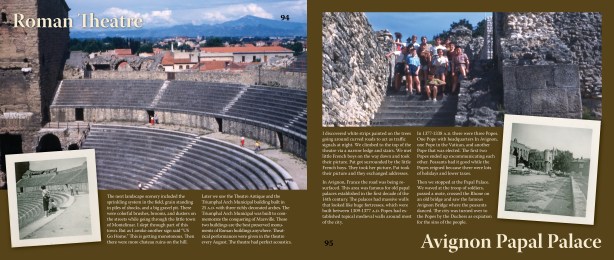
The next landscape scenery included the sprinkling system in the field, grain standing in piles of shocks, and a big gravel pit. There were colorful brushes, brooms, and dusters on the streets while going through the little town of Montelimar. I slept through part of this town. But as I awoke another sign said “US Go Home.” This is getting monotonous. Then there were more château ruins on the hill.
Later we saw the Theatre Antique and the Triumphal Arch Municipal building built in 25 a.d. with three richly decorated arches. The Triumphal Arch Municipal was built to commemorate the conquering of Marsville. These two buildings are the best preserved monuments of Roman buildings anywhere. Theatrical performances were given in the theatre every August. The theatre had perfect acoustics.
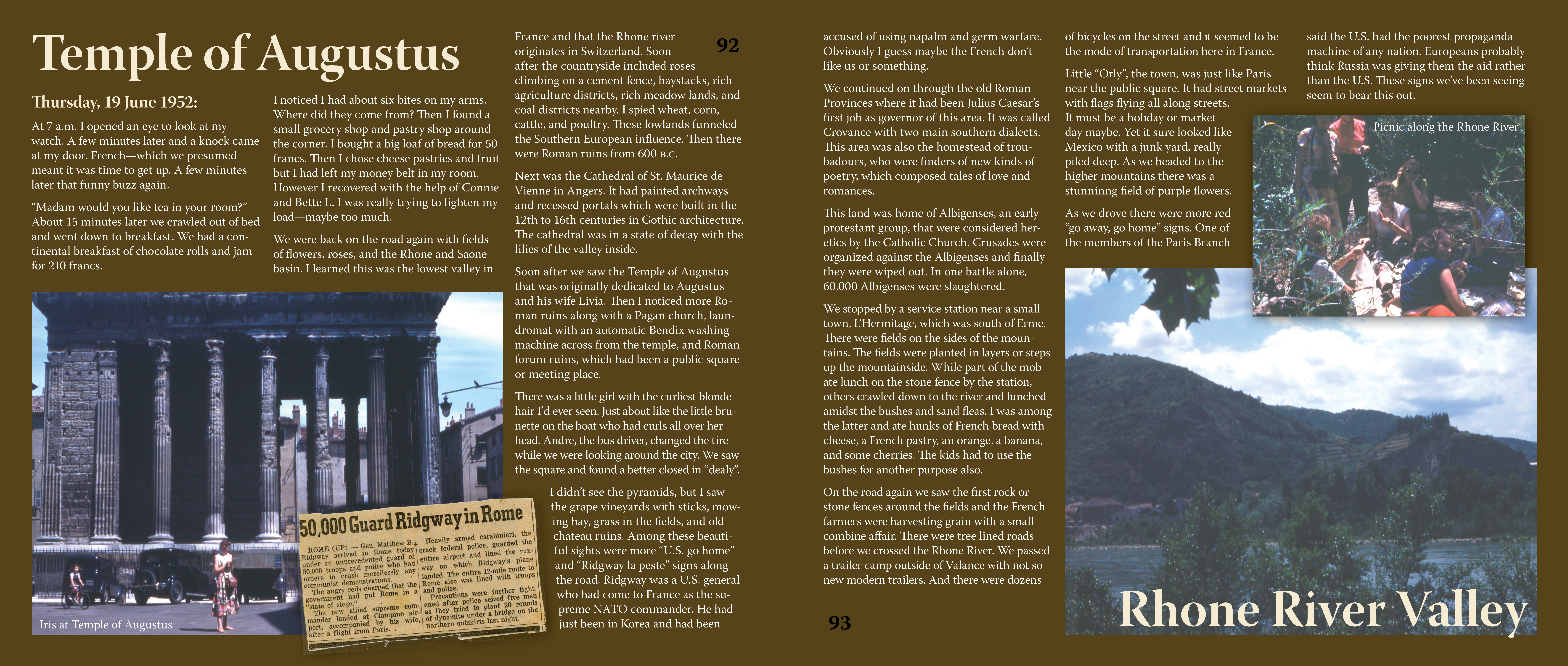
I discovered white strips painted on the trees going around curved roads to act as traffic signals at night. We climbed to the top of the theatre via a narrow ledge and stairs. We met little French boys on the way down and took their picture. Pat got surrounded by the little French boys. They took her picture, Pat took their picture and they exchanged addresses.
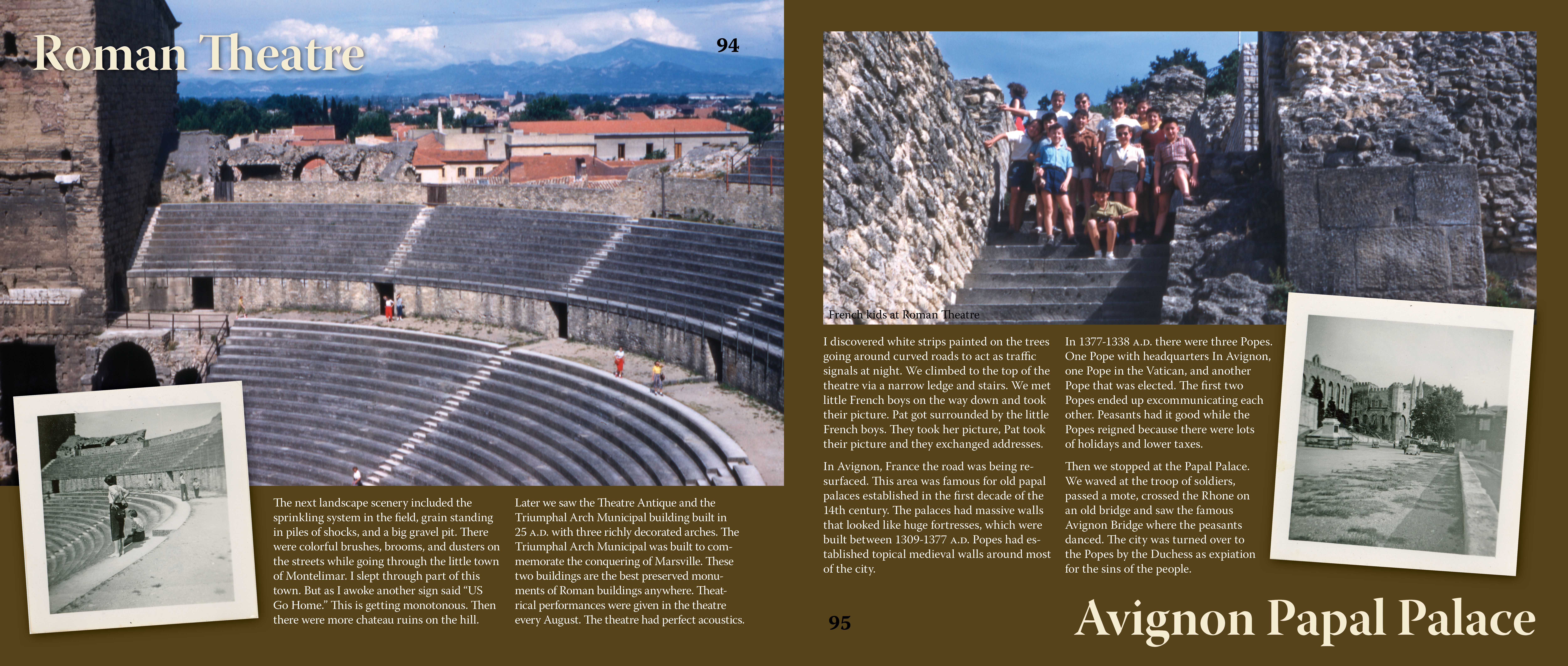
In Avignon, France the road was being resurfaced. This area was famous for old papal palaces established in the first decade of the 14th century. The palaces had massive walls that looked like huge fortresses, which were built between 1309-1377 a.d. Popes had established topical medieval walls around most of the city.
In 1377-1338 a.d. there were three Popes. One Pope with headquarters In Avignon, one Pope in the Vatican, and another Pope that was elected. The first two Popes ended up excommunicating each other. Peasants had it good while the Popes reigned because there were lots of holidays and lower taxes.
Then we stopped at the Papal Palace. We waved at the troop of soldiers, passed a moat, crossed the Rhone on an old bridge and saw the famous Avignon Bridge where the peasants danced. The city was turned over to the Popes by the Duchess as expiation for the sins of the people.

Soon after we observed one boat of girls and another boat of boys rowing on the river. Pont du Gard, which was one of the grandest Roman works in existence, had a bridge and aqueduct over the Gard River. It was 880 feet long by 160 feet high. Its system consisted of a system of three arches carrying water for 25 miles to Nimes. Other aqueducts copied Pont du Gard.
There was rocky country as we left Avignon and arrived at the Aqueduct. And the scenery included vineyards, tree lined roads, men harvesting grain with scythe, and another “US Go Home” sign. Maybe it was the communists who keep telling us to go home. I discovered spots to show the middle of the road.
We arrived at the aqueduct and climbed up the winding bush-lined trails. It was a massive structure. I took picture of the kids on the top with the aqueduct from the trail. It took 30 minutes to get to the top instead of 10 minutes. Next was a grove of olive trees, dry dock over some railroads, and houses with green, blue and yellow shutters.
At 7 p.m. we got into the city of Nimes. There was a Roman amphitheater that was built in 140 a.d. which held 20,000 spectators. It was one of the best preserved ancient arenas and it could be emptied in five minutes. This area contains more important well preserved ruins than any other city besides Rome.
Later on the bus ride was the Palais de Justice which was an old Gothic cathedral with flying buttresses. A physician lived here by the name of Nicot. He introduced tobacco in France and gave it his name. Next was the Temple of Maison Carree, considered one of the most beautiful temples of modern times. The French had bullfights in this arena.
Finally, we arrived at the Hotel Le Cheval Blanc. Its facade was nice looking. My room was 59 on the 4th floor. The suitcases were taken down early for tomorrow. I wasn’t able to sleep in my pajamas tonight. Carol and Eloise had difficulty with the door. Twila couldn’t get it to open either, but we finally got it open. The WC was at the other end of the hall. I cleaned up with a foot and spit bath combination. Then we dined at the hotel sidewalk café—omelet cambron and pomes frites for 15 francs. We had one omelet between the three of us.
We strolled down the boulevard in search of a French movie. We turned down one movie with Lucille Ball and then passed a street side cabaret deal with a small orchestra, but no one was dancing. People were sitting around watching each other. They really concentrated on us as long as we were in view. We found a movie Deux Sous de Violettes with Dany Robin. The heroine of the movie had so many heroes it was a little confusing, but quite amusing nonetheless. At the end of the day there was only one pillow on the bed.



 telling family tales