

Saturday, 28 June 1952:
Today we got to see the tombs of Keats, Shelley, and the Pyramid of Porta San Palo, an ancient tomb. But first we saw the Piazza Colonnade, Italian Senate, and Obelisk of Marcus Valerius. He was a Roman general, author and patron of literature and art.
While walking around the wall of the Vatican Museum, a man was washing his clothes in the fountain in St. Peter’s Square. There was a thick ornate bronze spiral staircase with large shallow stairs. Next was the Vatican Library, one of the oldest libraries in the world, that holds books and manuscripts behind locked cabinets. I observed gold miniatures of the Basilica of St. Anthony.
It was time to go to the Sistine Chapel, the official residence of the Pope. There were lit windows in the passageway. Pope Sixtus IV built the Sistine Chapel in 1470, 22 years before the discovery of America. There were frescoes, a type of painting done on plaster, representing Christ and Moses, which were begun in 1481 a.d. The frescoes included the circumcision and baptism of Christ by Pinturicchio, and the story of Moses and Christ by Botticelli.
In 1508 a.d. Julius II ordered Michelangelo to paint the ceiling in four years. Michelangelo began working on the Last Judgment three decades after finishing the ceiling of the chapel. It took four years to finish as well. The chapel was filled with groups of people crowded around their guides. Huh….this is certainly a contrast to our temples to which the public was not admitted.
Then we saw Raphael’s four rooms which form a suite of reception rooms for the public part of the papal apartments. School of Athens was one of Raphael’s most famous paintings. There was an optical illusion on the ceiling with John the Baptist’s head by Raphael. And the ceiling and the mosaic floors were elaborate. We viewed the sculpture Laocoon and His Sons. Laocoon was a figure in Greek and Roman mythology where the father and sons were killed by a snake.
We had to dash quickly through to make the appointment with the Pope. At the door we were met by the guards. Then the usher asked for our invitation and we entered a room almost full of people waiting for the Pope. The ushers were dressed in red costumes in the red-walled rooms. Many of us were left standing so we were ushered into another smaller room that was not quite so elaborate. I noticed paintings of all the popes on the walls.
Here we sat like bumps on logs, not knowing what to expect or what to do. I was anxious to see how the Pope handled us as an audience of curious students from BYU. Herr Watkins had a Book of Mormon autographed by each of us to give to the Pope. We thought perhaps we would be in a large group with others who were Catholics, but here we were pretty much by ourselves. Wrong clue! Now back into the main receiving room where everyone was standing in a circle. We looked like a bunch of peasants with our scarves.
The Pope, dressed in white, came in with his assistants. He was 77 years old with a pleasant manner. He shook hands with everyone and gave us each a little remembrance. Some of the Catholics kissed his hand and knelt before him. There were several monks in the audience and he spoke to them for several minutes. He had a pleasant personality.
Herr Rogers was one of the last to meet the Pope. He presented our scriptures to him. We all watched intently to see how he would receive it. The Pope asked if we wanted the book blessed, but Herr Rogers told him no. However, we would like him to put it in the Vatican Library. His secretary looked at it rather queerly and handled it gingerly.
After the Pope had talked to everyone individually, he spoke a few words to everyone collectively. Afterwards a photographer came in and took two pictures of the Pope and his audience. And if you put your name on a slip of paper, they would deliver a picture to your hotel for 500 lire. Talk about commercializing the Catholic Church!
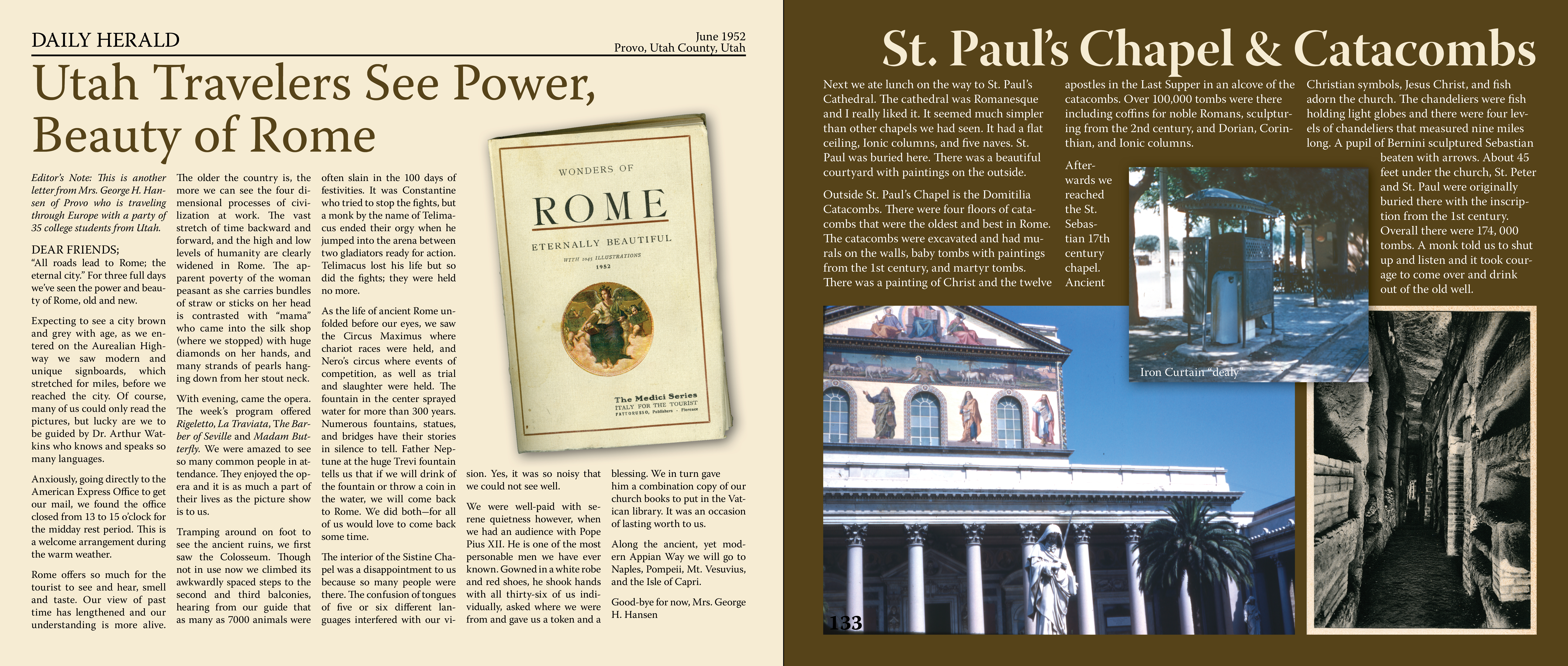
Next we ate lunch on the way to St. Paul’s Cathedral. The cathedral was Romanesque and I really liked it. It seemed much simpler than other chapels we had seen. It had a flat ceiling, Ionic columns, and five naves. St. Paul was buried here. There was a beautiful courtyard with paintings on the outside.
Outside St. Paul’s Chapel is the Domitilia Catacombs. There were four floors of catacombs that were the oldest and best in Rome. The catacombs were excavated and had murals on the walls, baby tombs with paintings from the 1st century, and martyr tombs. There was a painting of Christ and the twelve apostles in the Last Supper in an alcove of the catacombs. Over 100,000 tombs were there including coffins for noble Romans, sculpturing from the 2nd century, and Dorian, Corinthian, and Ionic columns.
Afterwards we reached the St. Sebastian 17th century chapel. Ancient Christian symbols, Jesus Christ, and fish adorn the church. The chandeliers were fish holding light globes and there were four levels of chandeliers that measured nine miles long. A pupil of Bernini sculptured Sebastian beaten with arrows. About 45 feet under the church, St. Peter and St. Paul were originally buried there with the inscription from the 1st century. Overall there were 174, 000 tombs. A monk told us to shut up and listen and it took courage to come over and drink out of the old well.
Utah Travelers See Power, Beauty of Rome
Editor’s Note: This is another letter from Mrs. George H. Hansen of Provo who is traveling through Europe with a party of 35 college students from Utah.
Dear Friends;
“All roads lead to Rome; the eternal city.” For three full days we’ve seen the power and beauty of Rome, old and new.Expecting to see a city brown and grey with age, as we entered on the Aurealian Highway we saw modern and unique signboards, which stretched for miles, before we reached the city. Of course, many of us could only read the pictures, but lucky are we to be guided by Dr. Arthur Watkins who knows and speaks so many languages.
Anxiously, going directly to the American Express Office to get our mail, we found the office closed from 13 to 15 o’clock for the midday rest period. This is a welcome arrangement during the warm weather.
Rome offers so much for the tourist to see and hear, smell and taste. Our view of past time has lengthened and our understanding is more alive. The older the country is, the more we can see the four dimensional processes of civilization at work. The vast stretch of time backward and forward, and the high and low levels of humanity are clearly widened in Rome. The apparent poverty of the woman peasant as she carries bundles of straw or sticks on her head is contrasted with “mama” who came into the silk shop (where we stopped) with huge diamonds on her hands, and many strands of pearls hanging down from her stout neck.
With evening, came the opera. The week’s program offered Rigeletto, La Traviata, The Barber of Seville and Madam Butterfly. We were amazed to see so many common people in attendance. They enjoyed the opera and it is as much a part of their lives as the picture show is to us.
Tramping around on foot to see the ancient ruins, we first saw the Colosseum. Though not in use now we climbed its awkwardly spaced steps to the second and third balconies, hearing from our guide that as many as 7000 animals were often slain in the 100 days of festivities. It was Constantine who tried to stop the fights, but a monk by the name of Telimacus ended their orgy when he jumped into the arena between two gladiators ready for action. Telimacus lost his life but so did the fights; they were held no more.
As the life of ancient Rome unfolded before our eyes, we saw the Circus Maximus where chariot races were held, and Nero’s circus where events of competition, as well as trial and slaughter were held. The fountain in the center sprayed water for more than 300 years. Numerous fountains, statues, and bridges have their stories in silence to tell. Father Neptune at the huge Trevi fountain tells us that if we will drink of the fountain or throw a coin in the water, we will come back to Rome. We did both-for all of us would love to come back some time.
The interior of the Sistine Chapel was a disappointment to us because so many people were there. The confusion of tongues of five or six different languages interfered with our vision. Yes, it was so noisy that we could not see well.
We were well-paid with serene quietness however, when we had an audience with Pope Pius XII. He is one of the most personable men we have ever known. Gowned in a white robe and red shoes, he shook hands with all thirty-six of us individually, asked where we were from and gave us a token and a blessing. We in turn gave him a combination copy of our church books to put in the Vatican library. It was an occasion of lasting worth to us.
Along the ancient, yet modern Appian Way we will go to Naples, Pompeii, Mt. Vesuvius, and the Isle of Capri.
Good-bye for now, Mrs. George H. Hansen

Next we went down the road to Naples via Appian Way. We were in the old Roman Campagna, which was a low-lying area surrounding Rome. Soon after we saw part of an old aqueduct, a tomb of Cecilia, fragments of an old Roman road, and remains of monuments all along the road leading into the city.
There was one spot with the original stones of the Appian Way, one of the earliest and strategically most important Roman roads of the ancient republic. Italian people used to live in the old mausoleum along the Appian Way. Today they live on streets with billboards and signs. Next was an old aqueduct and a woman thrashing with a broom.
Andre, drove down the wrong side of a four lane road. He turned around and went back along the new Appian Way. There were eleven aqueducts and modern Rome still used three of them. Again we saw acres with white stripes. Next were the ruins of the Baths of Caracalla which were the most extensive baths in ancient Rome. The Romans came to bathe everyday as part of their social life. Open air operas were still held here in July.
We spotted the Aurelian wall that was the last big wall built in the beginning of the 2nd century by Marcus Aurelius. Rome didn’t feel secure, so a wall was built for protection. We passed the Pyramid of Cestius that was built for himself as a burial place. It stands in a fork between two ancient roads and was erected in the last years of the republic on Piazzale Ostrense. There was a family of cats living at the base of the pyramid.

In a cemetery next to the Pyramid we proceeded to the gravesite of Percy Bysshe Shelley who died at age 30 in 1822. He drowned in a sudden storm while sailing back from Livorno to Lerici in his schooner in Italy. Percy, one of the major English Romantic poets, was critically regarded among the finest lyric poets in the English language. Edward J. Trelawny, a friend of Shelley’s, died in England and was buried next to him. His grave stone quotes from Shakespeare’s Tempest:
Nothing of him that doth fade
But doth suffer a sea-change
Into something rich and strange.
John Keats, a famous English poet, was also buried in the same cemetery. He was 25 years old when he died of tuberculosis. His last request was to be buried under a tombstone, without his name, and bearing only the legend in pentameter. Joseph Severn, devoted friend of John Keats, was buried next to him. The plaque on the wall near John Keat’s grave states:
This Grave contains all that was Mortal,
of a Young English Poet, Who,
on his Death Bed in the Bitterness of his Heart,
at the Malicious Power of his Enemies,
Desired these Words to be engraven on his Tomb Stone
Here lies One Whose Name was writ in Water.
24 February 1821
John Keats epitaph tombstone states:
Keats! if thy cherished name be “writ in water”
Each drop has fallen from some mourner’s cheek;
A sacred tribute: such as heroes seek,
Though oft in vain-for dazzling deeds of slaughter
Sleep on! Not honoured less for epitaph so meek!
Next was the tomb of Goethe’s son, August. After that I spotted a fellow running and jumping on a street car. The streets were wider here with modern buildings. Then we passed an anchor in front of a Navy building. We learned that the Italian government had tried to buy the Barberini Palace by our hotel. Then we saw the buildings and a stadium that the Fascist, Mussolini erected. At the end of World War II, Mussolini and his mistress, Petracchi, were shot and hung by their heels from the roof of a service station near Milano. His body was buried in a secret place.
Then we observed a monument to the Balilla youth organization, mosaic in a courtyard, and big rest camp for the 5th Army in 1945. Piazza Del Popolo, a city square, was to Rome what Place de la Concorde was to Paris. The name in modern Italian literally means piazza of the people. It was historically derived from the populus in Latin, pioppo in Italian. The Church of Santa Maria del Popolo was in the northeast corner of the Piazza.
Afterwards was the Banco di Santo Spirits, which was the first national bank in Europe founded by Pope Paul V. It was typical of the city eternal with spiritual and commercial mixed together.
We ate standing up at the cafeteria just around the corner from the hotel. One must see it before you can eat it! I had an egg salad and spaghetti—not bad. It was my turn to fix lunch for tomorrow so I went down the street with Alice to the bread, fruit, and pastry shops.
That night I had an interesting evening concert with Kay, Dean, and Dixon. The music included Bach, Mozart and Brahams. I think the atmosphere of the ruins and Basilica made the music sound better. At intermission we met American and English speaking Italian artists. They walked home with us and were interesting to talk to. It gave us a little more insight into the Italian people. Armando, one of the artists, claimed Italy hadn’t forgotten America. That they loved all of the United States. In fact, they were going to New York in December.


 telling family tales