Europe 1952 – Passport Stamps


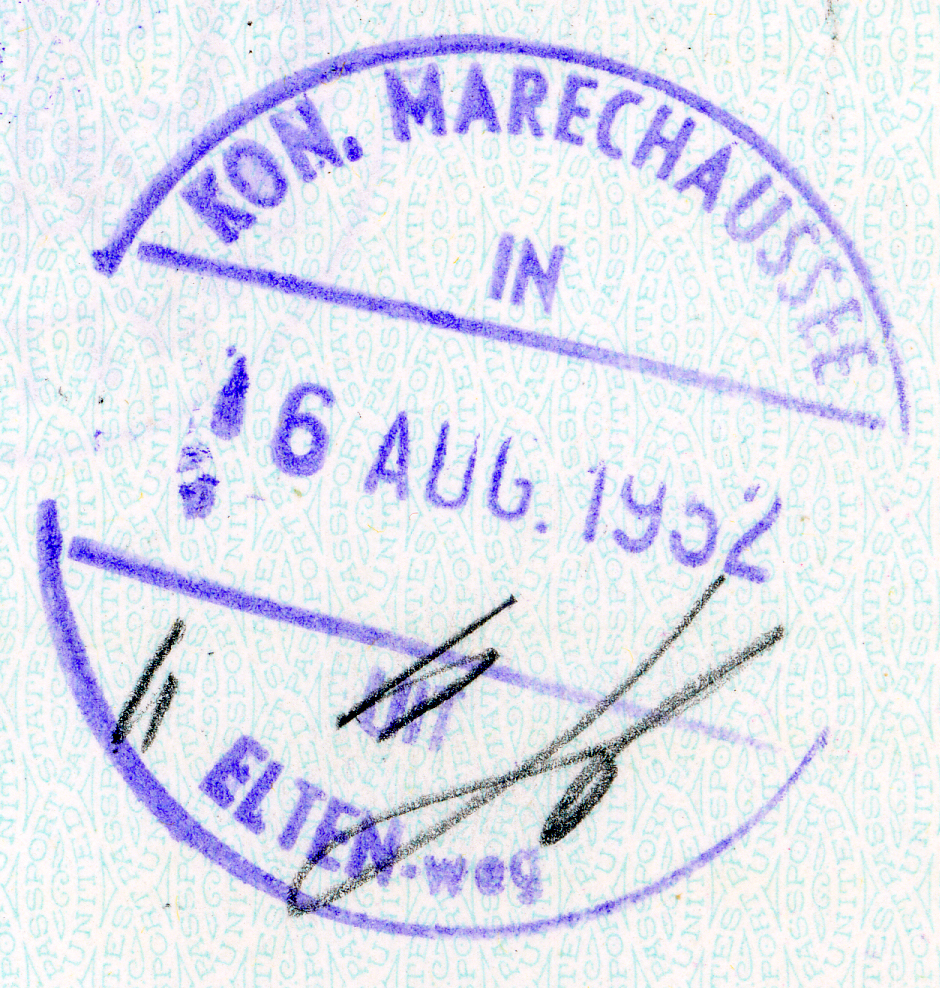
I’ve always loved passport stamps and dreamed of having a passport full of interesting stamps. So I wanted to find a way to include all the stamps from my mother’s passport into the book about her trip. But just scanning the pages and including them that way seemed like an ugly solution. After some thought I decided to figure out a way to include just the image of the stamp on each chapter heading page.

scan of passport page

After scanning the pages of her passport I  cropped each stamp into a separate image from the rest on the page. Some of the stamps overlap which just gave me more stuff that I erased from the image. All of these work was done in Adobe Photoshop.

cropped to single passport stamp

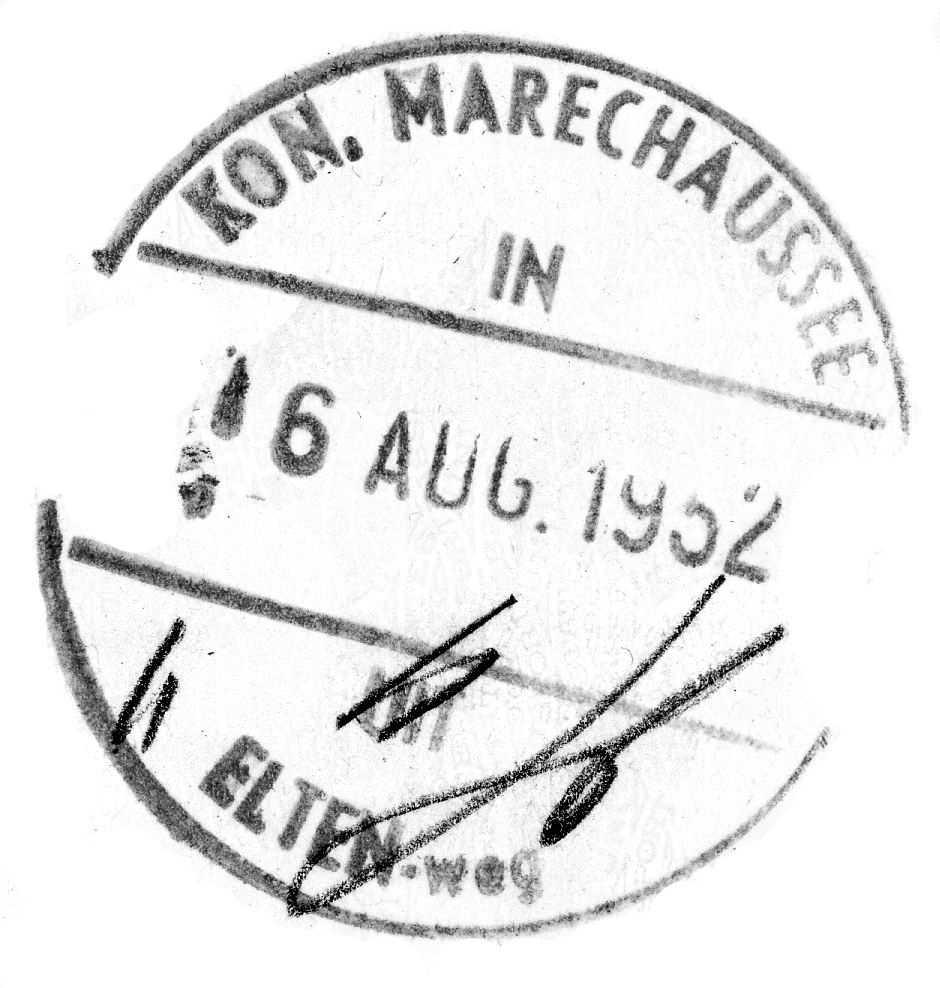
Now I started playing around with a way to separate the inked image from the background. With a simple white background it is easy to use the magic wand tool to select and then remove the background. But as you can see passport paper isn’t plain. The tool that helped the most was the background eraser tool. I hadn’t used this before so it was good to learn about it. But I still ended up doing some clean-up by hand.

cleaned up passport stamp

The last step I did was to make the image black and white before I placed it on the chapter heading page. To give it more of the effect of being stamped on the page I changed the transparency to multiply. There is probably a better way to clean-up these images but I got it done and I was happy with the effect. I like having the passport stamps for each country on that country’s chapter heading page.

What ways have you found to include things like passport stamps in your projects?


This Week in 1856 – Fort Laramie – Mary Taylor

8 October 1856: (near Salt Lake City)

Rescuers moved out from their meeting spot at Big Mountain.

8 October 1856:

Mary Taylor’s father, Joseph Taylor (age 44) died, probably from the combination of not enough food and dehydration or heat prostration. He was buried in an unmarked grave in the campground.

From John Jacques:

The company arrived at Fort Laramie October 8th, and camped east of Laramie For, about a mile from the fort. Before reaching Laramie, the company met a fine looking and finely dressed friendly Indian chief on a fine American horse, and soon after, two dragoons on horseback, gave some sweetmeats to the children of the company and appeared immensely pleased to see the people.

On the 9th many of the company went to the fort to sell watches or other things they could spare and buy provisions. The commandant kindly allowed them to buy from the military stores at reasonable prices, biscuits at 15 1/2 cents; bacon at 15 cents, rice at 17 cents per pound, and so on. Some bought a few things at the sutler’s, but much higher prices rule at his store.

I believe the company left Fort Laramie the next day. Thenceforth, until the close of the journey, although noteworthy events were on the increase and some of them were indelibly impressed on the minds of the emigrants, yet they were so fully occupied in taking care of themselves that they had little time to spare to note details with exactness, and many notes that we made at the time, were lost and cannot now be found.

Up to this time, the daily pound of flour ration had been regularly served, but it was never enough to stay the stomachs of the emigrants and the longer they were on the plains, and in the mountains, the hungrier they grew. Most persons who traveled the plains with ox teams or handcarts, know well enough the enormous appetite which that kind of life gives. It is an appetite that cannot be satisfied. At least, such was the experience of the handcart people. You feel as if you could almost eat a rusty nail or gnaw a file. You are ten times as hungry as a hunter, yea, as ten hunters, all the day long and every time you wake in the night. And so you continue to your journey’s end, and for some time after. Eating is the grand passion of a pedestrian on the plains, an insatiable passion, for her never get enough to eat. . .

Well, at the time when this great appetite was fully roused up and had put on its strength, it was further sharpened by the increasing coldness of the weather.

Soon after Fort Laramie was passed, it was deemed advisable to curtail the rations in order to make the hold out as long as possible. The pound of flour fell to 3/4 a pound, then to half a pound, and subsequently yet lower. Still the company toiled on through the Black Hills, where the feed grew scarcer for the cattle. As the necessities of man and beast increased, their daily flour diminished. In the Black Hills, the roads were harder, more rocky and more hilly, and this told upon the handcars, causing them to become rickety and need more frequent repairing.

Europe 1952: Maps

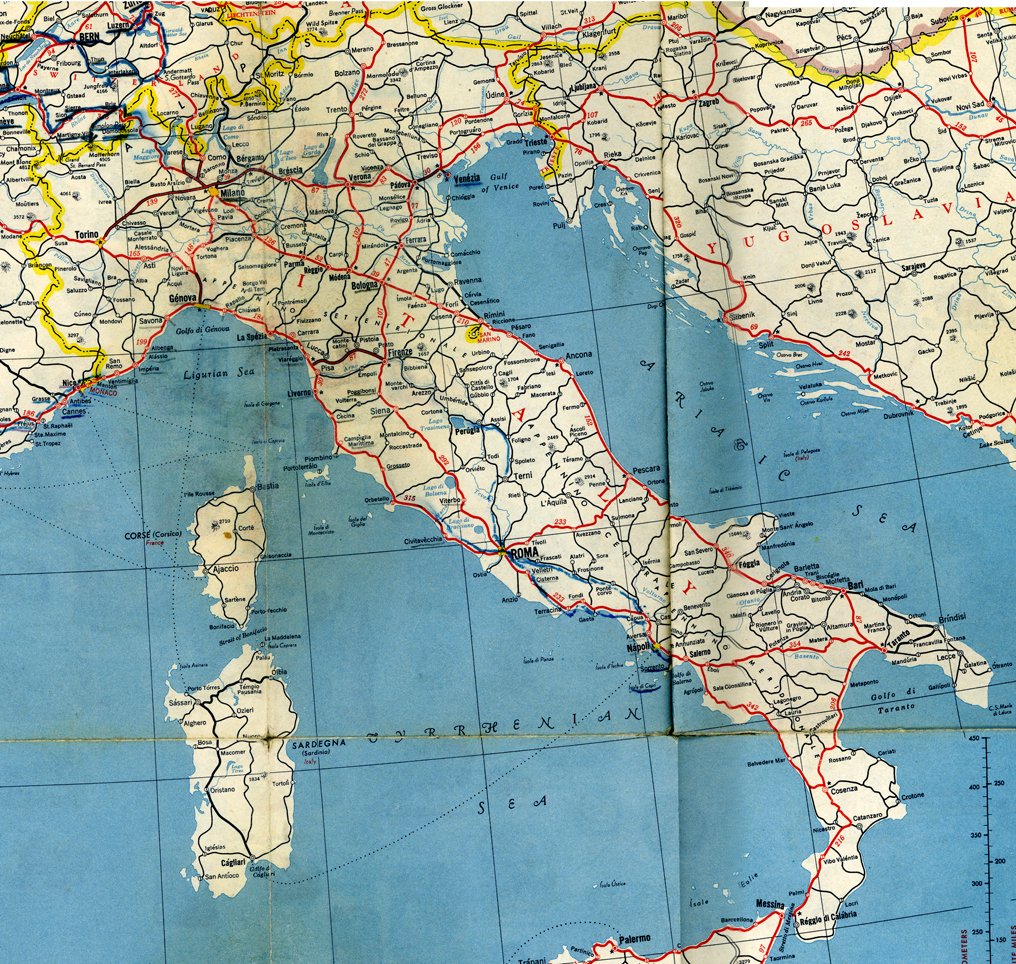
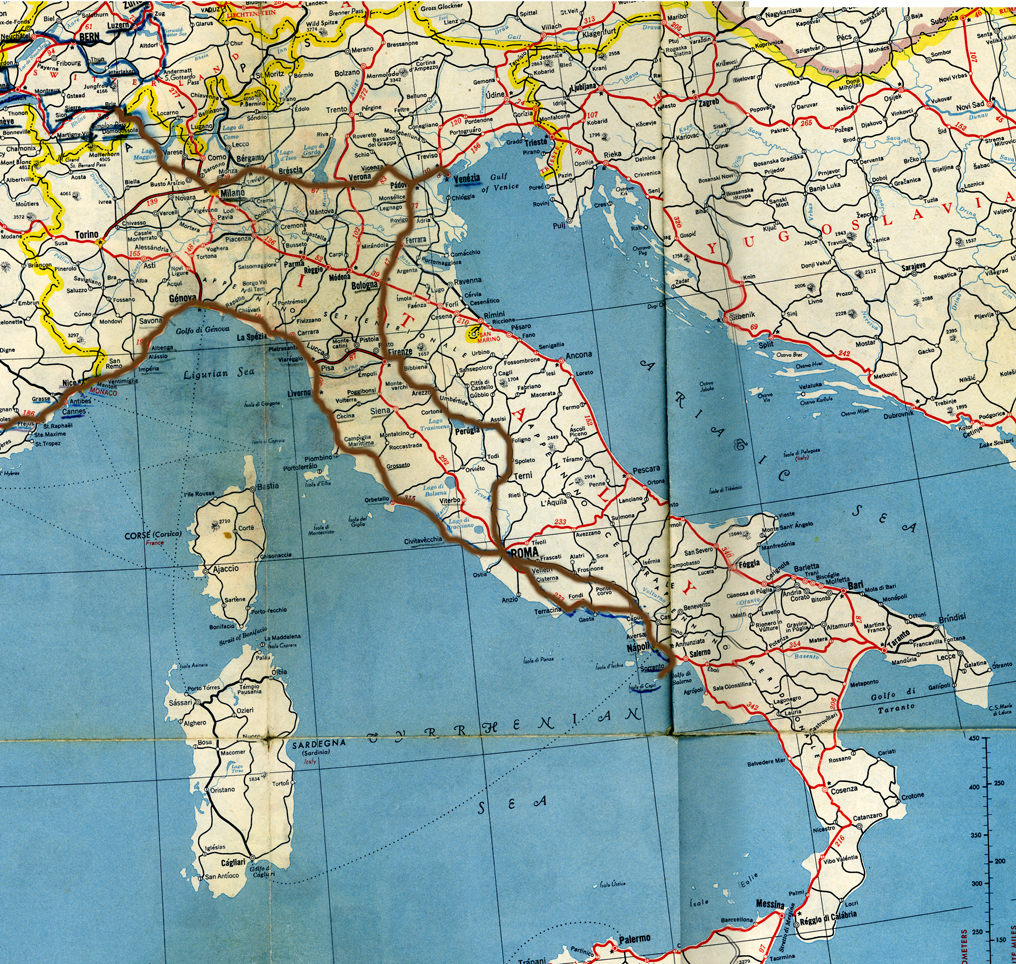
Among the many items that my mom saved from her trip to Europe in 1952 was a large map. I decided I wanted to use it at the beginning of each chapter. The map was challenging to scan because it was so big. So I scanned sections of it and then used Adobe Photoshop‘s photomerge to stitch together the section of the map for each country. If you’ve never used photomerge it is a very handy tool for doing things like panorama shots.

photomerged map

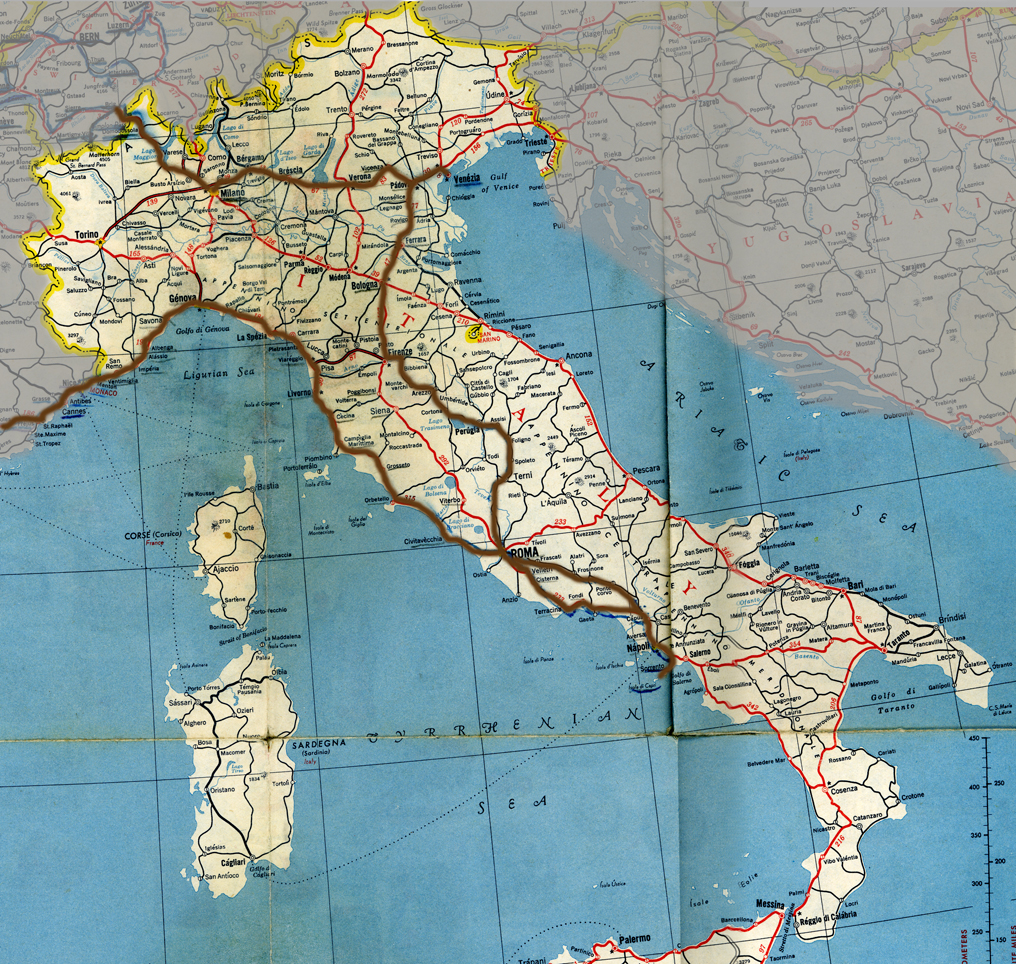
After I had a map section for each country I added a brown route line to mark the roads they traveled in that country. I did this also in Photoshop using the brush tool. To bring more focus to the country I added a grey mask that partially block out the neighboring countries, by adjusting the transparency of this layer.

map with route

map with surrounding countries grayed out

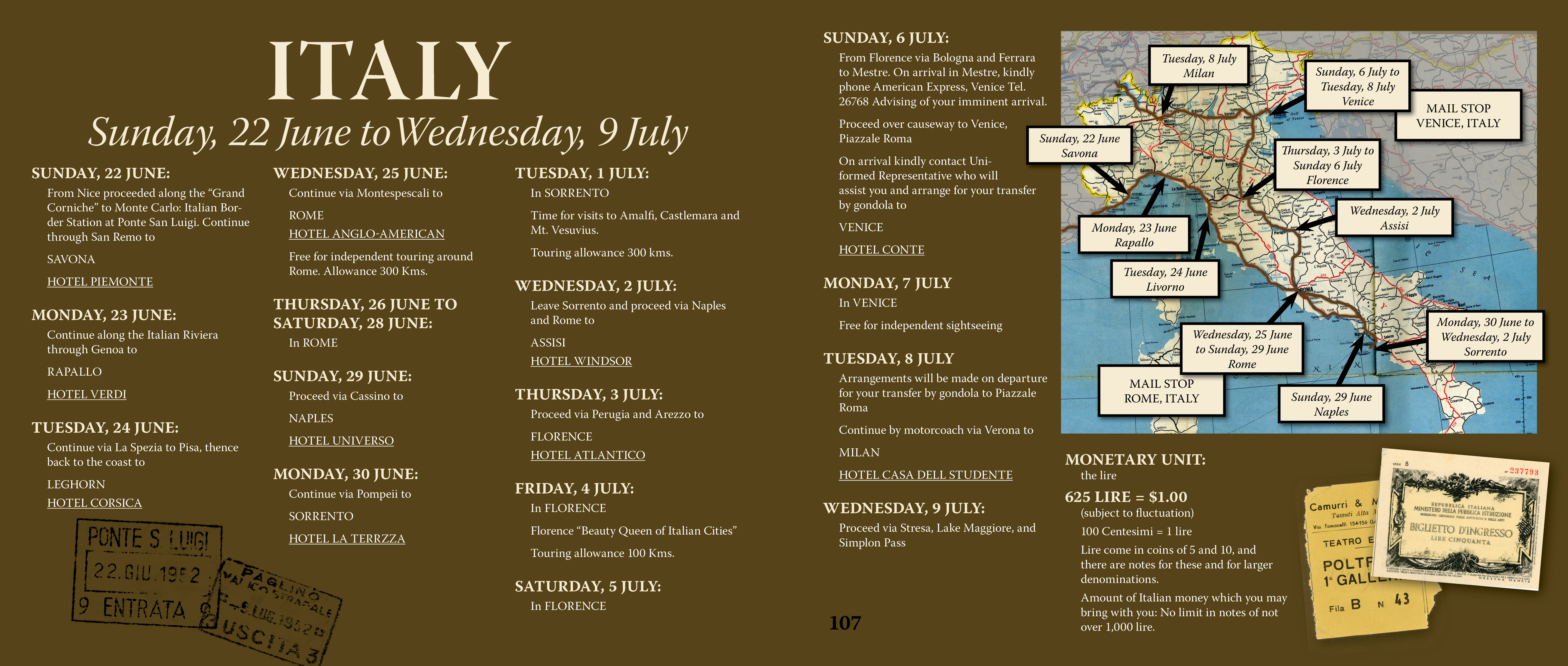
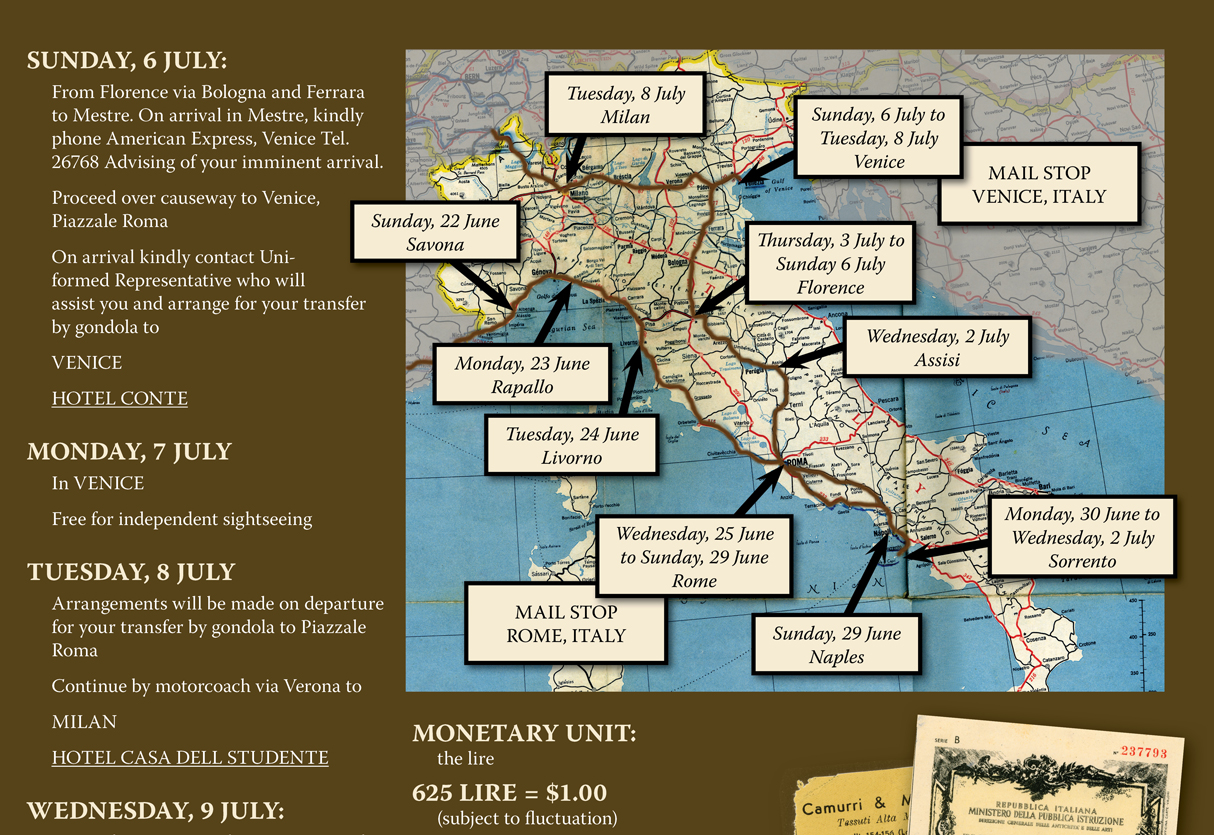
Once I brought the map image into Adobe InDesign, I added text boxes to label the cities they stayed in along with other relevant information and arrows to make it easier to tell the location of the city on the map. Arrows are easy to make in InDesign, just go to the stroke palette and select the style of arrow point you would like for the beginning or end of the line you made with the pen tool.

map with labels

I think the maps were effective in communicating a lot of the information at the beginning of each chapter in a visual way. How have you used maps in your projects?

This Week in 1856 – Chimney Rock – Mary Taylor

From Jessie Haven (with the Hodgetts Wagon Company):

2 October 1856:

Weather warm. Very warm for the season, and dry.

3 October 1856:

Hot today. Thermometer stood at noon in the sun at 119 degrees. United States troops passed us on their way to Laramie, Passed Chimney Rock today.

From John Jacques:

On the 3rd of October, near Chimney Rock, a company of United States Dragoons, under Major Hunter, with ten or twelve mule teams from Fort Kearny for Fort Laramie, passed the company and a boy named Aaron Giles, left the handcart company and went with the soldiers.

[There are some indications that Mary’s husband William Upton began to drive a wagon for the Hodgetts company at this time because some of their drivers left the company and went with the U.S. troops.]

On the 4th of October, the company passed Scott’s Bluffs. Parley P. Pratt‘s company of missionaries, going east from Salt Lake, passed the Bluffs about the same time, but the two companies did not see each other.

From Samuel Openshaw:

4 October 1845:

Passed Chimney Rock, which rises in the form of a monument or chimney, and can be seen at a distance.

———————————————————————————————

4 October 1856: (Salt Lake City, Utah)

Franklin D. Richards arrived and notified Brigham Young of the plight of the handcart companies on the plains.

5 October 1856: (Salt Lake City, Utah)

Brigham Young announced at General Conference the need for wagons, supplies and men to go rescue the handcart companies.

Europe 1952 – Chapter Headings

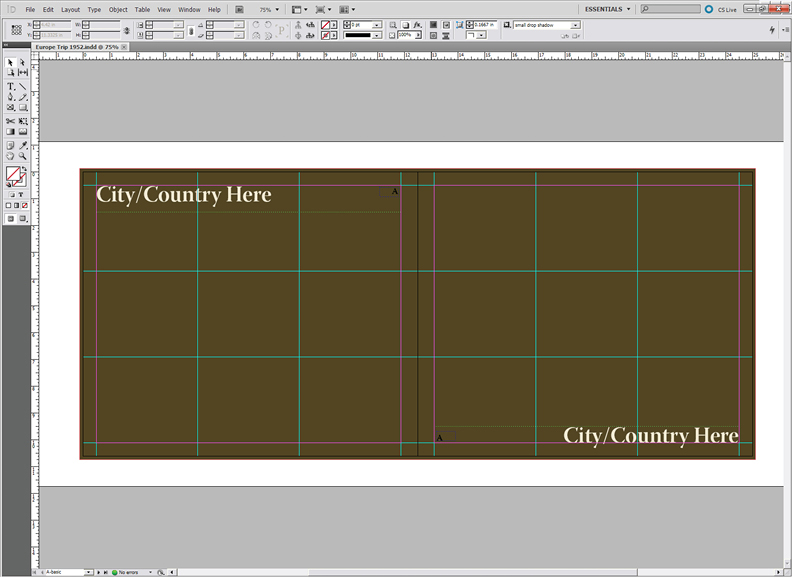
In the early stages of putting together this book, I decided to break it up into chapters for each country. (Germany ended up with two chapters because they re-entered Germany a second time.) So I put together another master page in InDesign to make it easy to have a consistent look for the beginning of each chapter.

master page for Chapter headings

The beginning of each chapter was a natural place to put the itinerary for each country along with a map showing the route that they traveled. On the map I included the mail stops where they could pick up letters from family and friends back home. I also had information about the money of each country and the exchange rates in 1952. My mom’s passport had lots of entry and exit stamps from her trip so I added those to the beginning of the chapter. I’ll go over how I put the route on the map and how I handled the passport stamps in an upcoming post.

This Week in 1856 – Nebraska – Mary Taylor

From Samuel Openshaw’s Diary:

23 September 1856:

Started half past 7 o’clock, crossed over sandy bluffs and sandy roads. Stopped for dinner at 12 o’clock, started again, continued over the sandy bluffs until 6 o’clock, when we came to Sandy Bluff Creek, where we camped for the night. Traveled 11 3/4 miles today, and it is, I think, the hardest day we have had on account of deep sand. We had to pull Eliza all through them. Saw Babbitt’s buggy burnt.

From John Jacques:

On September 23rd, about six miles east of Bluff Creek, and about seventy yards to the left of the road, a little harness, two wagon wheels and the springs of a burnt carriage or buggy and few other things were seen. These were supposed to be relics of Almon W. Babbitt‘s outfit. The company brought the springs along, but what became of them, I don’t know. Babbitt had left Kearny about the 2nd of September, with Thomas Sutherland and a driver. Two miles further on Captain Hodgett, Moses Cluff and Nathan T. Porter, were busy with a dead buffalo, which they had run our of a herd and killed for the handcart company, having previously killed on for their own wagon company. Some of the handcart people stayed to skin and quarter the buffalo, and bring it along on four handcarts. At night, it was divided among the company. This was the first buffalo beef the company had obtained. Buffalo beef, the lean part of it, is good eating on the plains, but is is courser than ox or cow beef.

The next day, September 24th, the company passed the place where it was supposed Thomas Margetts and others were killed by Indians, there being a quantity of feathers strewn about, a blood stained shirt and a child’s skull. The company camped at Duckweek Creek that night and after dark, all the men were called out to form a line aroudn the camp, as it was supposed that Indians were lurking around. About 11 o’clock, the men were called in, a double guard was set for the night and the rest of the men were seriously talked to for half and hour or so, by one of the company who was fond of preaching, on the necessity of vigilance in Indian country. Then the men were dismessed to their tents, except the double guard.

From Samuel Openshaw’s Diary:

24 September 1856:

Started at 8 o’clock this morning. Stopped for dinner at 12 o’clock, started again. Saw the blood stained garments of Thomas Margetts wife and child, who had been murdered by the Indians. They are committing depredations behind and before. In fact, they made an open attack in day light upon Fort Kearny, on the twenty second of August, the soldiers killed a great number of them, which has stirred them up against the white man, but they keep out of our way. Camped at the Platte.

25 September 1856:

Started at 8 o’clock. Still continued over the sandy bluffs. Saw several Indians on horseback, which are the first that we have seen since the above mentioned. Stopped for dinner at 12 o’clock at the Platte River, started again. The road is rather better, camped near the Platte at 6 o’clock.

From John Jacques:

In the afternoon of the 25th, five Indians, some of them squaws, on ponies, rode past the company and near to it, carefully scrutinizing it, but had nothing to say, and then they rode off towards the Platte. These were the first Cheyenne Indians the company had seen.

From Samuel Openshaw’s Diary:

26 September 1856:

Started at 8 o’clock, continued until 12 when we stopped for dinner. For several days, we have crossed through a great many creeks and forks of the Platte, which gave us plenty of opportunity to wash our feet.

Europe 1952 – Newspaper Articles


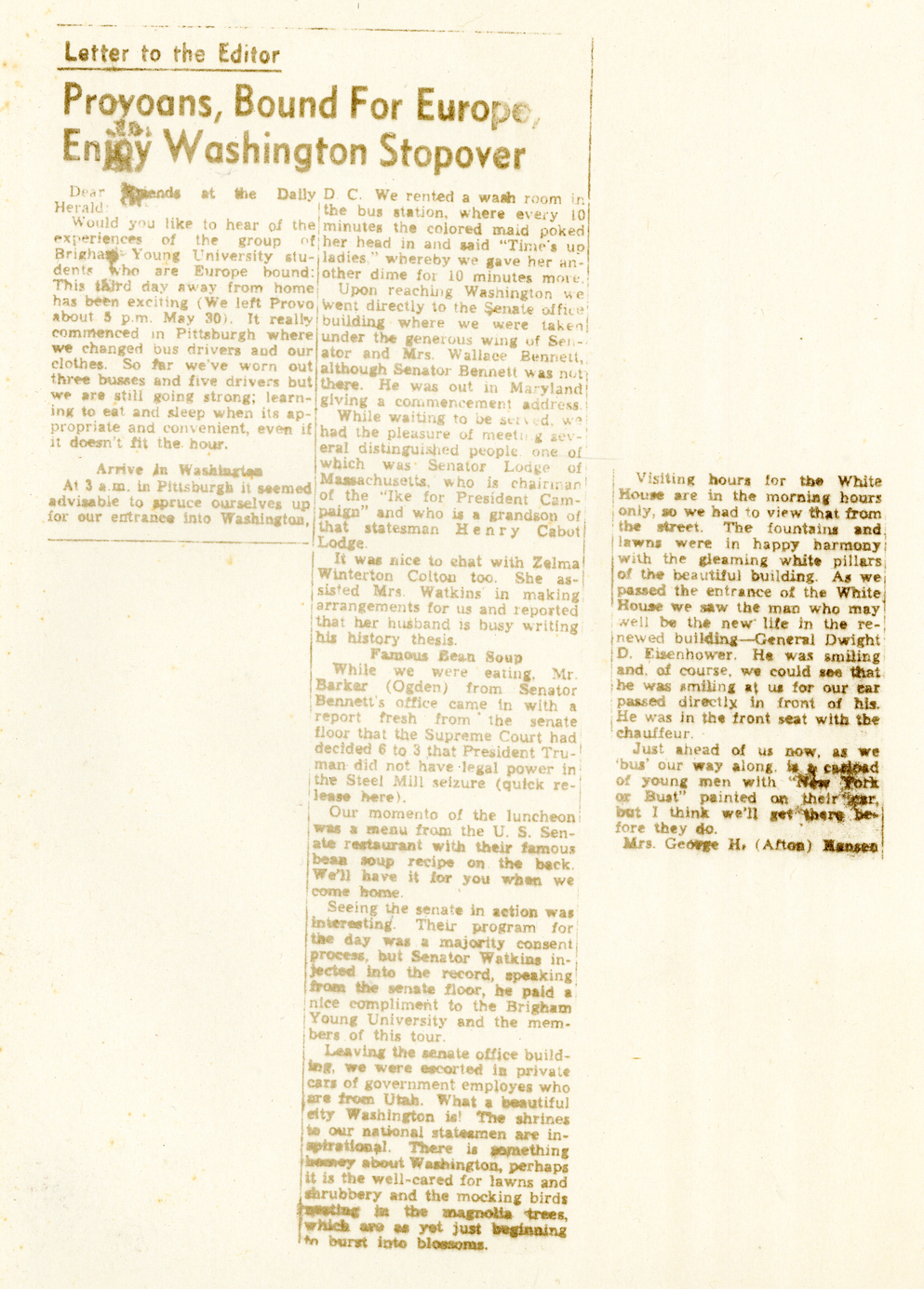
example of newspaper article

One of the wonderful resources I had for putting together this book for my mom was bunch of newspaper articles written by one of her fellow travelers on the trip. I wanted to include them because they had good information on what the trip was like, plus another perspective on Europe in 1952. But scanning in the articles and including them that way was problematic. First they were visually messy. They were different sizes and shapes and cut out from the paper in different way. Also some of them I just had a bad copy of the article and not the original. The next problem with going the scanned route was making them big enough on the page to be readable. After some thought I decided to try to replicated the look of the newspaper but to redo them so they fit into the book in a seamless way. The drawback was getting the text from the articles into my computer. I’ve never figured out how to do OCR so I had to type them in. It took awhile but I think it was worth it.

master page for newspaper articles

After I got the articles typed the next step was to create a master page for the newspaper articles. My basic master page has a dark brown background but that doesn’t look like a newspaper. So I changed the background to a nice cream color (I used the same color as the large text titles on each page). I changed the text to black and I went from three columns of text to five so that it would have the narrow column look of a newspaper. I added a header to duplicate the look of a newspaper and a large headline style for the title of each article.

Then we I came to the spot in the book where each newspaper article belonged it was a fairly simple task to change the master page and paste into the page the title and text. Then there were just a few little tweaks for the article and it was ready to go. I was very happy with the solution and I will keep it in mind for use in future projects.


This Week in 1856 – Nebraska – Mary Taylor

From Samuel Openshaw’s Diary:

16 September 1856:

Started at half past 8 o’clock. The weather is extremely hot, whick makes it hard traveling. Stopped at one o’clock, but moved no further today. It would truly be an amusing and interesting scene if the people of the old country could have a birds-eye view of us when in camp; to see everyone busy some fetching water, others gathering buffalo chips, some cooking, and if they could come forth upon these wild prairies, where the air is not tainted with the smoke of cities and factories. It is quiet here. One may see a creek at a distance and start and travel one hour towards it, yet you seem no closer than you did when you started.

17 September 1856:

An old sister died this morning, which delayed us until 10 o’clock. When we started out, it was a very hard, sandy road, and the wind was extremely cold, as if we had come into a different climate all at once. Stopped for dinner at one o’clock. Started again, and traveled until 6 o’clock when we camped for the night.

18 September 1856:

Started at 7 o’clock this morning, traveled until 1 o’clock, when we stopped for dinner at the Platte River. Old Sister Gregory from Chew Moore died, and was buried on the banks of the Platte River. Started again and traveled over the sandy bluffs and camped again at the Platte River.

19 September 1856:

Started at 6 o’clock and traveled until 12 o’clock when we stopped for dinner. Started again at 1 o’clock and still continued to travel over the sandy bluffs, which is very hard pulling. Eliza continues in a lingering state, so that we have to haul her on the handcart. We camped at half past 7 o’clock.

From John Jacques:

On September 19th, two or three teams from Green River, going east were met, and the men informed the emigrants that Indians had killed Almond Babbitt and burned his buggy, thirty or forty miles west of Pawnee Springs.

From Samuel Openshaw’s Diary:

20 September 1856:

We started and left the sandy bluffs on our right, went about three miles, and then crossed a creek about knee deep. The weather cold. It felt disagreeable to go into the water. Went about 8 miles and came to the Platte River where we stopped for dinner. Started again, contained down the side of the Platte. Measly rain. Camped on the Platte about 6 o’clock.

21 September 1856:

Small measly rain delayed us until 2 o’clock. In the meantime, another cow was killed. Eliza, on account of being exposed to the weather, is considerably worse. Traveled until 7 o’clock, when we camped but being not night to any wood, and the buffalo chips being wet, we were unable to do any cooking.

22 September 1856:

Started about 8 o’clock this morning, traveled until 12 o’clock, when we stopped for dinner at the Platte. Started again, went about three miles, came to the North Fork of the Platte, which is ten rods wide and two feet deep. Crossed over with our handcarts. It was a sandy bottom. Camped as soon as we had crossed, being about six o’clock.

Europe 1952 – Master Page and Using a Grid

When figuring out the way you want to layout the pages of a book I like to use a grid as the structure for the design. Before & After‘s has a two-part video that talks about using a grid in your design. If you want to learn more about grids in your designs it is well worth the 10 minutes or so it will take to watch them. I especially like part 2.

Because of the large size of the pages of this book (about 13″x11″) I wanted to have the text in columns. If a line of text gets too long in relation to the size of the letters it gets harder to read because it is so easy to lose your place on the line. Having columns of text solves this problem. I decided on three columns so I put guides on my master page for three columns. I also put guides horizontally to divide the page in three sections with in the margins. Instead of a small header or footer I chose to put a large title on each page. Part of the reason for this was that my mom, who the book is for, has macular degeneration plus cataracts so she couldn’t see well. Before I finished the project she had cataract surgery which helped her vision a lot. I thought that she would at least be able to read the title on each page and see something of the largest photos even if she couldn’t read all the text. It is important to keep in mind who you expect to read your stories and make decisions that will help them to be drawn into your book.

Basic Master page

If you haven’t used master pages you are missing a great time saver. In InDesign it is a simple as clicking on the master page in the pages pallet. By default there is a blank master page there called A-Master. Also by default this master page is applied to you whole document. When you add anything or edit anything on this page it is added to your entire document. Don’t worry, you can override this by dragging the [None] page in the pages pallet to any pages you don’t want to have the A-Master applied. I created two other master pages, one for the beginning of chapters and another for newspaper articles. I’ll talk about those in more detail in another post.

The advantage that having the three by three grid gave me was that it helped to make it simpler to figure out the layout for each page of the book. I had lots of photos and most of those photos are either one, two or three columns wide. Some are full bleed and a few go across to the facing page. But I still used those grid lines to help me to decide how large those photos were. Here are some examples pages.

The left hand page shows a “three column” photo and the right page is a full bleed.

This page has a bleed on three sides with a small “one column” photo overlapping on the left, while the right had page has two “two column” photos.

Here I have a “four column” full bleed and a couple of “one column” plus. When I was overlapping photos like here I was willing to allow photos to be wider than their column.

So how did I decide what size to make each photo? The first criteria was appeal of the image including the quality of the exposure. Because I wanted the photos to be the focus, if the image justified it I would make it as big as I could. Next I had to take into account how many photos or other memorabilia and the amount of text. Sometimes it is very tricky to get it to all coordinate together. But having the grid makes this easier and unifies the look of the book.

If you have any questions about how to do any of this please let me know. Next week I’ll cover how I handled the many newspaper articles I had for the book.

This Week in 1856 – Nebraska – Mary Taylor

From Samuel Openshaw’s Diary:

9 September 1856:

We started this morning about 8 o’clock, and traveled through a very hard, sandy uphill and down, road. Halted for dinner about 2 o’clock, but there was no water, just an old mud pit. Started again at 6 o’clock. It thundered and lightninged awfully, and rained at a distance, but, as if to give everyone their share, it rolled over and gave us a good soaking in the rain. It rolled on until it died away at a distance. We were almost worried with mosquitoes. Traveled until 11 o’clock, when we camped at Prairie Creek, which is very good water. We have traveled two days without water, except mud water, and only twice.

From John Jacques:

On the 9th of September, in the afternoon, the company came to a round pit or pond of water. Parched with thirst the cattle rushed pell mell into the pond and stirred up the mud until the water was thick and black, before the people had supplied themselves for their own use. But it was all the water available, and so it was used for cooking purposes, making coffee, tea, bread and porridge or hasty pudding, which when made was quite black, but was eaten and drunk nevertheless.

At 7 p.m. the camp started for Prairie Creek, nine miles, reaching it between 11 and 12 o’clock, but very glad to get to clear running water, after having been without two days.

From Samuel Openshaw’s Diary:

10 September 1856:

Started about 9 o’clock from Prairie Creek. We went about three miles and then crossed it. Traveled until 1 o’clock, when we stopped for dinner one hour. Traveled until 6 o’clock, and camped again at the Prairie, where we found a little wood, which is the first wood that we have seen since Monday morning. We had to cook with buffalo chips.

11 September 1856:

We started about 9 o’clock again this morning, traveled until 1 o’clock and stopped for dinner. Started again, traveled until 6 o’clock and camped again at Prairie Creek.

From John Jacques:

On September 11th, 8 or 9 miles from Lone Tree and Wood River, the company passed the graves of two men and a child belonging to Almon W. Babbitt‘s wagon train, who had been killed on the 25th of August by some Cheyenne Indians, who were on the war path that summer. Two of the teamsters escaped death, and Mrs. Wilson was taken prisoner. Most of the property plundered from the wagons was subsequently recovered by Captain Wharton and the Untied States troops at Fort Kearny. A mile or two east of the graves of the teamsters, a paper was tacked on a board, on which the chief of the Omaha Indians disclaimed participation in the murders. Early in the journey from Florence, the company met two or three hundred Omahas, who passed by quite peaceable.

From Samuel Openshaw’s Diary:

12 September 1856:

Started about 8 o’clock; traveled about 4 miles when we came to Wood River, which we crossed on a small bridge, continued down the side of it and stopped for dinner at 12 o’clock. For ought we knew, but a cripple, a young man who walked with crutches, had been left behind. We sent four men back to search for him which caused us to move none today. About sunset, they brought him into the camp.

13 September 1856:

Started about half past 8 o’clock this morning; traveled until one o’clock when we stopped for dinner, nearly opposite Fort Kearney, where the soldiers are stationed. Started again, and traveled until five o’clock when we camped at the Platte River. A man fell down dead, (William Edwards). The Indians are very hostile about here. They have attacked some of the emigrants who have passed through this season, and rumor says that some have been murdered, but they have kept out of our way, for se have seen none since the sixth, no even so much as one.

From an account of Josiah Rogerson:

September 13 1856:

About 10:30 this morning, we passed Fort Kearny, and as one of the singular deaths occurred on our journey at this time, I will give a brief and truthful narration of the incident. Two bachelors, named Luke Carter, from the Clitheroe Branch, Yorkshire, England, and William Edwards, from Manchester, England, each about 50 to 60 years of age, had pulled a covered cart together from Iowa City to this point. They slept in the same tent, cooked and bunked together; but for several days previous, unpleasant and cross words had passed between them.

Edwards was a tall, loosely built and tender man, physically and carter more stocky and sturdy. He had favored Edwards by letting the latter pull only what he could in the shafts for some time. This morning, he grumbled and complained, still traveling, about being tired, and that he couldn’t go any further. Carter retorted; “Come on, Come on. You’ll be all right again when we get a bit of dinner at noon.” But Edwards kept on begging for him to stop the cart and let him lie down and die. Carter replying, “Well, get out and die then, the cart was instantly stopped. Carter raised the shafts of the cart. Edwards waled from under and to the south of the road a couple of rods, laid his body down on the level prairie, and in ten minutes, he was a corpse.

We waited, (a few carts of us) a few minutes longer till the Captain came up and closed Edwards’s eyes. A light loaded open cart was unloaded. The body was put thereon, covered with a quilt, and the writer pulled him to the noon camp, some five or six miles, where we dug his grave and buried him a short distance west of Fort Kearney.

Just before Edwards closed his eyes and was dying, Albert Jones brought to him a drink of water in a tin panikin and moistened his dying lips.

From Samuel Openshaw’s Diary:

14 September 1856:

We started about 9 o’clock and traveled until 12 o’clock when we camped for the night. Eliza is a little better, but is so weak, that we still have to pull her on the handcart.

15 September 1856:

Started at 8 o’clock and traveled until 2 o’clock, when we stopped for dinner at Buffalo Creek, started again and traveled until 7 o’clock. Saw several droves of buffalo, but could not get no higher to them than three or four miles. Camped at Buffalo Creek.